
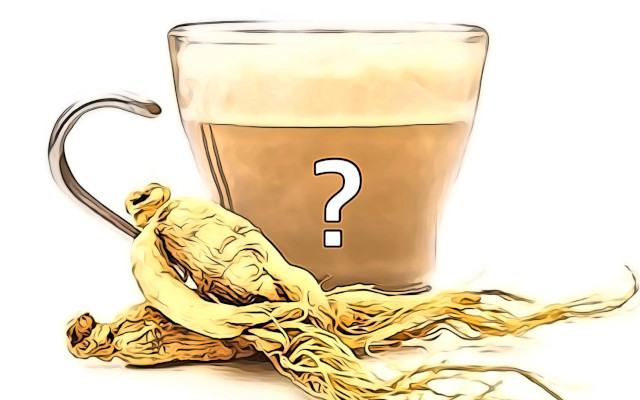
Ginseng coffee can contain problematic additives, as well as saturated fats and sugars in significant amounts. A shelf overview shows, however, that alongside many less appreciated products there is often a more than acceptable alternative. We examined the labels of 20 products, divided between soluble powders and capsules. (1)
Ingredients, the typical recipe
The typical recipe of ginseng coffees contains (in variable order)
– sugar
– glucose syrup
– skimmed milk powder
– instant coffee
– fat or coconut oil
– flavors, synthetic in 15 out of 20 products
– powdered ginseng extract.
Full of additives
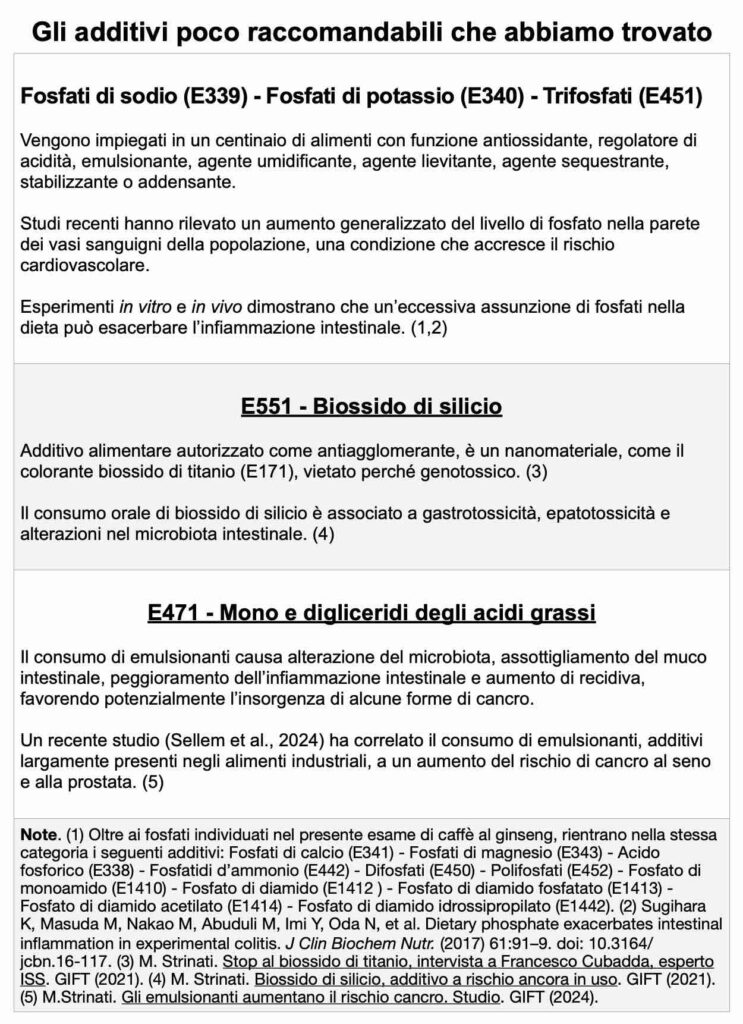
In almost all cases there are also additive mixes, sometimes undesirable. Three require particular attention:
– phosphates
– silicon dioxide
– mono- and diglycerides of fatty acids.
The table below summarizes their names, EC codes and reasons to avoid them (also because they are found in many other industrial products and their overall intake must be considered).
Nutritional profile
The intake of sugars and saturated fats deserves attention, especially if the consumption of ‘ginseng coffee’ is frequent.
Soluble ginseng coffee
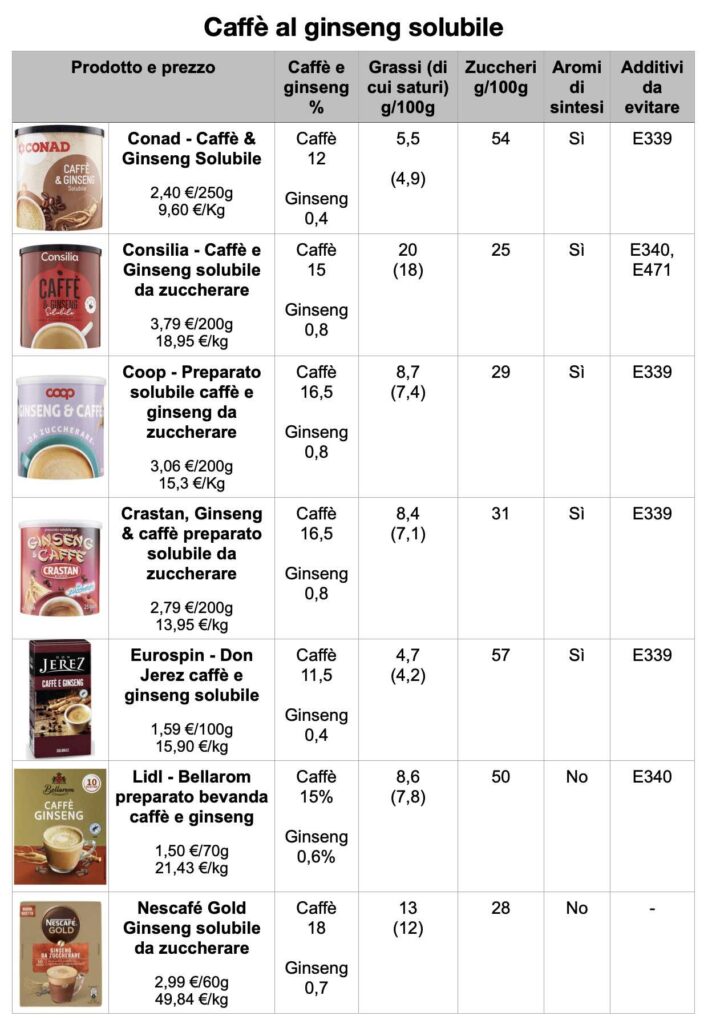
The seven products soluble selected are in fact ‘preparations for coffee and ginseng flavored drinks’. In fact, the concentration of the two characteristic ingredients is rather low.
– soluble coffee is present in a variable percentage between 11.5 and 18,
– ginseng varies between 0.4% and 0.8%.
The ‘structure’ of the drink is therefore not the homeopathic dose of ginseng but a ‘powder’ of fats and sugars.
The economical and ‘rich’ coconut fat – always present – consists of 91.94% saturated fatty acids. (2)
The concentration of saturated fats in the seven soluble ginseng coffees, consequently, varies from 4.2% to 18%.
The sugars in the ‘to be sweetened’ products vary from 25% to 31%, mainly due to the presence of glucose syrup. In the ‘classic’ ones, that is with sugar in the first place in the ingredient list, the share reaches at least half of the powder: from 50% to 57%.
The additives are not missing. Phosphates are always present, in one case even together with emulsifiers. The exception is Nescafé Gold Ginseng, free of problematic additives.
Barley baby, unsuitable for children
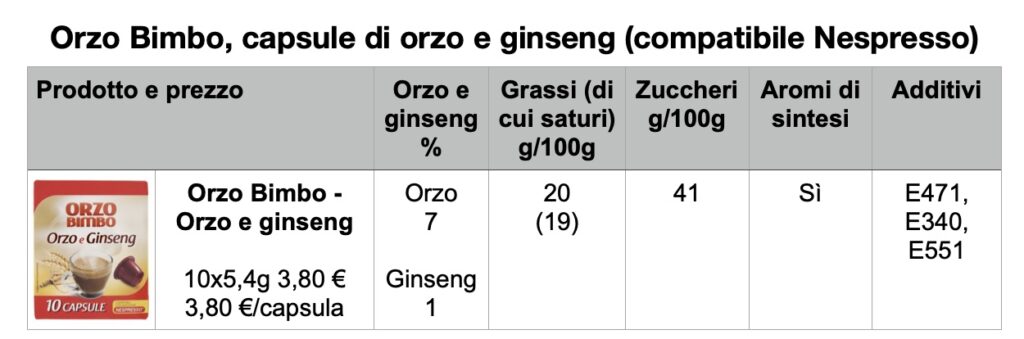
Among the 20 products sampled we included an extra product, as it is free of coffee. It is Orzo bimbo, barley and ginseng, in capsules compatible with Nespresso machines.
The exception is useful to remind that the words inserted in the brand names do not necessarily reflect the identity of the product. It would be otherwise alarming to find in a food dedicated to the youngest
- three additives to avoid in the child's diet: silicon dioxide, mono- and diglycerides of fatty acids and phosphates,
- 19% saturated fats
- 41% sugars.
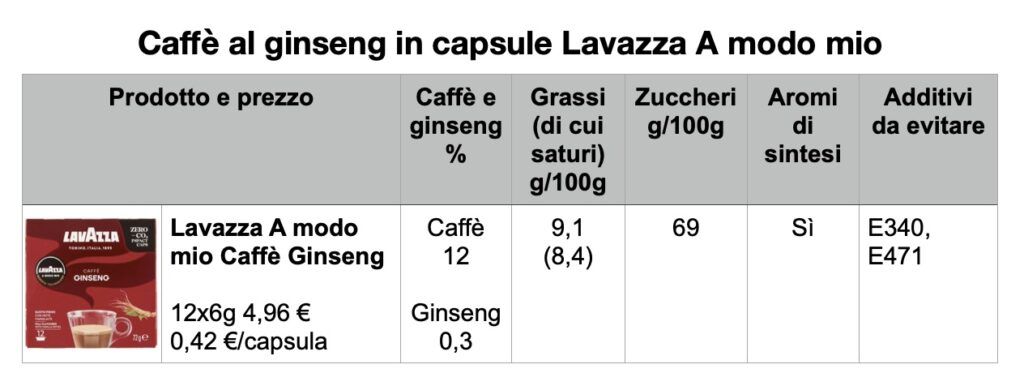
Nespresso-compatible capsules
The six capsules of coffee and ginseng compatible with Nespresso machines have a very low coffee concentration, from 11 to 20%. Except for the only capsules branded Nespresso, where coffee represents 96% of the powder to which 0.4% ginseng is added, without suspicious additives.
Zero additives problematic also in the Foodness capsules. Here however we find three sweeteners: erythritol, steviol glycosides and maltitol. The latter, at the top of the ingredient list, serves to give body to the blend, but forces to warn that the product may have laxative effects. (3)
The rest of the sample, as the table shows, does not skimp on undesirable additives.
In three cases, about half of the powder is made up of sugars: Cellini, King Cup with cane sugar (identical to white sugar, as we have seen) and Ristora, which reaches the threshold of 66%. (4)
Black palm for saturated fats in King Cup to be sweetened: 27.6%. In both capsules of this operator, moreover, there is hydrogenated coconut fat.
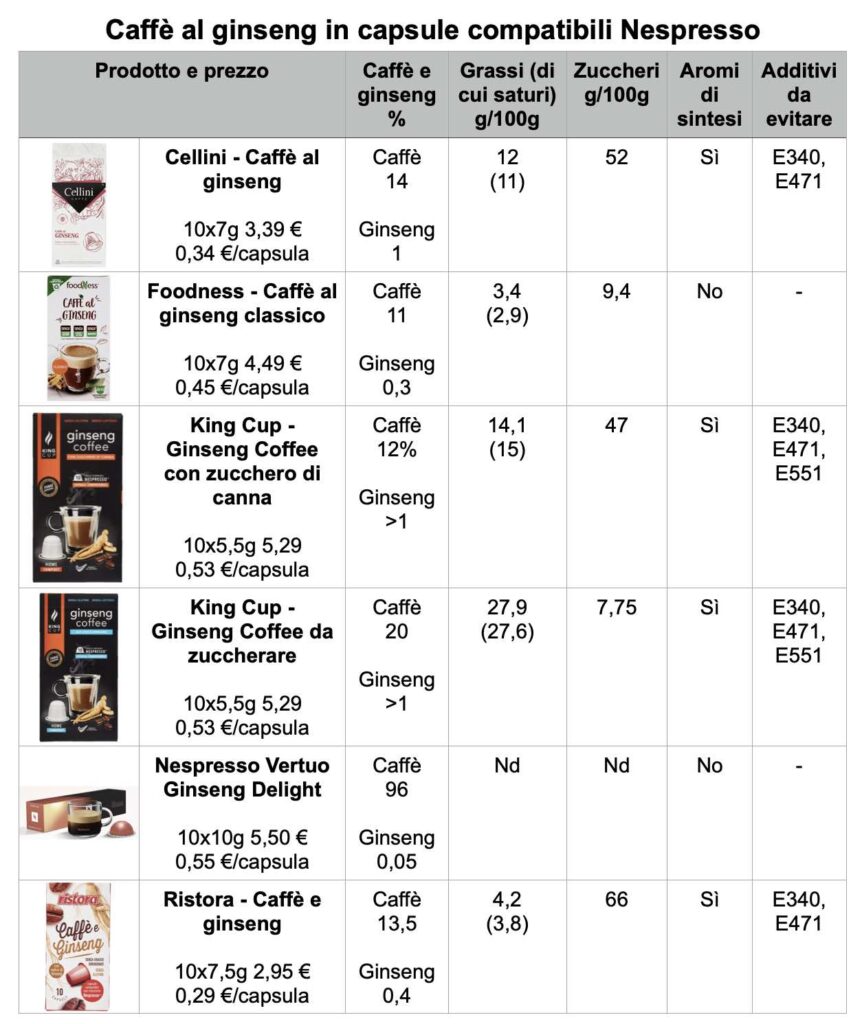
Coffee and ginseng for Nescafé Dolce Gusto machines
The five capsules compatible with the Nescafé Dolce Gusto machines examined here always contain one or more problematic additives.
The coffee varies in recipe from 12.5% to 19.4% of the ‘original’ Dolce Gusto capsules. The qualitative difference is evident both with the competitor Nespresso capsules and with the soluble versions of the same Nescafé: the coffee and ginseng, which we have just mentioned, but also decaffeinated coffee, subject of a previous market survey. (5)
The ginseng varies from 0.2% to 0.10%.
The sugars are present in significant amounts. In the three ‘to be sweetened’ products it ranges from 25% of Consilia (which suggests sweetening to taste only on the back of the package) to 42% of Eurospin, which offers its Jerez as ‘to be sweetened’.
The maximum peak is 54% sugars present in the Rafael capsule by Todis.
The saturated fats vary significantly, from 7.4% to 18%
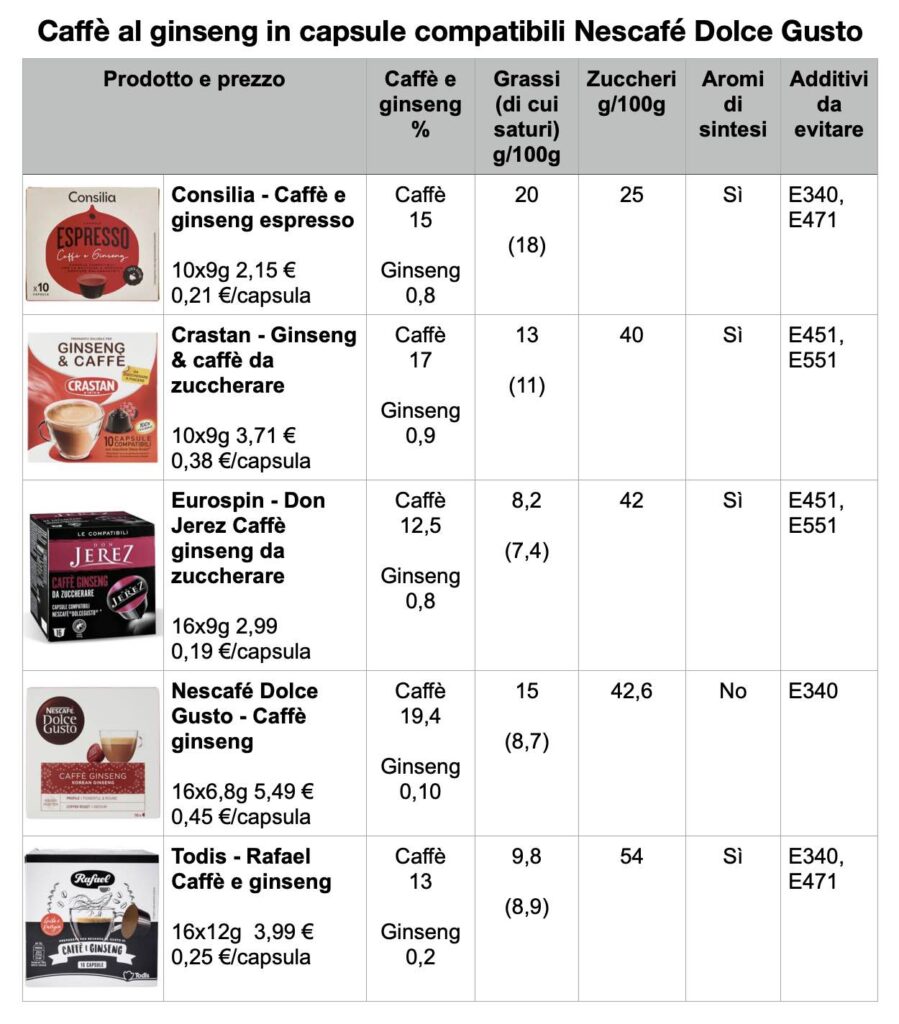
A modo mio, Lavazza capsules
Lavazza, with coffee and ginseng capsules suitable for ‘A modo mio’ machines, chooses not to aim for excellence:
- sugars for 69% of the powder
- saturated fats at 8.4%
- coffee 12%
- ginseng 0.3%.
Two problematic additives to complete the recipe.
How to improve the recipes
The examination of the labels could promote a more conscious purchase about the impact of additives, sugar and saturated fats.
The 139 products, especially ground coffee, also in capsules, or soluble, which show the presence of ginseng on the label, are worth a turnover of over 32 million euros, up by +15.5% in 2023. (6)
Leaving on the shelf unwanted products could help ‘less attentive’ operators to the healthiness of the recipe rediscover the pride of producing quality food.
Marta Strinati
Notes
(1) Sampling conducted from July 4-6, 2024 on ecommerce platforms and physical stores
(2) Food composition tables. Coconut oil. CREA https://www.alimentinutrizione.it/tabelle-nutrizionali/009620
(3) Marta Strinati. Sorbitol and other polyols, bulk sweetenersGIFT (Great Italian Food Trade). 4.4.18
(4) White or cane sugar. GIFT (Great Italian Food Trade). 7.1.17
(5) Marta Strinati. Decaffeinated coffee with or without chemical solvents. 20 comparedGIFT (Great Italian Food Trade). 9.6.24
(6) Marta Strinati. Food consumption in Italy in the 15th edition of the Immagino ObservatoryGIFT (Great Italian Food Trade). 1.7.24

Professional journalist since January 1995, has worked for newspapers (Il Messaggero, Paese Sera, La Stampa) and magazines (NumeroUno, Il Salvagente). Author of investigative reports on food, published the book 'Reading labels to know what we eat'.


