

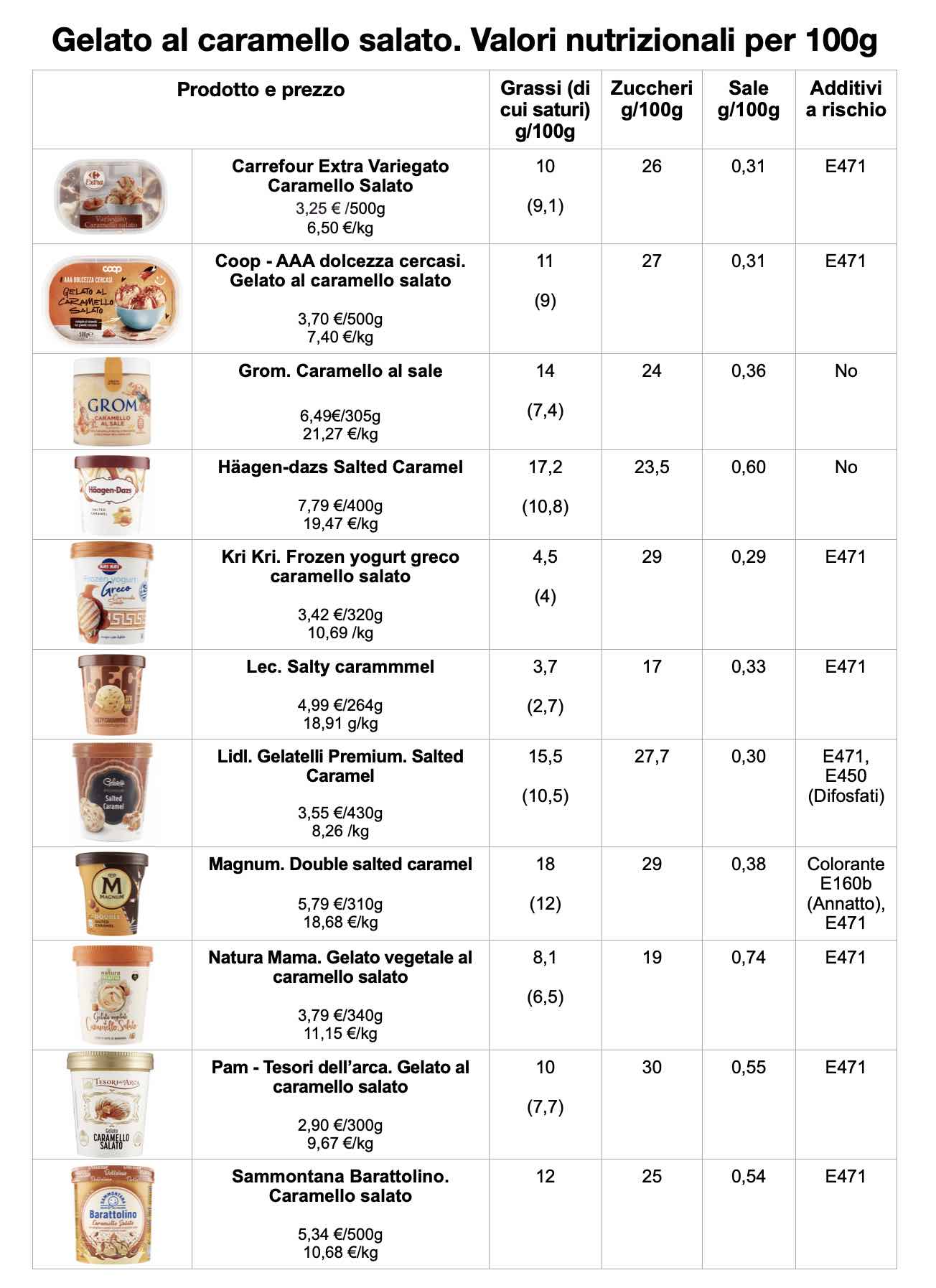
The ‘food trend’ of salted caramel has now widely reached ice cream as well. How much does the ‘new’ flavor impact salt consumption, already judged excessive (and harmful) by global health institutions? We calculated it by examining the recipe and nutritional profile of 11 tub ice creams sold in supermarkets. (1)
The recipe, coconut fat
In the fat composition of the 11 ice creams examined the recipe is divided into two macro-categories
- based on coconut oil, in addition to skimmed milk powder. In this recipe, the first three ingredients are skimmed milk, sugar, coconut oil. We find it in the ice creams of Carrefour Extra, Coop, Sammontana, Tesori dell’arca,
- based only on milk derivatives, including cream. Only three ice creams out of 11 are made this way: Lec, Grom, Lidl.
Halfway we find two products (Häagen-dazs and Magnum), which start well (cream, skimmed and whole milk, butter) but also contain coconut oil.
The vegan Natur Mama and Kri Kri, finally, also yield by adding – almond milk for the first and Greek yogurt (16%) for the second – the omnipresent coconut oil.
The economical tropical fat - composed of 91.94% saturated fatty acids – is increasingly present in industrial foods, as also observed in the ‘ginseng coffee’ category. (2)
A full load of sugars
Sugars abound. On average, a quarter of the product (25.2%) is made up of sugars.
The peak is reached by Tesori dell’arca (30%), closely followed by Kri Kri and Magnum (29%).
The lowest concentration (17%) of sugars belongs to Lec, which however also adds the sweetener erythritol.
Minimize sugar consumption, we remind you, it is EFSA's recommendation to prevent chronic metabolic diseases, as well as pregnancy-related conditions, dental caries, and other harmful health effects.
Salted caramel, but how much?
The daily salt dose recommended by WHO – OMS should not exceed 5 grams. However, average salt and other sodium sources intake in the European population almost doubles the safety threshold, due to their abundance in packaged foods as well as in food served in restaurants, and also in home cooking.
Salted caramel ice creams in turn contain non-negligible amounts of salt, considering the usual generosity of the portions:
– the average concentration is 0.43 grams per 100 g of ice cream
– 4 ice creams exceed 0.50 grams of salt per 100 g of product, peaking at 0.74 g for Natura Mama
– 7 products remain below 0.40 grams per 100 g.
Additives to avoid
Emulsifiers are enemies of the gut and are linked to a higher cancer risk, as has been seen. Among these, 'mono- and diglycerides of fatty acids' (E471) are present in 9 out of 11 ice creams.
Exceptions are Grom and Häagen-Dazs ice creams, which use egg yolk as a natural emulsifier.
Magnum also stands out for the use of the yellow-orange coloring E160b, which can cause severe allergic reactions.
Black palm, for additives, in Lidl ice cream. Emulsifier E471 and diphosphates (E450), harmful to the gut and linked to higher cardiovascular risk.
Synthetic flavors, finally, are present in 4 out of 11 ice creams: Carrefour Extra, Kri Kri, Lidl, and Magnum. The other products instead contain much more valuable natural flavors.
Marta Strinati
Notes
(1) Sampling was conducted on July 10 and 11, 2024 on e-commerce platforms and physical stores in Rome
(2) Marta Strinati. Ginseng coffee, beware of additives. 20 products compared. GIFT (Great Italian Food Trade). 5.7.24

Professional journalist since January 1995, she has worked for newspapers (Il Messaggero, Paese Sera, La Stampa) and magazines (NumeroUno, Il Salvagente). Author of journalistic investigations on food, she has published the volume 'Reading labels to know what we eat'.


