

Food consumption in Italy is still burdened by high prices that reduce the shopping cart to the bare essentials. Revenue grows, sold volumes decrease. In this scenario, however, marked trends emerge, as summarized by the 15th edition of the Immagino Observatory, which captures the scenario as of December 2023.
The GS1 Italy report, launched in 2016, analyzes the labels (with more than one hundred variables) of over 139 thousand products sold in supermarkets and hypermarkets and integrates the examination with consumption and sales data collected by NielsenIQ.
The metaproduct of the Immagino Observatory
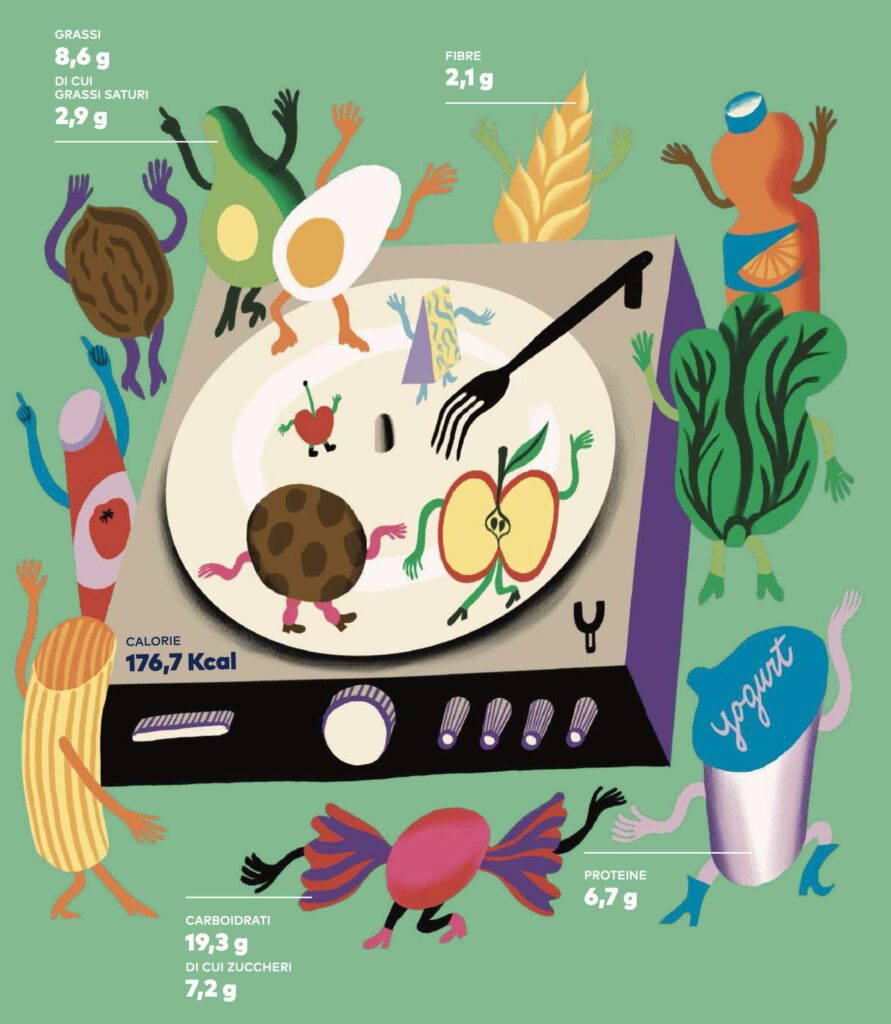
The metaproduct is a summary statistical indicator developed by the Immagino Observatory, which composes an average nutritional label of food consumption in Italy.
The average nutritional table is characterized, in the second half of 2023, by an increase in proteins and a reduction in sugars, with fats and carbohydrates stable. The latter remain the primary macronutrient (19.3%). The sub-component of simple sugars decreases, thanks to lower consumption of sugar, cola, fresh milk, nectars and similar, multipack ice creams, orange soda, 100% juices, tea-based beverages e fruit-based beverages 30-99%, variably generous in sugar content, as seen.
Fats, in second place, are stable (8.6%). Less extra virgin olive oil, olive oil, oil-packed tuna, seed oil, fresh milk, shelled nuts, multipack ice creams, sausages, fresh ready sauces, and stretched doughs for cooking are consumed.
More proteins and fibers
Proteins grow again (+1.3%, to 6.7%), thanks to the increased consumption of hen eggs, sports foods, grana and similar cheeses, traditional biscuits, shelled nuts, strained Greek yogurt/skyr, whole yogurt, fermented milk/kefir, tomato puree, and sweet spreads.
Dietary fibers slightly growing (2.1%, +0.5%), finally, thanks to the consumption of sports foods, traditional biscuits, shelled nuts, dried legumes, tomato puree, pastries, and milk substitutes.
Made in Italy, only PDOs are saved
The label reference to Italian-ness loses appeal. For more than 26,000 products so identified, 2023 ended with a -4.5% drop in volumes sold, against a +7.4% increase in turnover. The price increase has reduced purchases of foods prominently labeled with
– Italian flag (-4.1% volume sales compared to 2022), especially poor for multipack ice creams, fresh milk, and frozen pizzeria products
– 100% Italian (-5.3%, especially for fresh milk, multipack ice creams, and alcoholic beers)
– produced in Italy (-7%, particularly for Easter eggs, frozen breaded prepared fish, and Italian DOC and DOCG wines).
Protected geographical indications also give way. Only the DOPs are saved. In particular, among the top three protected denominations
– the 2,291 DOC wines are the most numerous. In 2023 they produced sales of over 533 million euros, +3.2% in value and -3.8% in volume
– the 1,328 DOP products instead top in sales value, nearly 716 million euros. In 2023 they recorded the highest growth rate in value (+9.1%) and – the only case in the basket of Italian-ness – also a volume increase of +1.6%,
– the 992 Docg wines experienced a volume sales decline of -3.6%. Despite the increases, the turnover still grew by +1.7%, up to over 298 million euros.
– finally, in 2023 Igp and Igt experienced a collapse in number sales (-5%) and a minimal increase in turnover, +1.7% to 298 million euros.
Regional origin
Regional origin is indicated on 10,420 products. As expected, in 2023 sales increased in value (+5.2%, up to over 3 billion euros) and decreased in volume (-3.7%).
The most significant trend belongs to Molise, followed by Puglia, Sardinia, Aosta Valley, and Basilicata, all regions with double-digit growth.
Only five regions closed 2023 with a positive sign also in volumes sold: Molise, Basilicata, and Aosta Valley increased them, while Abruzzo and Puglia kept them generally stable.
The top five regions in the ranking
The top five is composed as follows:
– Trentino-Alto Adige still at the top of the ranking. The volume sales decline (-2.7%) is contributed by classic sparkling wine, cubed cured meats, apples, and durum wheat pasta.
– Sicily confirms the second position, with 1,194 products. In 2023 it recorded a trend of +2.4% in value and -6.7% in volumes, penalized by the negative trend of oranges, multipack ice creams, mozzarellas, and alcoholic beers.
– Piedmont, holding third place, with a value growth of +3.8% and a volume sales decrease of -7.1%, especially in third-category beef processing, other traditional fresh cheeses, and Doc and Docg wines.
– Emilia-Romagna, with a value sales increase of +8.4% and a volume contraction of -4%. Wines (Igp, Igt, Doc, and Docg), egg pasta, and honey were among the most declining categories.
– Veneto, with 794 products generating 286 million euros (+6%) and also maintaining overall volume (-0.5%). The decline of Doc and Docg wines, fresh milk, and nectars and similar products is partly offset by the positive dynamic of tomato puree.
‘Free from’
The basket of free from – over 14 thousand foods whose labels boast the absence of certain ingredients or nutrients – together are worth a turnover of 8.1 billion euros, growing +9.7%. Conversely, volumes closed the year with a negative trend (-3.5%).
Among the monitored claims, five have also increased sales volumes, as is now customary, well below the revenue growth. In order of market share, they are
– ‘Low fat’, stable with +0.4% in volume (+11.5% turnover). Leading are strained Greek yogurt/skyr, traditional biscuits, turkey, and UHT milk.
– ‘Low sugar’, +1.9% (+18.3% in value). Among the brightest categories, fruit-based jams and spreads, traditional biscuits, preserved fruit, fruit-based beverages 30-99%, bases and cola.
– ‘No added sugars’, +5.4% (+18.5% in value). Very good fruit-based jams and spreads, preserved fruit, traditional biscuits and fruit-based beverages 30-99%.
– ‘No hydrogenated fats’ +1.7% (+15.2% turnover). Sales of healthy and traditional biscuits, pastries, ready cakes and margarine are growing.
– ‘No aspartame’, +5.1% (+10.8% in value). The synthetic sweetener – considered by IARC a possible carcinogen – is increasingly often rejected by consumers. Leading sweeteners, orange soda and cola.
‘Rich in’
The 11 thousand foods naturally rich or enriched with beneficial components have increased turnover by +10% in 2023. Volumes sold instead decreased by -2.2%, with only two exceptions:
– ‘lactic ferments’, remained substantially stable, with sales volumes at +0.3%, mainly thanks to fermented milk/kefir, whole yogurt and crescenza cheese,
– ‘proteins’, the main claim for turnover (+12.8%, up to 1.88 billion euros) in the ‘rich in’ basket grew in volume by +1.2%. Very good fresh and UHT milk, grana cheese and similar, bases and sports nutrition.
Foods for food intolerances
The almost 11 thousand products proposed as suitable for people with food intolerances are also burdened by high prices. Turnover grows overall by +6.2% (to over 4.7 billion euros) but volume sales decrease by -3.9%.
The negative series regarding volume sales concerns
– ‘gluten free’ (-4.4%),
– ‘lactose free’ (-1.3),
– ‘gluten free with AIC logo’, Italian Celiac Association (-7.3%),
– ‘milk free’ (-5.1%),
– ‘yeast free’ (-3.1%).
The claim ‘egg free’ is an exception. The smallest segment of the basket has in fact also grown in volume (+3.6%), especially thanks to fresh non-filled pasta, fresh gluten-free pasta, gluten-free pasta and healthy biscuits.
Lifestyle at the table
Among the five claims which identify products consistent with a precise lifestyle, the gap between revenue growth (+8.7%) and sales volume decline (-2.4%) is overall reiterated.
Three the references to the absence (total or partial) of ingredients of animal origin,
– 'veg', worth 24 billion euros, records +10.4% in sales value and -1.6% in volume trend. Very poor, in volume, ready first courses, whole and portion table cheeses, industrial fresh cheeses, sliced cheeses and multipack ice creams
– 'vegetarian', with a turnover of +9% and volumes at -3.1%, it declines in the same categories as the 'veg' claim
– 'vegan', finally, it increases sales by value (+11.9%) and volume (+0.2%). Jams and fruit-based spreads as well as natural vegetable/frozen fruit frozen products do well.
Organic
The 'bio' claim on 8,200 references in 2023 develops more than 1.2 billion euros in sales, +2.8%. Sales volumes instead fall by -5.1%. Especially fresh milk, fourth range vegetables, rice cakes, whole wheat/spelt/kamut/legume-based pasta and even hen eggs perform badly.
Organic foods, however, it should be remembered, are often purchased at farmers' markets and specialized stores, sales channels still not considered in the Immagino Observatory.
Kosher and halal
The same consideration applies to foods certified as kosher or halal, mainly available in dedicated commercial establishments. In the supermarket and hypermarket channel, the two claims related to religious prescriptions have different trends:
– 'kosher', suitable for the Jewish religion, appears on 1,710 products and grows in value by +10.3%, up to over 921 million euros. In volume, it falls by -1.4%, mainly due to extra virgin olive oil, ground coffee, jams and fruit-based spreads, pralines and chocolates,
– 'halal', present on 521 products, experiences a successful 2023, helped by the increase of Muslim foreigners from Bangladesh and Afghanistan. Growth is +16.7% in value (for a turnover of over 269 million euros) and +5.9% in volume, mainly thanks to semolina pasta, Grana cheese and similar products and natural vegetable/frozen fruit frozen products.
‘Beneficial’ ingredients
Among the foods with evidence on the label of a ‘beneficial’ ingredient, the general contrast between increasing revenue and declining sales volume is fully confirmed.
Traditional. Seven claims refer to the ‘traditional’ products most loved in Italy. Cocoa, hazelnut, lemon, vanilla, pistachio, walnuts, and caramel. The volume sales decline is widespread and double-digit in three cases: hazelnut (-12.9%), vanilla (-14.6%) and caramel (-12.9%).
Superfruit. Same trend for the seven monitored superfruits, with a volume sales decline of -4.4%.
Almond and blueberry lose volume sales by -7.4% and -7.9%, respectively.
Three exceptions. The volume sales quantity increases for
– cashews, +5.2%,
– avocado, +24.1%, marking growth that in recent years seems unstoppable,
– coconut water, essentially stable at +0.6%.
Rice and oats, the exceptions
In the group of super grains and flours, oats, rice flour and rice oil are the only ones boasting an increase in volume sales: +4.1%, +1.6% and +5.3%.
Of the two sweeteners monitored, volume sales plummet by -7.5% for cane sugar and remain essentially stable for stevia, -0.1%, despite revenue increasing by +5.6%.
Among the seeds, despite an overall increase in value sales (+6.8%) and a decrease in volume sales (-4.5%), there is a drastic reduction in the number of purchases of pumpkin seeds (-9.2%) and hemp seeds (-11.9%).
The spices record a negative performance in 2023 especially in volume (-10.5%) but also in value (-2%). For the latter, the drop is -10% for ginger, -17% for turmeric, and -8.1% for cinnamon.
Superfood
The superfoods, the last group of beneficial ingredients monitored by Osservatorio Immagino, are also in the wake generated by price increases: sales value increased by +2.8% while volumes decreased by -2.7%.
‘Royal jelly’ is the claim with the highest turnover: 20.3 million euros generated by 48 references. Sales grow in value (+6.8%) and, albeit slightly, also in volume (+0.8%).
‘Peanut butter’ is in second place by turnover, 18.4 million euros from just 50 products. Sales growth is double-digit both in value (+15.7%) and volume (10.7%). Sweet spreads, milk-based drinks, and wafers are doing well.
‘Edamame’, with 7.5 million euros in turnover and 28 products on the shelf, in 2023 it loses -7.9% in value and –13.8% in volume.
‘Goji’ and ‘Acaj’ plummet with volume sales reduced by -25.9% and -41% respectively.
‘Matcha’, ‘spirulina’ and ‘tahina’ hold steady with quantitative sales at +0.7%, +4.1%, and +2.7%.
Processing method
‘Artisanal’ is countertrend compared to other claims about the processing method. Found on 752 products, it increased sales in value by +21.6% (for a turnover of 143 million euros) and in volume by 17.1%, mainly thanks to frozen pizza.
‘Drying’ is the only other claim in the group to hold. Typical of dry pasta, the claim marks an increase in sales of +7.8% in value and +3.1%.
Very bad volume sales of ‘handmade’ (-13.2%), ‘unfiltered’ (-17.1%), and ‘smoking’ (-10.3%). Regarding this last claim, we recall the recent decision of the European Commission to refuse the renewal of authorization for smoking flavors as genotoxic, but keeping them in foods for another five years.
In decline also volume sales of products with the claim ‘cold extracted’, essentially extra virgin olive oil. Price increases raise revenue by +31.5%, but reduce volume sales by -3.1%.
Food consistency
The food consistency (The texture) represents an attraction for consumers. The related claims appear on 7,792 references, which in 2023 generated over 1.4 billion euros in sales. The sales trend is positive in value (+10.4%) but negative in volume (-4.1%).
Among the 11 claims monitored, only two show a positive sign in volume sales:
– 'soft' with +1.3% (+14.2% in value) driven by sandwich bread, loaf bread, sandwich bread and cold cuts. It is worth a turnover of 532 million euros,
– 'rough' with +0.9% (+13.7% in value) totals a turnover of 206 million euros. Semolina pasta and whole wheat pasta, spelt and kamut, as well as legumes, are doing very well.
Marta Strinati
Notes
(1) Immagino Observatory 2024.1. GS1 Italy https://servizi.gs1it.org/osservatori/osservatorio-immagino-15/

Professional journalist since January 1995, she has worked for newspapers (Il Messaggero, Paese Sera, La Stampa) and magazines (NumeroUno, Il Salvagente). Author of journalistic investigations on food, she published the book 'Reading labels to know what we eat'.


