
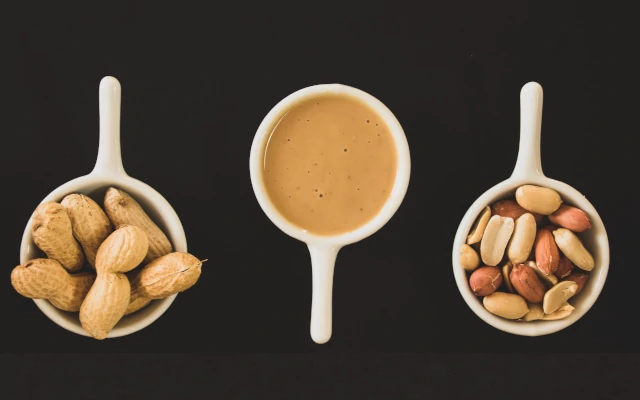
Peanut cream and butter, traditionally associated with the American diet, also show significant consumption growth in Italy. We examined 22 of them, including private label products, industrial brands, and discount brands.
Peanuts, what a passion
From a botanical point of view, peanuts belong to legumes (family of Fabaceae), although they are commonly associated with nuts for the benefits and energy contribution linked to their consumption.
In cream or butter form (more similar to American peanut butter), in the last three years, peanuts have become a must for breakfast and snacks among health food lovers. They are indeed a source of protein (about 25g per 100g) useful for muscle mass, monounsaturated fats, and fiber.
However, their energy value is high – over 600 kcal per 100g – similar to shelled nuts:
- for comparison, consider that a plate of Pasta with tomato sauce provides about 100-120 kcal per 100g;
- many peanut cream labels therefore indicate a portion, admittedly unrealistic, of 15 grams.
Italian recipe vs American style
The first distinction communicated on the label of peanut butters is the type of recipe. Alongside the clean labels – with roasted peanuts as the only ingredient – there are versions with added sunflower seed oil and salt as well as 'American-style' formulas, even including hydrogenated fats.
Brand industry
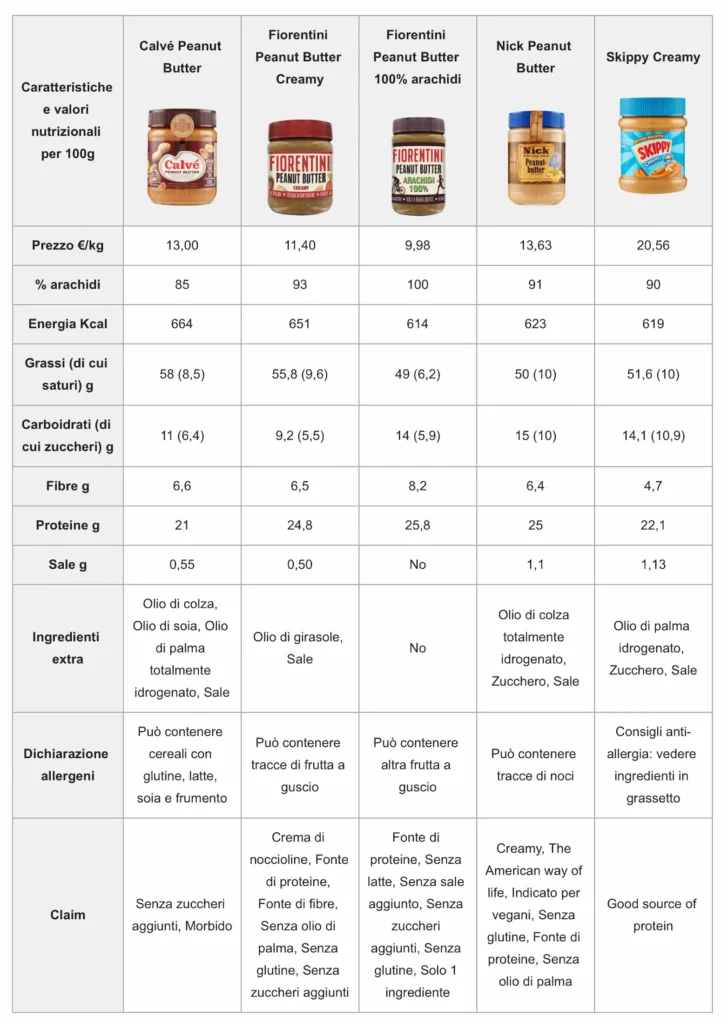
The 7 private label products from the industry we examined well express the variety of recipes offered in the more spreadable or creamy version.
The leader in Italy Fiorentini offers both a 100% peanut version and an option creamy with sunflower oil and salt.
Three foreign brands – on products made in the Netherlands – instead focus on the 'American' style with the addition of hydrogenated vegetable oils:
- Nick contains 9% fully hydrogenated rapeseed oil, sugar and salt;
- Skippy has a similar formula with hydrogenated palm oil, sugar and salt which make up 10% of the product;
- Calvé reaches 15% vegetable oils, including ‘fully’ hydrogenated palm oil, and salt.
These extra ingredients (compared to peanuts) have an impact on nutritional profiles with even significant increases in saturated fats (up to 9.5 g/100 g, compared to 6.2 g in Fiorentini’s 100% peanut butter), sugars (which in Nick and Skippy exceed 10 g/100 g) and salt (over 1 g/100 g for Nick and Skippy, half for Fiorentini creamy and Calvé).
Brand industry, the creamy ones
The crunchy creams
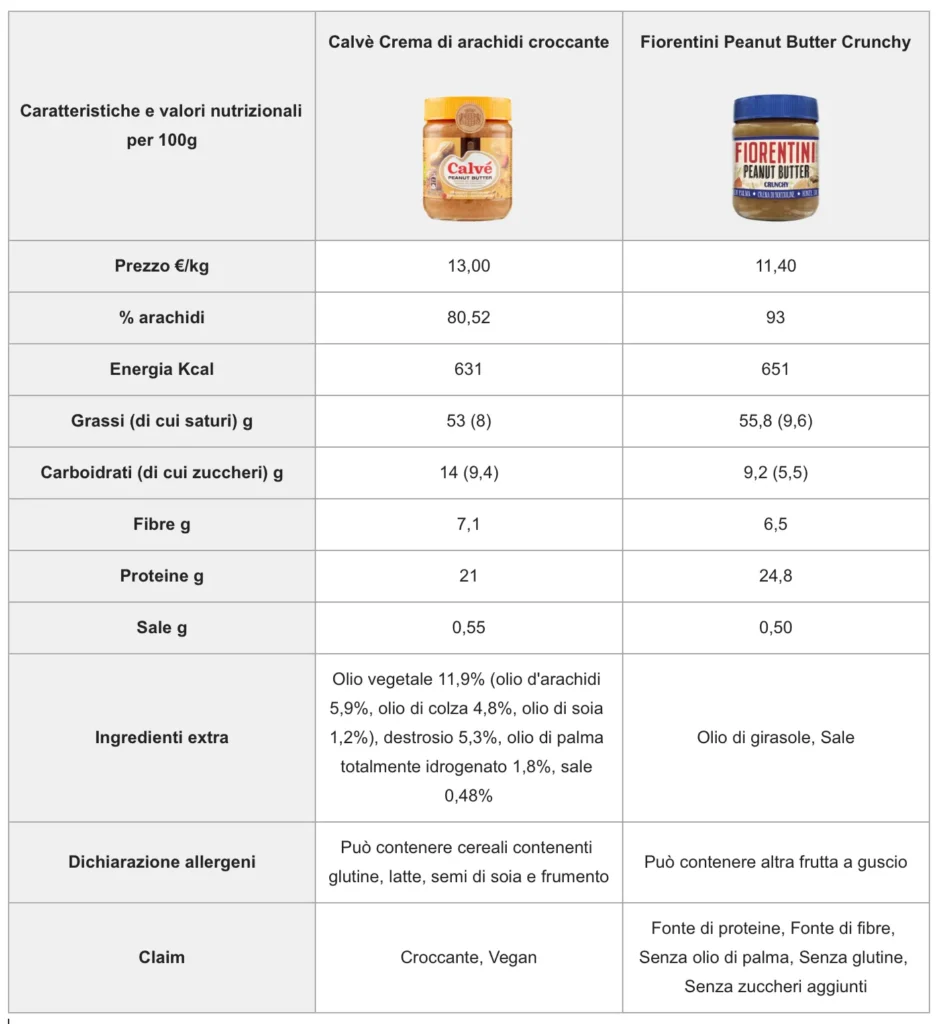
Fiorentini and Calvé also offer a crunchy version.
Calvé’s cream is composed of almost 20% of extra ingredients: the usual vegetable oils, hydrogenated palm oil and 5% of dextrose (or glucose), plus half a gram of salt per 100 g of product. Sugars jump to 9.4%.
Fiorentini instead maintains the same recipe as the creamy version, with only 7% extra ingredients: sunflower oil and salt (0.50%).
Brand industry, the crunchy ones
The Unilever anomaly: light peanut butter
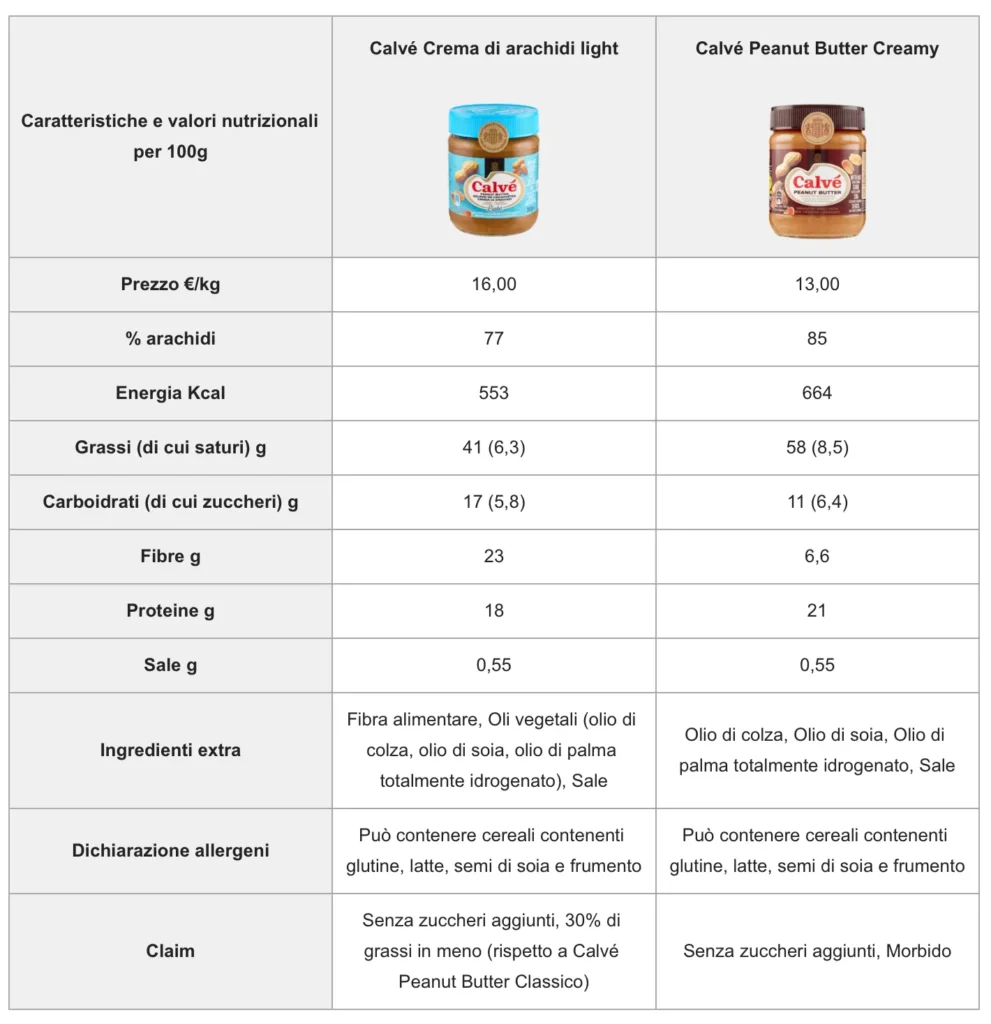
Unique on the scene, Calvé (Unilever) offers a light peanut butter. The recipe is still based on vegetable oils (rapeseed oil, soybean oil, fully hydrogenated palm oil) and salt, but dietary fiber is added to reduce its calorie impact.
The label states ‘30% less fat’ ‘compared to Calvé Classic Peanut Butter’ (read in lowercase characters on the back of the label). One incorrect statement, because the comparison parameter must be the average of the best-selling products in the same category, as provided by regulation (EC) no. 1924/2006 on nutritional and health claims.
In any case, by the numbers, light peanut butter compared to the classic one from the same Calvé contains
- -10.39% peanuts;
- -41.46% total fat, -34.92% saturated fat;
- +35.9% carbohydrates, -10.34 sugars;
- +71.30% fiber;
- -16.67% protein.
Light vs creamy
Store brand peanut butters
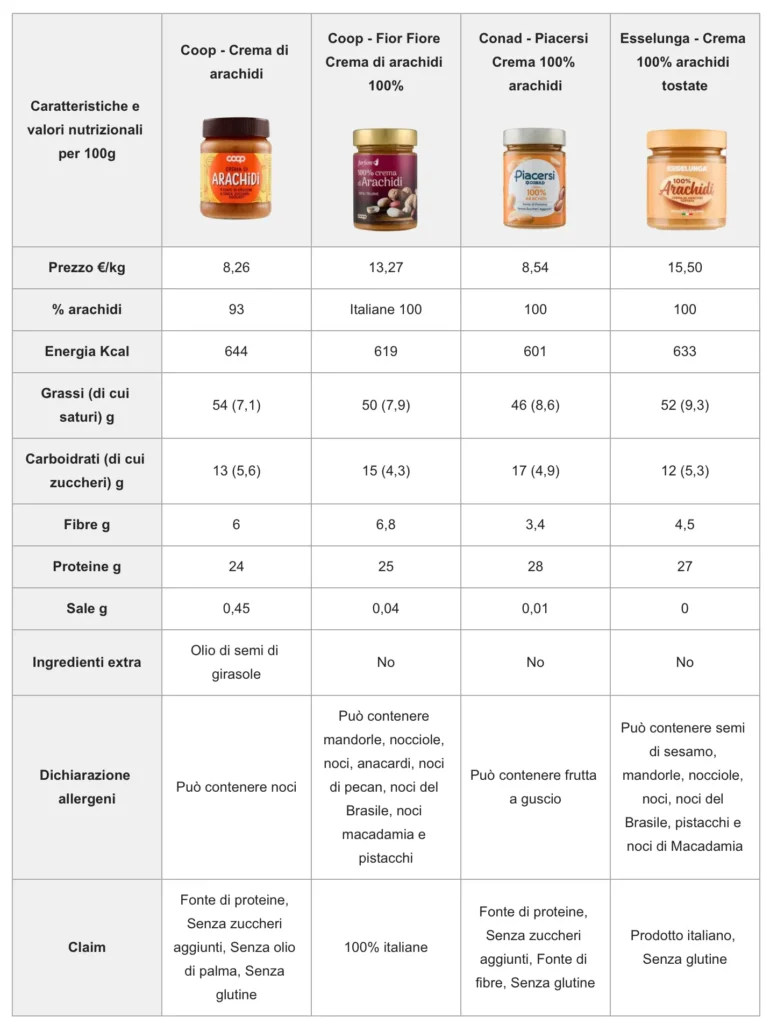
In the private label both Conad, and Esselunga offer a 100% peanut butter.
Coop stands out with a 100% Fior Fiore cream made from Italian peanuts, also offering a version with sunflower seed oil and salt (0.45%).
Discount offers
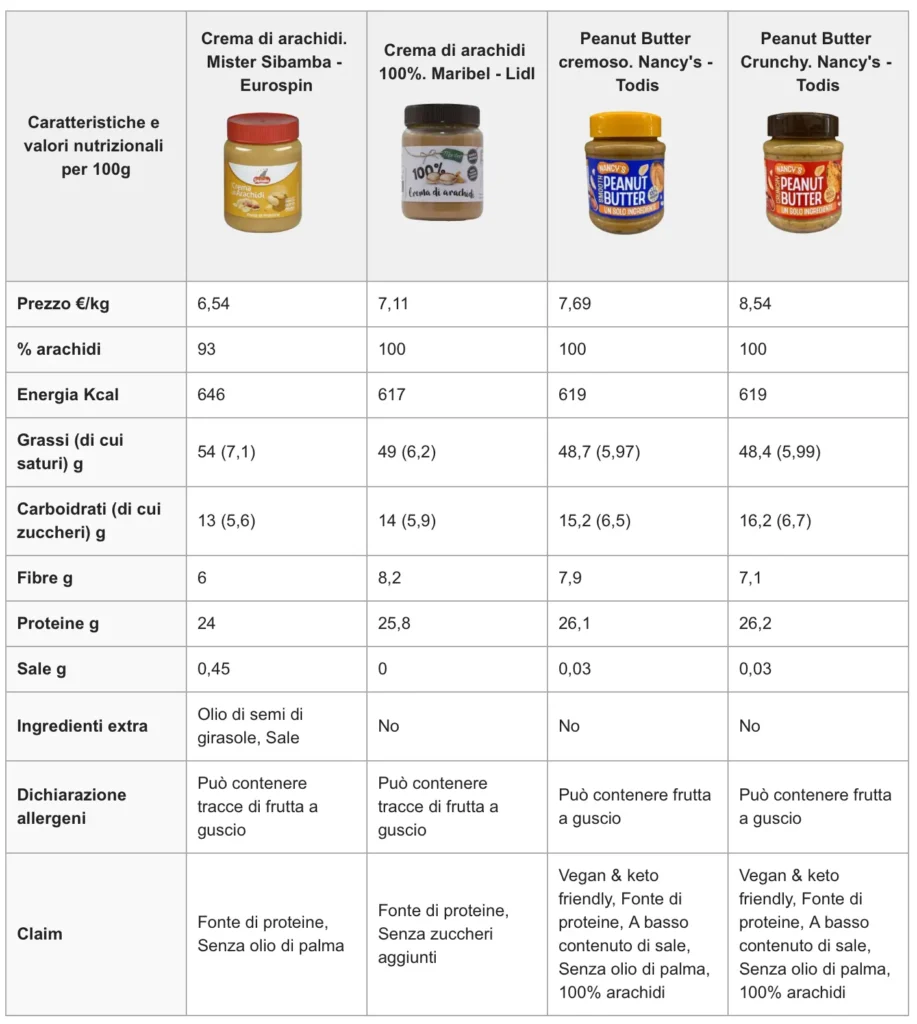
Clean labels represent half of the 4 products examined in discounts: Lidl and Todis do not add anything else to the peanuts.
Eurospin, in its Mister Sibamba cream, instead adds sunflower seed oil and salt.
Average price per kg 7.47 euros. The most expensive cream is Todis crunchy: 8.54 euros.
Discount peanut creams
Organic peanut creams
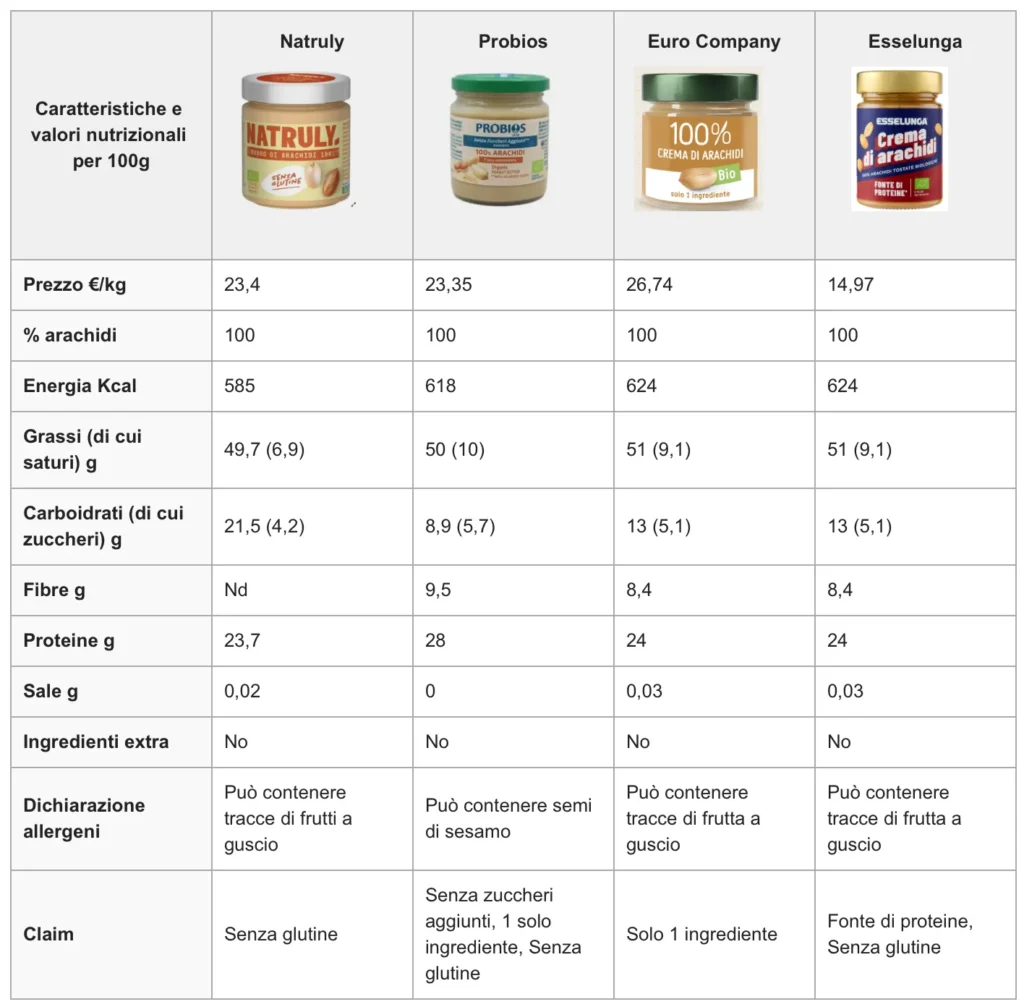
Four organic creams contain only peanuts: Probios, Euro Company, Natruly, and Esselunga.
The price average is about 22 euros/kg, from 14.97 €/kg of Esselunga to 26.74 €/kg of Euro Company.
100% organic peanuts
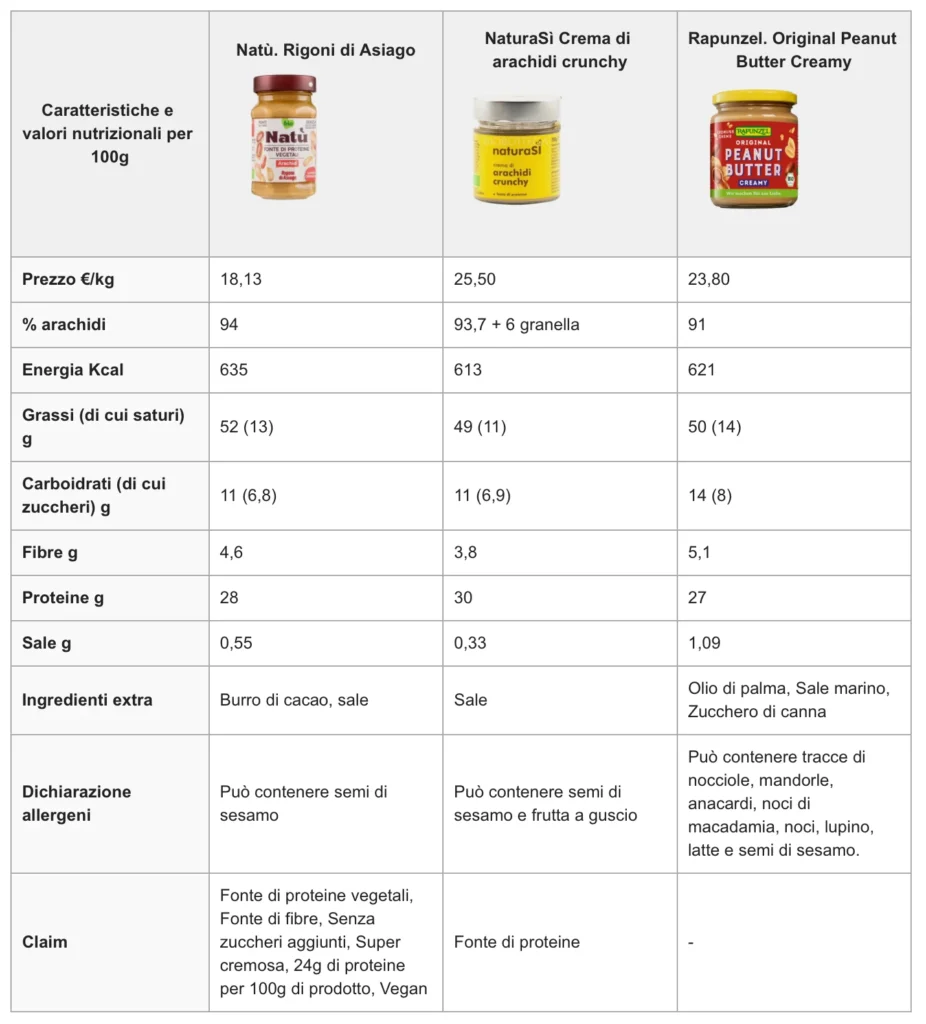
Three other organic creams contain extra ingredients compared to peanuts:
– NaturaSì adds a minimum of salt (0.33%);
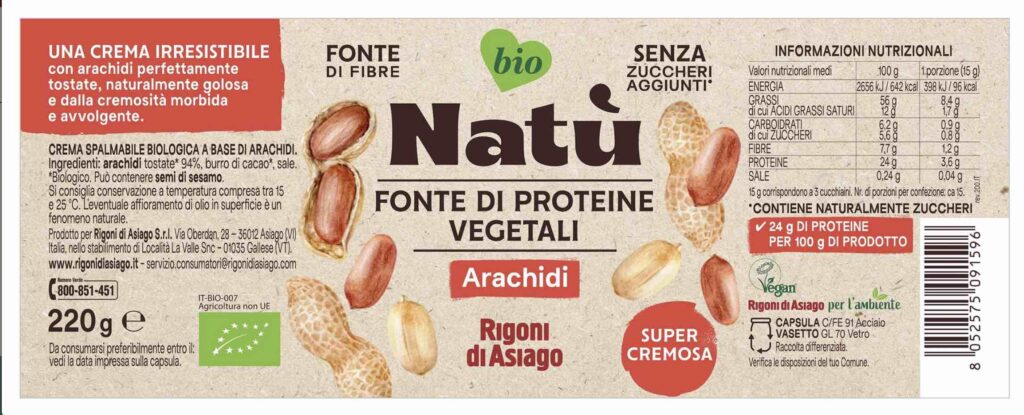
– Rigoni di Asiago enriches Natù with cocoa butter and salt (0.55%);
– Rapunzel instead follows the American style with palm oil, sea salt (1.09%), and (cane) sugar.
Average price 22.48 €/kg, with the best price for Natù (18.13 €/kg).
Organic peanut creams with extra ingredients
The great threat of allergens
Attention to allergic consumers is still very poor, despite existing European regulations. ‘The duty to specify on the label the exact nature of individual allergens present in each food was already introduced by Directive 2003/89/EC. Since the time of the application of this directive, the prohibition to designate gluten-containing cereals and nuts only by the category name has been clarified, as is evident in Annex VII part B, of EU Regulation 1169/2011’, recalls lawyer Dario Dongo, PhD in food law and editor of GIFT.
Non-compliant labels continue to be observed, such as:
- ‘May contain traces of nuts’ (without specifying which type of nut), on the labels of Eurospin, Lidl, Conad, Esselunga organic peanut creams (produced by Euro Company);
- ‘May contain other nuts' (another generic indication, neglecting among other things the legume nature of peanuts), on Fiorentini cream;
- ‘May contain sesame seeds and nuts’, on NaturaSì's label.
Blind ecommerce
Another sore point concerns the lack of information provided through corporate and distributor ecommerce websites.
In milder cases, the following is missing price per unit of measure (as in the case of Natù); in more serious cases, such as for Calvé crunchy on the company website, nutritional information is even omitted. Publishing the full label on ecommerce would solve every problem, but so far only Rigoni di Asiago does it.
‘It is unacceptable that 12 years after the application of rules that came into force 15 years ago, many operators in the food sector, organized distribution, and ecommerce still insist on omitting to report in the distance selling offer all the information required as mandatory on the label, except for batch code and/or shelf life, as prescribed by regulation 1169/11 in article 14’, observes Dario Dongo.
The aflatoxin risk
Besides the ingredients and commercial strategies, there is a less known but very serious health risk: contamination by aflatoxins, (natural contaminants produced by fungi or molds) toxic and carcinogenic. Here's what emerges from European controls:
- In the last two years, the European Union's Rapid Alert System for Food and Feed (RASFF) has recorded 300 notifications on peanuts, raw or in butter/cream, contaminated by mycotoxins;
- Two countries appear most frequently in RASFF: the Netherlands for having sent the highest number of notifications (138, equal to 46,2% of the total), the United States as the country of origin of the contaminated batches (113 cases, 37.8% of the total). In the ranking of Countries of origin follow India (44 cases), Egypt (41), China (39), and Argentina (15);
- From January 1 to April 22, 2026, there are already 15 notifications.
These data offer a dual perspective: on one hand, they highlight the concreteness and relevance of the aflatoxin risk; on the other, the effectiveness of official controls on foods imported into the European Union.
Conclusions
Given that peanut butter — like any high energy density food — should be consumed in moderation and included in a balanced lifestyle, accompanied by adequate physical activity, and that it is advisable to avoid products containing hydrogenated fats, we present below a summary of the main findings from the analysis of 22 products:
- best 100% peanut product from branded industry: Fiorentini;
- best 100% peanut product with distributor brand: Coop;
- best quality/price ratio with distributor brand: Conad;
- best quality/price ratio at discount: Lidl;
- best quality/price ratio in organic: Esselunga.
Marta Strinati
Credit cover: Image by cgdsro from Pixabay
Notes
Information relating to the products was collected between April 10 and 22, 2026, in stores and/or on the producer/distributor's websites
The RASFF was consulted on April 23, 2026

Professional journalist since January 1995, she has worked for newspapers (Il Messaggero, Paese Sera, La Stampa) and magazines (NumeroUno, Il Salvagente). Author of investigative reports on food, she published the volume 'Reading labels to know what we eat'.


, marca industriale e discount.)