

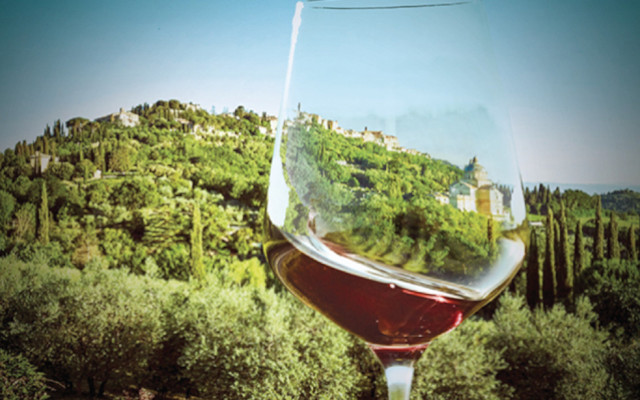
The Vino Nobile di Montepulciano DOCG is born on the hills of the municipality of Montepulciano, in the province of Siena, overlooking the Valdichiana. It is a red wine made from Sangiovese, a vine variety that here takes the local name of Prugnolo gentile, and its written history begins in the 8th century. In 2025 the denomination placed 6.4 million bottles on the market - almost two out of three sold abroad - and brought the first wines with the mention Pieve, the new type introduced in the production rules (Consorzio del Vino Nobile di Montepulciano, 2026). It is also the first Italian denomination to have obtained sustainability certification Equalitas.
Twelve centuries of documents
The hills of Montepulciano were already producing wine in Etruscan era, as evidenced by a kylix, the wine cup found in 1868 in a tomb near the city. Titus Livy attributes the decision to bring wine to the Gauls to induce them to come to Italy to Arrunte, an Etruscan from nearby Chiusi (Ab Urbe condita, V, 33): the episode concerns Chiusi and not Montepulciano in the strict sense, but documents the ancient fame of the wines of internal Etruria.
The oldest document attributable to Montepulciano wine dates back to 789, when the cleric Arnipert donated a piece of land cultivated with vines in the castle of Policiano to the church of San Silvestro sull'Amiata. An act of 1350, cited by Emanuele Repetti in his historical and geographical dictionary of Tuscany, establishes the first clauses for the trade and export of wine. In the mid-sixteenth century Sante Lancerio, cellar manager of Pope Paul III Farnese, described it as 'very perfect both in winter and in summer, odoriferous, pulpy, not rustic, nor full of colour, so that it is a wine for gentlemen' (disciplinary, article 9).
In 1685 Francesco Redi, doctor, naturalist and poet, closed the praise of Tuscan wines in the dithyramb Bacchus in Tuscany with the verse 'Montepulciano is King of every wine!'. 2026 marks the four hundredth anniversary of its birth, remembered by the Consortium with a program of initiatives (WineNews, 2026). The first known mention of the expression 'Vino Nobile'is from 1787, in a travel note written by Giovan Filippo Neri, governor of the royal retreat of San Girolamo in Montepulciano. In 1830 Giuseppe Giulj, in the Agricultural Statistics of the Val di Chiana, indicated it among the selected wines of the valley as the one 'known throughout Europe', and a decade later Alexandre Dumas entrusts 'a flask of Montepulciano wine' with the task of completing a lunch for the Count of Montecristo (disciplinary, article 9).
Thomas Jefferson and the cases shipped from Livorno
The link with the United States finds direct confirmation in the correspondence of Thomas Jefferson, published by the American National Archives. The third president had Montepulciano wine shipped from Livorno, via consul Thomas Appleton. On 1 April 1807 Appleton announced the dispatch of 350 bottles, embarked in March on the ship Jane bound for Baltimore, of at least equal quality to that of the shipment about two years earlier. The attached account reconstructs the entire supply chain: 175 flasks paid to a Bucelli, transport in seven crates from Montepulciano to Florence and from there to Livorno, duties along the road, bottling and corking in the port. The final cost was 26.6 cents per bottle, of which 12.9 for the wine, according to the calculation noted in the margin by Jefferson himself (Appleton, 1807).
In July 1808, a few months before the end of his second term, Jefferson requested another 100 bottles of Montepulciano and observed that British orders and French decrees on maritime traffic had interrupted his annual supply (Jefferson, 1808). In 1816, now retired to Monticello, he defined it as 'a very favorite wine', one of his favorite wines, and the following year he recommended Appleton to some friends gathered in an association to purchase it themselves (Jefferson, 1816, 1817).
These letters precede by more than twenty years the first shipment of Vino Nobile to America by ship, which the disciplinary places in 1828 on the basis of the Giornale agrario della Toscana of the Accademia dei Georgofili, even if in Appleton's accounts the wine appears with the sole name of Montepulciano (disciplinary, article 9). A recent volume by Francesco Clementi and Antonio Gaudioso, presented in Montepulciano in June 2026, credits Filippo Mazzei, a Tuscan intellectual and friend of Jefferson, with having introduced him to this wine, and interprets his predilection as an expression of a republican culture of moderation (Clementi & Gaudioso, 2026; WineNews, 2026).
From the DOC of 1966 to the twelve Pievi
In Montepulciano a cooperative winery was founded in 1937 and the producers' consortium in 1965. The following year the Vino Nobile di Montepulciano obtained the controlled designation of origin and in 1980 it became one of the first DOCG – controlled and guaranteed designation of origin as well as the first Italian wine to affix the replacement mark of the State band on the closure systems, to guarantee authenticity (disciplinary, article 9). In European Union law the name is protected as PDO, protected designation of origin (EU regulation 1308/2013, art. 93.1, letter 'a') and verification of compliance with the specification is entrusted to Valoritalia (disciplinary, article 10).
The ordinary amendment approved in 2025 introduced the mention Pieve, followed by the name of one of the twelve geographical units additional ones into which the territory is divided: Sant'Ilario, Ascianello, Badia, Caggiole, Cervognano, Cerliana, Gracciano, Le Grazie, San Biagio, Sant'Albino, Valardegna and Valiano. The reference is to the parish church, the rural church around which the communities of the Tuscan countryside were organised. The mention can also be recognized for wines from harvests from 2021 onwards that comply with the new requirements, and the first bottles arrived on the market in 2025 (disciplinary, article 7 and Annex A).
Rules for viticulture and vinification
The production area coincides with the hilly part of the municipality of Montepulciano, excluding the flat strip of Valdichiana, and admits only well-exposed vineyards between 250 and 600 metres altitude. The substrate is formed largely by marine sediments of the Pliocene, with prevalence of sands at higher altitudes: a feature which in Tuscany is found with similar distribution only in San Gimignano, while it is virtually absent in Montalcino and in Chianti Classico. The climate it is Mediterranean, with average rainfall of around 690 millimeters per year, dry summers and strong temperature variations between September and early October, which favor the aromatic and phenolic complexity of the grapes (disciplinary, articles 3, 4 and 9).
The wine must come at least 70% from grapes Sangiovese. Other vines suitable for cultivation in Tuscany can contribute up to 30%, with white grapes within 5% and excluding aromatic vines, except for Malvasia bianca lungo. For the Pieve mention, the Sangiovese threshold rises to 85% and the complementary ones, up to 15%, are restricted to Canaiolo nero, Ciliegiolo, Mammolo and Colorino, the latter within 5% (disciplinary, article 2).
For new plantings the minimum density is 3,330 K vines per hectare, with espalier forms and pruning as spurred cordon, inverted or Guyot. The maximum yield is 8 tons of grapes per hectare, reduced to 7 for the Pieve with a limit of 2.5 kilograms per vine, and the yield of grapes in wine cannot exceed 70%. The vineyards destined for the Pieve must be at least fifteen years old and the grapes must come exclusively from vineyards managed by the bottling company (regulations, articles 4, 5 and 9).
Vino Nobile di Montepulciano ages for at least two years from January 1st following the harvest, with three options chosen by the producer: twenty-four months in wood; at least eighteen months in wood and the rest in other containers; at least twelve months in wood and six in bottle. There Reserve requires three years, of which six months of ageing in bottle, and grapes with a minimum natural alcoholic content of 12.5%. The Pieve it also matures for three years, with at least twelve months in wood and twelve in the bottle, and is subjected to the chemical-physical and organoleptic examination only at the end of the refinement in the bottle (disciplinary, article 5).
Vinification, aging and bottling must take place in the area, except for limited exceptions for historic cellars. The label shows the vintage and the term Tuscany immediately after the denomination, and the wine can only be marketed in bottles dark glass Bordeaux bottles up to 5 litres, closed with flush cork stopper (regulations, articles 5, 7 and 8).
The sensory profile and food pairings
The regulations describe a wine of color ruby red tending towards garnet with aging, from aroma intense, ethereal and characteristic aroma, and flavor 'dry, balanced and persistent, with a possible hint of wood' (regulation, article 6). Zoning investigations conducted since 1989 have linked the soils of Montepulciano to the notes of sour cherry, of violet and of spices that Sangiovese develops there, supported by an tannicity evident which ensures good aging potential over time (regulations, article 9). In the early years dark fruit prevails; after bottle aging the color shifts towards garnet, the aroma becomes ethereal and the tannin accompanies a long and dry finish.
The regulations of Pieve they produce a more concentrated and cleaner wine. To the minimum alcoholic strength of 13% are added a total acidity of at least 5 grams per liter, a non-reducing extract of at least 26 grams per liter and a limit of 450 micrograms per liter to volatile phenols, the compounds responsible for the unwanted smells of stable and leather. Even wood must remain in the background: for Pieve the specification only allows a 'possible slight hint of wood' (disciplinary, article 6).
At table Vino Nobile pairs with grilled and roasted red meats, game, ragù pasta dishes and medium to long-aged cheeses. On the territory it finds its most natural pairings with bistecca alla Fiorentina and in Pecorino Toscano PDO aged, while from the same hills comes Vin Santo of Montepulciano DOC, for the end of the meal. The name of the city, finally, should not be confused with that of the vine from which takes its name Montepulciano d'Abruzzo, wine of another region and of different grape varieties.
Markets, areas and sales in 2025
In 2025 the following were placed on the market 6.4 million bottles K of Vino Nobile di Montepulciano DOCG e 2.5 million K of Rosso di Montepulciano DOC, which can come from the same vineyards. The figure follows the 6.9 million bottles in 2023 and the 6.7 million in 2024, in a year that the Consortium defines as positive in value (Consorzio del Vino Nobile di Montepulciano, 2024, 2025, 2026). Of the 16,500 hectares of the municipal territory, approximately 2,000 are under vineyards, of which approximately 1,400 are registered with the DOCG and 600 with the Rosso. The supply chain has over 250 winemakers and around 90 bottlers, 82 of which are associated with the Consortium, for a wine production value of around 65 million euros per year (Vigne, Vini & Qualità, 2026).
THE'export accounts for 64.5% of sales. Germany is the leading market, accounting for 36% of exports, followed by the United States with 27.5%, which has remained stable despite tariff tensions. In Italy, where the remaining 35.5% is located, sales are concentrated in the Centre (65%) and particularly in Tuscany (45%). The direct sales at the cellar exceeded 40% of the total, sign of the weight of wine tourism, and wine with organic certification represents 50% of sales in Italy and over 55% of sales abroad. A survey by Nomisma among US restaurateurs, wine sellers and distributors, presented at the February 2026 Preview, recorded a strong interest in Pieve, which 34% of those interviewed placed in the high price range (Consorzio del Vino Nobile di Montepulciano, 2026).
Equalitas certification of the territory
Since 24 May 2022, Vino Nobile di Montepulciano is the first PDO Italian wine PDO certified according to standard Equalitas, promoted by Federdoc and Unione Italiana Vini, which considers the environmental, social and economic dimensions of sustainability and includes a module dedicated to denominations, activated through the protection consortium. The path has distant roots: the vineyard zoning study started in the early nineties and the project on the carbon footprint of the denomination, which became a model on a national scale in 2015 (Consorzio del Vino Nobile di Montepulciano, n.d.).
The certification takes on further significance today. From 27 September 2026 the new rules against greenwashing prohibit 'displaying a sustainability label that is not based on a certification system or is not established by public authorities' (Consumer Code, art. 23.1, letter 'b-bis'). The comparison between sustainability certifications for Italian wine shows that Equalitas is the only one among the national schemes to also verify social requirements, on which those who boast sustainability as a whole must rely (Dongo, 2026). Regulation (EU) 2024/1143 also allows producer groups to agree sustainable practices more rigorous than those prescribed by law and to make them mandatory by including them in the specifications (EU regulation 2024/1143, art. 7). The Montepulciano experience shows how the certification of the territory can precede and prepare this step.
Dario Dongo
Credit cover Vino Nobile di Montepulciano PDO Consortium
References
European Union regulatory sources
Regulation (EU) No 1308/2013 of the European Parliament and of the Council of 17 December 2013 establishing a common organisation of the markets in agricultural products. Consolidated text: 18/08/2026. http://data.europa.eu/eli/reg/2013/1308/2026-08-18
Regulation (EU) 2024/1143 of the European Parliament and of the Council of 11 April 2024 on geographical indications for wine, spirit drinks and agricultural products, as well as traditional specialities guaranteed and optional quality terms for agricultural products. Consolidated text: 18/03/2026. http://data.europa.eu/eli/reg/2024/1143/2026-03-18
Italian normative sources
Legislative decree 6 September 2005, n. 206, 'Consumer Code, pursuant to article 7 of law 29 July 2003, n. 229'. Regulatory. Latest consolidated version: 05/16/2026. https://www.normattiva.it/uri-res/N2Ls?urn:nir:stato:decreto.legislativo:2005-09-06;206
Law 12 December 2016, n. 238, 'Organic discipline of vine cultivation and wine production and trade'. Regulatory. Latest consolidated version: 05/14/2026. https://www.normattiva.it/uri-res/N2Ls?urn:nir:stato:legge:2016-12-12;238
Ministry of Agriculture, Food Sovereignty and Forestry. Decree of 21 January 2025, 'Ordinary amendments to the production specifications of the controlled and guaranteed designation of origin of «Vino Nobile di Montepulciano» wines'. Official Journal, General series n. 29 of 5 February 2025, Annex A (consolidated regulations) and Annex B (single document). https://www.gazzettaufficiale.it/eli/gu/2025/02/05/29/sg/pdf
Historical sources
Appleton, T. (1807, April 1). To Thomas Jefferson from Thomas Appleton. Founders Online, National Archives. https://founders.archives.gov/documents/Jefferson/99-01-02-5399
Jefferson, T. (1808, July 28). From Thomas Jefferson to Thomas Appleton. Founders Online, National Archives. https://founders.archives.gov/documents/Jefferson/99-01-02-8402
Jefferson, T. (1816, January 14). Extract from Thomas Jefferson to Thomas Appleton. Thomas Jefferson Foundation, Monticello. https://tjrs.monticello.org/taxonomy/term/1828
Jefferson, T. (1817, September 29). Thomas Jefferson to Thomas Appleton. Founders Online, National Archives. https://founders.archives.gov/documents/Jefferson/03-12-02-0034
Livy. Ab Urbe Condita, Book V, 33.
Documents of the Protection Consortium
Consorzio del Vino Nobile di Montepulciano. (2024). Press kit 2024. https://consorziovinonobile.it/wp-content/uploads/2024/02/CARTELLA-STAMPA2024_W.pdf
Consorzio del Vino Nobile di Montepulciano. (2025). Press kit 2025. https://www.consorziovinonobile.it/wp-content/uploads/2025/01/CARTELLA-STAMPA-2025-ITA.pdf
Consortium of Vino Nobile di Montepulciano. (2026). Vino Nobile di Montepulciano: in 2025 it will fly abroad. https://www.consorziovinonobile.it/vino-nobile-di-montepulciano-nel-2025-vola-allestero/
Consorzio del Vino Nobile di Montepulciano. (N/A). Sustainability. https://consorziovinonobile.it/sostenibilita-en/
Books and specialized press
Clementi, F., & Gaudioso, A. (2026). The taste of freedom. Thomas Jefferson, Vino Nobile di Montepulciano and the birth of the United States. Il Pensiero Scientifico Editore.
Vigne, Vini & Qualità. (2026). Nobile di Montepulciano, a 1 billion Euro heritage. https://vigneviniequalita.edagricole.it/territori-prodotti/nobile-di-montepulciano-un-patrimonio-da-1-miliardo-di-euro/
WineNews. (2026). Among wine and freedom, Thomas Jefferson and Filippo Mazzei, and Vino Nobile di Montepulciano. https://winenews.it/en/among-wine-and-freedom-thomas-jefferson-and-filippo-mazzei-and-vino-nobile-di-montepulciano_594141/

Dario Dongo, lawyer and journalist, PhD in international food law, founder of WIISE (FARE - GIFT – Food Times) and Égalité.


