

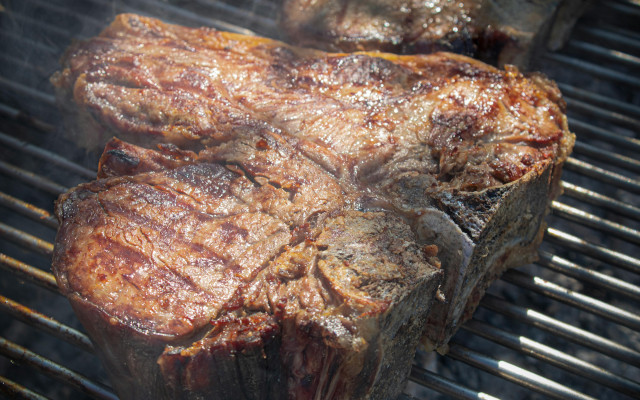
The Florentine steak is the result of technical rigor that transforms the raw material into a complex sensory experience. Beyond the gastronomic myth, this cut represents the pinnacle of an excellent livestock supply chain, where the selection of Italian native breeds and mastery in aging meet. Understanding the Florentine means analyzing a precise balance between bovine anatomy, biochemical transformations, and heat management, in compliance with the latest food safety standards.
The origins of the Florentine steak are placed in the Renaissance context, when Florence was one of the most important cultural and commercial centers in Europe. One of the most widespread legends attributes the birth of the term ‘bistecca’ to the presence of Anglo-Saxon merchants and travelers in Florence during the celebrations of Saint Lawrence, on August 10th. On that occasion, in Piazza San Lorenzo large pieces of beef were roasted on glowing embers and the English guests supposedly began to call them ‘beef steak’, from which the Italianization ‘bistecca’ would derive.
Other historical sources indicate that already in the fifteenth century, at the Medici court, cuts of premium beef, cooked over charcoal according to techniques that prefigure the current Fiorentina (Camporesi, 1980). Pellegrino Artusi, in his famous manual ‘The Science of Cooking and the Art of Eating Well‘ (1891), although not dedicating a specific recipe to Fiorentina, precisely describes the criteria to recognize top-quality veal beef and grilling methods, emphasizing the importance of live fire and the shortness of thermal treatment (Artusi, 1891).
The spread of Fiorentina as an identity dish was consolidated between the 19th and 20th centuries, with the development of the Chianina breed and specialized cattle breeding practices in Val di Chiana, an excellent territory extending between Tuscany, Umbria, and Lazio (Bosi & Russo, 2015). Ada Boni, in her fundamental ‘The Talisman of Happiness‘ (1929), expressly recommends the use of veal beef of the Chianina breed to achieve excellent results in grilling (Boni, 1929).

Essential characteristics of the meat
Zootechnical excellence between Chianina and native breeds of the Apennines
The authentic Fiorentina steak traditionally derives from cattle of Chianina breed, which is distinguished by its porcelain-white coat, somatic gigantism expressed in length and height of the trunk, powerful muscle mass, and low intramuscular fat content (moderate marbling) (ANABIC, 2020).
These cattle, fed primarily with forage and cereals, develop a meat with bright red color, white-cream fat, and excellent nutritional and organoleptic characteristics. Particularly tender after proper aging.
Over the decades, the production of Fiorentina steak has included beef from other local native breeds such as Romagnola and Marchigiana – recognized, together with Chianina, in the regulations of the White Veal of the Central Apennines PGI – as well as Calvana and Maremmana.
Profile of veal and young heifer, age and morphology
The ideal meat comes from vitelloni (young cattle, generally between 12 and 24 months), preferably castrated males or non-pregnant females (scottone). This phase ensures an optimal balance between tenderness, due to young age and limited connective tissue formation, and aromatic development, related to feeding and the physiological maturation of the animal (Priolo et al., 2001).
The scottona, a term that designates a young female that has never given birth, presents slightly superior marbling characteristics and particularly appreciated tenderness. The vitellone male castrated instead offers meat with greater muscular development and more intense flavor. The optimal slaughter age is between 16 and 20 months, when the meat has reached full organoleptic maturity without developing the excessive toughness typical of older subjects (Scollan et al., 2006).

Cut anatomy: tenderloin, sirloin and T-bone
The cut used for the Florentine steak is the loin, which is taken from the dorso-lumbar region of the animal, precisely between the twelfth dorsal vertebra and the fifth lumbar vertebra. This cut includes the tenderloin (muscle psoas major), The sirloin (muscle longissimus dorsi), and the characteristic T-shaped bone (T-bone) that separates them.
The rear part of the loin (porterhouse) includes larger portions of tenderloin, while the front part, with a smaller tenderloin, corresponds to the classic ‘T-bone steak’ (USDA, 2019). In Tuscany, the preference falls on the intermediate portion, where tenderloin and sirloin reach balanced proportions.
Biochemistry of ‘dry aging’ and new safety standards
The dry aging it is a crucial step: it can vary from 15 to over 30 days under controlled temperature (0-4°C) and humidity (75-85%) conditions. This process allows endogenous enzymatic activity (mainly calpains and cathepsins) that degrades myofibrillar proteins and collagen, improving tenderness and developing complex aromas through reactions of proteolysis e lipolysis (Troy & Kerry, 2010).
There are two main dry aging methods: dry aging (dry aging), traditionally favored for the Fiorentina, and vacuum aging (wet aging). Dry aging involves a partial surface dehydration of the meat, resulting in flavor concentration and the development of more intense aromatic notes, often described as nutty or buttery. Weight loss can reach 15-20% of the total, but the organoleptic result is considered superior (Dashdorj et al., 2016).
Specialized butcheries and high-end restaurants perform extended aging up to 45-60 days, obtaining meats of peculiar aromatic complexity. The microbiological control during this process is fundamental to ensure food safety, as prescribed by regulation (EU) 2024/1141 (Dongo et al., 2024).
Preparation and cooking
Steak thickness
The loins of Chianina breed cattle are ‘muscular, thick, wide, long’ (ANABIC, 2020). The weight of a Fiorentina steak (with bone) can therefore vary between 800 grams to over 1.5 kg, with a thickness ranging between 4 and 6 cm.
This thickness ensures differentiated cooking between surface and interior, creating that essential contrast between the caramelized crust outside and the pink, juicy core that defines the perfection of the Fiorentina.
Preparation
The meat must be brought to room temperature before cooking, ideally letting it rest out of the refrigerator for at least 30-60 minutes. This precaution prevents thermal shock and promotes more even cooking.
The surface of the meat should be dry before meeting the coals: surface moisture hinders crust formation through Maillard reaction, the chemical process that generates aromatic and savory compounds through the action of heat on proteins and sugars (Mottram, 1998).
Marination is not planned: seasoning only takes place after cooking, with coarse salt and a drizzle of extra virgin olive oil Tuscan, strictly raw.
Cooking
Traditional cooking takes place on wood embers, preferably oak, holm oak or olive tree, to impart characteristic aromas without covering the taste of the meat. The ember temperature must be very high (about 250-300°C on the surface), with well-formed embers, without live flames that could char the surface.
A highly effective technical trick, handed down by the steak makers from Florence and also documented by Luigi Carnacina in the ‘Great manual of regional cuisine’ (1966), consists instarting the cooking vertically, resting the T-bone bone on the grill, for 5-10 minutes depending on its thickness. This method promotes heat transmission through the bone, aiding the cooking of the inner part otherwise difficult to reach (Carnacina & Veronelli, 1966).
Subsequently, the steak is laid on the grill for a few minutes on each side, without piercing it with forks or pressing it with spatulas, to preserve internal juices. The empirical rule provides for a single turning, done with wide-tipped tongs. The ideal cooking is ‘rare’, with an internal temperature of about 50-52°C at the center, to maintain juiciness and tenderness.
The surface must have a golden and crispy crust, characterized by marked stripes left by the grill, while the inside remains reddish-pink, warm but not overcooked. The traditional test involves pressing with a finger: the meat must be yielding but not soft.
Table service and pairings
The Florentine steak is served hot, cut into thick slices (about 1-1.5 cm) arranged fanwise around the bone, which is traditionally left in the center of the plate as a decorative and symbolic element. The cut must follow the direction of the muscle fibers to facilitate chewing.
It is tradition to accompany it with simple side dishes, such as fresh salad seasonal dressed with extra virgin olive oil and lemon, Zolfino beans boiled and sautéed in oil and sage, or roast potatoes cut into wedges. The goal is not to overpower the taste of the meat, which remains the absolute protagonist. Artusi recommended accompaniment with 'seasonal greens,' emphasizing the importance of simplicity (Artusi, 1891).
As for wines, the classic pairing is with structured Tuscan reds, such as Chianti Classico DOCG (preferably Riserva), Brunello di Montalcino DOCG, Vino Nobile di Montepulciano DOCG or Carmagnano DOCG.
The pairing is based on the principle of balance: the wine must have enough body and structure to support the intensity of the meat without overpowering it. A 5-7 year-old Chianti Classico Riserva, with notes of ripe fruit, spices, and leather, represents the most traditional choice. The Supertuscan based on Sangiovese and Cabernet, such as Tignanello or Sassicaia, in turn offer aromatic complexity and elegant tannins (Robinson, 2015).
Conclusions
The identity of the Fiorentina lies in the transparency of the supply chain and the art of preparation. From the protection of animal welfare in farms of the central Apennines to the controlled maturation processes of the meat, every step contributes to a model of conscious consumption. In a market that demands guarantees on origin and sustainability, the Fiorentina confirms itself as an example of productive integrity, capable of combining respect for European regulations with the enhancement of Italian zootechnical biodiversity.
Dario Dongo
Credit cover Regina Tommasi
Bibliography
- Artusi, P. (1891). The Science of Cooking and the Art of Eating Well. Reported in Pellegrino Artusi. (n.d.). 556. Bistecca alla fiorentina. https://www.pellegrinoartusi.it/556-bistecca-alla-fiorentina/
- ANABIC (National Association of Italian Beef Cattle Breeders). (2020). Chianina breed standards. ANABIC https://www.anabic.it/servizio_tecnico/chianina.pdf
- Boni, A. (2006). The Talisman of Happiness (7th ed.). Rome: Colombo. ISBN 978‑88‑86359‑83‑2
- Carnacina, L., & Veronelli, L. (1980–1981). The Rustic Regional Cuisine (4 volumes). Milan: Rizzoli.
- Dry aging of beef: Review. Journal of Animal Science and Technology, 58(1), 20. https://doi.org/10.1186/s40781-016-0101-9
- Dario Dongo, Sarah Lanzilli, Maria Ada Marzano (2024, September 17). Aged meats, mobile slaughterhouses, EU identification mark. FT (Food Times). https://www.foodtimes.eu/it/sistemi-alimentari/carni-frollate-macelli-mobili-marchio-di-identificazione-ue/
- Flavour formation in meat and meat products: a review. Food Chemistry, 62(4), 415-424. https://doi.org/10.1016/S0308-8146(98)00076-4
- Priolo, A., Micol, D., & Agabriel, J. (2001). Effects of grass feeding systems on ruminant meat colour and flavour. Animal Research, 50(3), 185-200. https://doi.org/10.1051/animres:2001125
- Pulina, G. (2019). Carnipedia: Notes for a small encyclopedia of meat (pp. 159–164). FrancoAngeli. ISBN 9788891789549.
- Robinson, J. (Ed.). (2015). The Oxford Companion to Wine (4th ed.). Oxford University Press, Oxford. ISBN: 978-0-19-870538-3.
- Scollan, N., Hocquette, J. F., Nuernberg, K., Dannenberger, D., Richardson, I., & Moloney, A. (2006). Innovations in beef production systems that enhance the nutritional and health value of beef lipids and their relationship with meat quality. Meat Science, 74(1), 17-33. https://doi.org/10.1016/j.meatsci.2006.05.002
- Troy, D. J., & Kerry, J. P. (2010). Consumer perception and the role of science in the meat industry. Meat Science, 86(1), 214-226. https://doi.org/10.1016/j.meatsci.2010.05.009
- USDA (United States Department of Agriculture). (2019). Institutional Meat Purchase Specifications: Fresh Beef Series 100. USDA Agricultural Marketing Service, Washington D.C. https://www.ams.usda.gov/grades-standards/imps

Dario Dongo, lawyer and journalist, PhD in international food law, founder of WIISE (FARE - GIFT – Food Times) and Égalité.


