


The wine district of Montefalco is confirmed as the beating heart ofUmbrian oenology, capable of combining an ancient tradition with outstanding economic performance. Between the vigor of Sagrantino DOCG and the versatility of the denominations Montefalco DOC, the territory expresses a model of precision viticulture that drives the growth of regional added value. We analyze the technical characteristics, the strict production regulations, and the strategic positioning of these ambassadors of Made in Italy worldwide.
The XXIII ISMEA-Qualivita Report on the DOP Economy (2025) indicates an overall value of 11 billion euros in 2024 for Italian wines DOP and IGP , with bottled DOP IGP wine exports remaining stable at 11.0 billion euros, with a value atexport of 7.19 billion euros (+5.2% over 2023), equal to 88% of the total Italian wine export.
TheUmbria boasts 21 Geographical Indication wines, with a value that registered a 7.0% growth in 2024 compared to the previous year, reaching 74 million euros. In detail:
- 15 DOP wines, for a value of 38 million euros with an extraordinary growth, +15,3%, compared to 2023;
- 6 IGP wines, for a value of 36 million euros (-0.5%).
From medieval roots to DOCG recognition
Viticulture in Montefalco has been attested since the Middle Ages. 'From the first half of the 14th century, municipal laws began to protect vines and wine, dedicating entire chapters and headings in municipal statutes’. Popular legend links the name ‘Sagrantino’ to the Latin root sacer, as testimony of the liturgical and cultural rooting of the grape variety (Confraternity of Sagrantino). Monastic sources indeed confirm the production of sweet wine, from dried grapes, intended for religious occasions.
The earliest citation of the name ‘Sagrantino’ dates back to 1549, documented in a must order, while in 1598 the jurist Bartolomeo Nuti explicitly cites the use of ‘sagrantino’ grapes in the preparation of red wines. In 1925, at the Umbria Wine Exhibition, Montefalco was defined as the most important wine center of the region. The recognition DOC arrived in 1979 (Presidential Decree 30 October 1979), followed by the DOCG with Ministerial Decree of 5 November 1992.
Montefalco DOC: white, Grechetto and red in detail
The controlled designation of origin ‘Montefalco’ is reserved for four wines – two whites and two reds – that meet the requirements prescribed by the production regulations: white and Grechetto, red and red reserve (regulations updated with Ministerial Decree 3 July 2023, article 1 – Denomination and wines).
Blends and vinification: the technical regulations
The vineyards intended for the production of the different types of Montefalco DOC wine must comply with the following ampelographic composition:
- Montefalco white: Trebbiano Spoletino not less than 50%; other white, non-aromatic grapes from varieties suitable for cultivation in the Umbria Region listed
in annex 1 to the regulations;
- Montefalco Grechetto: Grechetto not less than 85%; other white, non-aromatic grapes may contribute,
originating from other grape varieties suitable for cultivation within the Umbria Region;
- Montefalco red e reserve red: Sangiovese from 60 to 80%; Sagrantino, from 10 to 25%. Non-aromatic red berries from grape varieties suitable for cultivation in the Umbria Region, as per annex 1 of the regulations (regulations, article 2 – Ampelographic base).
Production area
the Production area of the grapes suitable for the production of wines with designation of origin
controlled ‘Montefalco’ includes the entire territory of the Municipality of Montefalco and part of the
territory of the Municipalities of Bevagna, Gualdo Cattaneo, Castel Ritaldi and Giano dell’Umbria located in the province of Perugia (regulations, article 3 – Production area).
‘This is a very compact production area, with gently sloping soils along hilly profiles overseen by ancient medieval villages. The altitude range of cultivation fluctuates between 220 and 472 meters (…), while the slope of vineyard plots and the general exposure is variable, so as to create a wide range of microclimates and cultivation conditions, allowing interesting variations in the interpretation of wines by individual wineries.’
‘The climate has substantially Mediterranean – sub-continental characteristics, with hot but not sultry summers and fairly cold and moderately rainy winters' (article 9 – Link with the geographical environment).
Rules for viticulture
The environmental conditions and cultivation of vineyards must be suitable to confer to the grapes and derived wines the specific quality characteristics. For Montefalco red and reserve red ‘excessively humid or insufficiently sunny soils are to be excluded’.
the minimum planting density is 4,000 vines per hectare for red wines, 3,000 for white ones. The maximum yield of grapes per hectare is 12 tons for Montefalco whites, 11 t for reds.
The alcohol content natural minimum volumetric alcohol content of the grapes varies from 11% for white and Grechetto to 12% for red, up to 12.5% for reserve red (regulations, article 4 – Rules for viticulture).
Wine production rules
The maximum yield ofgrape to wine, at the time of release for consumption, including any enrichment, is 70% for all Montefalco DOP wines. The maximum production of wine per hectare is 84 hectoliters for whites and 77 hl for reds.
The period of minimum aging is 18 months for Montefalco red; 30 months for the red riserva, of which 12 in wooden barrels of any size (disciplinary rule, article 5 – Wine production rules).
The winemaking and mandatory aging operations must take place in the production area (with exemption for companies that vinified grapes suitable for Montefalco since 1990 in the municipalities of Foligno and Spoleto).
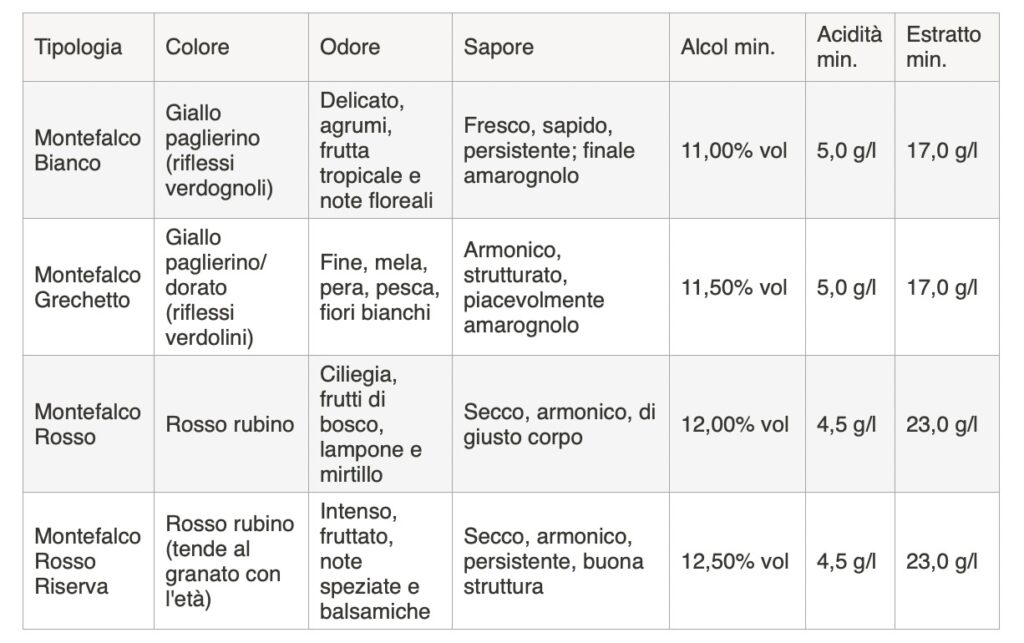
Consumption characteristics of Montefalco DOC wines
The characteristics of Montefalco DOC wines at consumption, pursuant to article 6 of the disciplinary regulation, are the following.
Labeling and packaging
In the labeling, designation and presentation of Montefalco DOC wines:
- The specifications additional specifications ‘white’, ‘red’, ‘Grechetto’ and ‘reserve’ must appear on the label below the wording ‘Montefalco Denomination of Controlled Origin’, in characters of no greater size, of the same emphasis and color;
- The mention ‘vineyard’, followed by the relevant toponym or traditional name, provided that the vinification and storage of the wine take place in separate containers;
- The use of the broader geographical reference, ‘Umbria’, separated from the geographical name of the denomination and the DOC mention, in characters of lesser height with the same font, style, spacing, emphasis, color;
- Theproduction vintage of the grapes is always mandatory;
- The addition of qualifications other than those provided by the production regulations is prohibited, including the adjectives: ‘extra’, ‘fine’, ‘selected’, ‘chosen’, ‘superior’, ‘old’ and similar (disciplinary rule, article 7 – Labeling, designation and presentation).
The packaging of Montefalco DOP wines must be carried out in glass bottles with a volume not exceeding 18 liters, sealed with a flush cork stopper, or with a screw cap with a long capsule cover. The flush cork stopper is mandatory for the red riserva (disciplinary rule, article 8 – Packaging).
Montefalco Sagrantino DOCG: the excellence of the native grape variety
The controlled and guaranteed designation of origin ‘Montefalco Sagrantino’ is reserved for red wine exclusively derived from this ancient Umbrian grape variety, in the ‘Dry’ and ‘Passito’ types, which meets the conditions and requirements prescribed by the specific regulations.
Purity and winemaking regulations
The Sagrantino DOCG must be ‘obtained from grapes coming from vineyards composed exclusively from the grape variety Sagrantino’. The production area is delimited within the territories of the same municipalities falling within the Montefalco DOP area. Similarly, the minimum planting density is set at 4,000 vines per hectare, with a distance between rows not exceeding 2.5 linear meters.
The superior quality of Sagrantino DOCG is already evident from the viticulture rules, in article 4 of the regulations, where:
- the maximum grape production is only 8 tons per hectare of vineyard in specialized cultivation and 2.5 kg per vine;
- The alcohol content minimum natural volumetric of grapes is 12.50%; 13.50% for dry wine with the mention ‘Vigna’; 17.00%, after drying, for grapes intended for the ‘Montefalco Sagrantino’ Passito type;
- the maximum yield the grape yield in wine must not exceed 65% for Montefalco
Sagrantino Secco (52 hl/ha) and 35% referred to the fresh state of the grape for the Passito type (28 hl/ha).
Aging and refinement: the secrets of longevity
The wine ‘Montefalco Sagrantino’ DOCG, in both Secco and Passito types, must undergo:
- a period of mandatory aging of at least 33 mesistarting from December 1 of the year of grape production, of which – for the Secco type only – at least 12 months in oak barrels of any size;
- a further bottle aging period of at least four months.
‘Regarding the “Montefalco Sagrantino” wine in the Passito version, in addition to natural drying, the practice of humidity control is allowed. In this case, the environments may be subjected to dehumidification and possible lowering of ambient temperature. Heating is however prohibited’ (regulation, article 5 – Wine production rules).
Sagrantino Montefalco DOCG, consumption characteristics
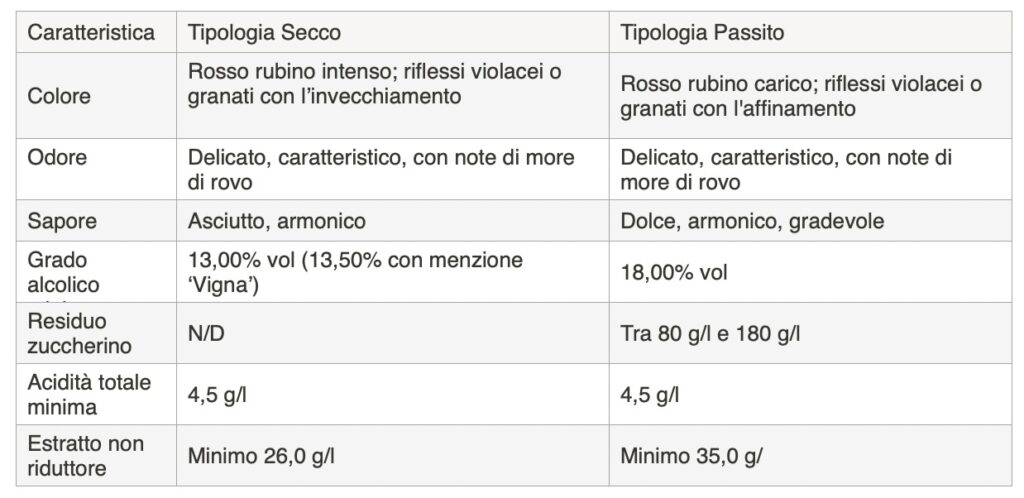
Montefalco Sagrantino stands out for its imposing structure and longevity, expressed in two historic versions: Secco, austere and harmonious, and Passito, which maintains the varietal character in a sweet and velvety form (regulation, article 6 – Characteristics at consumption).
Comparison between Dry and Passito types
Pairings
Montefalco Bianco DOC and Grechetto DOC: appetizers, soups and legumes, risottos, fish, white meats, porchetta, fresh cheeses and rustic pies.
Montefalco Rosso DOC: Umbrian cured meats, pasta with ragù, roasted and grilled meats, medium-aged cheeses.
Dry Sagrantino DOCG: braised dishes, game, important red meats, aged hard cheeses (e.g. Parmigiano Reggiano >24 months).
Sagrantino DOCG passito: dessert with dark chocolate, dry pastries (e.g. cantucci), blue cheeses (e.g. Gorgonzola DOP); meditation wine.
Buying guide and opportunities for international buyers
For gourmets — Favor certified organic labels or low-impact agronomic practices; for dry Sagrantino, consider vintages with at least 5–8 years of aging to appreciate full tannic integration; for passito, prefer producers with well-managed natural drying and balanced residual sugars.
For professional buyers — The Montefalco district offers a premium positioning for fine dining wine lists and specialized retail. Focus on verticals of Sagrantino (dry and passito) and DOC reds with strong territorial identity. GIFT (Great Italian Food Trade) supports international buyers in selecting reliable suppliers, focusing on organic producers, supply chain audits, logistics support, and export compliance.
Conclusions
The Montefalco denomination is a stronghold of ampelographic biodiversity, as well as a flagship of the Italian DOP Economy. The ability of Sagrantino to evolve over time, combined with the rigor of supply chain controls, guarantees international markets a product of the highest qualitative and identity profile. For industry operators, investing in the Montefalco district means betting on an unbreakable link between territory and oenological innovation, fundamental pillars for the success of the fine dining and retail sector.global.
Dario Dongo
References
- Confraternity of Sagrantino. https://confraternitadelsagrantino.it
- Consortium for the Protection of Montefalco Wines. Montefalco DOC — blends and current regulations. https://www.consorziomontefalco.it/
- ISMEA & Qualivita Foundation. (2025). ISMEA-Qualivita 2025 Report on Italian agri-food and wine productions with DOP, IGP and STG designations (23rd ed.). Qualivita Editions. https://www.ismea.it/flex/cm/pages/ServeAttachment.php/L/IT/D/1%252Fe%252F8%252FD.fefdd2e7c08546544955/P/BLOB%3AID%3D13512/E/pdf?mode=download
- Ministry of Agriculture, Food Sovereignty and Forests. (2023). Montefalco DOP (DOC): Consolidated regulations. MASAF. https://www.masaf.gov.it/flex/cm/pages/ServeBLOB.php/L/IT/IDPagina/19834
- Ministry of Agriculture, Food Sovereignty and Forests. (2023). ‘Montefalco Sagrantino’ DOP (DOCG): Consolidated regulations. MASAF. https://www.masaf.gov.it/flex/cm/pages/ServeBLOB.php/L/IT/IDPagina/19833

Dario Dongo, lawyer and journalist, PhD in international food law, founder of WIISE (FARE - GIFT – Food Times) and Égalité.


