

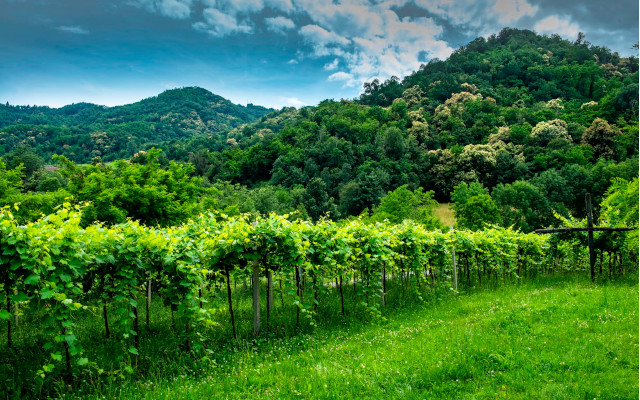
In the sparkling wine scene of North-East Italy — dominated by Prosecco e Conegliano Valdobbiadene, Franciacorta e Trentodoc — two sister denominations of Veneto are earning recognition with an unmistakable territorial identity: Lessini Durello PDO e Monti Lessini PDO. These sparkling wines, produced with the native grape variety Durella on the volcanic Monti Lessini, between the provinces of Verona and Vicenza, express one of the most original and less known voices among Italian sparkling wines.
Vibrant acidity, marked minerality and aromatic profiles which, thanks to the basaltic rocks, evoke the ancient sea define its character, together with remarkable gastronomic versatility and aging capacity. With the regulatory changes approved in 2024, the area has redefined its identity: the Martinotti-Charmat method remains with Lessini Durello DOP, while the classic method is now identified by the Monti Lessini DOP denomination (MASAF, 2024).
The article analyzes updated market data, millenary history, the latest consolidated versions of the two regulations — with comparative tables on production requirements and product characteristics — as well as pairings and advice for informed buyers, with attention to organic products as a guarantee of environmental sustainability and biodiversity protection.
One soul, two denominations
The distinction debuts on the label after a process lasting about ten years and translates into two denominations the two sparkling wine methods, which differ in the place of the second fermentation, the one that generates the bubbles (Il Sole 24 Ore, 2025):
- Lessini Durello PDO, Martinotti (or Charmat) method: the refermentation takes place in large pressurized tanks (autoclaves), in a short time, preserving freshness, fragrance and fruity aromas of the grape variety;
- Monti Lessini PDO, classic method: the refermentation takes place in the bottle, with a stay on the lees of at least 24 months — and reserve mention from 36 — which gives complexity, structure and notes of bread crust (Monti Lessini, n.d.-a; Veneto Region, n.d.).
Monti Lessini is the only Venetian denomination exclusively reserved for the classic method, a regional uniqueness that aims to compete with the great Italian classic method PDOs.
Production and market 2025/2026
The numbers of the denomination
The production area extends over more than 30,000 hectares in the hilly part of the Eastern Lessini; the district counts about 600 hectares of Durella, with an estimated production potential of six million bottles. The current market is worth about 400,000 bottles of classic method and over 700,000 of Charmat, and the share of classic method has jumped from 6% in 2019 to 35% from 2024 (Il Sole 24 Ore, 2025).
The turnover of the classic method alone is estimated at about 6 million euros, with an average cellar price of 15 euros per bottle. The 70% of sales goes through the channel catering20% from company shops and only a minimal share from large-scale retail. The Consortium, chaired by Gianni Tessari, brings together 34 wineries between private companies and cooperatives (Il Sole 24 Ore, 2025).
The export scenario
Italian wine export closed 2025 at 7.78 billion euros (-3.7% on 2024), penalized by US tariffs and the dollar depreciation; the sparkling wines limited the decline to -2.5% in value (2.3 billion euros), with volumes even slightly growing (+0.7%) (UIV, 2026). The Veneto confirms itself as the top exporting region with 2.9 billion euros (-1.2%) (UIV, 2026).
In this context, the Lessini Durello remains a niche with a mainly local and Horeca vocation, with ample growth margins in specialized international catering. Sparkling wines represent one third of wine consumption outside the home in Italy and Prosecco accounts for 47% of this: half of the market consists of 'other sparkling wines', the natural positioning space for Monti Lessini Metodo Classico (Il Sole 24 Ore, 2025).
History of the native grape variety, between fossils and Venetian merchants
A terroir born underwater
The Lessini Mountains formed about 45 million years ago, when rising magma bubbles lifted them from the bottom of a primordial sea: hence the coexistence of basalt rocks and fossil deposits of extraordinary richness, such as the famous Pesciara di Bolca, a world reference for the Eocene. Some fossil grapevines found in the area testify how favorable this habitat was for the vine even in very remote times (Monti Lessini, n.d.-b).
From the medieval ‘Durasena’ to Durella
Organized viticulture arrived with the Romans. Pliny the Elder mentions grapes ‘duracinae’, with hard skin, to which local tradition attributes the etymology of the grape variety (Monti Lessini, n.d.-b). Written records follow in the thirteenth century: the Statutes of Vicenza of 1264 cite the grape ‘Duriciana’, those of Costozza from 1292 the ‘Durasena’, from Latin durus acinus. The Germanic Cimbri people, settled at the end of the thirteenth century, also left their mark on Lessini areas (Monti Lessini, n.d.-b).
It was the Republic of Venice that gave commercial impetus to Lessinia wine: an edict of the 1377 it prescribed boarding on long-distance ships, attributing pharmaceutical and strengthening qualities, probably due to the high acidity which made it resistant to changes during travel. 19th-century ampelography consolidated its identity: Ciro Pollini records the 'Durasena' grape in the catalog of Verona grapes (1824) and Giuseppe Acerbi describes in 1825 a Durella grown in Vicenza.
The path of the denominations
The DOC was born with DM 25 June 1987; the success of Durello leads in 2009 producers to request the recognition of the autonomous denomination ‘Lessini Durello‘, while in 2011 the restructuring assigns to the denomination ‘Monti Lessini‘ the still wines of the territory, which the 2024 regulation eliminates completing the conversion to classic method sparkling wines (MASAF, n.d.-b; Regione Veneto, n.d.).
The Consortium for protection, recognized by the Ministry in November 2000, has led the zoning of the area, identifying 15 subzones, or Cru. With the ordinary amendments of 2024 the last step is completed: autoclave sparkling for Lessini Durello, bottle sparkling for Monti Lessini (MASAF, 2024).
The disciplinary regulation of the DOP Lessini Durello
The regulation of the DOP ‘Lessini Durello’ or ‘Durello Lessini’ has been modified by decree of the Ministry of Agriculture, Food Sovereignty and Forestry dated 26 August 2024, con applicazione dalla campagna vendemmiale 2024/2025 (MASAF, 2024).
Denomination and ampelographic base
The denomination is reserved for a single type, the sparkling wine Martinotti or Charmat method; the classic method is referred to DOP Monti Lessini. The wine must come from vineyards with Durella for at least 85%; may include, up to 15%, Garganega, Pinot blanc, Chardonnay and Pinot noir (regulation, articles 1 and 2).
Production area
Province of Verona: entire territory of Vestenanova and San Giovanni Ilarione; part of Montecchia di Crosara, Roncà, Cazzano di Tramigna, Tregnago, Badia Calavena.
Province of Vicenza: entire territory of Arzignano, Castelgomberto, Chiampo, Brogliano, Gambugliano, Trissino; part of Cornedo, Costabissara, Gambellara, Isola Vicentina, Malo, Marano Vicentino, Monte di Malo, Montebello Vicentino, Montecchio Maggiore, Montorso Vicentino, Nogarole Vicentino, San Vito di Leguzzano, Schio, Zermeghedo (regulation, article 3).
Viticulture rules
The vineyards must be placed in sloping position, excluding excessively humid and fertile soils. Training system: simple or double espalier, or Veronese pergola with vegetation opening in the inter-row; minimum density of 2,500 vines/ha for Durella and Garganega, 3,000 for Pinot noir, Chardonnay and Pinot blanc. Maximum yield: 16 tons/ha (exceedable up to 20% in exceptional years, with the excess destined for IGT); minimum natural alcohol content 9.00% vol (regulations, article 4).
Vinification and consumption characteristics
Vinification takes place in the municipalities of the production area, with exceptions for neighboring municipalities traditionally involved; the sparkling process, exclusively by natural fermentation in autoclave, must take place in Veneto (MASAF, n.d.-a).
At consumption: fine and persistent foam; pale straw yellow color with greenish reflections; delicate, slightly fruity aroma; dosages from pas dosé to demi-sec; minimum total alcohol content 11.00% vol; minimum total acidity 6.5 g/l; minimum non-reducing extract 14 g/l (regulations, articles 5 and 6).
Labeling, packaging and controls
Laudatory qualifications (‘extra’, ‘fine’, ‘selected’, ‘chosen’) are prohibited; the mention ‘Vineyard’ requires place name, distinct registration of the surface area and separate vinification; ‘Vintage’ requires indication of the year. Bottles up to 15 liters, with cork mushroom stopper mandatory between 0.500 and 3 liters (screw cap allowed up to 0.375 liters). Control body: Siquria, Soave (regulations, articles 7-10).
The Monti Lessini PDO regulations
With the 2024 amendment, the DOP ‘Monti Lessini’ performs a complete conversion to sparkling wine by the traditional method: the still types of the previous regulation — Bianco, Durello (including passito) and Pinot nero — are eliminated, and the denomination is reserved for only three quality sparkling wines: ‘Monti Lessini’, ‘Monti Lessini reserve’ and ‘Monti Lessini crémant‘ (Regione Veneto, s.d.).
Ampelographic base
Sparkling wines must be obtained from grapes with Durella for at least 85%; white non-aromatic grape varieties suitable for cultivation in the provinces of Verona and Vicenza may contribute for the difference, in addition to Pinot Nero vinified in white — un perimetro più ampio della lista chiusa prevista dal disciplinare gemello (Regione Veneto, s.d.).
Production area and viticulture
The production area remains unchanged and fully coincides with that of Lessini Durello, in the provinces of Verona and Vicenza. Training on trellis or pergola with opening between rows or on the row and maximum load of 50,000 buds/hectare; minimum density of 3,000 vines/hectare (2,500 for Durella and Garganega). Maximum yield: 16 tonnes/hectare and minimum natural alcohol content 9.00% vol for all three types. It is mandatory manual harvest delle uve (Regione Veneto, s.d.).
Vinification rules
Winemaking operations take place in the municipalities of the production area, with exceptions for the same adjacent municipalities provided by the twin specification; the elaboration of sparkling wines must take place within the provinces of Verona and Vicenza — narrower perimeter compared to the entire Veneto region permitted for Charmat. The transition from grape to must occurs with pressing of whole grapes; la resa massima uva/vino è del 70%, calcolata al netto dei prodotti aggiunti alla presa di spuma (Regione Veneto, s.d.).
The refermentation occurs exclusively in bottle, according to the classic method, with lees aging of at least 24 months — higher compared to the 18 months of the previous text — and at least 36 months per la riserva; il crémant risponde ai requisiti della normativa vigente per la relativa menzione. I dosaggi ammessi vanno da dosaggio zero (pas dosé) a demi-sec; per il crémant, da brut a demi-sec. È consentito il travaso isobarico tra bottiglie, per l’impiego di formati particolari (Regione Veneto, s.d.).
Consumption characteristics
For all three types: minimum alcohol content 11.5% vol, minimum total acidity 6.0 g/l — increased compared to the previous 5.5 g/l, safeguarding the identity of the grape variety — and minimum non-reducing extract 15 g/l.
La spuma è fine e persistente, intensa nella riserva, cremosa nel crémant; l’odore è caratteristico con delicato sentore di lievito, con note complesse ed evolute da lungo affinamento nella riserva (Regione Veneto, s.d.).
Designation, packaging and controls
The same prohibitions on laudatory qualifications and the conditions for the mention ‘Vineyard‘ of the twin regulations; for the reserve the indication of the vintage year is optional and the term ‘Vintage‘ is reserved for single harvest wines.
Sparkling wines are placed on the market exclusively in glass bottles up to 15 liters, sealed with a cork mushroom stopper. Control body: Siquria S.p.A., San Bonifacio (VR) (Veneto Region, n.d.).
Two regulations compared
Table 1 – Production requirements
| Requirement | Lessini Durello PDO | Monti Lessini PDO |
| Sparkling wine method | Martinotti-Charmat (tank), exclusive | classic method (bottle), exclusive |
| Types | sparkling wine | sparkling wine, reserve, crémant |
| Ampelographic base | Durella ≥85% + Garganega, Pinot blanc, Chardonnay, Pinot noir ≤15% | Durella ≥85% + suitable non-aromatic white grape varieties for Verona and Vicenza and Pinot noir vinified in white ≤15% |
| Production area | provinces of Verona and Vicenza | identical |
| Grape harvest | not restricted | exclusively by hand |
| Maximum grape yield | 16 tons/hectare | 16 tons/hectare |
| Minimum natural alcohol content | 9.00% vol | 9.00% vol |
| Grape/wine yield | ≤70% | ≤70%, net of foam capture |
| Time on lees | not foreseen | ≥24 months; reserve ≥36 months |
| Sparkling wine processing area | Veneto Region | provinces of Verona and Vicenza |
| Closure | cork mushroom stopper (0.500-3 l); screw cap up to 0.375 l | glass bottles up to 15 l, cork mushroom stopper |
| Control body | Siquria | Siquria |
Table 2 – Characteristics of the two products
| Characteristic | Lessini Durello PDO | Monti Lessini PDO |
| Foam | fine and persistent | fine and persistent; intense (reserve), creamy (crémant) |
| Color | pale straw yellow, greenish reflections | straw yellow more or less intense; up to golden in the reserve |
| Odor | delicate, slightly fruity | characteristic, with delicate yeast scent; complex and developed notes in the reserve |
| Taste (dosages) | from pas dosé to demi-sec | from pas dosé to demi-sec; crémant from brut to demi-sec |
| Minimum total alcohol content | 11,00% vol | 11.5% vol |
| Minimum total acidity | 6.5 g/l | 6.0 g/l |
| Minimum non-reducing extract | 14 g/l | 15 g/l |
| Vocation | aperitif, raw seafood, immediate freshness | structured gastronomy, aging over 10 years |
Sources: consolidated regulations (MASAF, n.d.-a; Veneto Region, n.d.).
Gastronomic pairings
The vibrant acidity and mineral sapidity make Durello a versatile dining companion:
- ‘Vicenza-style salted cod‘: the acidity cuts the creaminess, cleansing the palate with every sip;
- ‘sopressa vicentina’ and fatty cured meats: fine foam and acidic nerve balance the sapidity;
- blue fish and freshwater fish, eel first and foremost.
The Charmat method (Lessini Durello PDO) excels as an aperitif and with raw seafood, tartare, oysters, and shellfish; the classic method (Monti Lessini PDO) pairs with fish first courses, white meats in sauce, aged cheeses — such asAged Asiago, the Old Piave, the Montasio 'Mountain Product PDO' — and the more structured dishes of Venetian cuisine. Serving temperature: 6-8 °C, with reserves towards the upper limit to enhance complexity.
Tips for buyers
For gourmets
- Choose the right method: fruity and immediate profiles in Lessini Durello PDO Charmat; complexity, structure, and longevity in Monti Lessini PDO traditional method, especially with reserve designation (36 months on lees);
- look for vintage wines, to appreciate variations between harvests of a variety very sensitive to vintage;
- explore the 'Vigna' mentions, guarantee of selection and detailed geographical traceability;
- prefer organic: in Italy the organic vineyard area is 132,441 hectares, about 21% of the national vineyard, compared to a total organic utilized agricultural area exceeding 2.5 million hectares, 20.2% of the total (ISMEA-SINAB, 2025).
For professional buyers
- Quality-price ratio: the traditional method from Durella grapes offers organoleptic profiles comparable to more prestigious denominations at generally lower prices;
- wine list diversification: distinctive alternative to Prosecco (Charmat) and Franciacorta and Trentodoc (traditional method), with a unique volcanic identity;
- trend of the classic method: the share increased from 6% to 35% in five years indicating a premium positioning in full expansion (Il Sole 24 Ore, 2025);
- certified sustainability: the area is the first consortium of Italian wine to have obtained, in January 2022, the certification ‘Biodiversity Friend‘ of the World Biodiversity Association on about 400 hectares of vineyards, thanks to 18 member wineries, with monitoring of soil, water and air and the goal of advancing from bronze to silver level (L’Arena, 2022; WBA, 2022).
The value of organic certification
Organic farming, regulated by (EU) 2018/848, offers the best guarantees for the protection of soil, water and biodiversity, through the prohibition of synthetic chemical pesticides and habitat conservation practices.
Choosing organic sparkling wines means rewarding a production model that combines quality, environmental and social responsibility, in line with the European ‘Farm to Fork’ and ‘Biodiversity 2030’ goals (GIFT, 2026).
Conclusions
Lessini Durello and Monti Lessini DOP are among the most fascinating pages, still partly unwritten, in Italian sparkling wine. An indigenous grape variety documented for over seven centuries, a unique volcanic terroir, and two regulations that in 2024 clarified — Charmat method for Lessini Durello, traditional method for Monti Lessini, with identical production zones and distinctive requirements such as hand harvesting and 24 months on the lees — offer consumers a finally readable identity map and professionals an opportunityconcrete diversification.
The growth of the traditional method from 6% to 35% of production in five years, the first consortium biodiversity certification in Italy and one of the most competitive quality-price ratios in the national sparkling wine scene testify to the vitality of an area that has chosen to bet everything on the strength of its indigenous grape variety.
Dario Dongo
Credit cover Consorzio Tutela Vino Lessini Durello DOC
References
Legislation and institutional sources
MASAF. (2024). Lessini Durello or Durello Lessini DOC – Ordinary amendment decree to the production regulations (Official Gazette No. 205 of 2.9.2024). Ministry of Agriculture, Food Sovereignty and Forestry. https://www.masaf.gov.it/flex/cm/pages/ServeBLOB.php/L/IT/IDPagina/20839
MASAF. (n.d.-a). Production regulations – Lessini Durello or Durello Lessini DOC. National catalog of denominations. http://catalogoviti.politicheagricole.it/scheda_denom.php?t=dsc&q=2167
MASAF. (n.d.-b). Production regulations – Monti Lessini DOC. National catalog of denominations. http://catalogoviti.politicheagricole.it/scheda_denom.php?t=dsc&q=2203
Region Veneto. (n.d.). Monti Lessini disciplinary summary – consolidated text and amendments. Official Bulletin of the Veneto Region. http://bur.regione.veneto.it/BurvServices/pubblica/Download.aspx?name=Sinottico_disciplinare_Monti_Lessini_563561.pdf&type=3&storico=False
Regulation (EU) 2018/848 of the European Parliament and of the Council, of 30 May 2018, on organic production and labeling of organic products. https://eur-lex.europa.eu/eli/reg/2018/848/oj
Market data and analysis
GIFT – Great Italian Food Trade. (2026, January 7). Italian organic farming reaches historic milestones: Organic in Figures 2025. https://www.greatitalianfoodtrade.it/notizie/agricoltura-biologica-bio-cifre-2025/
ISMEA-SINAB. (2025). Organic in figures 2025. https://sinab.it/bionovita/bio-in-cifre-2025-il-rapporto-completo/
Italian Wine Union. (2026, March 11). Italian wine export 2025: decrease to 7.78 billion (-3.7%)UIV Wine Observatory on Istat data. https://www.unioneitalianavini.it/approfondimenti-tematici/news/export-vino-italiano-in-calo-nel-2025-pesa-il-rallentamento-delleconomia-globale
Consortium and territory
Monti Lessini – Lessini Durello DOC Wine Protection Consortium. (n.d.-a). Durello: one soul, two denominations. https://www.montilessini.com/metodi-durello/
Monti Lessini – Lessini Durello DOC Wine Protection Consortium. (n.d.-b). Between history and myth. https://www.montilessini.com/tra-storia-e-mito/
Monti Lessini – Lessini Durello DOC Wine Protection Consortium. (2021). Lessini Durello: launch of the first territorial biodiversity certification. https://www.montilessini.com/lessini-durello-certificazione-biodiversita-territorio/
World Biodiversity Association. (2022, January 26). Lessini Durello: the first Biodiversity Friend® wine Consortium. https://biodiversityassociation.org/en/2022/01/lessini-durello-wines/
Press
Il Sole 24 Ore. (2025, November 21). The bubbles of Monti Lessini rely on the strength of the native grape. https://www.ilsole24ore.com/art/le-bollicine-monti-lessini-puntano-forza-vitigno-autoctono-AHZZuirD
L’Arena. (2022, February 7). Lessini Durello obtains the biodiversity label. https://www.larena.it/argomenti/economia/lessini-durello-ottiene-il-marchio-di-biodiversita-1.9173919

Dario Dongo, lawyer and journalist, PhD in international food law, founder of WIISE (FARE - GIFT – Food Times) and Égalité.


