

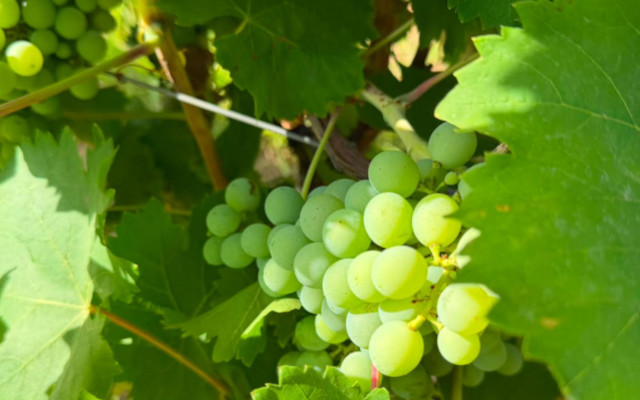
The Grillo is a Sicilian white grape variety born in Marsala in the nineteenth century from the spontaneous crossing of common Catarratto Bianco and Zibibbo, documented since 1873. It covers 8,579 hectares, 8.84% of the regional vineyard, and since 2020 it can only be indicated on the label of DOC Sicilia wines: maximum yield 14 tons per hectare, minimum alcohol content 11.50% vol.
Born to serve Marsala and becoming dry white only since the seventies, it is today the commercial core of the denomination. Molecular markers define its ancestors, the regulations consolidated in 2025 and the most recent market data measure the repositioning of the Sicilian supply chain, which leads Italy and Europe in organic production.
Vineyard areas and volumes of the DOC Sicilia denomination
Regional vineyard area and area claimed as DOC Sicilia are distinct quantities, in a ratio of about five to one. The Sicily counts 96,903 hectares of vineyards (2024), 14.2% of the national total, second after Veneto (103,504 hectares) which took the lead in 2020. The DOC Sicilia has seen the claimed area 20,595 hectares in 2024.
Table 1 — The Sicily vineyard and DOC Sicilia in numbers
| Indicator | Value | Year | Source |
| Regional vineyard area | 96,903 ha (2nd in Italy, 14.2%) | 2024 | IRVO on AGEA |
| Grillo vineyard area | 8,579 ha (8.84% of the Sicily vineyard) | 2021 | Regional Vineyard Inventory |
| Hectares claimed as DOC Sicilia | 20.595 | 2024 | DOC Sicilia Consortium |
| DOC Sicilia grape growers | 7.264 | 2024 | DOC Sicilia Consortium |
| DOC Sicilia bottlers | 500 | 2024 | DOC Sicilia Consortium |
| Hectoliters bottled DOC Sicilia | 614.825 | 2024 | DOC Sicilia Consortium |
| Bottles produced DOC Sicilia | 75.411.197 | 2025 | DOC Sicilia Consortium |
| Hectoliters certified DOC Sicilia | 701,094 (84.2% of the Sicilian DOP certified) | 2024 | IRVO, OdCC Wines |
| Regional production of wine and must | 2,774,000 hl (4th in Italy, 6%) | 2024 | IRVO on AGEA |
The Grillo occupies 8,579 hectares, 8.84% of the regional vineyard: the island's fourth grape variety after Catarratto bianco lucido (15,661 ha), Nero d'Avola (15,387 ha) and Catarratto bianco comune (13,190 ha).
Production is concentrated in the west, in the grape variety’s historical area: average 2020-2023 Trapani accounts for 42.2% of the regional wine production, Agrigento for 31.8% and Palermo for 11.6%, for a total of about 86% (IRVO, 2025).
The size of organic farming in regional viticulture
The Sicily counts 32,787 hectares of organic vineyard area, almost 25% of the Italian total, ahead of Tuscany (23,534 ha) and Puglia (20,515 ha). Compared to its own vineyard, the incidence is 34.2%, third after Marche (40.1%) and Tuscany (38.6%) (IRVO Observatory on SINAB data).
On organic wine certified under regulation (EU) 2018/848 the primacy is also clear in volume: 426,522 hectoliters in 2023, the 21.6% of the Italian total, ahead of Veneto (402,399 hl) and Tuscany (328,615 hl).
At the national level, the ISMEA-SINAB report ‘Bio in figures 2025' records 132,441 hectares of organic vineyards (-0.4% compared to 2023), of which 128,929 are wine grapes, with an incidence of 21% on the total vine area.
Table 2 — Sicilian organic farming in the national context
| Indicator | Sicily | Italy | Year |
| Organic vineyard area | 32,787 ha (1st, ~25%) | 132,441 ha | 2023 / 2024 |
| Organic incidence on regional vineyard | 34.2% (3rd) | 19,7% | 2023 |
| Organic wine production | 426,522 hl (1st, 21.6%) | 1,972,796 hl | 2023 |
| Organic wineries | 157 (4th by number) | — | 2020/21 |
First by volumes, Sicily ranks fourth in number of organic wineries — 157, after Tuscany (592), Veneto (236) and Piedmont (196): therefore, the regional organic sector passes through large capacity facilities, including cooperatives with many delivering members.
Export dynamics in the main foreign markets
National wine export closes 2025 at 7.78 billion euros, -3.7% compared to 2024, with 21 million hectoliters (-1.9%). The decline is almost entirely due to the US market: -9.2% to 1.76 billion, i.e., 178 million less, almost 60% of the overall deficit, due to tariffs and the dollar depreciation in the second half. EU markets hold (+0.5%, almost 3.2 billion), extra-EU falls by 6.4%.
I Sicilian still white DOP wines are among the few regional denominations growing: +2.4% in value in 2025 and +8.4% in the United States, in response to a drop of about 13% in US imports of Italian wine. The island's DOP reds lost 11% in the same period, dragged down by the American market (Nomisma Wine Monitor, 2026).
The divergence continues in first four months of 2026: Italian export of denomination wines declines by 6.2% in value — France −3.4%, Germany −5.5%, Spain −8.5% — while Sicilian whites grow by 2,8% and Tuscan by 3.3%; Veneto whites decline (−4% approx.) and Mosel Rieslings (−11%).
In 2024 Sicily was tenth Italian region by value of wine export, with 154.9 million euros and a share below 2%. The data underestimates reality: ISTAT records the shipping location, and some Sicilian wine leaves the country from ports of other regions.
Table 3 — Export of still white Sicilian DOP wines, main markets (2024)
| Country | Value (mln €) | Change vs 2023 | Volume (.000 hl) | Change vs 2023 |
| Germany | 19,0 | +12,2% | 57,2 | +21,0% |
| United States | 6,5 | +10,7% | 9,4 | +21,3% |
| United Kingdom | 3,0 | +37,1% | 9,6 | +47,2% |
| Japan | 2,1 | +9,5% | 4,4 | +8,1% |
| Netherlands | 1,9 | +3,3% | 6,1 | +2,3% |
The table concerns only still white DOP, where Germany is by far first. Nomisma instead indicates the United States as the first market for Sicilian white wines overall — followed by Germany, United Kingdom, Netherlands and Canada — an aggregate including IGT Terre Siciliane, almost half the regional bottled wines. For Grillo, which exists only as DOC since 2020, the relevant reference is the table.
There are no disaggregated export data by grape variety: Grillo does not appear as a customs item in either ISTAT or Nomisma series. The above values relate to the category that contains it.
In the last decade the export of Sicilian sparkling wines has grown by 227%, the most marked progression together with Apulia's, but starting from minimal volumes — and in a sector where Grillo is excluded by regulation from the traditional method.
The two lives of Grillo
A crossing born by chance
Grillo is not an ancient grape variety and is not the result of a selection. It was born in the districts of Marsala in the 19th century, at a time when English demand for musts had caused an explosion of vineyard surface in western Sicily, and vineyards were promiscuous: different varieties cultivated mixed, an ideal condition for casual pollination to generate something new.
Molecular markers have accurately established the relationship. The female parent is the Common white Catarratto, the male is Zibibbo — the direction is known because Catarratto and Grillo share the same chlorotype, and in vine the plastids are transmitted maternally (Sparacio et al., 2021).
The first documented attestation dates back to 1873, when Antonino Alagna Spanò listed it among the white grapes cultivated in the Marsalese area; the attribution to Baron Antonio Mendola, circulating for over a century, finds no evidence in either documentation or DNA.
A century inside the barrel
For a hundred years Grillo had a single use: to provide sugar and structure to Marsala. It is a destination that explains the variety better than any organoleptic description — in the comparative characterization conducted in Marsala, Grillo shows the highest sugar accumulation among the four cultivars examined, 25.8 degrees Brix. That was what was needed, and that was what it provided.
In the second half of the twentieth century it was the third Sicilian white after Catarratto and Inzolia, with 5.2% of the regional area: widespread, but invisible. No bottle bore its name.
1990: the name on the label
The turning point comes from Marsalese itself. In 1978 Marco De Bartoli he founded the winery in contrada Samperi and started the recovery of unfurnished Marsala; in 1990 bottles the first dry Grillo table wine. It is the commercial birth certificate of still white wine: from grapes delivered, Grillo becomes a wine with a declared identity. The subsequent growth is however driven more by regulatory decision than by fashion.
From 2020 the name ‘Grillo’ may appear only on DOC Sicilia labels, with yields 22% lower than those allowed by IGT. The grape variety thus exits the volume segment and drags the denomination along: today the 2026 campaign opened in western Sicily at the end of July, with the Consortium choosing — in line with other Italian denominations — not to release early quantitative estimates. Grillo, a mid-late variety, ripens in the following weeks.
Aromatic parameters and sugar concentration
A detail that rarely appears in technical sheets. In the comparative characterization conducted on an experimental vineyard in Marsala, Grillo results a non-aromatic variety despite the parentage of Zibibbo: the total glycosylated monoterpenes stop at 123.8 micrograms per kilo of grapes, compared to 7,033 of Zibibbo and 4,371 of Moscato Cerletti (Sparacio et al., 2021).
Grillo shows the highest value of the four samples for the 3-hydroxy-β-damascone, a norisoprenoid precursor linked to floral and ripe fruit notes, and it is the variety with the greatest sugar accumulation, 25.8 degrees Brix. This is why it was the grape of Marsala for a century: not for the aroma, but for the power. The same power which today, harvested earlier, translates into structure e sapidity in a dry white wine.
Production rules of the protection regulations
The current version of the DOC Sicilia regulation is the one consolidated with the MASAF decree of 24 July 2025, which approved the ordinary amendment proposed in Official Gazette No. 111 of 15 May 2025 and incorporated the framework of Regulation (EU) 2024/1143. The amendment applies from the 2025/2026 harvest campaign.
Ampelographic composition and blending proportions
To use the grape variety specification on the label the wine must come from vineyards composed of at least 85% from the corresponding grape variety; the remaining 15% may come from other varieties with similarly colored berries suitable in Sicily. The regulations also allow, in single-variety types, blending with musts or wines from grapes with similar berries in quantities not exceeding 15% (art. 5, paragraph 5). 'Pure Grillo' is therefore not subject to a regulatory requirement but a producer's choice.
Yields per hectare and minimum alcohol levels
Table 4 — Grillo DOC Sicilia: production limits by type (arts. 4 and 5)
| Type | Max grapes (t/ha) | Minimum natural alcohol content (% vol) | Grape to wine yield | Max wine (hl/ha) |
| Grillo, including reserve | 14 | 11,50 | 70% | 98 |
| Grillo sparkling | 14 | 10,50 | 70% | 98 |
| Grillo superiore | 10 | 12,00 | 70% | 70 |
| Grillo late harvest | 8 | 13,00 | 60% | 48 |
| Grillo passito | 8 | 14,00 | 50% | 40 |
In favorable years, production may exceed limits by up to 20%, provided grape-to-wine yield constraints are respected; beyond that, the right to the denomination ceases for the entire product. The Sicilian Region, at the Consortium's request, may reduce yields or allocate the surplus to vineyard reserve, which can be released in subsequent years. This is the mechanism that has allowed management of very irregular vintages in recent years.
Dry extract and analytical requirements at consumption
Table 5 — Minimum parameters at market release (art. 6)
| Type | Minimum total alcohol content | Minimum total acidity | Minimum non-reducing extract |
| Grillo | 11.50% vol | 4.5 g/l | 19.0 g/l |
| Grillo superiore | 12.00% vol | 4.5 g/l | 19.0 g/l |
| Grillo reserve | 12.50% vol | 4.5 g/l | 19.0 g/l |
| Grillo late harvest | 13.00% vol (of which 11.00% fermented) | 4.0 g/l | 22.0 g/l |
| Grillo passito | 14.00% vol (of which 11.00% fermented) | 4.0 g/l | 28.0 g/l |
| Grillo sparkling | 11.50% vol | 5.0 g/l | 15.0 g/l |
The profile described for basic Grillo is essential and precise: color straw yellow, more or less intense, aroma elegant and fine, taste from dry to semi-dry, harmonious, full, savory.
It should be noted that thenon-reducing extract minimum of 19 g/l is higher than that required for Catarratto and Inzolia (18 g/l) and the generic 'white' type (17 g/l): the regulations recognize Grillo, analytically, a upper structure.
Vineyard, cellar, packaging
- Allowed training systems for new plantings and replantings: trellis or bush vine, density not less than 3,200 vines per hectare. The pergola system is allowed only in the provinces of Agrigento and Caltanissetta and only for Nero d'Avola.
- All forcing practices are prohibited; only emergency irrigation is allowed.
- Vineyards can be designated for the DOC only from the third year from planting.
- Vinification, mandatory aging and bottling must take place in Sicily, except for individual authorizations for pre-existing rights.
- For the mention reserve aging starts from November 1 of the grape production year; topping up allowed within 5%.
- The sparkling wine is obtained by natural fermentation using the charmat or traditional method; the traditional method is however reserved for the White and Rosé types, not for the varietal specification.
- Containers in glass up to 3 liters (up to 18 for bordolese, borgognotta and renana); alternative containers from 2 to 6 liters allowed for basic Grillo but excluded for reserve, superior, late harvest, passito, vineyard and sparkling wine. Crown caps prohibited.
- The qualifications 'fine', 'selected', 'chosen', and similar are prohibited on the label; the vintage is mandatory, except for sparkling wines.
2026 news: Salemi, first additional geographical unit
The 2025 amendment introduces in article 7 the possibility to indicate on the label additional geographic units, municipal or supra-municipal, listed in a positive annex. The first and currently only name is Salemi, in the province of Trapani, whose registration came with the request to cancel the IGT Salemi. At the Consortium's request, the entry into force was postponed to the 2026/2027 campaign.
The transition is less technical than it seems.
DOC Sicilia was born as a regional denomination, with a production area coinciding with the entire administrative territory of the island: a very vast area, effective as an umbrella brand and by definition silent about the terroir. The UGAs are the tool with which the denomination begins to differentiate internally. For a grape variety like Grillo, which changes radically between the sandy coast of Marsala and the internal hills, it is the premise of future zoning.
The reserved use of the varietal mention in the DOC
Between 2016 and 2020, one of the most significant disputes in Italian wine law took place. The Consortium obtained the parallel modification of the two regulations: Grillo and Nero d’Avola reserved for the DOC Sicily, excluded from the IGT Terre Siciliane. Some producers challenged the decrees; the Ministry reinstated them with decrees no. 18388 and no. 18390 of March 27, 2020, in execution of the Council of State ordinance no. 996/2020 published on February 28, 2020, applicable since the 2020 harvest.
The basis of the decision is quantitative before being identity-based. For whites, the IGT Terre Siciliane allowed up to 18 tons of grapes per hectare; the DOC Sicilia allows 14, with a grape-to-wine yield of 70%. Transferring Grillo from IGT to DOC meant structurally cutting the productive potential per hectare.
The effect on volumes is documented. In 2017 DOC Sicilia certified 337,722 hectoliters; in 2018, 790,945. Sicilian production at DOP has gone from 16% approximately of the regional total in 2015 to 41% approximately in 2023, while IGT, after the 2017 drop, stabilized around 35-36% (IRVO, 2025). The 2024 packaging shows the current balance: IGT Terre Siciliane 836,607 hectoliters, DOC Sicilia 612,805, out of a total Sicilian DOP/IGP of 1,568,413 hectoliters.
The pairing profiles and sensory response
The grammar of pairing derives from analytical parameters: minimum acidity 4.5 g/l, extract 19 g/l, contained alcohol. A white with a structure that does not depend on alcohol content and works through saline contrast rather than aromaticity. The most frequent pairings:
- Sicilian seafood cuisine. Swordfish with Pachino tomatoes IGP, capers and olives, pasta with sardines and fennel, couscous Trapani style: preparations where salt and acid are already on the table. Grillo accompanies them instead of fighting them;
- raw and crustaceans. On the red shrimp of Mazara del Vallo and fish tartare, Grillo plays subtractively: not being aromatic it does not overwrite the iodized sweetness of the raw, and the extract — the non-volatile matter perceived as weight in the mouth — gives it the density to match the flesh of the crustacean;
- fresh cheeses and vegetables. Ricotta (preferably Sicilian), primosale, caponata, white parmigiana: Grillo's acidity cleans the greasy film and prepares the next bite, while its sapidity interacts with the lactic note instead of overpowering it;
- superior and reserve. One degree more and yields one-third lower produce wines with greater density: baked tuna or amberjack, maccu di fave, caciocavallo young ragusano or provola from Nebrodi PDO;
- late harvest and passito. With 22 and 28 g/l of extract, they leave the fish register and enter that of blue cheeses and Sicilian dry pastries.
Selection criteria for consumers and industry operators
For enthusiasts
The mention ‘Grillo’ on the label is today, in itself, a guarantee of origin: since 2020 it can only appear on DOC Sicilia wines, therefore on products subject to yields and parameters of table 4. There is no Grillo IGT.
On the other hand, the following must be read carefully Type. ‘Superiore’ is not a commercial adjective but a mention with reduced yields of 29% (10 t/ha versus 14) and a higher minimum alcohol content. ‘Riserva’ involves aging starting from November 1st. Thevintage is mandatory and, for the basic Grillo, it is advisable to stay within two or three harvests. Finally, pay attention to the format: if a Grillo is in a 3 or 5 liter bag-in-box, it is by definition the basic type, because the regulations exclude alternative containers for superiore, riserva, late harvest, passito, and sparkling.
For restaurateurs, sommeliers, and buyers
The positioning of Grillo faces a structural problem that is also an opportunity. According to ISMEA estimates (average of the last five campaigns, sector sheet April 2023) Sicily is second to last among Italian regions for average revenue per hectare of wine grapes, with 3,826 euros total and 4,397 euros for PDO grapes, against a much higher national average. The differential compared to common grapes (2,893 euros per hectare) is modest, whereas in other areas the leap to denomination is worth much more, up to 21,463 euros per hectare in Bolzano. The quality-price ratio is thus excellent for buyers and insufficient for producers.
For the wine list this means competitive margins on an indigenous white with a strong narrative and low internal competition. In terms of assortment, the discriminating choice is between the basic Grillo in large-scale distribution and areal versions — preferably organic — with Salemi becoming, from the 2026/2027 campaign, the first claimable geographical reference.
The advantages of organic farming production
In line with GIFT's editorial policy, the recommendation is to prioritize productions organic certified pursuant to regulation (EU) 2018/848. In Sicily, availability is not an obstacle: with 32,787 hectares the region is the leading organic wine-growing area in Italy and the first in terms of volume of organic wine produced.
The ban on herbicides and synthetic pesticides favors spontaneous vegetation cover between the rows, soil microbial biodiversity, and the survival of pollinating insects and natural antagonists of pests. In a warm and windy Mediterranean context, with low fungal pressure — as also reported for the 2026 campaign — the agronomic cost of conversion is lower compared to other Italian areas.
Grillo, moreover, is a variety known for its tolerance to fungal diseases and vegetative vigor: characteristics that make it technically more suitable for organic management than other international grape varieties grown on the island.
Summary of the identity and economic value of Grillo
The evolution of Grillo shows how the enhancement of a native grape variety goes through the protection of the denomination. Reduced yields, exclusivity with respect to the IGT, and the arrival of additional geographical units are stages of the same process; the average revenue per hectare, among the lowest in Italy, indicates that it is not yet complete.
Whether zoning and conversion to organic will translate into greater value recognized for winegrowers is an open question, which will be measured in the coming campaigns. For the consumer and for the Ho.Re.Ca. sector, there remains a verifiable fact: Grillo DOC Sicily organic certification offers documented guarantees of origin, yield and method of production.
Dario Dongo
Credit cover Michele Frasca, Modica (Ragusa)
References
Regulatory sources
Decree of the Ministry of Agriculture, Food Sovereignty and Forestry July 24, 2025. Approval of an ordinary amendment to the production regulation of the controlled designation of origin wines «Sicilia» (25A04301). Official Gazette of the Italian Republic, General Series, no. 181 of August 6, 2025. https://www.masaf.gov.it/flex/cm/pages/ServeAttachment.php/L/IT/D/1%252F3%252F6%252FD.8cc610ca3ea76f07a94c/P/BLOB%3AID%3D22762/E/pdf?mode=download
Decrees of the Ministry of Agricultural, Food and Forestry Policies no. 18388 and no. 18390 of March 27, 2020, executing the precautionary order of the Council of State, Section III, no. 996/2020 of February 28, 2020. In Federvini, The production regulation of Doc Sicilia wines and that of Igt Terre Siciliane wines changes. https://www.federvini.it/normative/cambia-il-disciplinare-di-produzione-dei-vini-doc-sicilia-e-quella-dei-vini-igt-terre-siciliane
Regulation (EU) 2018/848 of the European Parliament and of the Council of 30 May 2018 on organic production and labelling of organic products and repealing Council Regulation (EC) No 834/2007. Consolidated text: 25/03/2025 http://data.europa.eu/eli/reg/2018/848/2025-03-25
Regulation (EU) 2024/1143 of the European Parliament and of the Council of 11 April 2024 on geographical indications for wine, spirit drinks and agricultural products, as well as traditional specialities guaranteed and optional quality terms for agricultural products. Consolidated text: 18/03/2026 http://data.europa.eu/eli/reg/2024/1143/2026-03-18
Official data and statistics
Consortium for the Protection of DOC Sicily Wines. (2026). The strength of DOC Sicily — statistical data 2024/2025. https://siciliadoc.wine/
Consortium for the Protection of DOC Sicily Wines. (2021). Consolidated production regulations of the PDO wines «Sicily». https://siciliadoc.wine/wp-content/uploads/2021/12/Sicilia_DOC___disciplinare_di_produzione_consolidato.pdf
ISMEA. (2023). Italy of wine. Sector sheet [data on average revenue per hectare of wine grapes, average of the last five campaigns].
ISMEA. (2025). Bio in figures 2025. SINAB — National Information System on Organic Farming. https://sinab.it/bionovita/bio-in-cifre-2025-il-rapporto-completo/
Regional Institute of Wine and Oil, Regional Viticulture and Olive Oil Observatory. (2025). Sicilian viticulture. Sicilian Region. https://www.irvos.it/wp-content/uploads/2021/02/Vitivinicoltura-regionale-APRILE-2025.pdf
Italian Wine Union, Observatory. (2026). Italian wine export decline in 2025. https://www.unioneitalianavini.it/approfondimenti-tematici/news/export-vino-italiano-in-calo-nel-2025-pesa-il-rallentamento-delleconomia-globale
Scientific literature
Alfonzo, A., Francesca, N., Prestianni, R., Settanni, L., & Moschetti, G. (2020). Use of grape racemes from Grillo cultivar to increase the acidity level of sparkling base wines produced with different Saccharomyces cerevisiae strains. Yeast, 37(9-10), 475-486. https://doi.org/10.1002/yea.3505
De Lorenzis, G., Mercati, F., Bergamini, C., Cardone, M. F., Lupini, A., Mauceri, A., Caputo, A. R., Abbate, L., Barbagallo, M. G., Antonacci, D., Sunseri, F., & Brancadoro, L. (2019). SNP genotyping elucidates the genetic diversity of Magna Graecia grapevine germplasm and its historical origin and dissemination. BMC Plant Biology, 19, 7. https://doi.org/10.1186/s12870-018-1576-y
D’Onofrio, C., Tumino, G., Gardiman, M., Crespan, M., Bignami, C., de Palma, L., Barbagallo, M. G., Muganu, M., Morcia, C., Novello, V., Schneider, A., & Terzi, V. (2021). Parentage atlas of Italian grapevine varieties as inferred from SNP genotyping. Frontiers in Plant Science, 11, 605934. https://doi.org/10.3389/fpls.2020.605934
Mercati, F., De Lorenzis, G., Mauceri, A., Zerbo, M., Brancadoro, L., D’Onofrio, C., Morcia, C., Barbagallo, M. G., Bignami, C., Gardiman, M., De Palma, L., Ruffa, P., Novello, V., Crespan, M., & Sunseri, F. (2021). Dissemination routes and new genetic insights into the Eurasian grapevine germplasm through integrated Bayesian approaches. Frontiers in Plant Science. https://doi.org/10.3389/fpls.2021.692661
Sparacio, A., Mercati, F., Sciara, F., Pisciotta, A., Capraro, F., Sparla, S., Abbate, L., Mauceri, A., Planeta, D., Corona, O., Crespan, M., Sunseri, F., & Barbagallo, M. G. (2021). Moscato Cerletti, a rediscovered aromatic cultivar with oenological potential in warm and dry areas. OENO One. https://oeno-one.eu/article/view/4605
Historical and ampelographic sources
Alagna Spanò, A. (1873). La vite ed il vino in Marsala. Journal of Agriculture Industry and Commerce of the Kingdom of Italy, year 10, series III, 20(22), 232-233.
Cipriani, G., Spadotto, A., Jurman, I., Di Gaspero, G., Crespan, M., Meneghetti, S., Frare, E., Vignani, R., Cresti, M., Morgante, M., Pezzotti, M., Pè, E., Policriti, A., & Testolin, R. (2010). The SSR-based molecular profile of 1005 grapevine (Vitis vinifera L.) accessions uncovers new synonymy and parentages. Theoretical and Applied Genetics, 121(8), 1569-1585. https://doi.org/10.1007/s00122-010-1411-9
Di Vecchi Staraz, M., Bandinelli, R., Boselli, M., This, P., Boursiquot, J. M., Laucou, V., Lacombe, T., & Vares, D. (2007). Genetic structuring and parentage analysis for evolutionary studies in grapevine. Journal of the American Society for Horticultural Science, 132(4), 514-524. https://doi.org/10.21273/JASHS.132.4.514
Lacombe, T., Boursiquot, J. M., Laucou, V., Di Vecchi-Staraz, M., Peros, J. P., & This, P. (2013). Large-scale parentage analysis in an extended set of grapevine cultivars (Vitis vinifera L.). Theoretical and Applied Genetics, 126, 401-414. https://doi.org/10.1007/s00122-012-1988-2
Industry sources
Assovini Sicily. (2026, July 29). Start of the 2026 harvest in Sicily: a journey of about one hundred days. https://www.assovinisicilia.it/inizia-la-vendemmia-2026-in-sicilia-un-viaggio-lungo-circa-cento-giorni/
Nomisma. (2026, April 22). Wine Monitor: what evolutionary scenarios for Sicilian wine? https://www.nomisma.it/news/wine-monitor-scenari-evolutivi-per-il-vino-siciliano-unicredit/
Nomisma Wine Monitor & UniCredit. (2026). 4th Report on the competitiveness of Wine Regions [presented at Vinitaly, Verona, April 14, 2026].
UniCredit. (2026, April 14). UniCredit-Nomisma Wine Monitor: wine tourism as a strategic lever for the resilience and development of the national wine sector [Press release]. https://www.unicreditgroup.eu/it/press-media/press-releases/2026/april/unicredit-nomisma-wine-monitor–enoturismo-leva-strategica-per-l.html
Vineyards, Wines & Quality. (2026, July 29). European DOP wine exports fall in the first four months, Italy −6.2%. https://vigneviniequalita.edagricole.it/mercato/cala-export-vini-dop-europei-nel-i-quadrimestre-italia-62/

Dario Dongo, lawyer and journalist, PhD in international food law, founder of WIISE (FARE - GIFT – Food Times) and Égalité.


