
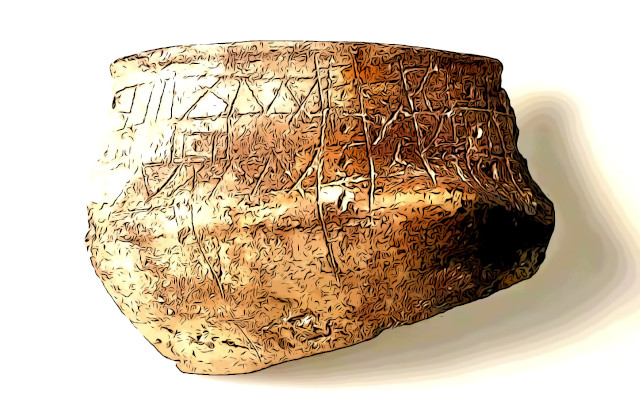
The oldest traces of wine consumption in Italy date back to the Bronze Age, 3500 years ago. They emerged for the first time thanks to archaeological excavations conducted in Bondeno, Ferrara, by the Department of Cultural Heritage of the University of Padua.
The discovery is described in a study published in November 2020 in the Journal of Archaeological Science, scientific journal covering ‘the development and application of scientific techniques and methodologies to all areas of archaeology’. (1)
Wine consumption in the Bronze Age
The archaeological site of Pilastri di Bondeno dates back to the Terramare culture, in the Po plain. In an archaeobotanical context where researchers, coordinated by Prof. Massimo Vidale, consider that the Vitis vinifera L. was already known and used in the Middle Bronze Age.
The Terramare are the ancient villages established in the mid-2nd millennium BC, in Emilia and the low Po plain areas (current provinces of Cremona, Mantua and Verona). Around some remains emerged in the hill of Montale a Park has been created that reproduces the setting, ‘visitable’ even remotely, in this historical period.
Tartaric acid in ancient bowls
The evidence of the consumption of Wine or other grape derivatives (such as vinegar or must) 3500 years ago is suggested by the analysis of organic residues on ceramics recovered both in the aforementioned site of Pilastri di Bondeno (Ferrara) and in that of Canale Anfora (Aquileia, Udine).
The analyses carried out by Alessandra Pecci of the University of Barcelona indeed reveal the presence of tartaric acid and others bio-markers of wine in over one third of the fragments recovered from various ceramic vessels. More precisely in 20 of the 31 samples analyzed among glasses, bowls (like the one on the cover), coarse pots, and presumed storage containers (15th-14th century BC).
Traces of sulfur and resin
The researchers explain that in some cases the organic residues also contain traces of sulfur and pine resin. It is hypothesized that sulfur was added to the beverage for anti-fermentation purposes, that is, used to sterilize the containers.
The traces of resin of pine could instead indicate a technique for waterproofing the inner walls of the vessels.
Wine consumption in the Mediterranean
In the other site archaeological subject of the study, Canale Anfora, the local stratigraphy had already brought to light macro-remains of Vitis vinifera L. A further clue, according to the researchers, that derivatives of grape juice (including wine and/or vinegar) were probably consumed at the sites. ‘Combined with botanical evidence, these results contribute to our understanding of the emergence of wine consumption in the western Mediterranean‘.
Notes
(1) Alessandra Pecci, Elisabetta Borgna, Simona Mileto, Elisa Dalla Longa, Giovanna Bosi, Assunta Florenzano, Anna Maria Mercuri, Susi Corazza, Marco Marchesini, Massimo Vidale, Wine consumption in Bronze Age Italy: combining organic residue analysis, botanical data and ceramic variability. Journal of Archaeological Science. Volume 123, November 2020, 105256. doi: https://doi.org/10.1016/j.jas.2020.105256

Professional journalist since January 1995, she has worked for newspapers (Il Messaggero, Paese Sera, La Stampa) and magazines (NumeroUno, Il Salvagente). Author of investigative reports on food, she published the book 'Reading labels to know what we eat.'


