
There are many differences among mozzarella cheeses on the market. Using language understandable only (and not always) to industry experts, the labels 'hide' technically relevant aspects regarding the quality of the final product. In many cases, moreover, they are also unsuitable for vegetarians. Our market survey provides an overview of the offer and a reasoned guide to conscious purchasing.
Market survey. Prices distorted by Everli
Overall we examined 25 mozzarellas, 3 of which were sliced and 2 organic. Sampling was conducted in November 2020 on the sites of ecommerce food retailers Everli and EasyCoop, as well as in some stores to locate unavailable references online. Includes a random selection of the most common products in supermarkets and in discount.
Before delving into the market survey results it is necessary to warn shoppers online regarding the persistence of illegal practices on the platform of ecommerce food Everli (formerly 'Supermercato24'). Consumer information required by EU regulation 1169/11 (article 14) is missing, but also prices per unit (1 kg) of product are falsified, which is instead required by the Consumer Code (legislative decree 206/05). The case will be further investigated and reported to the Antitrust Authority, which has already received two reports about this operator.
Mozzarellas, the comparison parameters
The comparison evaluates the elements that every attentive consumer can independently verify on the labels of prepackaged mozzarellas:
– price,
– origin of the milk,
– production method,
– addition of preservatives.
Price
In food shopping the price should be given careful consideration. Below-cost offers or ‘unbeatable’ prices are often a sign of unfair commercial practices by the distributor towards the producer, but also of the use of lower-quality ingredients and technologies. A compromise that obviously also affects the quality of the food.
For the mozzarellas under examination, the price ranges from 4.20 to 13.95 euros/kg. A very wide gap, where ‘first price’ mozzarellas – from discount and pre-sliced, always from foreign raw materials (milk or frozen curds?) – cost one third of the higher quality ones. A great variability also characterizes supposedly equivalent mozzarellas.
Milk origin, a serious offense
The origin of the milk is foreign in 8 cases. In those already sliced (Carrefour, Consilia, Gran Casale) and in another 5 mozzarellas (Carrefour classic, Land of Eurospin, Alival, Prealpi, Milbona). To verify the provenance of the milk, it is sufficient to carefully read the label. This information has in fact been mandatory since 2017, even if allowed in very approximate terms (e.g., ‘EU’ or ‘non-EU’). Those who use Italian milk usually make this widely known.
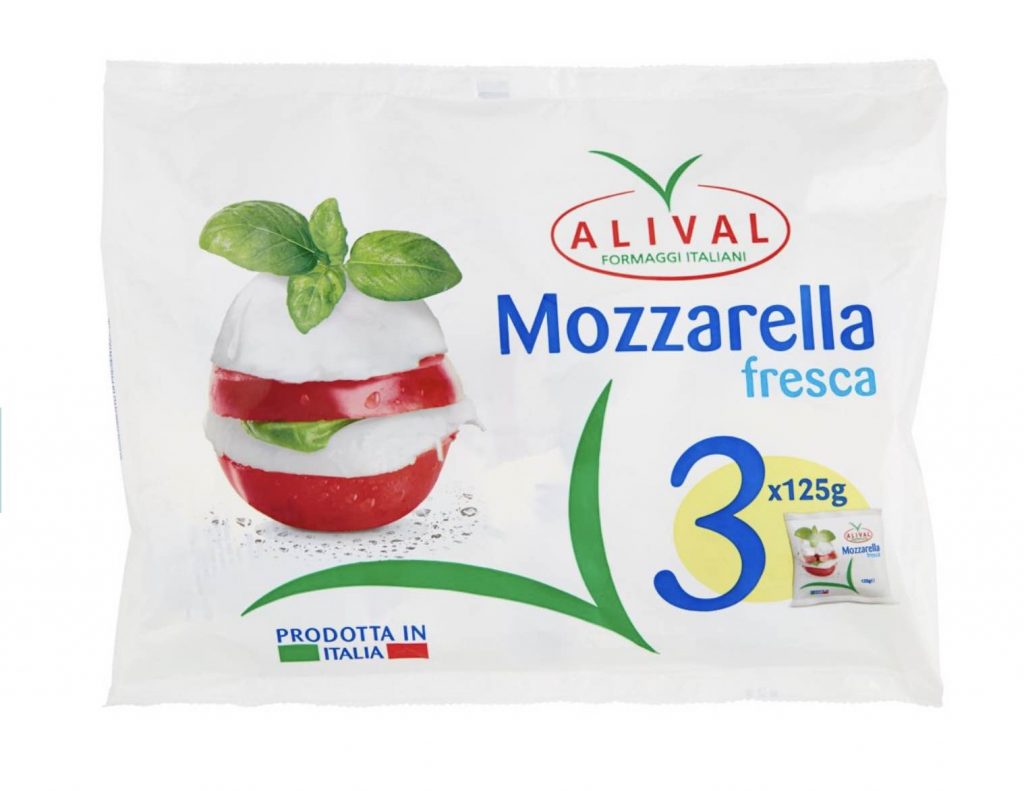
The wording ‘Product in Italy’, note well, does not in itself mean that the ingredients are Italian, but only that the last substantial transformation took place in Italy (see previous article). And a serious offense is committed by ‘Alival Italian Cheeses’, which boasts emphatically on the label the indication ‘Produced in Italy’. With the addition of a tricolor composed of images of basil, mozzarella and tomato. Without reporting in the same visual field – as prescribed by EU regulation 2018/775 – the notice of the ‘EU’ origin of the milk (or frozen curd), which is reserved for the back of the package.
Production method
In the production of mozzarella, the curd is obtained according to different methods, as we have seen.
The whey starter (or milk starter) is the traditional method. This practice – common in buffalo mozzarella – is adopted, in the examined sample, only for mozzarella ‘Taste of the old days‘ from Granarolo. Among other things, it is distinguished by the use of Italian A2 milk (which contains only the A2 variant of beta-casein), to which scientific literature attributes some health benefits.
E330, rapid coagulation to save time
Citric acid (E330) is added in milk processing to speed up coagulation times, saving a lot of time. A 'technological shortcut' to natural fermentation which, however – by blocking the conversion of lactose into lactic acid – contributes to reducing the digestibility of the food.
The additive E330 is used as an 'acidifying additive' in 10 of the 25 products examined.
Mozzarellas unsuitable for vegetarians
Rennet (or rennet) is another traditional ingredient in the production of mozzarella and cheeses in general. Added to milk, it activates enzymatic processes that allow curd formation.
In the absence of different specifications (vegetable or microbial rennet), this ingredient is of animal origin. It is indeed obtained from the stomach cells of young ruminants, due to the high levels of chymosin (the enzyme responsible for digesting mother's milk). The vegetarian diet is therefore incompatible with the consumption of most mozzarella on the market.
Alternatives to animal rennet
The alternatives to animal rennet compatible with a vegetarian diet exist and are quite widespread. The substitute veg most popular is microbial rennet, often combined with lactic ferments and organic acids (citric acid or lactic acid).
In the 25 mozzarellas examined, the situation is as follows:
– 11 contain animal rennet, 'enhanced' by the addition of lactic ferments,
– 4 contain animal rennet and additive E330: Bianca Bontà, Brimi, Prealpi (the only one to add a preservative) and the sliced Gran Casale (which also includes lactic ferments),
– 5 contain microbial rennet. In 3 cases the additive E330 is also used (Milbona, Granarolo Alta Qualità, Carrefour Classic). In the remaining 2, additional lactic ferments are used: this is the case of two sliced mozzarellas made with German and EU milk (Carrefour Mozzarella slices, Consilia saper scegliere fette perfette).
– 3 use exclusively the additive E330 (Galbani Santa Lucia, Alival, Invernizzi Mozarì)
– 1 uses exclusively lactic ferments (Vallelata)
– 1 uses the starter culture (the already mentioned ‘Taste of the old days‘ of Granarolo).
The nutritional profiles of the mozzarellas
The nutritional profiles of the 25 examined mozzarellas vary substantially. The values per 100 grams of product are as follows:
– energy (kcal), from 214 to 319 kCal,
– fats, from 15.8 to 24 grams,
– saturated fats, from 10 to 16 g,
– carbohydrates from 0.4 to 2.7 g,
– of which sugars from 0 to 1.60 g,
– proteins from 15.2 to 25 g/100g.
Salt deserves a note. The sample ranges from a minimum of 0.40 to 1.50 g/100g. The highest recorded value occupies a good part of the recommended maximum daily threshold, which amounts to
– 5 grams/day, with the goal of halving it, according to WHO and the Healthy Eating Guidelines of CraNut,
– 6 grams/day, according to the milder measure (Reference Intakes, RI) defined in EU Regulation 1169/11.
In this table all the detailed data relating to the 25 examined mozzarellas are displayed.

Professional journalist since January 1995, she has worked for newspapers (Il Messaggero, Paese Sera, La Stampa) and magazines (NumeroUno, Il Salvagente). Author of investigative reports on food, she published the book 'Reading labels to know what we eat'.


