

The Directorate-General for Agriculture and Rural Development of the European Commission (DG Agri) has rejected the wording 'natural wine', deducing its hypothetical misleading nature. A Pyrrhic victory for the lobbyists of the large wine industries, since the natural wine market continues its unstoppable growth, also in Italy, regardless of the use of this or similar wording.
It will therefore not be a name, on the label and in advertising, to testify the efforts of operators who cultivate vineyards without agrochemicals and produce wine without coadjuvants and chemical additives. Instead, it will be the blockchain, the QR-code and the apps – that is collective trademarks associated with specific regulations – to communicate and express the values of wines produced according to nature. As consumers increasingly demand.
Wine, the lobby of silence and pesticides
The CEEV (Comité Européen des Entreprises Vins) is the lobby European association of wine producers. And it is one of the most powerful, as demonstrated by the shame of the unjustified exemption of alcoholic beverages from the obligation to indicate ingredients and nutritional values on the label. To the point that it is still admitted today that major producing countries like France and Germany continue to conceal the legalized adulteration of must with sugar (so-called chaptalization). And it is precisely CEEV that advocates silence on the composition of alcoholic beverages, as well as various tricks such as 'wood in wine' on bottles with Protected Geographical Indication (PGI).
The lobby of wine has always sided with COPA-COGECA – the European confederation of agricultural confederations, dominated by Coldiretti – which on 20.10.20 sank the ecological transition project of the CAP (Common Agricultural Policy). And it is closely linked to the Big 4, the global monopolists of pesticides who find their biggest market in conventional vineyards. It is no coincidence that in the Prosecco-shire, as has been seen, the use of agrotoxins represents 625% compared to the European average. And this explains the relentlessness against natural wine.
Natural wine, Brussels at the service of lobbyists
The big industries – those who command every representative organization, with the power of membership fees – have decided to counter the extraordinary market phenomenon of natural wines, incompatible with the financial logics on which their businesses are based. CEEV therefore submitted a ‘question’ to DG Agri on 15.4.20, aimed at challenging the use of the term ‘natural’ as well as terms like ‘vin nature’, ‘vin méthode nature’ in labeling and presentation of some Bacchus nectars.
The European Commission has followed the requests of the lobbyists, in its letter dated 7.9.20 in response to CEEV. (1) The Brussels institution thus stated that the adjective ‘natural’ could be able to create in the consumer the expectation of a superior quality product and ‘healthier’ than ‘common’ wine, suggesting substantial differences in its composition and nature.
Instrumental arguments
The DG Agri has entrusted its assessments to a restrictive interpretation of the applicable European regulations. With arguments instrumental to the thesis proposed by CEEV:
– the category ‘natural wine’ is not contemplated among the categories of wine products referred to in Annex VII, Part II, of Reg. EU 1308/2013 (so-called single CMO). Although no independent winemaker, as far as is known, has requested the amendment of the regulation on the Common Market Organization,
– ‘Wine is the product obtained exclusively from the total or partial alcoholic fermentation of fresh grapes, crushed or not, or grape musts’. (2) It is therefore legitimate to use the denomination ‘wine’ for products known as natural wines,
– ‘authorized oenological practices are employed only to allow good winemaking, good preservation or proper aging of the products’. (3) Needless to say, it is worth adding. Although, as is evident, such a broad definition of the purposes of using authorized technological aids and food additives leaves free rein to the imagination of the most daring winemakers.
Are all wines the same?
The bureaucrats of Brussels therefore deduce that ‘all authorized practices in the EU are such as to preserve the natural and essential characteristics of wine and do not cause a substantial change in the composition of the product’. As if the use of substances derived from allergenic ingredients (e.g., milk, eggs) – not yet listed on most labels – did not affect the composition of the product (and the safety of its consumption by allergic consumers). Or if the amounts of sulfur dioxide and sulfites were indifferent, not to mention other substances such as synthetic tartaric acid.
The height is the statement that any product could be marketed as ‘natural wine’, provided the designation of ‘wine’, ‘regardless of the authorized oenological practices used in its production and whether oenological practices were used.' This, we add, would be misleading information. Where organizations exist, such as VinNatur, which have defined very strict disciplinary rules and analytical criteria.
Information for the consumer
The DG Agri officials then ventured into a topic beyond their expertise, the Food Information Regulation (FIR). For a sterile reference to the general criteria of transparency and non-deceptiveness of consumer information regarding food products, defined in Article 36 of Regulation (EU) 1169/11.
The use of the term ‘natural’ associated with a wine would in itself be suitable, for the lobbyists’ lackeys, to deceive the consumer and ‘interfere with their rights to objective information’. But this is a discussion about angels' sex, as the clarity and transparency of consumer information must instead be evaluated case by case. And one cannot doubt the correctness of those who show (and can prove) objective rigor, for example, in excluding chemical weed control and other agrotoxins from vineyards and certain winemaking practices.
Legal implications
‘This opinion is provided based on the facts presented in your letter [from CEEV, ed.] dated April 15, 2020, expresses the viewpoint of the Commission’s services and does not bind the European Commission.’ DG Agri does not even dare to share its theses with other Directorates-General such as Sante, Grow, and Competition. And it duly reminds that the only official interpretation of EU law is that provided by the Court of Justice of the European Union.
The winemakers who intend to designate their wines and their production methods as ‘natural’ must only precisely specify the meaning of such terms. Providing clear communication to consumers, as established by Regulation (EU) 1169/11. It is precisely on these bases that the French authorities have already recognized the legitimacy of the use of the term vin naturel. These products are appreciated, among other things, also because they are metabolized better than conventional wines. And this is the only information that cannot be displayed on the label, although supported in a recent scientific study.
Dario Dongo and Silvia Giordanengo
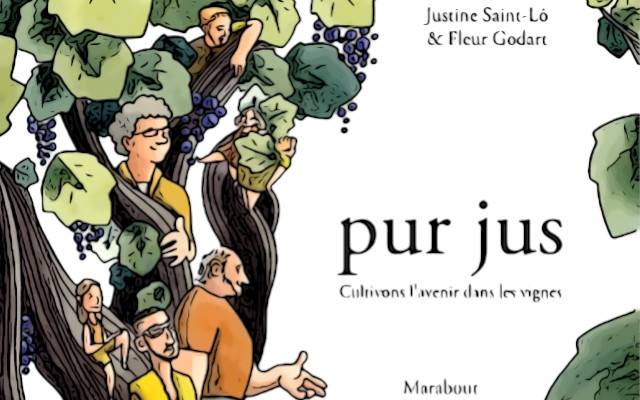
Cover image: Pur Jus. Cultivating the future in the vineyards, by Justine Saint-Lô and Fleur Godart, Marabout, 2016, 221 p., 22 €. ISBN: 9782501116671
Notes
(1) European Commission, DG Agri. Letter 7.10.20 to CEEV, document AGRI.DDG3.G.2/EM/RR(2020) 2580198, on https://news.unioneitalianavini.it/wp-content/uploads/sites/6/2020/09/reply_to_ceev_on_the_labelling_indication_natural_wine_20200907.pdf
(2) EU Reg. 1308/2013, Annex VII (Definitions, designations and sales denominations of products referred to in Article 78), Part II (Categories of wine products), point 1
(3) EU Reg. 1308/13, article 80 (Oenological practices and methods of analysis), paragraph 102

Dario Dongo, lawyer and journalist, PhD in international food law, founder of WIISE (FARE - GIFT – Food Times) and Égalité.

Civil lawyer, master's in Food, Law and Finance.


