
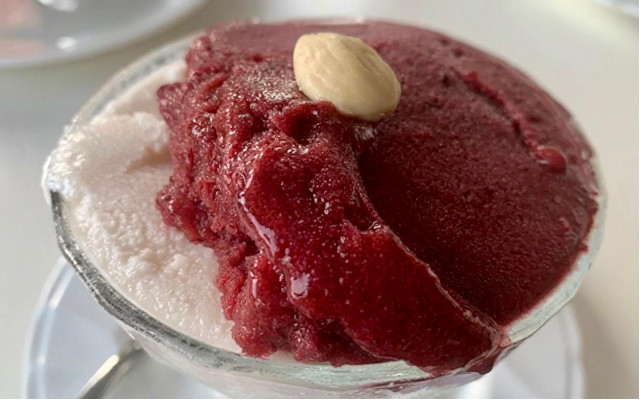
The granita it is a frozen dessert of water, sugar and fruit, coffee or almond, frozen on the go until fine, uniform crystals form. In Sicily it accompanies breakfast with brioche, in the rest of Italy it is served at the bar as a summer refreshment, while in Rome it has its own interpreter, the gratichecca, obtained by scratching a block of ice.
On the production level, two models coexist. Some Italian gelato shops and bars still prepare granita with fresh raw materials in dedicated churning machines; national and global distribution, on the other hand, is due to syrups and industrial preparations, processed in public establishments with granita machines, refrigerated machines with transparent tanks largely designed and built in Italy.
The framework presented here combines market data, historical sources, regional uses, technologies, ready-made products and recipes from gastronomic literature.
The reference market, gelato and frozen beverage machines
Official statistics do not isolate granita which is included, together with sorbets, in entry 2105 of the Combined Nomenclature, 'Ice cream and other frozen food products, whether or not containing cocoa' (EEC regulation 2658/87, Annex I). According to Eurostat, in 2025 the Italy produced 549 million litres of gelato, +10% on 2024, second in the European Union after Germany (608 million) out of a total of 3.44 billion litres, and is the second exporter to third countries with 55.2 thousand tonnes, 19% of the total, preceded by France with 59.1 million kg, equal to 20% (Eurostat, 2026). THE'export detected by ISTAT for the 'ice cream production' activity (ATECO 10.52) reached the provisional value of €468 million, +18.8%, with 70.4% directed to Europe (MAECI, 2026).
Alongside ingredients, the importance of technology of equipment. Research firms estimate the global market of dispensers for frozen drinks, including slush machines, around the $2 billion in 2025, with a compound annual growth rate (CAGR) of 6-6.7% in the coming years (Fortune Business Insights, 2026; Global Market Insights, 2026; The Business Research Company, 2026). Among the global players, the same analyses mention the Italians Carpigiani, Elmeco, SPM Drink Systems, Ugolini and Cofrimell (Global Market Insights, n.d.). The Italian supply chain of machines and ingredients thus also supports the artisanal gelato, offered by over 39,000 retail points including gelato shops, pastry shops, bars and restaurants (SIGEP World, 2025).
From mountain snow to Sicilian wells
The original raw material was the snow of the Sicilian mountains, collected in winter and stored in the snow-ice maker. In Palermo, the diaries of Filippo Paruta and Nicolò Palmerino date the beginning of a new habit to 1557: 'in the year 1557 they began to use drinking refreshed with snow'. The snow was cut into blocks of approximately one cantaro (79.3 kg), wrapped in straw and hemp nets, and carried on the back of a mule to the ports of Campofelice di Roccella and Termini Imerese (Scaduto, 2013).
The cards of the Traditional Agri-food Products (PATs) of the Sicily document three granitas: of black mulberries, of lemon and of almond (Sicilian Region, 2024):
- the card of the mulberry granita black mulberries, widespread especially in the Messina area, recalls the ancient method: the snow was mixed with juice in a tub turned by hand, immersed in a small pit with coarse salt, while today ice-cream makers are used;
- that of the granita of lemon indicates Racalmuto, in the province of Agrigento, with lemons harvested in the districts of Raffo, Saraceno, Garamoli and Roccarossa: the granita is processed in the machine, stored in steel containers at -12/-14 °C and also sold to take away in expanded polystyrene containers;
- for the granita of almond from eastern Sicily the sheet describes peeled almonds, some bitter, crushed in a mortar with sugar, sieved and combined with water before freezing.
Granita in Italian gastronomy
In gastronomic literature, granita first appears in an indirect form. Pilgrim Artusi he does not dedicate an independent recipe to it, but in Science in the kitchen and the art of eating well (1891) he suggests for the great summer heat the 'Frozen coffee-milk' (recipe no. 775), 'a coffee with condensed milk as a granita': a liter of milk, half a liter of coffee and 300 grams of sugar, passed into an ice cream maker and served in cups or glasses. His 'Roman punch' (n. 770), orange and lemon ice lightened with meringue and rum, was instead served at large lunches before the roast, to aid digestion (Artusi, 1891-1911).
The Silver Spoon offers the coffee granita with a dollop of whipped cream, as an afternoon interlude or dessert at the end of dinner, the lemon granita with fresh mint leaves and the strawberry granita, to also be enjoyed with whipped cream (Cucchiaio d'Argento, s.d.-b; s.d.-c; s.d.-d). The variations they range from tomato granita, spicy with Tabasco and flavored with mint, to Barolo Chinato granita served with a caramel and dark chocolate sauce (Cucchiaio d'Argento, n.d.-a; n.d.-e).
Gambero Rosso reports three classic granitas of the Sicilian tradition: with coffee, with sugar dissolved in hot espresso, frozen in cubes then chopped for a long time and completed with a dollop of sugar-free whipped cream; almond, from almond paste blended with water; with lemon (Gambero Rosso, 2023b). Chef Viviana Lapertosa offers a signature version, an aniseed almond milk granita with espresso coffee jelly and almond crunch (Gambero Rosso, s.d.-f).
Ingredients and artisanal preparation
The basic recipe includes water, sugar and the characterizing ingredient: citrus juice, fruit pulp, espresso or almond milk. Sicilian supply chains offer valuable raw materials such as Etna Lemon PGI, the Red Orange of Sicily PGI, the Avola almond, i Pistachios from Bronte PDO and i Pistachios from Raffadali PDO. In the artisanal preparation, the mixture is cooled and mixed continuously in the batch freezer, so the ice crystals remain small and the consistency creamy, without the air incorporated into the sorbet.
Syrups, preparations and granita bases Made in Italy
The industrial production linked to granita has developed especially upstream of the glass, with syrups and preparations that bars, kiosks and gelato shops transform on site. Fabbri 1905, a family business active since 1905, offers, among other things, Granitina, to be dosed at 100 grams per liter of water: with a single bowl slush machine it allows you to serve all flavours, flavoring in the glass with syrups (Fabbri 1905, s.d.-a; Fabbri 1905, s.d.-b). The Naxos neutral base by Almar Drink & Food works on the same model: a bag in 4 liters of water, poured into the machine, is ready in 45-50 minutes for 33 portions of 180 ml, and the syrup of the chosen flavor is added to the glass; the base can be stored for 36 months at room temperature (Almar, s.d.).
The granita machine is a refrigerated machine with one or more transparent tanks, from which the product is dispensed through a tap. The European patent filed by Carpigiani in 1995 he described its structure: a transparent tank with a horizontal axis, a double-walled hollow metal cylinder with the evaporator of the refrigeration unit in the cavity, an internal screw driven by a motor, fins with toothed edges that rotate around the cylinder continuously scraping its surface and helical blades that push the product towards the tap (Cocchi & Pietra, 2000). The ice is thus kept in rotation and mixing continuous movement, without forming blocks.
The refrigeration mechanics is an Italian primacy. Elmeco, founded in 1961 by Salvatore Cortese, claims the first granita machine in the world (Elmeco, N/A). SPM Drink Systems from Spilamberto, in the province of Modena, now part of the Electrolux group, operates in 90 countries (UCIMA, N/A). The Milanese granita machine manufacturers Ugolini adopt a magnetic transmission patented system, free of seals and transmission components (Ugolini, N/A).
Typical consumption uses in Italian regions
In Sicily granita is a ritual that varies from province to province. In the Catania area it is very dense, with dark chocolate enhanced by cinnamon; in the Syracuse area lemon and almond predominate, in the Messina area a more liquid consistency. The classic pairings are almond, black mulberry, lemon and coffee, and the most requested Catania breakfast combines almond spotted with coffee and cream, from May to October (Domani, N/A). In Messina the granita of Coffee with whipped cream it is called 'mezza con panna' and is served with brioche col tuppo, a ritual celebrated in 2025 by the Italian Academy of Cuisine (Milioti, 2025). In Modica, cremolates, with seasonal fruit pulp, accompany granitas (Gambero Rosso, s.d.-a), while in Noto Caffè Sicilia is among the reference addresses (Gambero Rosso, s.d.-e).
In Calabria the signature granitas draw on local products. In Gerace, Bar Tocco offers, among others, a peach granita with white Greco from Cantina Ippolito di Cirò, a traditional southern end meal, and a chocolate granita made only of dark chocolate and water (Gambero Rosso, s.d.-b). On the Ionian coast of Reggio, from Scilla to Monasterace, 95% of Italian bergamot is cultivated, a citrus fruit with an intense fragrance also used in gelato shops (Gambero Rosso, 2023a). In Puglia cremolata, or gramolata, based on water, sugar and around 80% fruit, is widespread, famous in the airy version figs (Gambero Rosso, 2023b).
Roman grattachecca
A Rome granita gives way to grattachecca: ice hand-scraped from a block and served in the glass with syrups, juices and fresh fruit. According to the Capitoline tourism board, the name derives from the technique, since the block of ice in Roman dialect is called 'queer' (Tourism Rome, n.d.); an oral tradition instead attributes it to the exhortation 'gratta, Checca' addressed to a seller named Francesca, while the history of the word has been reconstructed by the linguist Daniele Baglioni (Baglioni, 2020).
The difference with Sicilian granita it's technical: the granita comes from freezing a mixture in motion, the scratch from the scraping of already formed ice, flavored on the spot. The historic kiosks stand along the Tiber walls. The best known is that of Sora Mirella, on the Lungotevere degli Anguillara near Ponte Cestio, with roots from 1915, where the ice is still scraped by hand (Affaritaliani, n.d.; Cirillo, n.d.); among the reported addresses also include Alla Fonte d'Oro on the Lungotevere Raffaello Sanzio and La Sora Maria (Gambero Rosso, s.d.-c).
Emerging consumption trends
Granita steps out of the sweet category in the Aeolian Islands (Messina, Sicily) where you can find granite with glasswort and with capers, alongside the classic ritual of lemon granita with brioche (Balarm, s.d.), while haute cuisine brings it to savory dishes, such as oyster with white chocolate granita, green tabasco and sorrel by Gianfranco Pascucci (Gambero Rosso, s.d.-d). Granita vendors also serve cold creams and iced cocktails, and wine or rum granitas from some Calabrian gelato shops demonstrate its versatility (Gambero Rosso, s.d.-b).
One line of research concerns sport. Iced slush drinks are being studied as an internal cooling strategy for those exercising in the heat: a meta-analysis of 47 studies and 486 participants found a positive effect of internal cooling, including iced drinks, on exercise time to exhaustion (Heydenreich et al., 2023).
Ready-made granitas and technological innovation
Granita packaged for takeaway it developed following the cold chain. Dolfin – the creator of Polaretti, the historic iced lollies to freeze at home – proposes preparation for Sicilian granita 'Senso Freddo', pasteurized and without preservatives, also to freeze at home, in flavours such as almond, coffee and Sicilian red orange PGI; ingredients include thickeners based on pectin and carob seed flour, which stabilise the structure (Dolfin, s.d.). For food service, Sicilian laboratories such as that of Gaspare Perniciaro in Sambuca di Sicilia (Agrigento) produce artisanal frozen granite in single-portion jars of 200 grams, shipped throughout Europe (Perniciaro, s.d.).
As regards food technology, a study by the University of Palermo showed that the high pressure (600 MPa for 300 seconds), non-thermal treatment (Carlini, 2024), does not significantly modify the lemon and mango water-based mixtures (Torregrossa et al., 2026). A result of interest for water-based bases such as those for granita.
Conclusions
Granita combines a documented heritage, from the neviere to the PAT cards of the Sicilian Region, to an industrial supply chain based on Italian syrups, preparations and granitas exported all over the world. Ready-made granitas and non-thermal treatments today expand consumption opportunities beyond the bar counter, provided that supply chain raw materials such as citrus fruits and almonds are valorised with commercial information that complies with the rules of the different target markets.
Our team of FARE (Food and Agriculture Requirements) supports operators and their representatives in enhancing supply chains and products, from formulation to labelling, including nutrition & health claims, in compliance with the rules in force in the various EU and non-EU destination markets. It also offers support in the strategic planning of food safety and sustainability compliance, as well as in the development of systems governance Corporate and operating procedures.
Dario Dongo
Credit cover: Dario Dongo, Sicilian almond and mulberry granita in Catania (Sicily), 2019
Frequently Asked Questions
What is the difference between granita and sorbet? Both are water, sugar and fruit-based, without milk; granita has fine and perceptible ice crystals, sorbet incorporates air during churning and is softer.
What is half with cream? It is the name by which a coffee granita with whipped cream is ordered in Messina, served with brioche col tuppo.
How does a granita machine work? A transparent tank contains a refrigerated cylinder; a screw conveyor and rotating blades continuously mix the product and scrape ice from the cylinder surface, then a tap dispenses the granita.
Are there pre-packaged granitas for takeaway? Yes: in retail you can find pasteurised granitas to freeze at home, while for catering some Sicilian laboratories produce frozen granitas in single portions.
What is the difference between granita and grattachecca? Granita originates from freezing a mixture in motion; Roman grattachecca from ice scraped from a block and flavoured on the spot with syrups and fruit.
References
Market data on gelato and granita machines
Eurostat (2026, 19 August). EU ice cream production up almost 2% in 2025. https://ec.europa.eu/eurostat/web/products-eurostat-news/w/ddn-20260819-1
Fortune Business Insights (2026). Frozen Beverage Dispenser Market Size, Share, and Industry Analysis. https://www.fortunebusinessinsights.com/frozen-beverage-dispenser-market-112719
Global Market Insights (N/A). Frozen Beverage Dispenser Market Opportunity, Growth Drivers, Industry Trend Analysis, and Forecast 2025-2034. https://www.marketresearch.com/One-Off-Global-Market-Insights-v4130/Frozen-Beverage-Dispenser-Opportunity-Growth-40976815
Global Market Insights (2026). Frozen Beverage Dispenser Market Size & Share 2026-2035. https://www.gminsights.com/industry-analysis/frozen-beverage-dispenser-market
Ministry of Foreign Affairs and International Cooperation, Economic Observatory (2026, June 4). Sectoral trade exchange. Gelato (processing based on ISTAT data). https://www.infomercatiesteri.it/public/osservatorio/interscambio-commerciale-settoriale/Interscambio_Settoriale_%20Gelati_04_06_2026_1780562524.pdf
SIGEP World, Italian Exhibition Group (2025, December 22). SIGEP World 2026, the gelato, pastry, chocolate, bread, pizza and coffee supply chains are worth over 40 billion euros [press release]. https://www.sigep.it/restricted-assets/press-releases/2025_12_22_SIGEP_09_Economico_2026_2.docx
The Business Research Company (2026). Frozen Beverage Dispenser Global Market Report 2026. https://www.thebusinessresearchcompany.com/report/frozen-beverage-dispenser-global-market-report
Historical sources and Traditional Agri-food Products (PATs)
Artusi, P. (1891-1911). Science in the kitchen and the art of eating well (final ed., 790 recipes). Liber Liber digital edition. https://linux.studenti.polito.it/static_resources/liberliber/biblioteca/a/artusi/la_scienza_in_cucina_e_l_arte_di_mangiar_bene/pdf/la_sci_p.pdf
Sicilian Region, Department of Agriculture (2024). PAT Sicily cards, XXIV update: Black mulberry granita; Lemon granita; Almond granita. https://www.regione.sicilia.it/sites/default/files/2024-04/Schede%20PAT%20Sicilia%20XXIV%20aggiornamento.odt
Scaduto, R. (2013). Architectures to conserve snow: from the Madonie to Villa Cattolica. In V. Trapani & M. I. Vesco (eds.), Madonie, Madonie. Digressions on contemporary habitat (pp. 75-81). Palermo: Caracol. https://iris.unipa.it/retrieve/e3ad8916-a801-da0e-e053-3705fe0a2b96/madonie%2c%20madonie%20scaduto-1.pdf
Syrups, preparations and granita machines
Almar (N/A). Naxos Granita, neutral base for Italian granita [product sheet]. https://b-match.promositalia.camcom.it/kdocs/2073654/granite_eng_rev01.pdf
Cocchi, G., & Pietra, G. (2000). Machine for making crushed ice drinks (European patent EP0710446B1, holder Carpigiani Group Ali S.p.A.). https://patents.google.com/patent/EP0710446B1/en
Elmeco (N/A). Exhibitor profile, HRC. https://www.hrc.co.uk/exhibitors/elmeco-srl
Fabbri 1905 (N/A-a). Granitina 1 kg [product sheet]. https://en.cocktail.fabbri1905.com/products-for-beverage/granitina.kl
Fabbri 1905 (N/A-b). Company profile. https://www.fabbri1905.com/kdocs/2086935/company_profile_2023.pdf
UCIMA (N/A). SPM Drink Systems acquired by Electrolux. https://old.ucima.it/uc-en/press-area/news/spm-drink-systems-acquired-by-electrolux/
Ugolini (N/A). Granita machine, technical sheet (magnetic transmission according to Ugolini patent). https://ristoattrezzature.com/bspk-catalog/product_pdf/index/id/31089
Ready-made granitas and gelato industry
Dolfin S.p.A. (N/A). Senso Freddo the Sicilian granita [product sheet]. https://dolfin.it/it/estate-da-gelare/granigel
Perniciaro, G. (N/A). Artisanal Sicilian black mulberry granita, single-serving pots [product sheet]. https://gaspareperniciaro.it/prodotto/granita-gelsi-neri-12-pz/
Scientific studies
Carlini, F. (2024, 8 August). High-pressure processing, HPP, applications. Food Times. https://www.foodtimes.eu/it/ricerca/processi-ad-alta-pressione-hpp-applicazioni/
Heydenreich, J., Koehler, K., Braun, H., Grosshauser, M., Heseker, H., Koenig, D., Lampen, A., Mosler, S., Niess, A., Schek, A., & Carlsohn, A. (2023). Effects of internal cooling on physical performance, physiological and perceptional parameters when exercising in the heat: A systematic review with meta-analyses. Frontiers in Physiology, 14, 1125969. https://doi.org/10.3389/fphys.2023.1125969
Torregrossa, F., Cinquanta, L., Palumbo, F. S., Biscari, G., Licciardi, M., Bonomo, F. P., Pollon, M., & Planeta, D. (2026). Effects of high-pressure processing on rheological and physical properties of artisanal ice cream mixes. Journal of Food Processing and Preservation, 2026, 8868056. https://doi.org/10.1155/jfpp/8868056
Regional uses, grattachecca and recipes
Affaritaliani (N/A). Ice, syrup and fresh fruit: the street social food through the city streets. https://www.affaritaliani.it/roma/ghiaccio-sciroppo-e-frutta-fresca-il-social-food-da-strada-per-le-vie-della-citta-quando-il-caldo-si-fa-sentire.html
Baglioni, D. (2020). For the story of 'scratchy'. In 'E parole de Roma'. Studies in Roman etymology and lexicography. https://iris.unive.it/handle/10278/3719524
Balarm (N/A). Small tastes of Sicily: granita with salicornia and with capers that you eat in the Aeolian Islands. https://www.balarm.it/news/piccoli-assaggi-di-sicilia-le-granite-alla-salicornia-e-coi-capperi-che-mangi-alle-eolie-168591
Cirillo, C. (s.d.). Ice, syrup and joy. His 'summer' the scratcher. the newspaper. https://www.ilgiornale.it/news/ghiaccio-sciroppo-e-allegria-sua-estivit-grattachecca.html
Domani (N/A). Ice from Sicily, granita is religion. https://www.editorialedomani.it/idee/cultura/ghiaccio-di-sicilia-la-granita-e-religione-lsx3fp6n
Gambero Rosso (2023a, 26 October). Reggio Calabria, bitter festival for Bergamot: 70% less product. https://www.gamberorosso.it/attualita/reggio-calabria-festival-amaro-per-il-bergamotto-70-di-prodotto-in-meno/
Gambero Rosso (2023b, 16 July). Granita is not just Sicilian! From kakigori to halo halo: all the frozen drinks in the world. https://www.gamberorosso.it/notizie/storie/granita-8-varianti-dallitalia-e-dal-mondo/
Gambero Rosso (N/A-a). Where to eat true Sicilian granita: the addresses worth the trip. https://www.gamberorosso.it/?p=385808
Gambero Rosso (N/A-b). The granitas of Bar Tocco in Gerace. https://www.gamberorosso.it/notizie/rubriche/storie/granite-bar-tocco-gerace/
Gambero Rosso (N/A-c). Don't call it granita: here is Rome's grattachecca. https://www.gamberorosso.it/notizie/classifiche/cose-e-dove-trovare-la-vera-grattachecca-romana/
Gambero Rosso (N/A-d). Oyster, white chocolate granita, green tabasco and sorrel (recipe by Gianfranco Pascucci). https://www.gamberorosso.it/ricette/antipasti/ostrica-granita-di-cioccolato-bianco-tabasco-verde-e-acetosella/
Gambero Rosso (n.d.-e). The best granitas of eastern Sicily. https://www.gamberorosso.it/notizie/rubriche/miniguide/migliori-granite-sicilia-orientale/
Gambero Rosso (n.d.-f). Granita with almond milk and coffee (recipe by Viviana Lapertosa). https://www.gamberorosso.it/ricette/scheda-ricetta/granita-di-latte-di-mandorle-e-caffe/
Milioti, S. (2025, June 29). The Italian Academy of Cuisine pays homage to the Messina granita. Tempostretto, in the Italian Academy of Cuisine, press review. https://accademiaitalianadellacucina.it/sites/default/files/1%29%20Per%20Rassegna%20stampa%20.pdf
Turismo Roma (n.d.). Grattachecca. https://turismoroma.it/de/22072013-la-grattachecca-e-la-granita
Silver Spoon Recipes
Silver Spoon (s.d.-a). Barolo Chinato granita. https://www.cucchiaio.it/ricetta/ricetta-granita-barolo-chinato/
Silver Spoon (s.d.-b). Coffee granita. https://www.cucchiaio.it/ricetta/granita-al-caffe/
Silver Spoon (l.d.-c). Lemon granita. https://www.cucchiaio.it/ricetta/granita-al-limone/
Silver Spoon (l.d.-r). Strawberry granita. https://www.cucchiaio.it/ricetta/granita-fragole/
Silver Spoon (l.d.-e). Tomato granita. https://www.cucchiaio.it/ricetta/ricetta-granita-piccante-pomodoro/
European regulations on customs nomenclature
Council Regulation (EEC) No 2658/87 of 23 July 1987 on the tariff and statistical nomenclature and on the Common Customs Tariff. Consolidated text: 01/01/2026. http://data.europa.eu/eli/reg/1987/2658/2026-01-01

Dario Dongo, lawyer and journalist, PhD in international food law, founder of WIISE (FARE - GIFT – Food Times) and Égalité.


