

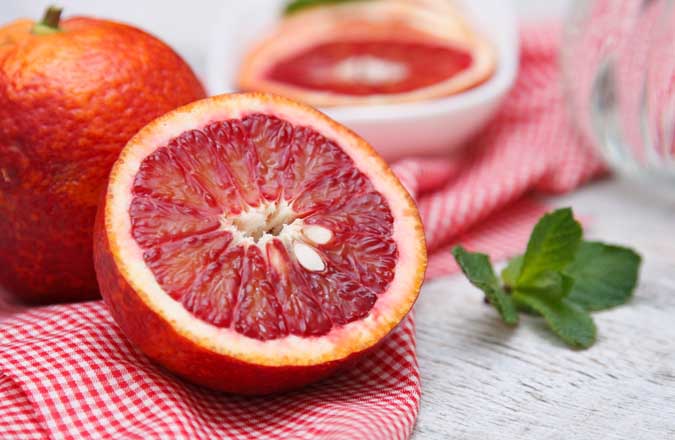
TheSicilian Blood Orange PGI is not only an icon of Mediterranean agri-food, but truly a unique functional food in the world. If its pigmented pulp is rooted in natural mutations already documented in 1646, modern science is revealing its clinical potential: a recent clinical study indeed demonstrates the role of extracts from the ‘Moro’ variety in weight management and in the reduction of visceral fat. Among strict regulations, botanical and nutraceutical history, here is why this citrus represents an irreplaceable excellence for health and the territory.
The cultivation of citrus fruits in Sicily has ancient roots dating back to the Arab domination of the island, which occurred between the 9th and 11th centuries. The Arabs introduced the bitter orange (Citrus aurantium) around the 7th century, initially cultivated for ornamental purposes in the noble ‘gardens’, a term still used today in Sicily to indicate the plots destined for citrus cultivation. The first scientific documentation of blood oranges in Sicily dates back to 1646, when the Italian Jesuit and botanist Giovanni Battista Ferrari (1584-1655) described a particular orange characterized by red pulp (purpurei coloris medulla). Ferrari reported that this fruit, named Aurantium indicum, had been observed by a Genoese missionary returning from the Philippines.
Only in the 19th century the cultivation of the blood orange in Sicily acquired economic importance. The variety Tarocco, today the most widespread and appreciated among blood oranges, probably originated from a spontaneous bud mutation of the Sanguinello variety, discovered in a citrus orchard near Francofonte, in the province of Syracuse.
The peculiarity of the Sicilian blood orange is closely linked to unique microclimatic conditions of Eastern Sicily, particularly in the area surrounding the Plain of Catania and the slopes of Mount Etna. In these areas, characterized by volcanic soils rich in nutrients, the Mediterranean climate and marked temperature variations between day and night during the ripening period (winter-spring) favor the accumulation of anthocyanins and sugars in the fruits. This phenomenon gives blood oranges their intense color, balanced flavor, and antioxidant properties that have made them famous worldwide.
Botanical characteristics and varieties
The Sicilian Blood Oranges PGI belong to the species Citrus sinensis (L.) Osbeck and include three main varieties: Tarocco, Moro e Sanguinello. These cultivars differ in shape, pulp color intensity, and ripening period, but share the presence of anthocyanins, the natural pigments responsible for the characteristic red streaks.
The harvest of blood oranges begins in mid-December and continues until May-June, with variations depending on the variety. Moro from December to March, Tarocco from December to May, Sanguinello from February to April.
Sicilian Blood Orange PGI, the specification
The production area of the Sicilian Blood Orange PGI includes municipalities in the provinces of Catania, Enna, and Syracuse. The specification states that cultivation must take place in suitable areas of eastern Sicily, characterized by volcanic soils, Mediterranean climate, and strong daytime-nighttime temperature variations, essential elements for the full expression of the fruit's organoleptic characteristics.
The production specification establishes strict criteria:
- allowed varieties: Tarocco, Moro and Sanguinello, with the related nucellar clones;
- minimum physico-chemical characteristics: size, color of the peel and pulp, minimum content of soluble solids in the juice ensure typical flavor, sweetness and quality;
- maximum yields per hectare: 250 quintals for Tarocco; 300 quintals for Moro; 320 quintals for Sanguinello;
- harvest exclusively manual, with curved scissors that cut the peduncle without damaging the peel;
- traceability: strict control at all stages of production and marketing.
These rules ensure that every IGP red orange comes from a strict and verified production process, protecting the consumer and strengthening the value of the brand.
Nutritional values
According to the Food Composition Database of IEO, the average nutritional values per 100 g of fresh red orange juice are:
- Energy: 47 kcal
- Water: 86.7 g
- Proteins: 0.9 g
- Lipids: 0.1 g
- Available carbohydrates: 9.3 g (of which soluble sugars 9.3 g)
- Total fiber: 1.6 g
One of the most distinctive nutritional elements of oranges is the high content of vitamin C. A medium-sized fruit helps cover more than two-thirds of the recommended daily intake. The orange also contains vitamin A, in the form of beta-carotene, and minerals including potassium and magnesium.
Bioactive properties and health benefits
The blood orange is particularly rich in bioactive compounds – including anthocyanins, flavonoids, hydroxycinnamic acids, and vitamin C itself – which are associated with various beneficial effects on human health.
Antioxidant compounds
Scientific research has documented that blood oranges contain significant levels of antioxidants. According to Fallico et al. (2017), the average values in the fruits are:
- anthocyanins: 9.6 mg/100 g
- total hydroxycinnamic acids: 8.1 mg/100 g
- ascorbic acid: 59.1 mg/100 g
These bioactive compounds exhibit antioxidant and anti-inflammatory activity which may contribute to reducing the risk of cardiovascular and inflammatory diseases.
Effects on body composition
A clinical study published in Nutrients (Briskey et al., 2022) evaluated the effects of standardized Moro blood orange extracts on weight management. The researchers conducted a randomized, double-blind, placebo-controlled study on 98 overweight adults, who took 400 mg of standardized Moro orange extract (rich in cyanidin-3-glucoside) for 6 months.
The results showed significant reductions compared to placebo in body mass, body mass index, hip circumference, waist circumference, fat mass, fat distribution (visceral and subcutaneous).
The authors suggest that cyanidin-3-glucoside, abundant in Moro varieties, may promote modulation of lipid metabolism and reduce body fat accumulation through antioxidant, anti-inflammatory, and metabolic pathways. In conclusion, the study ‘demonstrates that the standardized extract of Moro blood orange can be a safe and effective option to aid weight loss when used in combination with diet and exercise’.
Other benefits
The intakes of vitamin C and polyphenols are associated with a range of health benefits – partly recognized also by regulation (EU) 432/2012 on food health claims – including notable beneficial contributions to:
- immune system;
- cellular protection against oxidative stress;
- health of skin, gums and teeth, connective tissues and cartilage, blood vessels and bones;
- nervous system and psychological function;
- reduction of tiredness and fatigue;
- improvement of iron absorption.
Versatility in gastronomy
The versatility of the Sicilian IGP Blood Orange in culinary applications is extraordinary:
- fresh consumption in segments or in salad;
- freshly squeezed juices and juices with intense color and characteristic flavor;
- pastry: sweets, jams, creams and sorbets;
- savory dishes: salads with oranges and olives, meat sauces, citrus risottos;
- peels: candied or to flavor sweet and savory preparations.
The characteristic aroma and the balance between sweet flavor and slightly acidic aftertaste make the blood orange an ideal wildcard for an extraordinary variety of preparations. The organic oranges have the additional advantage of being usable in their entirety, including peels, without exposure to pesticide residues.
Conclusions
The Sicilian IGP Blood Oranges represent much more than a simple citrus fruit: they are the result of centuries of agricultural tradition, a unique terroir, and a supply chain combining quality and sustainability. Their rich nutritional profile, together with the health properties documented by scientific literature, make them a valuable element of a balanced diet. The IGP mark protects the consumer and enhances an Italian agri-food excellence recognized worldwide.
Dario Dongo
References
- Briskey, D., Malfa, G. A., & Rao, A. (2022). Effectiveness of “Moro” blood orange Citrus sinensis Osbeck (Rutaceae) standardized extract on weight loss in overweight but otherwise healthy men and women—A randomized double-blind placebo-controlled study. Nutrients, 14(3), 427. https://doi.org/10.3390/nu14030427
- Consortium for the Protection of Sicilian PGI Blood Oranges. (n.d.). The Consortium's Documents. https://www.tutelaaranciarossa.it/i-documenti/
- Fallico, B., Ballistreri, G., Arena, E., Brighina, S., & Rapisarda, P. (2017). Bioactive compounds in blood oranges (Citrus sinensis (L.) Osbeck): Level and intake. Food Chemistry, 215, 67–75. https://doi.org/10.1016/j.foodchem.2016.07.142
- Ferrrari, G. B. (1646). Hesperides sive de Malorum Aureorum cultura et usu Libri Quatuor. Sumptibus Hermanni Scheus.
- IEO (European Institute of Oncology). (2022). Food Composition Database. Oranges. IEO, Milan. https://smartfood.ieo.it/nutrizione-e-salute/alimenti/arance/
- Regulation (EU) No 432/2012 of 16 May 2012 establishing a list of permitted health claims made on foods, other than those referring to the reduction of disease risk and to children’s development and health. Consolidated text: 20/08/2025. http://data.europa.eu/eli/reg/2012/432/2025-08-20

Dario Dongo, lawyer and journalist, PhD in international food law, founder of WIISE (FARE - GIFT – Food Times) and Égalité.


