
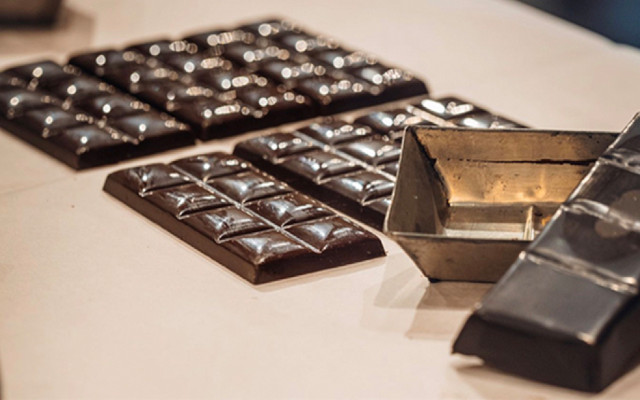
The Modica Chocolate is born from a gesture that has remained unchanged since the eighteenth century: the cold processing of bitter paste with sugar, without conching, which leaves the crystals intact and gives the bar its distinctive granular texture. A unique method that in 2018 received the first recognition of Protected Geographical Indication (PGI) in the chocolate category.
Also in Modica, the oldest chocolate factory in Sicily still in operation – the'Antica Dolceria Bonajuto – instead decided not to adhere to the PGI in order to safeguard the processing from the bean to the bar according to the original recipe. Two complementary visions of the same heritage: following the specifications, data and history of the Bonajuto-Ruta family workshop, in the interview conducted by GIFT.
Origins, from Mesoamerican cacao to the County of Modica
The populations of Mesoamerica consumed cocoa for millennia in the form of a bitter beverage, also by grinding roasted beans on a metate, a stone heated by a brazier, and then flavoring the paste with spices. It was the Spanish, in the sixteenth century, to bring cocoa in Europe as well as to add sugar to it, giving rise to chocolate as we know it today. In Sicily the processing arrived through the County of Modica, for centuries governed by Iberian houses, where original tools and gestures were preserved without significant variations.
The first documentary evidence dates back to the eighteenth century. In Palermo, in the 1723, the Guild of Chocolate Makers had been established, an autonomous corporation with its own statutes (La Sicilia, 2026). An Modica act of 1746 preserved in the Grimaldi family archive, it mentions the 'cicolateri' working on cocoa blends, a testimony recalled as the birth certificate of local production. In the 19th century, processing passed from noble houses to monasteries, then to cafés which became artisan workshops (regulation, article 6).
Cold processing, the distinctive feature
The Chocolate classic is subjected to conching, a long hot mixing that refines the paste until it becomes smooth and homogeneous. In Modica the cocoa paste is instead melted at low temperature, then mixed with sugar without prolonged refining.
Because the sugar does not dissolve, its crystals remain perceptible on the palate. The result is an opaque, crumbly chocolate, with a crunchy bite and rapid melting, in which the aroma of toasted cocoa prevails over every other note.
Modica PGI Chocolate, the current production rules
The Modica Chocolate PGI, registered via regulation (EU) 2018/1529, is the first chocolate to have obtained recognition of a geographical indication in the European Union. The specification reserves the name to the product obtained from the processing of bitter cocoa paste with sugar, in the entire administrative territory of the municipality of Modica, in the province of Ragusa (disciplinary, articles 1 and 3).
The tablet has shape a rectangular parallelepiped shape with sides in the form of truncated pyramids, weight not exceeding 100 grams, colour brown as well as evident graininess due to sugar crystals; a slight bloom of cocoa butter on the surface is allowed. At taste It tastes sweet with a bitter note, with a granular or sandy texture, crispy and easy to melt. It chemical requirements provide for cocoa solids not less than 50%, cocoa butter not less than 25%, moisture not exceeding 2.5% (product specification, article 2).
The essential ingredients are cocoa paste, from 50 to 99%, and sugar, from 1 to 50%, also cane, refined or whole. They are allowed, in defined minimum quantities, optional ingredients optional ingredients such as spices (cinnamon, vanilla, chilli pepper, nutmeg), natural aromas (citrus, fennel, jasmine, ginger), dried or dehydrated fruit (citrus, pistachio, hazelnuts, almonds) and salt, or other spices, aromas or fruit. Are prohibited colourants, preservatives, emulsifiers, vegetable fats other than cocoa butter, vanillin and milk (disciplinary regulation, article 5).
The production is divided into the following phases:
- the cocoa paste is melted in a bain-marie or melting kettle, maintaining the core temperature below 50 °C;
- sugar and any optional ingredients are added, stirring continuously. Tempering is optional;
- the mass is divided into portions in moulds, vibrated for one to three minutes, then cooled at room temperature or in cells at 5-15 °C;
- packaging, in individual wrappers, must take place within twelve hours of cooling, in production facilities or adjoining premises (disciplinary regulation, articles 5 and 8).
On label include the denomination 'Cioccolato di Modica', the European symbol of the PGI, the logo of the denomination as well as the name and address of the producer.
The indication of Country of origin of cocoa is optional, while any qualification not provided for in the disciplinary regulation is prohibited. The controls of conformity are entrusted to CSQA Certificazioni (disciplinary regulation, articles 7 and 8).
The Protection Consortium del Cioccolato di Modica PGI, established in its current form in 2024, was recognized by the Ministry of Agriculture pursuant to Regulation (EU) 2024/1143. It is entrusted with the functions of promotion, valorisation, supervision, protection and consumer information (MASAF, 2024).
Production and market, PGI figures
Certified production reached 348 tonnes in 2024, approximately double that of five years earlier. According to the Ismea-Qualivita Report, in 2024 production value rose to €6.9 million (+14.7%), that for consumption at 12.2 million (+12.5%). In the months of October and November 2025 growth over 2024 reached 22% (Sgambato, 2026).
The Consortium has 14 companies, two of which produce 60% of the volumes, for approximately 4 million tablets per year (Gaeta, 2025). The denomination is also used more and more often as ingredient, with 173 authorisations issued for the use of Modica PGI Chocolate in processed products.
The Consortium is also planning cocoa bean processing plant in Modica, to shorten the supply chain and contain the cost of bitter chocolate paste (Sgambato, 2026), after the average price of cocoa on the Amsterdam market rose from €4 to €19 per kilo between 2022 and 2024 (Gaeta, 2025).
Antica Dolceria Bonajuto, six generations of chocolate makers
the'Antica Dolceria Bonajuto – in Modica, in Corso Umberto I – is the oldest chocolate factory in Sicily still in operation. The family's roots date back to the mid-eighteenth century, when notary Vincenzo Bonajuto settled in Modica. In 1820 his son Francesco Ignazio – Italian pioneer of the approach bean-to-bar – started a business with a 'Fattojo' for grinding cocoa beans, inherited in 1854 by his son Federico. In 1880 Francesco, known as Don Ciccio, opened the 'F. Bonajuto', mechanized some phases of production and in 1911 obtained the gold medal at the International Agricultural Exhibition in Rome (Bonajuto, s.d.-a; Criscione, 2025).
Following Francesco's death in 1932, leadership passed to his widow Carmela Di Martino, assisted by Carmelo Ruta, a close collaborator of the shop and fiancé of Rosa, the child adopted by Francesco. Carmelo lived through the post-war period and the economic boom, years in which artisanal chocolate in Modica risked disappearing: in 1992 remained only three artisans to produce it using the traditional method, Carmelo Ruta and two confectioners trained as apprentices in the same shop (Bonajuto, n.d.-b). Among Carmelo's clients was the famous Sicilian writer Leonardo Sciascia, who described that chocolate as 'with an unrivaled flavour' (Surrusca, 2007).
In 1992 Franco Ruta, son of Carmelo and Rosa, started together with his son Pierpaolo – who represents the sixth generation of the family - the relaunch of the historic confectionery, recovering ancient Iblean recipes as well as cold-worked chocolate, brought to the attention of the international press. We interviewed Pierpaolo Ruta, who tells us that the company he now manages works every year 28-30 kt of cocoa – between cocoa mass and cocoa beans – to produce 'approx 700 K bars, to which are added other products such as chocolates, chocolate beverage, etc. The main customers are wine bars, restaurants and hotel facilities, specialty product shops. The turnover is around 2.5 million euros, with 8%. export aimed mostly at Japan and the United States, to a lesser extent at Germany, Austria and Australia.
The ancestral recipe
Bonajuto chocolate preserves a extreme simplicity: cocoa, obtained from toasted and ground beans or from cocoa paste, sugar, spices. Originally only cinnamon o vanilla, the two flavors with which the confectionery started the production of bars (ICE, N/A). It is the original chocolate, born in Mesoamerica and arrived in Modica from Spain, where sugar was added to pestle cocoa; in the absence of machinery, the recipe was passed down without variants.
A 'gastronomic fossil', in the words of Pierpaolo Ruta interviewed by the author.

Figure 1 – the metate, the stone used for grinding toasted beans. The stone was on the ground and the operator, on his knees, crushed the seeds with the stone roller (credit image: Antica Dolceria Bonajuto)
The toasted beans were ground by hand on the stone with the metate (see figure 1), already depicted in the Florentine Codex of 1590. This work was also very tiring, and starting from the mid-1960s, cocoa paste was used.
The processing The subsequent one, however, remained unchanged, since the paste is melted around 42-45 °C, a temperature at which sugar does not dissolve (Bonajuto, s.d.-b).
From the Fattojo to the tablet
In 2018, 164 years after the will with which Francesco Ignazio left the 'fattojo' to his son Federico, Bonajuto opened the Fattojo, laboratory bean to bar on Corso Umberto I open to visitors. Here the beans are checked at the stone grinding for fermentation, selected by hand, roasted, separated from the shell and stone-ground until obtaining the cocoa mass. To this, sugar and flavourings are added (Bonajuto, N/A). With Fattojo, Bonajuto is among Modica operators – together with Ciokarrua and Ciomod – to have resumed processing from the bean.

Figure 2 – the separation of cocoa bean granules from husks, after roasting, with the cocoa cracker (credit image: Fattojo Bonajuto)
The production process is described in the video by Antica Dolceria Bonajuto. (2026, 17 November). How chocolate is made [Video]. YouTube. https://youtu.be/ZDS-xhR0lwA
The search for raw materials follows precise criteria of sustainability. The Bonajuto confectionery directly selects cocoa producers in Africa as well as in Latin America, such as those in El Salvador, Guatemala and Honduras involved in the REVICACAO project of the International Italian-Latin American Organization (IILA, 2024). A multicultural team works in the laboratory with people originally from Venezuela and Senegal, as well as from Modica. Chocolate is now also produced with cane sugar local.
A choice of loyalty to the original recipe
Bonajuto, one of the promoters of the Consortium, left it in the mid-2000s, after having brought Modica chocolate to the attention of the international press. Among the initiatives of those years there was also a documentary dedicated to Don Luigi Baglieri, the last traveling chocolatier in Modica, who sold strictly cinnamon or vanilla bars. With the registration of the PGI, in 2018, the Dolceria chose not to join and thus renounce the use of the wording 'di Modica' (Bonajuto, s.d.-a). Pierpaolo Ruta smiles, observing that at most we can talk about a chocolate produced in a small village near Ragusa (Gaeta, 2025).
The choice reflects a different idea of the product. The specification leaves producers freedom in choosing cocoa and allows a wide range of flavours; Bonajuto instead favors the direct selection of cocoa beans, with the only historic spices of the Modica recipe. Its history, reconstructed on archive papers and period documents, is told by Giovanni Criscione in the volume L'antica dolceria Bonajuto. History of the oldest chocolate shop in Sicily, published by Rubbettino (Criscione, 2025).
A designation and a historic shop
The Cioccolato di Modica PGI and the chocolate from Antica Dolceria Bonajuto tell the same story from two points of view: a growing denomination, whose production has almost doubled in five years, and a historic shop that preserves the ancestral recipe from bean to bar. Both offer Italian consumers as well as international buyers a unique product, linked to a territory and a processing method that has miraculously survived the centuries.
Dario Dongo
Credit cover Antica Dolceria Bonajuto
References
European regulatory acts
Commission Implementing Regulation (EU) 2018/1529 of 8 October 2018 entering a name in the register of protected designations of origin and protected geographical indications ('Cioccolato di Modica' (PGI)). OJ L 257, 15.10.2018, p. 3. http://data.europa.eu/eli/reg_impl/2018/1529/oj
Regulation (EU) 2024/1143 of the European Parliament and of the Council of 11 April 2024 on geographical indications for wines, spirit drinks and agricultural products, as well as traditional specialities guaranteed and optional quality terms for agricultural products, amending Regulations (EU) No 1308/2013, (EU) 2019/787 and (EU) 2019/1753 and repealing Regulation (EU) No 1151/2012. Consolidated text: 18/03/2026, http://data.europa.eu/eli/reg/2024/1143/2026-03-18
Production rules and protection consortium
MASAF, Ministry of Agriculture, Food Sovereignty and Forestry. (2024). Decree of 5 December 2024. Recognition of the Consortium for the protection of Modica PGI Chocolate and assignment of the task of carrying out the functions referred to in the art. 53, paragraph 15, of law 24 April 1998, n. 128. Official Gazette n. 294 of 16.12.2024. https://www.cioccolatodimodica.it/wp-content/uploads/2025/12/MASAF-2024-0642510-DM-incaricoConsorzioCioccolatodiModicaIGP-signed.pdf
Ministry of agricultural, food, forestry and tourism policies. (2018). Production specifications for the protected geographical indication 'Modica Chocolate'. Official Gazette n. 252 and n. 258 of 2018. https://www.cioccolatodimodica.it/wp-content/uploads/2025/12/All-4-Disciplinare-cioccolato-di-modica.pdf
History of Modica chocolate and Bonajuto
Bonajuto. (n.d.-a). The Bonajuto Family. https://www.bonajuto.it/en/the-bonajuto-family/
Bonajuto. (n.d.-b). Chocolate processing. https://bonajuto.it/en/chocolate-processing
Bonajuto. (n.d.-c). Fattojo. https://www.bonajuto.it/en/fattojo/
Criscione, G. (2025). The ancient Bonajuto sweet shop. History of the oldest chocolate shop in Sicily. Rubbettino. ISBN 978-88-498-8531-6. First edition: The Bonajuto sweet shop, Kalós, 2014. https://www.store.rubbettinoeditore.it/catalogo/lantica-dolceria-bonajuto/
Sicily. (2026, February 10). The eighteenth-century chocolatiers of Modica, guardians of an ancient art [interview with Grazia Dormiente]. https://www.lasicilia.it/news/cultura-e-spettacoli/3017372/i-settecenteschi-cioccolatieri-di-modica-custodi-di-un-arte-antica.html
Surrusca, A. (2007, 21 June). The Sicilian Way to Chocolate. La Stampa. https://www.bonajuto.it/wp-content/uploads/2017/05/LASTAMPA-Giugno-2007.pdf
Cacao supply chain and Modica producers
ICE, Agency for the promotion abroad and the internationalization of Italian companies. (s.d.-a). Bonajuto, company details. https://www.ice.it/en/my-home/find-your-italian-partner/company-details/151254/Bonajuto
ICE, Agency for the promotion abroad and the internationalization of Italian companies. (s.d.-b). Grezzopuro Chocolate from Modica PGI organic cocoa 70. https://trackit.ice.it/prodotto/grezzopuro-cioccolato-di-modica-igp-bio-cacao-70/
IILA, International Italian-Latin American Organization. (2024). Production of Chocolate Tablets with Cocoa from Beneficiaries of the REVICACAO Project. https://iila.org/it/produzione-di-tavolette-di-cioccolato-con-cacao-proveniente-dai-beneficiari-del-progetto-revicacao/
Production and market data
Gaeta, F. (2025, September 22). In Modica not all the chocolate is 'from Modica'. The Post. https://www.ilpost.it/2025/09/22/cioccolato-modica/
Sgambato, E. (2026, 6 January). Modica PGI chocolate, production doubled in five years and new licences. Il Sole 24 Ore. https://en.ilsole24ore.com/art/modica-igp-chocolate-production-doubled-5-years-and-new-licences-AIddq7W

Dario Dongo, lawyer and journalist, PhD in international food law, founder of WIISE (FARE - GIFT – Food Times) and Égalité.


