


Oats, originating from the Mediterranean and the Middle East, have established themselves throughout history as a fundamental food, thanks to their significant contribution of proteins, lysine, dietary fibers (β-glucan), vitamins, and minerals. Qualities that make it a ‘supercereal’.
The oat market
Global production of oats, according to FAO, reached about 26 million tons in 2022. The main producers are Canada and Russia, accounting respectively for 20% and 17% of the total. (1)
In Italy, demand is growing (as evidenced by thelatest edition of the Immagino Observatory) while the cultivated area decreases, mainly due to the reduction of the equine heritage and the characteristics of the plant, which is characterized by
- high water requirements,
- poor cold resistance,
- need for cool and humid environments.
According to Istat the area cultivated with oats in Italy decreased by about 17%, from 108,459 hectares in 2010 to 102,597 hectares in 2023. Production fell by 22% in the period 2010-2017, reaching 2,354,907 quintals in 2023. (2)
Botany
TheAvena Sativa L. is an annual herbaceous plant belonging to the family of . It has spread in different parts of the world, adapting to a multitude of climatic conditions, particularly in temperate climates. (3). It has spread to different parts of the world, adapting to a multitude of climatic conditions, particularly in temperate climates. (3)

The flowering generally occurs between July and August. The plant produces a panicle inflorescence, erect and open, between 15 and 30 cm long, with thin lateral branches that branch slightly. The spikelets, which usually bear two or three flowers, are androgynous and are characterized by their upper floral bracts, sometimes lacking glumes. During ripening, the spikelets tend to droop (lodging), giving the oat its characteristic appearance in the fields.
The seeds of the oat, called caryopses, have an ellipsoid shape and are plano-convex, measuring between 7 and 8.5 mm in length and 3 to 3.5 mm in width. At maturity, the seed pericarp remains fused with the outer testa, or in some cases, such as in naked oats, the seed separates from the hull and falls naked.
The natural habitat of the oat includes ruderal areas, nitrogen-rich soils, and roadside margins, from flat levels up to mountainous areas. Thanks to its resistance and adaptability, it has established itself as a primary crop in many regions, especially where there is abundant rainfall and a temperate climate. (5)
History. From weed to beneficial cereal
The cultivation of the oat dates back to 2000 BC in the Near East regions. Its wild ancestor, Avena sterilis, originated in the Fertile Crescent of the Near East, an area recognized as one of the cradles of agriculture.
Initially considered a weed, it was later appreciated for its qualities as food and fodder, especially in regions with cooler and wetter climates. Thus, its spread and subsequent domestication grew in various parts of the Middle East and Europe.
The ancient Greeks and Romans initially underestimated oats, considering it more as animal feed than a cereal for human consumption. However, the recognition of this plant grew over time.
In the Middle Ages, studies began on its various applications and health benefits. Botanists like Lonicer and Mattioli described its medicinal and nutritional properties and suggested its use as food and as a remedy for various diseases. (6)
For centuries, boiled oats or porridge have been a breakfast staple in many cultures, especially in England, Scotland, and Germany, witnessing its evolution from simple fodder to essential food.
Cultivation
The cultivation Oat cultivation is optimal in temperate regions. It is less demanding in terms of summer heat compared to other cereals such as wheat, rye, or barley, and shows greater tolerance to rain. Well-drained soils are ideal for its growth. This characteristic makes oats particularly valuable in areas with cool and humid summers, such as northwestern Europe and Iceland.
Sowing It is generally carried out in spring in the colder regions, as soon as the soil becomes workable. But it can be sown both in autumn and spring, depending on the local climate, and has good cold tolerance capacities. Seeding rates vary depending on soil type and climatic conditions, but generally range between 100-175 kilograms per hectare (Kg/ha). Fertilizer requirements for oats include nitrogen, phosphorus (in the form of phosphorus pentoxide), and potassium, with specific amounts depending onprevious soil fertility and specific crop needs.
Weed management in oat fields is fundamental to ensure maximum yield. As a cover crop, oats help improve soil structure, reduce erosion, and combat weeds by naturally choking many weeds, although some tall or broadleaf weeds can still be a problem and may require moderate herbicide use.
Although generally resistant, the plant can be affected by various diseases, particularly rust and anthracnose, which attack stems and leaves.
Fusariosis is one of the most devastating diseases of cereal crops, affecting yield and grain quality; it is another threat. This disease is caused by various species of Fusarium. The accumulation of mycotoxins in cereal grains is dangerous for humans and animals. Hofgaard et al. (2016) studied the effect of tillage on the virulence of Fusarium species and found that soil cultivation significantly affects the inoculum potential of Fusarium. Two species of Fusarium, F. avenaceum e F. graminearum, were found to have a lower inoculum potential in plowed soils compared to harrowed soils. (7)
Grain production is very variable: the average yield ranges between 3-5 tons/ha.
Nutritional characteristics
Oats is rich in complex carbohydrates, fiber, B vitamins, minerals such as manganese, phosphorus, magnesium, and iron, and antioxidants. Notable is its content of β-glucan, a soluble fiber that helps regulate blood glucose and cholesterol levels. It also contains proteins (8-18%) and essential amino acids like lysine, which are often lacking in other cereals. (8,9)
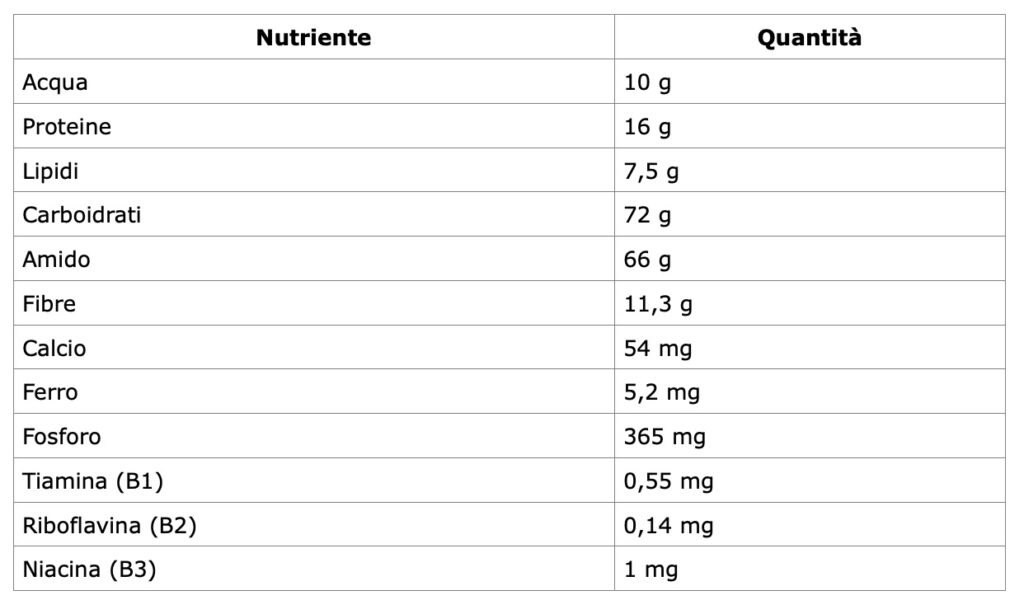
Oats contain bioactive compounds, such as lipids and beta-glucan, which are associated with improving diet quality by reducing cholesterol, regulating satiety, and protecting against colon carcinogenesis.
Daily consumption optimal oat intake is 40-100 g per day (providing 2.5-2.9 g of beta-glucan), according to Korczak et al. (2020). This dose has been shown to reduce fecal pH and beneficially alter fecal bacteria. (11)
Besides the nutritional qualities, oats have properties that favor their use in special diets, such as gluten-free ones. (12) Although its safety for celiac patients has been debated, recent studies have shown that the consumption of pure oats, free from contamination by other gluten-containing cereals, can be safe for most people with celiac disease. However, it is essential that the oats consumed are certified gluten-free to avoid the risk of cross-contamination. (13)
Uses and applications of oats
Oats is used in various forms for human consumption:
- oat flakes, derived from crushed grains with the husks removed, are mainly used for flour preparation, typically considered unsuitable for bread making but used in the production of cookies and puddings,
- other breakfast foods are made from whole dehulled grains (groats).
In livestock feeding, oats are used either pure or in mixtures, although demand has declined due to competition with hybrid corn and alfalfa. Straw, on the other hand, serves both as feed and bedding for animals.
At the industrial level, oat hulls are a source of furfural, a chemical compound used in various types of solvents.
For its soothing and moisturizing properties it is used in cosmetics. Used in masks, baths, or as an ingredient in natural soaps, it helps calm irritated skin, and treat eczema and dermatitis.
Conclusions
Oats it presents itself as a precious and multifunctional food, essential for enriching our diet with fundamental nutrients and promoting a healthy dietary regime. Its beneficial properties, ranging from antioxidant capacities to cholesterol-lowering and anti-inflammatory effects, make oats an important ally in the prevention of various diseases.
However, the alarming reduction of the area cultivated with oats in Italy, which contrasts with a 9% increase in demand, reflects a disconnect between production and consumption that deserves particular attention. This imbalance highlights the need to encourage oat cultivation through targeted agricultural policies, thus supporting farmers and at the same time ensuring a constant supply of this cereal for the domestic market.
Gabriele Sapienza
Notes
(1) Crops and livestock products, FAOSTAT, https://www.fao.org/faostat/en/#data/QCL/visualize
(2) Cultivations: Cereals, legumes, roots bulbs and tubers, ISTAT, http://dati.istat.it/Index.aspx?QueryId=33702
(3) Avena sativa L., Acta Plantarum, https://www.actaplantarum.org/flora/flora_info.php?id=1113
(4) Avena sativa L., World Flora Online, https://www.worldfloraonline.org/taxon/wfo-0000852231
(5) Avena sativa L., Royal Botanic Garden Kew, https://powo.science.kew.org/taxon/urn:lsid:ipni.org:names:391732-1
(6) Avena sativa L., A. Volgel Plant Encyclopedia, https://www.avogel.com/plant-encyclopaedia/avena_sativa.php
(7) Hofgaard Ingerd S., Seehusen Till, Aamot Heidi U., Riley Hugh, Razzaghian Jafar, Le Vinh H., Hjelkrem Anne-Grete R., Dill-Macky Ruth, Brodal Guro, Inoculum Potential of Fusarium spp. Relates to Tillage and Straw Management in Norwegian Fields of Spring Oats, Frontiers in Microbiology, 7, 2016 https://www.frontiersin.org/journals/microbiology/articles/10.3389/fmicb.2016.00556 DOI: 10.3389/fmicb.2016.00556
(8) Oats (Includes foods for USDA’s Food Distribution Program), USDA, FoodData Central, https://fdc.nal.usda.gov/fdc-app.html#/food-details/169705/nutrients
(9) Oats, Humanitas, https://www.humanitas.it/enciclopedia/alimenti/cereali/avena/
(10) Pieter Van den Abbeele, Alison Kamil, Lisa Fleige, Yongsoo Chung, Peter De Chavez, and Massimo Marzorati, Different Oat Ingredients Stimulate Specific Microbial Metabolites in the Gut Microbiome of Three Human Individuals in Vitro, ACS Omega, 2018 3 (10), 12446-12456 DOI: https://doi.org/10.1021/acsomega.8b01360
(11) Renee Korczak, Megan Kocher, Kelly S Swanson, Effects of oats on gastrointestinal health as assessed by in vitro, animal, and human studies, Nutrition Reviews, Volume 78, Issue 5, May 2020, Pages 343–363, https://doi.org/10.1093/nutrit/nuz064
(12) Safety of Adding Oats to a Gluten-Free Diet for Patients With Celiac Disease: Systematic Review and Meta-analysis of Clinical and Observational Studies, Pinto-Sánchez, María Inés et al., Gastroenterology, Volume 153, Issue 2, 395 – 409.e3 Published: April 18, 2017 DOI: https://doi.org/10.1053/j.gastro.2017.04.009
(13) Comino I, Moreno ML, Sousa C. Role of oats in celiac disease. World J Gastroenterol 2015; 21(41): 11825-11831 [PMID: 26557006 DOI: https://dx.doi.org/10.3748/wjg.v21.i41.11825

Graduate in Agriculture, with experience in sustainable agriculture and permaculture, laboratory and ecological monitoring.


, vitamine e minerali.)