

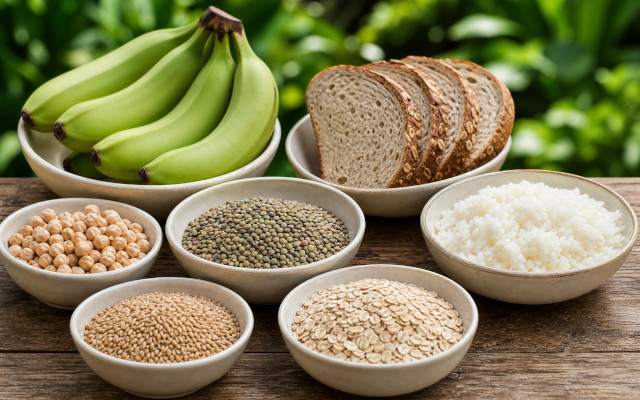
Theresistant starch (Resistant Starch, RS) is the fraction of starch that escapes digestion in the small intestine to reach the colon, where it is fermented by the microbiota intestinal (Englyst, Kingman & Cummings, 1992). It thus combines the nutritional properties of fiber dietary with the technological versatility of starch: it modulates the glycemic response, acts as a prebiotic for intestinal health and allows invisible addition of fiber to foods.
The five types of resistant starch
The most accredited classification distinguishes five types of resistant starch (Englyst et al., 1992):
– RS1 is physically inaccessible, protected inside intact cell walls (whole grains, legumes);
– RS2 is the type most common, consisting of native starch in ungelatinized, crystalline and compact granules (high amylose corn, green banana, raw potato);
– RS3 is retrograded starch, also formed in home preparations after cooking and cooling cereal-based foods;
– RS4 is chemically modified starch (e.g. distarch phosphate, cross-linked distarch);
– RS5 It is a more recently described form of resistant starch that includes complexes formed between amylose and lipids, which are poorly digestible by digestive enzymes.
The role of thermal retrogradation in foods
The richest natural sources are legumes and whole grains (RS1), unripe bananas and green banana flour (RS2). Their content depends on cooking, cooling, and storage. The key phenomenon is retrogradation: during cooking the granules absorb water, swell and lose their crystalline structure (gelatinization); on cooling the amylose chains and long branches of amylopectin re-associate into more ordered double helices, resistant to enzymes, generating RS3. A study on rice starch gel showed that the determining factor is storage time, followed by storage conditions and gelatinization temperature (Denchai et al., 2019).
Thus, by example cooling cooked white rice at 4 °C for 24 hours and reheating it or bringing it back to room temperature before consumption — as is customary in the preparation ofrice salad — the resistant starch content rises from 7.52 to 11.96 g/100g; in patients with type 1 diabetes this results in significantly lower peak blood sugar, glycemic increase, and area under the curve compared to fresh rice (Strozyk et al., 2022). Similar results in healthy populations had previously emerged (Sonia et al., 2015).
In domestic and professional cooking, practically speaking, cooking, cooling and reheating of pasta, rice, potatoes and bread converts part of the digestible starch into functional fiber.
Industrial extraction technologies
Production depends on the target type. ForRS3 the most common method combines repeated cycles of heating (autoclave at 121 °C) and cooling, often with enzymatic debranching using pullulanase or isoamylase, which hydrolyze the α-1,6 bonds of amylopectin, increase linear amylose and promote re-crystallization. A dedicated review reports RS yields ranging from 10% to 80%, up to a maximum of 84%, with sequential enzymatic treatment (β-amylase, transglucosidase and pullulanase) (Ismail et al., 2025). Physical treatments with ultrasounds increase the surface accessible to enzymes, while theextrusion followed by enzymatic de-branching represents a 'green' and efficient pathway. For theRS4 chemical modifications such as cross-linking with phosphate are used, which confer enzymatic resistance while preserving technological functionality (Stewart et al., 2018).
The evolution of scientific research from 1990 to today
Resistant starch was identified in the 1980s by Hans Englyst, Sue Kingman, and John Cummings, who at Dunn Clinical Nutrition Centre of the University of Cambridge recognized for the first time a fraction of starch not digested in the human small intestine, then formalizing the classification into its different types (Englyst et al., 1992). This discovery refuted the assumption that all ingested starch would be absorbed as glucose, paving the way for nutritional characterization of complex carbohydrates.
This evidence stands, in a certain sense, as acritical anticipation of modern systems for food classification based on their level of processing, such as the Brazilian system NOVA:
- if the narrative on ultra-processed foods tends to indiscriminately penalize every form of industrial transformation, the case of resistant starch shows the opposite;
- technological treatments (such as thermal cycles or enzymatic debranching) do not degrade the value of food but can convert digestible starches into functional fiber, improving the metabolic impact of the food.
Control of postprandial glycemic response
The best documented effect of resistant starch (RS) intake is the reduction of postprandial glycemic response. Replacing digestible starch with RS in a meal lowers the blood glucose increase (Robertson et al., 2005; Stewart et al., 2018). In healthy adults, 30 g/day of RS improved insulin sensitivity measured with euglycemic-hyperinsulinemic clamp (9.7 vs 8.5 × 10⁻² mg glucose · kg−1 · min−1 · (mU insulin/L)−1; P = 0.03) and increased sensitivity by 33% during the meal test (Robertson et al., 2005).
The evidence has recently solidified: in adults with type 2 diabetes, replacing about 15% of dietary starch with resistant starch under everyday living conditions reduced glycemic excursions and increased time in range monitored by continuous sensor (Collins et al., 2025). The benefits are mainly mediated by colonic fermentation metabolites, the short-chain fatty acids.
Prebiotic effect and intestinal health
Reaching the colon intact, resistant starch supports intestinal health because it is fermented with production of short-chain fatty acids (SCFA) – especially butyrate, propionate and acetate. Butyrate is the main energy substrate of colonocytes and supports the integrity of the intestinal barrier, the modulation of immune system and colon metabolism (Cummings, Beatty, Kingman, Bingham & Englyst, 1996). RS acts as a powerful substrate prebiotic, promoting the proliferation of beneficial bacteria, in particular Bifidobacterium adolescentis, with positive effects on microbiome balance and improvement of metabolic profile overall (Li et al., 2024).
Body weight and satiety
A randomized controlled trial (RCT) with design crossover — where each participant receives, at different times, both the experimental treatment and the control — evaluated supplementation with resistant starch in 37 overweight or obese adults for 8 weeks:
- average weight loss of 2.8 kg;
- improvement in insulin resistance and reduction of inflammation, associated with
- remodeling of the microbiota (particularly increase of B. adolescentis), as well as to
- alteration of bile acid profile and
- inhibition of lipid absorption (Li et al., 2024).
RS also contributes to satiety and modulates hunger and food craving (Stewart et al., 2018).
Cancer prevention: the CAPP2 trial
Among the strongest evidence — although not yet evaluated by EFSA (European Food Safety Authority), for potential authorization of a specific health claim — the trial is noted CAPP2 (Colorectal Adenoma/Carcinoma Prevention Programme 2), which studied the long-term effects of resistant starch on tumor incidence in patients with Lynch syndrome (hereditary predisposition to gastrointestinal tumors).
Of 918 participants randomly assigned to treatment groups with 30 g/day of resistant starch (RS) or placebo for a median intervention of about 25 months, with follow-up planned at 10 years (and registry data up to 20):
- no differences emerged on colorectal cancer, but
- there was a significant reduction of extracolonic tumors in the RS group (HR 0.54; 95% CI 0.33–0.86; P = 0.010), with a particularly marked effect on tumors of the upper gastrointestinal tract (Mathers et al., 2022). Theeffect was found persistent for over ten years after cessation of supplementation.
Fatty liver and lipid profile
The most interesting research chapter in recent years concerns fatty liver. In a 4-month randomized controlled trial on 200 patients with non-alcoholic fatty liver disease (NAFLD/MASLD), high-amylose corn RS2 reduced intrahepatic triglycerides by 9.08% in absolute value (5.89% net of weight loss) compared to the control group, through a reduction of Bacteroides stercoris and modulation of the microbiome (Ni et al., 2023).
It is the first large randomized clinical trial (RCT) to propose resistant starch as a ‘microbiota-directed’ dietary intervention in a pathology currently lacking approved pharmacological therapies. On the cardiovascular front, human evidence is still consolidating, but the ability to modulate glycemia, lipids, and bile acids suggests potential benefit.
Authorized health claim in the EU and conditions of use
The European Union has authorized only one health claim specific on resistant starch with Regulation (EU) No 432/2012, based on EFSA’s favorable opinion (EFSA NDA Panel, 2011):
- ‘replacing digestible starches with resistant starch in a meal contributes to reducing the postprandial glycemic rise after that meal'.
- this health claim can only be used for foods in which digestible starch has been replaced by resistant starch so that the final RS content is at least 14% of total starch (European Commission, 2012).
The condition of use is decisive: it concerns replacement of digestible starch and not just the simple addition of resistant starch. A decisive detail for the formulation and valorization of food products containing this functional ingredient.
Development of functional bakery and snack products
White breadIt is the most promising use for a historically high glycemic index food. Bread made of 80% wheat flour and 20% corn, with long baking at low temperature and no added ingredients (2.4% RS3 vs 0.8% reference), produced a significantly lower postprandial glycemic response at equal available carbohydrates, especially from 45 minutes onward (Amaral et al., 2022). Resistant starch thus allows increasing fiber content without altering texture, color, and flavor.
Cookies. In gluten-free cookies, the use of resistant starch (about 11.5% of dough weight) combined with sucrose substitutes (maltitol, inulin) markedly reduced theglycemic index: from the high control value (77) down to 33 in formulations with total sugar replacement (Di Cairano et al., 2022). A high-fiber cookie with RS4 reduced postprandial glycemic and insulinemic area in healthy adults (Stewart & Zimmer, 2017).
Bars and crackers. In the functional and protein bars resistant starch increases fiber — and supports satiety, although such a claim is not (yet) accepted in the European Union — without altering taste and texture. In crackers, RS can be used as a partial fat replacer while maintaining crispiness, provided humidity and baking temperature are optimized.
Extruded snacks. In extruded snacks, gelatinization followed by retrogradation during cooling contributes to the porous and crunchy structure: the challenge is to balance the starch-protein-fiber ratio to control expansion, density, and hardness.
Global market growth trend
Market estimates diverge by methodology but converge on the growth trajectory. Various 2025/2026 analyses place the global resistant starch market value between roughly 10.6 and 13.2 billion dollars in 2025 (some sources indicate lower figures around 7–8 billion), with a CAGR of 6–8% and projections toward 18–24 billion by 2033–2035 (Cervicorn Consulting, 2025; Global Market Insights, 2026; IMARC Group, 2025; Precedence Research, 2025).
The segment Food & Beverage drives demand (over 45% of applications), Asia-Pacific is the largest region (about 35%), the Cereals dominate among sources and RS2 remains the best-selling type by appeal clean labelThe market is concentrated: the top five players – Ingredion, Cargill, Tate & Lyle, ADM, and Roquette – control about two-thirds of the total (Global Market Insights, 2026).
Conclusions
Resistant starch consolidates itself as functional ingredient of great interest to the food industry, capable of improving the nutritional profile of complex matrices such as bread, biscuits, and snacks without compromising their sensory characteristics. The use of the only health claim authorized in the EU offers a lever for transparent and safe commercial enhancement, provided the strict criterion of replacing digestible starch is respected.
The future of the sector lies in optimizing the industrial yields of RS3 and especially in the scientific demonstration of the promising benefits — for the health of the gut microbiota and beyond — in view of the authorization of new health claim in the European Union. Our team of FARE (Food and Agriculture Requirements) is available to companies, their associations, and research consortia intending to undertake this path.
Dario Dongo
References
Scientific studies (peer-reviewed)
Amaral, O., Guerreiro, C. S., Almeida, A., & Cravo, M. (2022). Bread with a high level of resistant starch influenced the digestibility of the available starch fraction. Bioactive Carbohydrates and Dietary Fibre, 28, 100318.
Collins, S. M., Egan, M. B., Whyte, M. B., & Robertson, M. D. (2025). Partial starch substitution with resistant starch lowers postprandial glucose and glycaemic variability in people with type 2 diabetes. Diabetic Medicine. https://doi.org/10.1111/dme.70079
Cummings, J. H., Beatty, E. R., Kingman, S. M., Bingham, S. A., & Englyst, H. N. (1996). Digestion and physiological properties of resistant starch in the human large bowel. British Journal of Nutrition, 75(5), 733–747. https://doi.org/10.1079/bjn19960177
Denchai, N., Suwannaporn, P., Lin, J., Soontaranon, S., Kiatponglarp, W., & Huang, T.-C. (2019). Retrogradation and digestibility of rice starch gels: The joint effect of degree of gelatinization and storage. Journal of Food Science, 84(6), 1400–1410. https://doi.org/10.1111/1750-3841.14633
Di Cairano, M., Tchuenbou-Magaia, F. L., Condelli, N., Cela, N., Ojo, C. C., Radecka, I., Dunmore, S., & Galgano, F. (2022). Glycaemic index of gluten-free biscuits with resistant starch and sucrose replacers: An in vivo and in vitro comparative study. Foods, 11(20), 3253. https://doi.org/10.3390/foods11203253
Englyst, H. N., Kingman, S. M., & Cummings, J. H. (1992). Classification and measurement of nutritionally important starch fractions. European Journal of Clinical Nutrition, 46(Suppl. 2), S33–S50.
Ismail, A., Saradhuldhat, W., Tananuwong, K., & Krusong, K. (2025). Enzymes for resistant starch production. Food Bioscience, 63, 105529. https://doi.org/10.1016/j.fbio.2024.105529
Li, H., Zhang, L., Li, J., Wu, Q., Qian, L., He, J., Ni, Y., Kovatcheva-Datchary, P., Yuan, R., Liu, S., Shen, L., Zhang, M., Sheng, B., Li, P., Kang, K., Wu, L., Fang, Q., Long, X., Wang, X., … Jia, W. (2024). Resistant starch intake facilitates weight loss in humans by reshaping the gut microbiota. Nature Metabolism, 6(3), 578–597. https://doi.org/10.1038/s42255-024-00988-y
Mathers, J. C., Elliott, F., Macrae, F., Mecklin, J.-P., Möslein, G., McRonald, F. E., Bertario, L., Evans, D. G., Gerdes, A.-M., Ho, J. W. C., Lindblom, A., Morrison, P. J., Rashbass, J., Ramesar, R. S., Seppälä, T. T., Thomas, H. J. W., Sheth, H. J., Pylvänäinen, K., Reed, L., … Burn, J. (2022). Cancer prevention with resistant starch in Lynch syndrome patients in the CAPP2-randomized placebo controlled trial: Planned 10-year follow-up. Cancer Prevention Research, 15(9), 623–634. https://doi.org/10.1158/1940-6207.CAPR-22-0044
Ni, Y., Qian, L., Siliceo, S. L., Long, X., Nychas, E., Liu, Y., Ismaiah, M. J., Leung, H., Zhang, L., Gao, Q., Wu, Q., Zhang, Y., Jia, X., Liu, S., Yuan, R., Zhou, L., Wang, X., Li, Q., Zhao, Y., … Jia, W. (2023). Resistant starch decreases intrahepatic triglycerides in patients with NAFLD via gut microbiome alterations. Cell Metabolism, 35(9), 1530–1547.e8. https://doi.org/10.1016/j.cmet.2023.08.002
Robertson, M. D., Bickerton, A. S., Dennis, A. L., Vidal, H., & Frayn, K. N. (2005). Insulin-sensitizing effects of dietary resistant starch and effects on skeletal muscle and adipose tissue metabolism. The American Journal of Clinical Nutrition, 82(3), 559–567. https://doi.org/10.1093/ajcn.82.3.559
Sonia, S., Witjaksono, F., & Ridwan, R. (2015). Effect of cooling of cooked white rice on resistant starch content and glycemic response. Asia Pacific Journal of Clinical Nutrition, 24(4), 620–625.
Stewart, M. L., & Zimmer, J. P. (2017). A high fiber cookie made with resistant starch type 4 reduces post-prandial glucose and insulin responses in healthy adults. Nutrients, 9(3), 237. https://doi.org/10.3390/nu9030237
Stewart, M. L., Wilcox, M. L., Bell, M., Buggia, M. A., & Maki, K. C. (2018). Type-4 resistant starch in substitution for available carbohydrate reduces postprandial glycemic response and hunger in acute, randomized, double-blind, controlled study. Nutrients, 10(2), 129. https://doi.org/10.3390/nu10020129
Strozyk, S., Rogowicz-Frontczak, A., Pilacinski, S., LeThanh-Blicharz, J., Koperska, A., & Zozulinska-Ziolkiewicz, D. (2022). Influence of resistant starch resulting from the cooling of rice on postprandial glycemia in type 1 diabetes. Nutrition & Diabetes, 12(1), 21. https://doi.org/10.1038/s41387-022-00196-1
Regulations and institutional sources
European Commission. (2012). Commission Regulation (EU) No 432/2012 of 16 May 2012 establishing a list of permitted health claims made on foods, other than those referring to the reduction of disease risk and to children’s development and health. Official Journal of the European Union, L 136, 1–40.
EFSA Panel on Dietetic Products, Nutrition and Allergies (NDA). (2011). Scientific opinion on the substantiation of health claims related to resistant starch and reduction of post-prandial glycaemic responses (ID 681), ‘digestive health benefits’ (ID 682) and ‘favours a normal colon metabolism’ (ID 783) pursuant to Article 13(1) of Regulation (EC) No 1924/2006. EFSA Journal, 9(4), 2024. https://doi.org/10.2903/j.efsa.2011.2024
Market analysis
Cervicorn Consulting. (2025). Resistant starch market size, share & growth analysis 2025–2035.
Global Market Insights. (2026). Resistant starch market size, share & growth forecast 2026–2035.
IMARC Group. (2025). Resistant starch market size, share, trends & forecast 2025–2033.
Precedence Research. (2025). Resistant starch market size, share & trends 2025–2034.

Dario Dongo, lawyer and journalist, PhD in international food law, founder of WIISE (FARE - GIFT – Food Times) and Égalité.


