

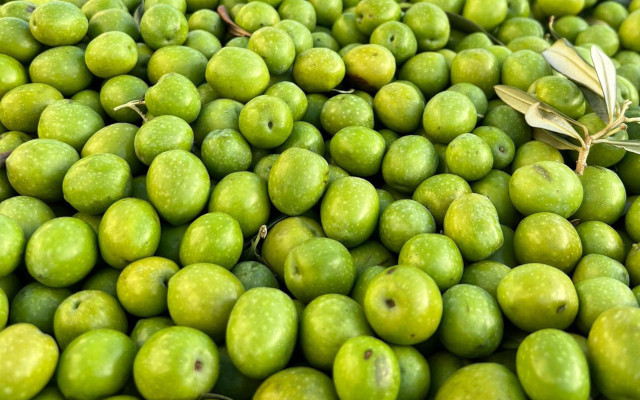
The Nocellara del Belice is the best known among Sicilian table olives. Cultivated in the Belice Valley, in the province of Trapani, it comes from an indigenous cultivar with dual aptitude, able to offer both an excellent table olive and an extra virgin oil of high quality. It is the only variety in Europe to boast two distinct Protected Designations of Origin: Nocellara del Belice for table olives and Belice Valley for oil.
Known in Anglo-Saxon markets as ‘Castelvetrano olive’ — and locally also as ‘oliva di Mazara’, ‘Tonda’, or ‘Trapanese’ — it is recognized for its medium-large size (5-7 g per fruit), firm and crunchy pulp, intense green color that turns to wine-red at ripening and a taste delicately bitter-sweet. It is one of the few Italian table olives to boast the DOP.
Double certification for a single variety
The same variety, which represents about 95% of the valley's olive heritage, simultaneously offers an excellent table olive — with fruits of 5-7 g, larger than the average size of table olives, and a firm and crunchy pulp — and a extra virgin oil with an intense and rich aromatic profile of phenolic compounds.
The double DOP recognition certifies that, in its territory of origin, the same variety achieves high quality standards in two distinct destinations of use. This versatility is attributable to the morphological characteristics of the fruit: the pulp is particularly abundant and the ratio between pulp and pit equally favorable.
History: from Magna Graecia to DOP
The name Nocellara refers to the round and compact shape of the fruit, similar to a small nut. The roots of the cultivation date back to antiquity: the first documents on the presence of the olive tree in the valley date back to the Greek colony of Selinunte, in the 7th century BC, when it was precisely the Greek colonists who introduced and spread the variety in western Sicily (Terrà, 2025). From there the cultivar extended to the areas of Trapani, Palermo and Agrigento, soon entering the commercial circuits of Magna Graecia; the remains of the archaeological area of Selinunte, with the remnants linked to milling, testify how deeply rooted the oil culture was even then.
For a long time the variety was used mainly for oil. The enhancement for table use is more recent: only from the 19th century onwards did the discovery of the market qualities of the fruit for direct consumption start a progressive diversification, culminating in the 20th century in the table specialization that characterizes it today.
The path of protection was completed in three stages: the recognition of the DOP for table olives (1998), that of the DOP Belice Valley for extra virgin oil (2004) and finally the Consortium recognition for the protection and enhancement of the Nocellara del Belice DOP table olive, formalized in 2017.
Processing methods and impact on polyphenols
The harvest is manual, between late September and November, with a ban on fruit loosening agents (plant regulators used to promote the detachment of fruits from the plant). The transport takes place in rigid boxes with layers no thicker than 20 cm and the processing must be started within 24 hours from detachment, to guarantee freshness and crunchiness. The regulation distinguishes three systems for green olives and two for black ones.
The transformation method is the primary determinant of nutritional quality:
- the Castelvetrano system (sweet) provides for complete de-bittering in a sodium solution;
- the Sivigliano system (semi-sweet) a partial de-bittering followed by lactic fermentation in brine;
- the 'Al naturale' method renounces the alkaline treatment, relying only on fermentation. Research confirms that the treatment with soda (Castelvetrano) reduces part of the polyphenols, while the ‘al naturale’ and Sivigliano processes preserve a higher share compared to oxidative Californian-style systems, which blacken the fruit due to forced oxygenation in an alkaline environment (Rocha et al., 2020).
The spontaneous fermentation of Nocellara del Belice hosts a lactic microbiota of functional interest. From olives processed with the Spanish and ‘Castelvetrano’ methods, strains of Lactiplantibacillus pentosus e Levilactobacillus coryniformis capable of surviving gastrointestinal transit and inhibiting pathogens such as Salmonella, Listeria monocytogenes and E. coli enterotoxigenic. A potentially probiotic profile that paves the way for table olives as a vehicle for beneficial bacteria (Guantario et al., 2018).
Acid profile and functional potential of the drupe
The olive Nocellara del Belice has a markedly oleic lipid fraction, with a stable acid profile throughout maturation (Rizzo et al., 2024):
- oleic acid — about 72-73% of total fatty acids;
- palmitic acid — recorded around 15%;
- linoleic acid — increasing from 5.9 to 9.9%.
To oleic acid Food and Drug Administration (FDA) recognizes a qualified health claim for the reduction of the risk of coronary heart disease, referring to the consumption of olive oil in place of an equivalent amount of saturated fats (FDA, 2018).
On the side of bioactive compounds, the most represented phenol ishydroxytyrosol, with marked antioxidant and anti-inflammatory properties. Among the minor compounds, Nocellara del Belice is among the cultivars richest in squalene — steroid precursor and scavenger of reactive oxygen species — with about 468 mg/kg in the raw drupe (Ambra et al., 2017).
Evidence on humans is still preliminary. A first pilot nutritional intervention study, conducted on healthy subjects who consumed twelve green olives per day for thirty days, associated the consumption of these olives with antioxidant and anti-inflammatory effects — with reduction of malondialdehyde and interleukin-6 — attributed to polyphenols and oleic acid (Accardi et al., 2016). However, the literature calls for caution: human trials on table olives remain limited and hydroxytyrosol bioavailability is mainly demonstrated from oil.
Even the cultivar’s waste has value. The phenolic extract from Nocellara del Belice leaves, rich in oleuropein e luteolin-7-O-glucoside, has shown in vitro a strong antioxidant and anti-inflammatory activity and the ability to reduce lipid accumulation in a model of hepatic steatosis, suggesting nutraceutical uses within the logic of circular bioeconomy (Musolino et al., 2023).
A warning: olives in brine should be consumed with moderation, possibly rinsed, within a balanced dietary model, because rich in sodium (Rocha et al., 2020).
Technical requirements and controls of the DOP regulation
The latest consolidated version of the specification is available on the CREA-Olive Growing, Fruit Growing and Citrus Growing portal (CREA, 2024). Below is the analysis of its individual articles.
Denomination
The protected designation of origin ‘Nocellara del Belice’ is reserved for green or black table olives, whole or processed, obtained from the homonymous cultivar and produced in the delimited area. Also included are processed products — pitted, crushed, sliced, incised, seasoned olives — provided they comply with the requirements of the regulation (article 1).
Production area
The area is located in Belice Valley, in the municipalities of Castelvetrano, Campobello di Mazara and Partanna, in the province of Trapani. The area is characterized by a Mediterranean climate, with rainfall concentrated in autumn and winter, mild temperatures and soils derived from marly-sandy and marly-clayey substrates, from subalkaline to alkaline (article 2).
Characteristics of the cultivar
The olive groves must consist of clones of the native varieties specialized, identified by the technical services of the Sicily Region. The plant has an expanded habit, generally not exceeding 3.50 meters in height; leaves flat and straight, intense green on the upper side and sage gray on the underside; flowering hermaphrodite but self-incompatible, requiring pollinators (Giarraffa, Biancolilla). The fruit is spherical with a rounded base, weighing 5-7 g, with pulp about 85% of the weight (article 3).
Cultivation methods
The guidelines prescribe a maximum density of 300 plants per hectare for new plantations; training systems include vase, polyconic vase, palmette or others suitable for manual harvesting; manual harvesting (handpicking) or with tools that do not damage the fruit, with prohibition of shaken olives; transport in rigid-walled perforated crates, with layers not exceeding 20 cm; start of processing within 24 hours from harvesting (article 4).
Production and processing methods
For the green olives three systems are permitted: ‘Castelvetrano’ (sweet), with complete de-bittering in sodium solution, salting and preservation in brine; ‘Sivigliano’ (semi-sweet), with partial de-bittering in sodium hydroxide, washing, lactic fermentation and brine; ‘al naturale’ (changing), with fermentation and preservation in brine without alkaline treatment.
For the black olives: mature without alkaline treatments (natural brine, vinegar, dehydrated with dry salt or oven-dried) or with alkaline treatment (California system for oxidation, or preservation with dry salt. Article 5).
Organoleptic and chemical-physical characteristics
The product must present large size (5-7 g), rounded shape with a broad base, intense green color (green), wine-red at maturity or black (mature), firm and crunchy pulp with a slightly bitter taste, high pulp-to-stone ratio. The parameters follow the Codex Alimentarius and the commercial standards of the International Olive Council (article 6).
Product types
The green PDO olives are marketed whole in brine (with pit), pitted in brine, crushed, sliced, cut or seasoned (oil, garlic, chili pepper, oregano, wild fennel). Black PDO olives are currently marketed only in the type in natural brine (article 7).
Packaging and labeling
The product must be packaged in containers of glass, tin band, heat-sealable plastic bags, food-grade plastic or terracotta. The label bears the denomination 'Nocellara del Belice DOP', the community logo and the indications provided by the regulations on Protected Designations of Origin (article 8).
Control system
Compliance is verified by Agroquality. The system requires mandatory registration in the operators' register (growers, processors, intermediaries, packagers), control of 100% of registrants, annual documentary and inspection verification, sampling of the finished product (one check every 10,000 kg) and chemical-physical and organoleptic analyses according to Codex parameters (article 9).
Gastronomic use in Mediterranean tradition
The green olives ‘Castelvetrano’, sweet and delicate, are enjoyed natural with rustic bread, Sicilian pecorino cheese and caciocavallo. They are an indispensable ingredient of caponata, where the slightly bitter touch balances the sweetness of eggplants and the acidity of tomatoes; crushed or sliced they flavor fish sauces, white meats and vegetables, as well as the classic pâté for bruschetta.
The black olives natural accompany meat and pork dishes and rustic sauces. The versatility of the cultivar has also conquered the mixology — green olives as garnishes for aperitif cocktails — and gourmet cuisine, which uses them to contrast sweet notes in bold pairings.
Elements for informed choice
Five criteria not to go wrong:
- certification: verify the EU logo and the wording ‘Nocellara del Belice DOP’; absence may indicate a non-compliant product;
- organic (EU reg. 2018/848): excludes synthetic pesticides, protects soil, water and pollinating insects, promotes biodiversity;
- type: ‘Castelvetrano’ for the sweet taste, ‘sivigliana’ for more acidic notes, ‘natural’ for the full bitter character;
- brine: clear and without abnormal sediments; the green must be uniform, without brownish spots;
- consistency: crunchy and compact pulp; a soft texture indicates poor preservation.
For buyers professional it is useful to consider a double reference — sweet green and Sevillian — to meet different uses, with complete traceability and priority for organic references. Our team of GIFT (Great Italian Food Trade) is available to international buyers interested in identifying reliable suppliers.
Frequently Asked Questions
Why are they called ‘Castelvetrano olives’? From the municipality of Castelvetrano, heart of the Belice Valley, with which Nocellara del Belice is marketed mainly in the United States.
What is the difference between Nocellara del Belice and Valle del Belice? They are two PDOs of the same cultivar: Nocellara del Belice designates the table olive, Belice Valley the extra virgin oil.
Are Nocellara del Belice olives good for you? They provide monounsaturated fats, fiber, vitamin E and polyphenols such as hydroxytyrosol, with antioxidant properties; however, they are high in sodium and should be consumed in moderation (Rocha et al., 2020).
Why do they have a higher price than other olives? Hand harvesting, processing within 24 hours, niche yield and PDO certification affect the cost, in exchange for consistent quality and recognizability.
Conclusions
The value of Nocellara del Belice DOP lies in the ability to combine a rigorous agricultural and processing tradition with modern health and sustainability requirements. While the acid profile and richness in phenolic compounds confirm its key role in the Mediterranean dietary model, recent evidence on the associated microbiota and the reuse of leaves within a circular economy perspective open new prospects for the entire Sicilian olive supply chain, under the sign of transparency and enhancementterritorial.
Dario Dongo
References
Regulatory references
Regulation (EU) 2018/848 of the European Parliament and of the Council of 30 May 2018 on organic production and labelling of organic products and repealing Council Regulation (EC) No 834/2007. Consolidated text: 25/03/2025. http://data.europa.eu/eli/reg/2018/848/2025-03-25
Scientific studies
Accardi, G., Aiello, A., Gargano, V., Gambino, C. M., Caracappa, S., Marineo, S., Vesco, G., Carru, C., Zinellu, A., Zarcone, M., Caruso, C., & Candore, G. (2016). Nutraceutical effects of table green olives: A pilot study with Nocellara del Belice olives. Immunity & Ageing, 13, Article 11. https://doi.org/10.1186/s12979-016-0067-y
Ambra, R., Lucchetti, S., Moneta, E., Peparaio, M., Nardo, N., Baiamonte, I., Di Costanzo, M. G., Saggia Civitelli, E., & Pastore, G. (2017). Effect of partial substitution of sodium with potassium chloride in the fermenting brine on organoleptic characteristics and bioactive molecules occurrence in table olives debittered using Spanish and Castelvetrano methods. International Journal of Food Science & Technology, 52(3), 662–670. https://doi.org/10.1111/ijfs.13319
Guantario, B., Zinno, P., Schifano, E., Roselli, M., Perozzi, G., Palleschi, C., Uccelletti, D., & Devirgiliis, C. (2018). In Vitro and in VivoSelection of Potentially Probiotic Lactobacilli From Nocellara del Belice Table Olives. Frontiers in microbiology, 9, 595. https://doi.org/10.3389/fmicb.2018.00595
Musolino, V., Macrì, R., Cardamone, A., Serra, M., Coppoletta, A. R., Tucci, L., Maiuolo, J., Lupia, C., Scarano, F., Carresi, C., Nucera, S., Bava, I., Marrelli, M., Palma, E., Gliozzi, M., & Mollace, V. (2023). Nocellara del Belice (Olea europaea L. cultivar): Leaf extract concentrated in phenolic compounds and its anti-inflammatory and radical scavenging activity. Plants, 12(1), 27. https://doi.org/10.3390/plants12010027
Rocha, J., Borges, N., & Pinho, O. (2020). Table olives and health: A review. Journal of Nutritional Science, 9, e57. https://doi.org/10.1017/jns.2020.50
Rizzo, M., Godino, G., Perri, E., Zelasco, S., & Lombardo, L. (2024). Development of a rapid and fruit-saving method for fatty acid composition analysis in olive: A comparative study on 27 cultivars. Frontiers in Plant Science, 15, 1457518. https://doi.org/10.3389/fpls.2024.1457518
Institutional sources and DOP sheets
International Olive Council. (n.d.). Nocellara del Belice. World Catalogue of Olive Varieties. https://worldolivecatalogue.internationaloliveoil.org/en/variety/italy/nocellara-del-belice
CREA — Research Center for Olive growing, Fruit growing and Citrus growing. (2024). Production regulations for the Protected Designation of Origin ‘Nocellara del Belice’. https://oleario.crea.gov.it/wp-content/uploads/2024/05/Disciplinare-Nocellara-del-Belice.pdf

Dario Dongo, lawyer and journalist, PhD in international food law, founder of WIISE (FARE - GIFT – Food Times) and Égalité.


