

Italian supermarkets offer a considerable variety of industrial kefirs, a beverage considered beneficial for its high content of lactic ferments and yeasts. We examined 27 of them, plain and flavored, all 'drinkable', that is liquid, to evaluate their nutritional profiles and adherence to the traditional recipe.
Kefir, the Caucasian tradition
Kefir is a fermented drink made from milk (or water) typical of the Caucasian region. It is considered beneficial for health – especially for the intestine, its microbiota, and the immune system (Dongo, 2025) – thanks to the synergistic action of a variety of microorganisms contained in it.
The traditional recipe is based on kefir grains, small pearls, white or yellow, composed of a complex mixture of bacteria, yeasts, and the exopolysaccharide kefiran (Witthuhn et al., 2005; Guzel-Seydim et al., 2011).
These microorganisms form a synergistic relationship where yeasts produce vitamins, growth factors, and amino acids for the bacteria, while the bacteria in turn generate a series of metabolites used by the yeasts.
The resulting fermented beverage is slightly fizzy and acidic, with a characteristic flavor.
Which bacteria and yeasts in kefir grains
The composition exact composition of kefir grains varies depending on their geographical origin (Prado et al., 2015).
The species of lactic bacteria commonly include:
– Lactobacillus paracasei ssp. paracasei,
– Lactobacillus acidophilus,
– Lactobacillus delbrueckii ssp. bulgaricus,
– Lactobacillus plantarum,
– Lactobacillus kefiranofaciens and
– Lactobacillus kefiri.
Species of yeasts such as Saccharomyces cerevisiae, S. unisporus, Candida kefyr, Kazachstania unispora e Kluyveromyces marxianus ssp. are frequently present.
I acetic bacteria (which produce vinegar), such as Acetobacter aceti, Acetobacter pasteurianus e Acetobacter rancens, contribute in turn to the microbial diversity of kefir grains.
Industrial kefir vs traditional kefir
Unlike traditional or authentic preparations, which can also be reproduced at home by purchasing the grains, industrial kefirs are generally prepared using starter cultures, which are easier to control. Or with kefir grains left to ferment for a much shorter period than required by the traditional recipe. The result is a more standardized kefir with fewer benefits.
In the products examined here, among the lactic bacteria indicated in Prado's work as common in kefir grains:
– four never appear (Lactobacillus paracasei ssp. paracasei, Lactobacillus plantarum, Lactobacillus kefiranofaciens e Lactobacillus kefiri)
– Lactobacillus acidophilus is present in Almaverde kefirs, in all versions of Milk, Todis and Yomo, and only in the flavored versions of Conad and Esselunga
– Lactobacillus delbrueckii ssp. bulgaricus is instead indicated among the lactic ferments present in all versions of Milk, Todis, Conad, Coop and only in the plain kefir of Esselunga.
I yeasts, when present, are not specified.
I acetic bacteria, finally, they appear only in two organic products, Almaverde and BioNova.
Reduced bacterial variety
A lower bacterial variety in industrial kefirs compared to traditional ones also emerges from scientific studies. The most recent was conducted in Ireland where Léon Maughan and colleagues analyzed the bacterial and fungal communities in 28 commercial kefirs (21 milk kefirs, including 3 thick yogurt kefirs, and 4 water kefirs).
‘Bacillota (previously known as Firmicutes) dominated the bacterial population in all kefirs, representing 99% of the bacterial community. Lactococcus and Streptococcus were the predominant genera in 26 of the 28 kefirs tested. This is in accordance with previous studies’, conclude the authors.
Consumers' protest
The French consumer monthly Que Choisir, in 2024, dedicated an in-depth analysis to the characteristics of industrial kefirs. In light of the huge gap with traditional fermented beverages and the high shelf cost, Que Choisir denounced ‘the kefir scam’.
The shortcomings of industrial kefir
Among the deficiencies of industrial kefirs, compared to authentic ones, the following are highlighted:
– the failure to use kefir grains, replaced by freeze-dried starters
– the absence of yeasts
– the reduced variety of microorganisms
– accelerated fermentation conditions, which keep the industrial preparation far from the traditional one, even in cases where kefir grains are used instead of starter cultures (Que Choisir cites Danone's Activia kefir).
The regulatory vacuum
The food industry justifies these deviations from the traditional recipe with the need to standardize the product, avoid the production of alcohol (due to small amounts of ethanol) and gas (from yeasts) that would make the kefir sparkling (an unusual taste in dairy products, according to Western habits).
The ultimate excuse, however, is that kefir in the EU lacks specific regulation and is therefore simply equated to fermented milk.
The only reference to the correct composition of kefir actually comes from Codex Alimentarius, which provides for the presence of at least 10,000 yeasts per gram. However, the FAO-WHO food good practice standards remain voluntary when not incorporated into the regulations of the member states and/or the European Union.
Industrial kefirs in Italy
The analysis of the kefirs available in Italy confirms a general standardization of the product, a deviation towards industrial recipes with ingredients foreign to the Caucasian tradition (and perhaps to any food tradition), and a marked concentration of production in some large plants abroad.
The invasion of foreign milk
Several operators omit to indicate the origin of the milk and the country of production of the food. However, it is enough to consult the identification mark of the plant, whose presence on the label is mandatory for all animal origin products (Dongo, 2024), to reveal the mystery. It turns out that:
– the kefir Activia by Danone is produced in Romania, in a plant owned by the French giant, as can be understood from the identification code (and confirmed to us by customer service)
– Sveltesse I love kefir, which on the label omits the origin of the food, is produced in Croatia. Specifically from Dukat, controlled by the French group Lactalis, which in partnership with Nestlé manages under the name LNPF Italia (Lactalis Nestlé Fresh Products) brands such as Frùttolo, Mio, Galak, Perugina and Nesquik, in addition to the aforementioned kefir. It 'on its own' – like Lactalis – manages historic Italian brands, such as Galbani, Parmalat, Invernizzi, Locatelli, Cademartori, Vallelata, Nuova Castelli, and Ambrosi
– Smart Esselunga is produced in Italy, at the Elena plant, Parmalat group (Lactalis), with milk from EU countries
– the kefir Land by Eurospin is produced with EU milk in two different plants, the aforementioned Elena and another in Slovenia
– Milk explicitly states on the label the origin Austrian. The producer is NÖM, which entered the Italian market in 2009 and is now well established. Already after 5 years, in 2014, Italy replaced Germany as the main export market. Today, in addition to the large presence of its basic milk products under the Milk brand, it is the plant of origin for most of the kefirs produced on commission, for large retail chains such as Coop and Conad, and discount stores like Lidl and Todis.
The Austrian NÖM, as well as the Croatian Dukat, boast greatly on their company websites aboutnational origin of their products, a detail dear to consumers:
‘Dukat carries with pride the brand Milk from Croatian farms, which is a guarantee of the best quality and national origin’.
‘You too can choose a product from your region and make a valuable contribution to the local economy, because our milk comes exclusively from family-run farms in Lower Austria, southern Burgenland, and eastern Styria’.
As forItaly, the contribution to the local economy and pride 100% Italian milk contained in the industrial kefirs inspected belong only to Yomo by Granarolo, which also produces for Esselunga, and most of the kefirs organic (except the two products from the Austrian NÖM: Milk and Lidl).
Plain kefirs compared
In the 11 white kefirs examined, there are no flavors, additives, or colorings present.
In the four branded industry products, two use granules and yeasts: Activia and Sveltesse. The latter, however, does not specify which lactic ferments are present in the mixture. Otherwise, the recipe is based on milk and various lactic ferments. In this segment, the presence of powdered milk in Danone's Activia kefirs is noted.

The four kefirs of the private label are all composed of yeast and lactic ferments. The latter are not specified in the ingredient list of Smart Esselunga.
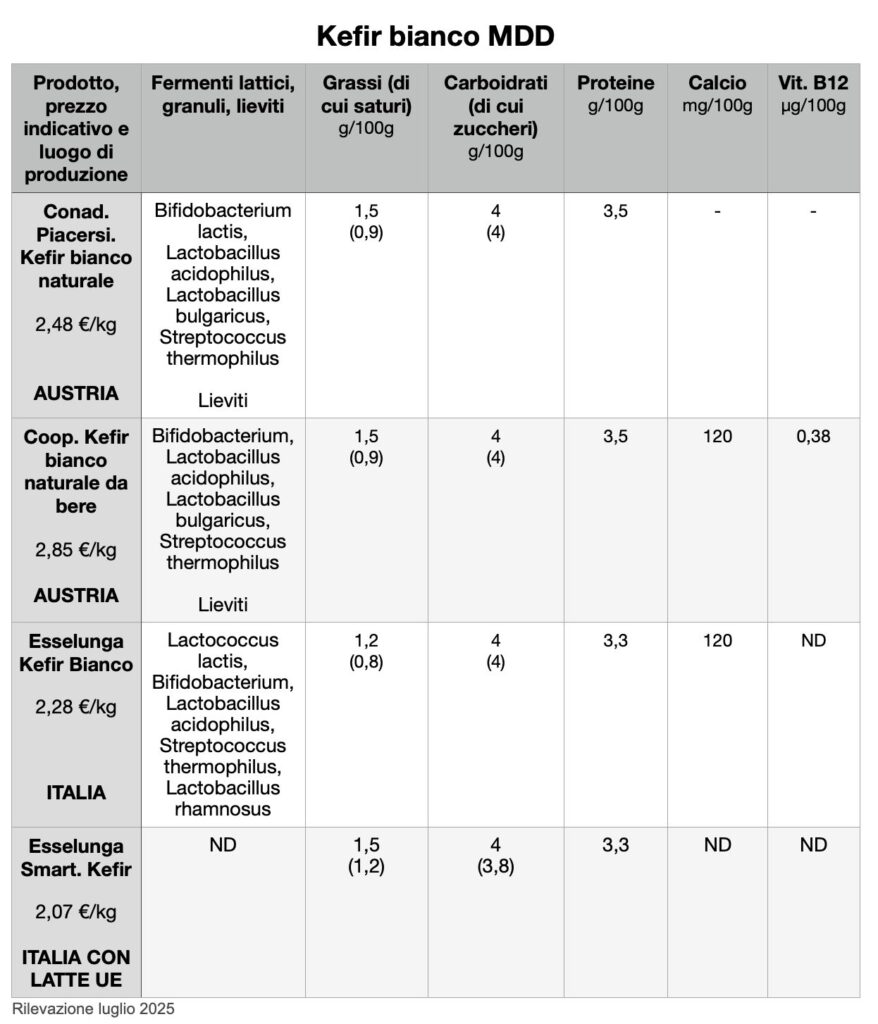
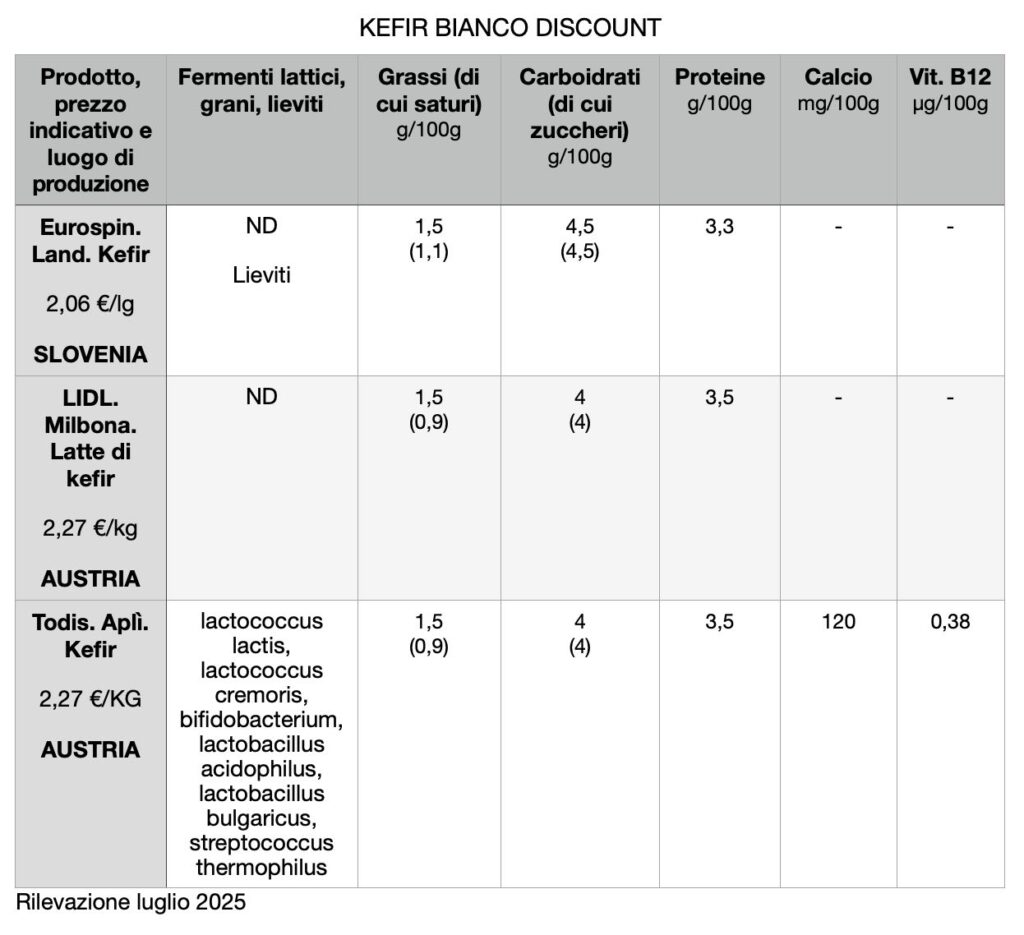
Of the three white kefirs offered by discount, two (Eurospin and Lidl) contain undisclosed lactic ferments.
Flavored industrial kefirs
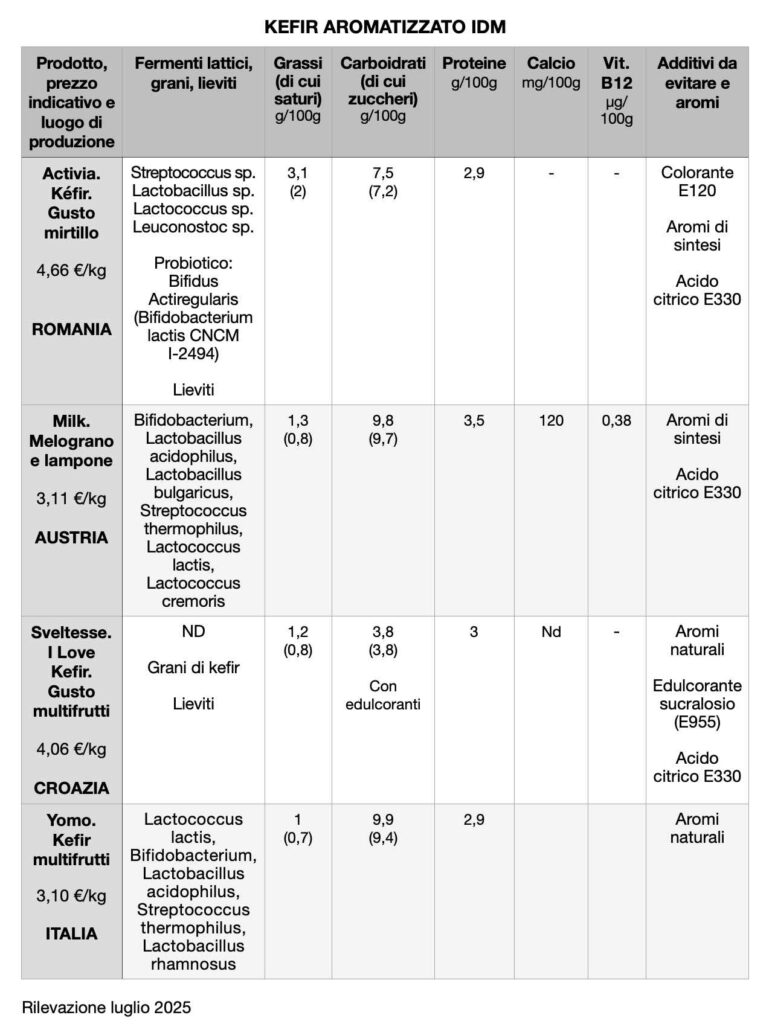
In the flavored kefirs, the base is the already examined product, white kefir, to which ingredients are added to give flavor and color to the mixture.
Two problematic elements common to the entire sample are:
- theexcessive amount of sugar. Not considering Sveltesse which uses a sweetener, the range goes from 7.2% (Activia) to 12% (Coop)
- the presence of citric acid (E330). Except for Yomo, Esselunga (both products by Granarolo), and Todis, it is always present. This additive, widely used also in soft drinks, can damage teeth if consumed in large amounts, especially in children.
Two kefirs with synthetic flavorings
The two flavored kefirs from Big Food follow the classic pattern of ultra-processed foods, characterized by the use of ‘cosmetic’ ingredients:
- Activia blueberry flavor does not contain even traces of blueberry. The flavor of the sought-after red fruit is due only to synthetic aromas. Among the six additives contained, cochineal (E120), obtained from the squeezing of an insect and a potential cause of allergy, stands out.
- Sveltesse I love kefir multifruit flavor follows the same pattern. Synthetic aromas provide the reminder of the fruit flavor. Sucralose is chosen to reduce added sugars sucralose (E955), a sweetener suspected of harming health. It is a probable carcinogen, associated with higher risk of cardiovascular diseases, type 2 diabetes, intestinal inflammation, alteration of the gut microbiota, as well as being an enemy of weight control. Another problematic additive present is theemulsifier locust bean gum (E410), linked to alteration of gut flora, as well as a higher risk of breast cancer, according to a recent INSERM study.
In the other two kefirs in the branded industry segment, fruit is present in the form of concentrated juice and/or puree. However, Milk adds synthetic aromas, Yomo natural aromas.
The distributor's brand
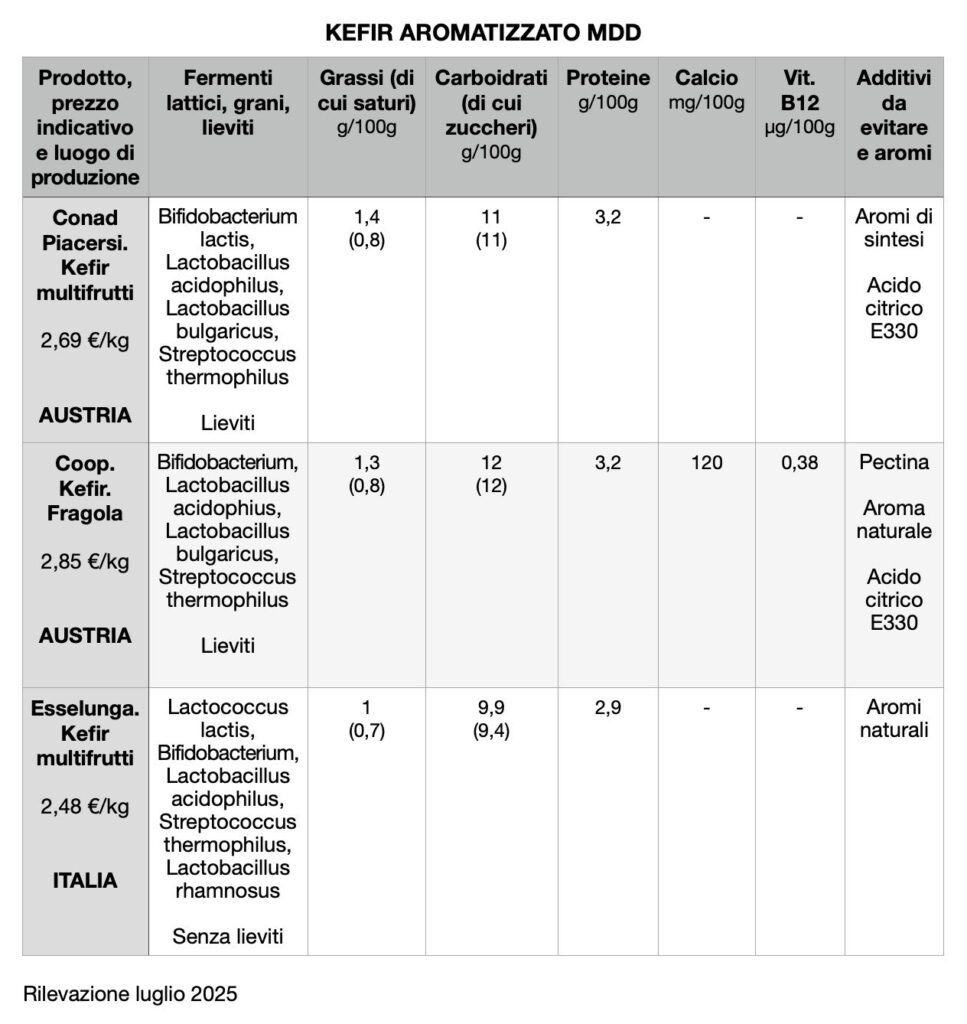
Among the flavored kefirs of the store brand, fruit (concentrated juice and/or puree) is always present.
The cleanest recipe is from Esselunga (produced by Granarolo), which uses only natural aromas. Followed by Coop, which adds pectin to the natural aromas.
Discount flavored kefirs
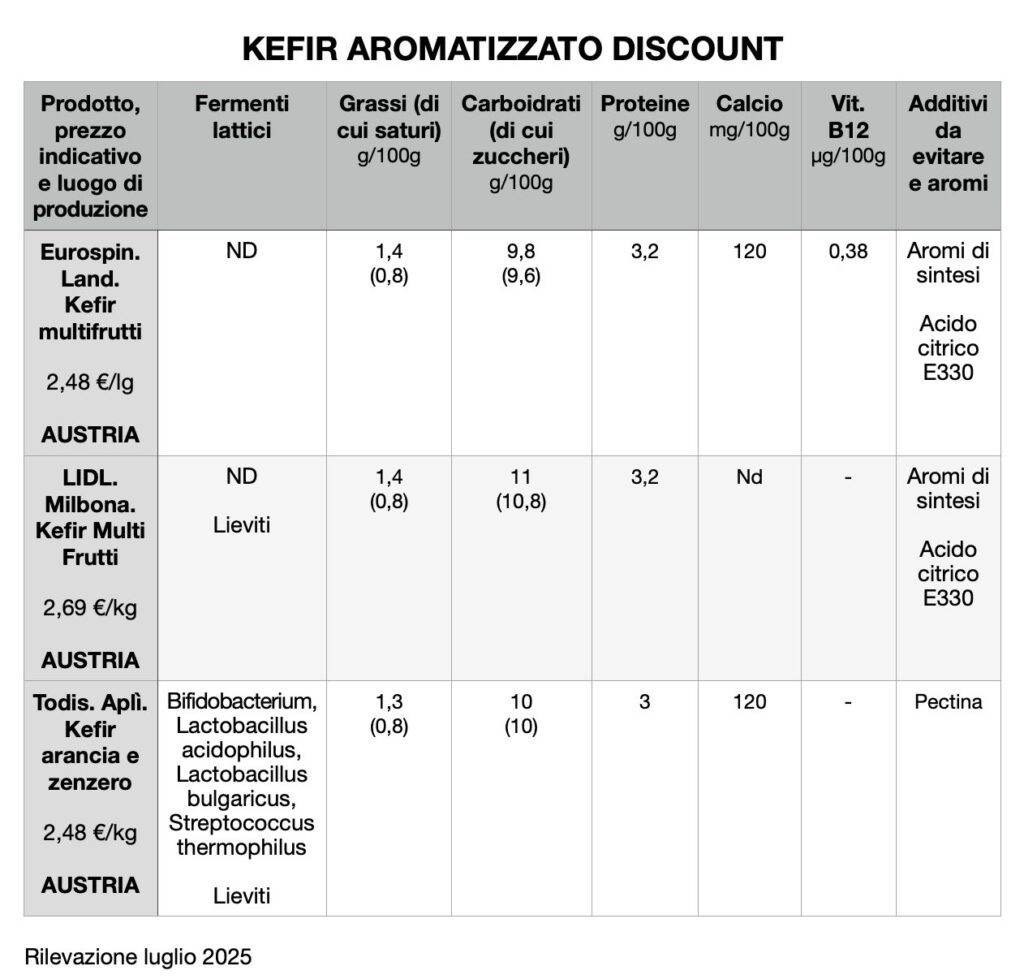
The three flavored kefirs offered at discount are all produced by the Austrian company NÖM, with different recipes. The cleanest is from Todis, which however adds pectin. In the other two (Eurospin and Lidl) the fruit flavor is entrusted to synthetic aromas.
Organic kefir
Six organic white kefirs close the sample. As with ‘conventional’ white kefir, the recipe is free of problematic ingredients. The milk, always organic, in NaturaSì's Sì Essenziali kefir (produced by BioNova) is obtained from hay-fed cows.

A regulation to protect consumers is urgently needed
With the same name, commercial kefir available at the supermarket can never be like the traditional Caucasian recipe, probably hardly appreciated by the average consumer.
Nonetheless, one appears necessary regulatory reform that allows the use of the term kefir only in the presence of characteristics as close as possible to the traditional recipe.
Marta Strinati
References
– Abdoun, E (2024, November 22). After skyr, the kefir scam? Que Choisir. https://www.quechoisir.org/actualite-produits-laitiers-apres-le-skyr-l-arnaque-du-kefir-n132718/
– Codex Alimentarius. STANDARD FOR FERMENTED MILKS CXS 243-2003 Adopted in 2003. Revised in 2008, 2010, 2018. Amended in 2022 and 2024.
– Dongo, D. (2025, July 3). Kefir, a functional beverage? FT (Food Times).
– Dongo, D (2024, December 28). Operator name and identification mark? Lawyer Dario Dongo answers. FARE (Food and Agriculture Requirements).
– Maughan, L., Koolman, L., Macori, G., Killian, C., Fanning, S., Whyte, P., & Bolton, D. (2025). Characterization of bacterial and fungal populations in retail kefirs in Ireland. Journal of Dairy Science. Advance online publication. https://doi.org/10.3168/jds.2025-26587
– Prado, M. R., Blandón, L. M., Vandenberghe, L. P. S., Rodrigues, C., Castro, G. R., Thomaz-Soccol, V., & Soccol, C. R. (2015). Milk kefir: Composition, microbial cultures, biological activities, and related products. Frontiers in Microbiology, 6, 1177. https://doi.org/10.3389/fmicb.2015.01177

Professional journalist since January 1995, she has worked for newspapers (Il Messaggero, Paese Sera, La Stampa) and magazines (NumeroUno, Il Salvagente). Author of investigative reports on food, she has published the book 'Reading labels to know what we eat'.


