
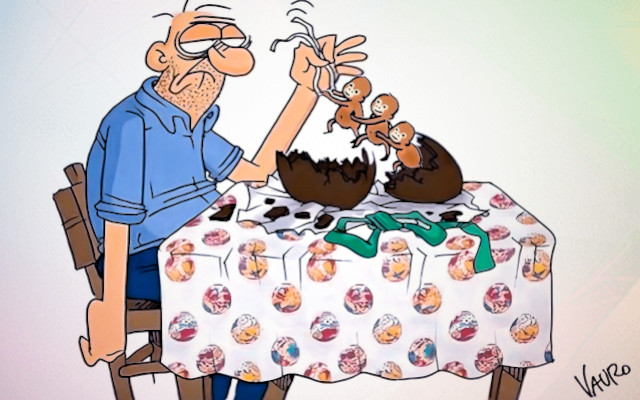
Chocolate eggs, the ‘indispensable’ Easter gift, are the classic example of Big Food mocking consumers. Exorbitant prices for the mere shape of molds and the ‘surprise’ (actually revealed on the packaging), regardless of product quality. Below, the analysis of 24 chocolate eggs available on supermarket shelves. The sample includes 13 milk chocolate eggs, 5 ‘white’ chocolate and 6 dark chocolate eggs. (1)
The grand ball of chocolate eggs
The first element that catches the consumer’s eye is inflation, or rather greedflation. The average price of chocolate molded into an egg shape is 52 euros/kg, and it is not at all justified by either the quality of the ingredients, which are on average poor, or the type of chocolate (milk or dark).
The price difference per kilo seems instead linked only to the brand notoriety of the producer and the gadgets (cartoon characters, TV series, etc.), that is to the type of surprise. With an average price increase of 7.4%, compared to 2023, according to the survey conducted by Altroconsumo. (2)
Palm oil and synthetic flavors
Palm oil seemed almost to have disappeared from foods in Italy, thanks to the success of our petition against its use in food because its production is a primary cause of land grabs, deforestation and orangutan extermination. Even more so after EFSA revealed the carcinogenicity and genotoxicity of three process contaminants present in the lowest quality fats. (3) Instead, it is found in the ingredient list of one third of the chocolate eggs examined, all bearing the Ferrero and Nestlé brands.
The synthetic flavors chemicals are in turn present in over 37% of the sample.
The cocoa is significant only in dark chocolate eggs, while in the other two versions it is overwhelmed by sugar.
Milk chocolate eggs, dear Kinder
Among the 13 milk chocolate eggs, 6 are accompanied by children's gadgets. The average price is 52 euros/kg, with a range between 33 €/kg of Pernigotti and 80 €/kg of Kinder Gran Sorpresa. The latter is also the most expensive in the children's segment alone, where the average cost is 56 €/kg.
Price and quality are independent variables. The Kinder Gran Sorpresa egg is emblematic and is characterized by
- the lower amount of cocoa. 14.5%, compared to an average of 30.7%
- the higher amount of saturated fats. 24.1%, compared to an average of 19.6%
- the presence of palm oil, along with Ferrero Rocher and Kit Kat by Nestlé
- the addition of synthetic flavors, as well as in 5 other milk chocolate eggs: Dolfin, Ferrero Rocher, Lindt, Motta, and Bauli in the children's version only (the adult egg uses natural vanilla).
Sugars abound. With an average of 52.5% – more than half of the entire egg – the range goes from 39% of Sperlari to 56.6% of Dolci Preziosi. Soy lecithins are always present.

White chocolate eggs, the lost cocoa
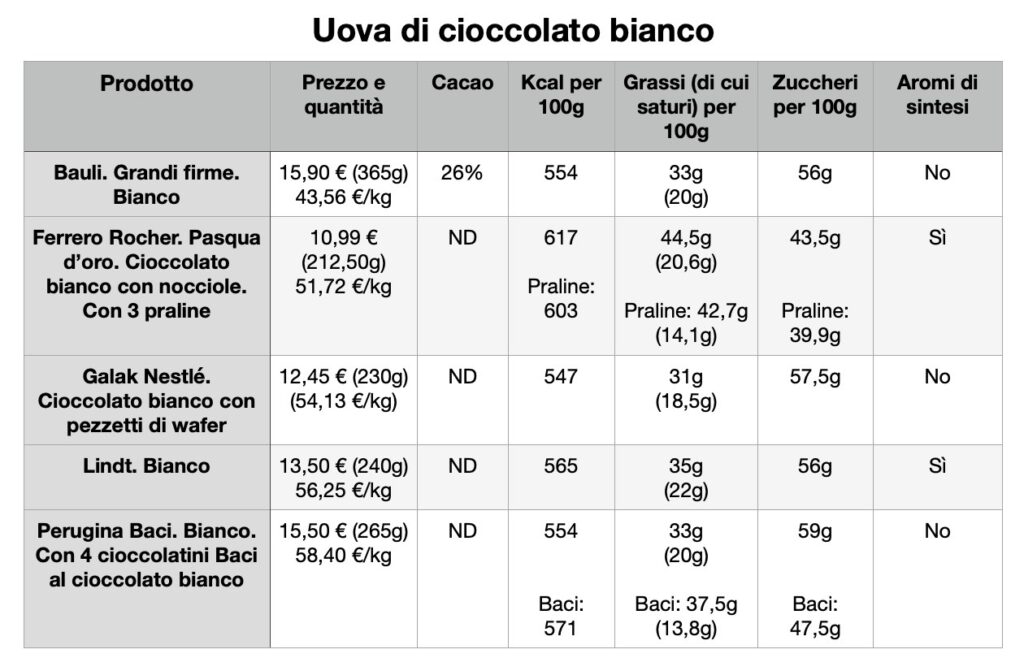
The cocoa is a marginal element in white chocolate. Among the five selected products, only in Bauli 'Grandi firme' is the percentage specified (26%).
Saturated fats and sugars, instead, abound:
– the average for saturated fats is 20.22 g per 100 g of product, with a minimum of 18.5 g in Galak Nestlé and a maximum of 22 g in Lindt,
– sugars are more abundant than in milk chocolate eggs. The average is 54.4%, with a minimum of 43.5% in Ferrero Rocher and a maximum of 59% in Perugina Baci Bianco by Nestlé.
Palm oil is used in Galak and in the pralines included in Ferrero Rocher. The latter is the only one, along with Lindt, that uses synthetic flavors. Soy lecithins are everywhere.
The average price is 53 €/kg, with a minimum of 43 € for Bauli and a maximum of over 58 € for Perugina Baci.
Dark chocolate eggs
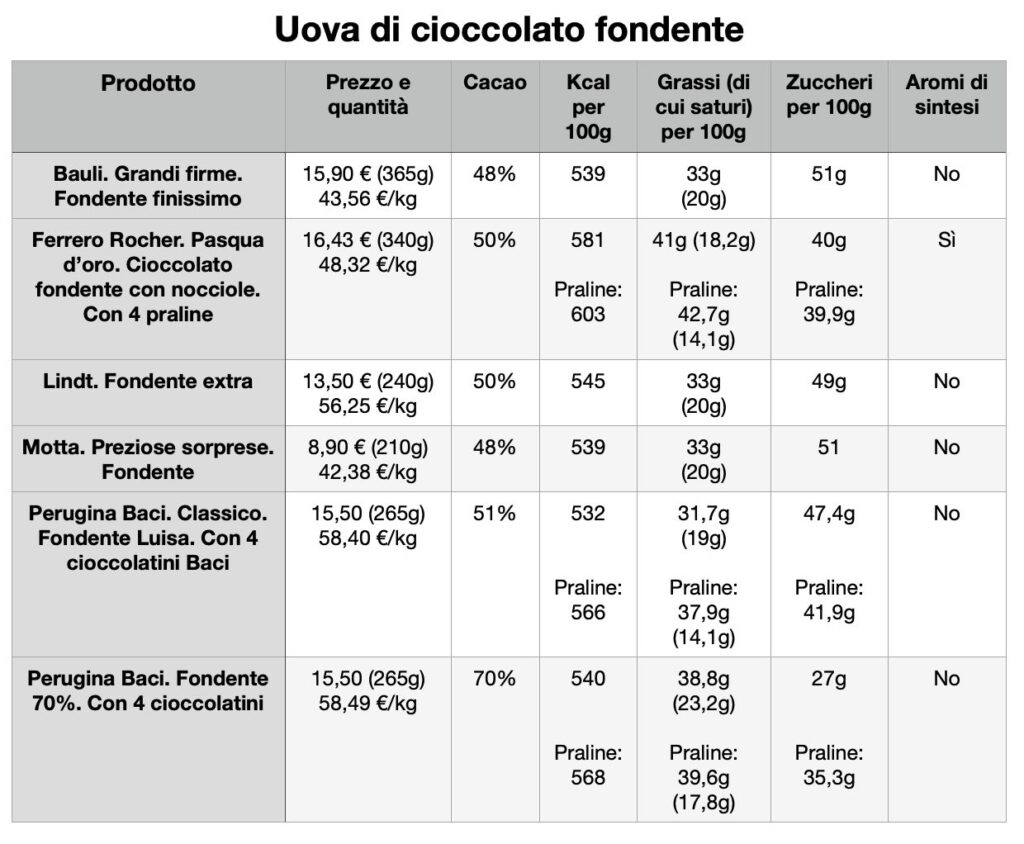
In dark chocolate eggs cocoa takes center stage with percentages around 50%. The ultra-dark Perugina Baci 70% is an exception.
Ferrero Rocher dark with hazelnuts is the only one of the six compared products to use palm oil in the pralines and synthetic flavors.
The emulsifier soy lecithin is always present. As for macronutrients,
– saturated fats average 20% of the product, with a maximum peak of 23.2 in Perugina Baci 70% dark and a minimum (18.2%) in Ferrero Rocher Pasqua d’oro,
– sugars are less invasive compared to milk and ‘white’ chocolate eggs. The average is 44g per 100 grams of egg, with a maximum of 51g in Bauli Grandi firme and a minimum of 27g in the ‘bitter’ version of Perugina 70%.
The average price is 51 euros, slightly less than the ‘milk’ versions, often intended for children and therefore burdened by the cost of gadgets.
Gluten and other allergens
Almost all of the 24 chocolate eggs examined declare the absence of gluten. Exceptions are
– Kit Kat
– Sperlari Zanzibar
– Ferrero Rocher hazelnuts
– Bauli Grandi firme.
In two cases the ‘gluten free’ claim appears on the front of the label: Dolci Preziosi al latte (Pokemon) and Galak Nestlé. In others, it appears at the end of the ingredient list.
In the same area of the label the possible presence of other allergens is communicated. And here the violation of the rules is widespread. Almost all operators declare ‘may contain nuts’ or ‘may contain other nuts.’ A warning that is incorrect because it lacks the indication of the type of allergen, as we have seen. (4)
An exception is Ferrero:
– in the white Rocher and the hazelnut one it correctly warns ‘May contain almonds, pistachios’
– in Kinder Surprise it does not include any warning about contamination risk.
Despite the presence of soy lecithins, no label warns of the possible presence of this allergen. Yet, as we have seen, the consumption of lecithins (additive E 322) is not recommended for people allergic to soy, because the possibility of contamination by the protein fractions of this allergen cannot be excluded. (5)
The unsustainability of chocolate eggs
Sustainability It is not fashionable at Easter. At least three ingredients of chocolate eggs are at high risk of exploitation, but this is almost never reflected on the labels.
For cocoa, the only brand that displays a logo related to the sustainability of this ingredient is Nestlé with Rainforest Alliance. However, this precious ingredient is often obtained through violent practices, such as child labor exploitation with exposure of minors to dangerous pesticides and herbicides without personal protective equipment, abuses recently challenged by International Rights Advocates against the giants Mars, Cargill, and Mondelez.
For hazelnuts, only Sperlari Zanzibar reports an Italian origin. However, even for this ingredient, imports from abroad pose significant risks, as documented by the BBC investigation into child labor and worker exploitation in Turkey in the hazelnut plantations supplying Ferrero.
On palm oilfinally, over the years we have extensively documented the cases of land robbery and deforestation still underway in Brazil to produce 'sustainable' palm oil destined for Ferrero and other giants of the globalized food industry. Nestlé, PepsiCo, Kellogg's, Mars, Danone and Langnese among others. The labels are silent on the subject. And maybe it's better.
Marta Strinati
Notes
(1) Sampling carried out on March 23, 2024 in large-scale retail trade.
(2) R. Usai, G. Voto. Compared to last year, Easter egg prices have risen by 7.4%. Dove prices are stable. Altroconsumo. 19.3.24 https://www.altroconsumo.it/alimentazione/fare-la-spesa/speciali/prezzi-dolci-pasquali
(3) Palm oil contains carcinogenic and genotoxic substances. EFSA alert for children and adolescents. Record consumption in Italy. Food Times. 5.5.16
(4) Dario Dongo. May contain traces of… allergens? Indication of crime. FARE (Food and Agriculture Requirements). 11.8.17
(5) Marta Strinati. Frùttolo and other milk snacks, 10 products compared. GIFT (Great Italian Food Trade). 25.9.21

Professional journalist since January 1995, she has worked for newspapers (Il Messaggero, Paese Sera, La Stampa) and magazines (NumeroUno, Il Salvagente). Author of investigative reports on food, she has published the book 'Reading labels to know what we eat'.


