

Broth cubes, convenient culinary shortcuts, are also an emblem of food industrialization, often rich in salt and controversial additives. This market survey of 33 products does not limit itself to a superficial comparison, but offers a critical and detailed analysis, revealing deceptive marketing strategies and the real health implications.
Liebig’s meat extract, the precursor of broth cubes
The German chemist Justus von Liebig In the mid-1800s he developed a method to extract and concentrate meat nutrients, creating a product that could be stored for a long time and used to prepare nutritious broths. This meat extract, called ‘Liebig’s Extract of Meat’, became very popular in Europe and the United States.
From extract to the ‘modern’ cube
Liebig’s concept was further developed and marketed by other companies. One of the first modern broth cubes, in cube form, was introduced by the Swiss company Maggi, founded in 1884 by Julius Maggi at the end of the 19th century.
The Maggi brand was acquired by Nestlé back in 1947. Its vegetable and legume-based cubes revolutionized the market, offering a more economical plant-based alternative compared to meat extracts. Liebig's extract was initially aimed at a wealthy audience.
Broth cubes, the standard recipe
Broth cubes today mainly consist of:
– salt, often present in large quantities, as the first ingredient
– fats, of vegetable or animal origin
– flavor enhancers such as monosodium glutamate
– flavors (often synthetic) and spices
– dehydrated vegetables, such as carrots, celery, and onion
– proteins, in products containing meat or poultry extracts.
Health problematic aspects
The basic recipe of broth cubes can be problematic for health especially due to the presence of salt and flavor enhancers.
The harmful effects of salt
Salt in the amounts present in these products can harm those suffering from hypertension or cardiovascular problems and negatively affect health andlife expectancy.
Excessive salt intake – in addition to causing water retention and swelling – is indeed associated with an increased risk of a range of NCDs (Non-Communicable Diseases) including osteoporosis, stomach cancer, cognitive decline, and dementia in the elderly, diabetes.
The WHO therefore recommends reducing salt consumption within a maximum threshold of 5 grams per day (about one teaspoon), which corresponds to about 2 grams of sodium, for adults. With corresponding reductions based on weight for children.
Flavor enhancer additives
Among flavor enhancer additives, the most well-known is monosodium glutamate. In addition to temporary discomforts (headache, nausea, collected under the expression 'Chinese syndrome', due to the widespread use of glutamate in Chinese restaurants), E 621 is associated with a higher risk of cardiovascular diseases and impairment of the gut microbiota.
Also problematic are the other flavor enhancer additives, namely
- E635, disodium ribonucleotides,
- E627, disodium guanylate
- E631, disodium inosinate.
These additives are 10 times more potent than glutamates, with which they are combined. They are metabolized and expelled from the body in the form of uric acid. Increasing the concentration of uric acid in the blood may favor gout in predisposed people.
Low quality ingredients
The quality of meat extracts is obviously very different from that of homemade meat broth, as it contains the slaughterhouse waste.
Other low-cost ingredients very common in industrial stock cubes are
- palm oil. This cheap tropical fat causes great ethical repulsion. Oil palm plantations are in fact systematically associated with land grabs e deforestations
- synthetic flavors. Synthetic chemical substances, are often used, in non-organic products, to imitate the taste of natural flavors typical of broth, meat, and vegetables.
33 cubes compared
The above highlighted characteristics are clearly evident in part of the 33 broth cubes examined.
Salt is always the first ingredient and – except for products marketed as ‘with less salt’ – exceeds 50% of the product.
Hidden salt
Knorr (Unilever) and three organic brands (Più Bene and Fior di loto, both from Naturasì, and Rapunzel) are particularly hostile to transparency towards consumers. The nutritional label of these cubes in fact reports the salt concentration per serving (expressed as one cube in 250 ml of water) instead of per 100 grams of product.
This anomaly prevents the consumer from comparing the amount of salt contained in the related products with others, forcing them to consult information presented in microscopic characters and engage in mathematical calculations.
In the case of Knorr, the preparation indicated by the producer involves dissolving one cube in half a liter of water and the ‘serving’ is 250 ml of ‘broth’. In practice, the nutritional values per ‘serving’ correspond to half a cube, which weighs 10 grams. Therefore, you must multiply the serving value by two and then by 100 to get the value per 100 grams of product. In this way we recalculated the nutritional values reported by Knorr to make our comparative tables understandable. We made a similar calculation for the other three ‘less forthcoming’ products.
Illegal nutritional claim
The EU regulation 1169/11 on consumer information concerning food requires reporting nutritional values per food ‘as sold’. Providing ‘if applicable’ the alternative to refer to the food ‘after preparation, provided that the preparation methods are described in sufficiently detailed manner and the information refers to the food ready for consumption’ (article 31.3).
Unilever however:
- labels the nutritional values to the broth made by diluting the product with water, and however
- designates the Knorr cube as ‘broth and seasoning preparation based on glutamate’
- indeed suggests, on the official website, the use of the cube as seasoning as is, in solid form, without dilution in water (‘To season: add a cube directly in the pan during cooking to give a touch of flavor to your recipes’).
Our lawyer Dario Dongo, Ph.D. in international food law, notes in this regard that the nutritional declaration therefore does not comply with the requirements of the Food Information Regulation (EU) 1169/11 under both aspects of:
- inconsistency between the nutritional declaration expressed for the food prepared according to the indicated methods and its different recommended use by the same responsible operator on the website
- resulting consumer confusion about the properties or nutritional composition of the product, in violation of fair information practices (article 7.1.a).
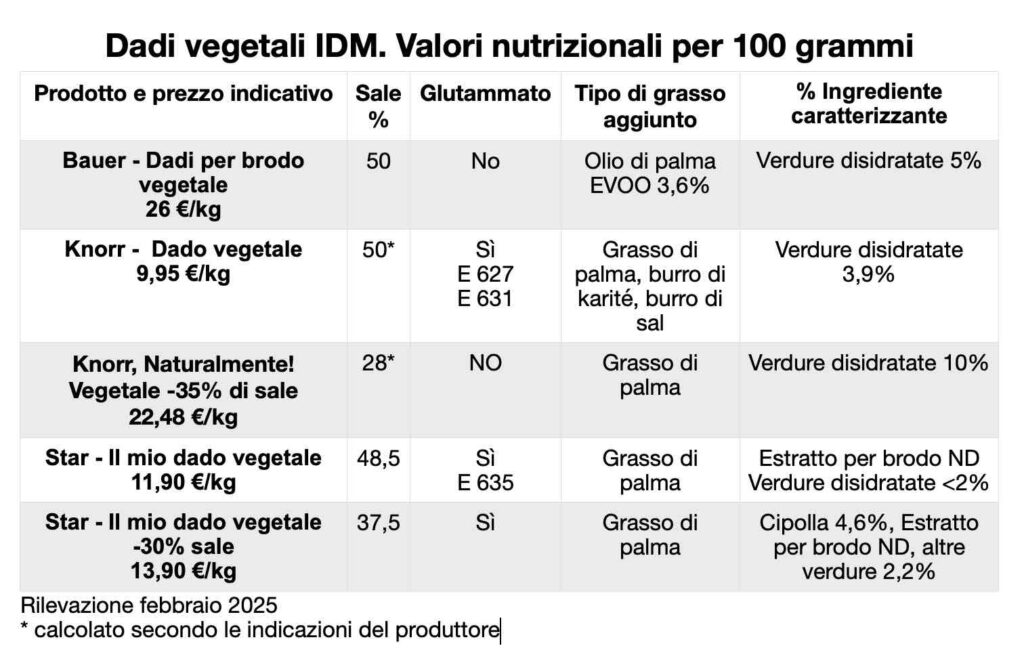
The five classic vegetable cubes of brand industry
Among the five classic vegetable branded industry cubes examined, the salt concentration is always around 50%. Exceptions are the two 'less salt' products of Star and Knorr, with 28 and 37 grams of salt per 100 grams of product respectively.
Glutamate and other flavor enhancers are always present, except in two products (Bauer and Knorr ‘naturally vegetable’).
The fat is always palm oil. Bauer adds a modest amount of extra virgin olive oil (3.6%), Knorr shea butter and palm butter.
The vegetables that should give flavor to the vegetable cube are present in amounts ranging from less than 2% to 10%.
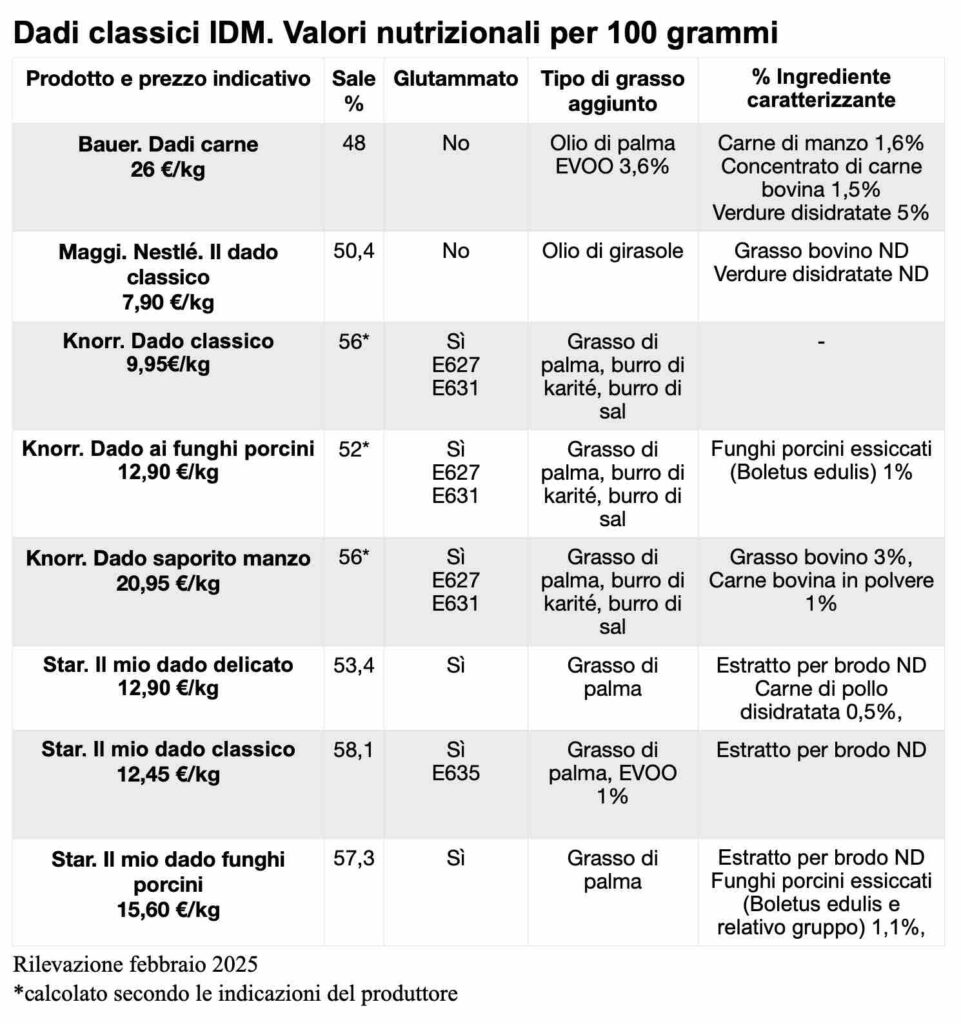
The eight classic non-vegetable cubes of industrial brands
Among the eight classic branded industry stock cubes not labeled as vegetable, the salt ranges from a minimum of 48% in Bauer to over 58% in Star classic cube.
Glutamate and related compounds are missing in only two cubes: Bauer and Maggi. The latter is the only cube in the group without palm oil, replaced with sunflower oil. In two cases, extra virgin olive oil (EVOO) is also found: 3.6% in Bauer and just 1% in the Star cube.
The concentration of the key ingredient in meat cubes is higher in Bauer, while in those with porcini mushroom flavor it just exceeds 1%.
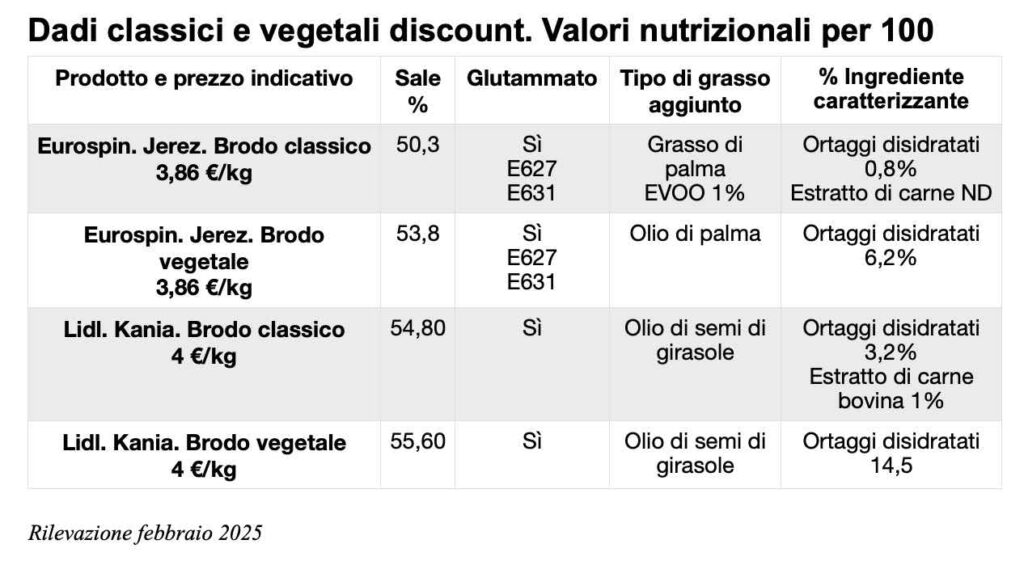
The four discount brand cubes
At the discount stores, the four classic stock cubes examined are very cheap, 4 euros per kg. Salt is always over 50% and peaks at 55.60% in Lidl's vegetable broth. The latter brand uses only sunflower seed oil, while the Italian Eurospin always uses palm fat.
Flavor enhancer additives are indispensable. Regarding key ingredients, Lidl’s vegetable cube uses 14.5% dehydrated vegetables, more than double the analogous Eurospin product.
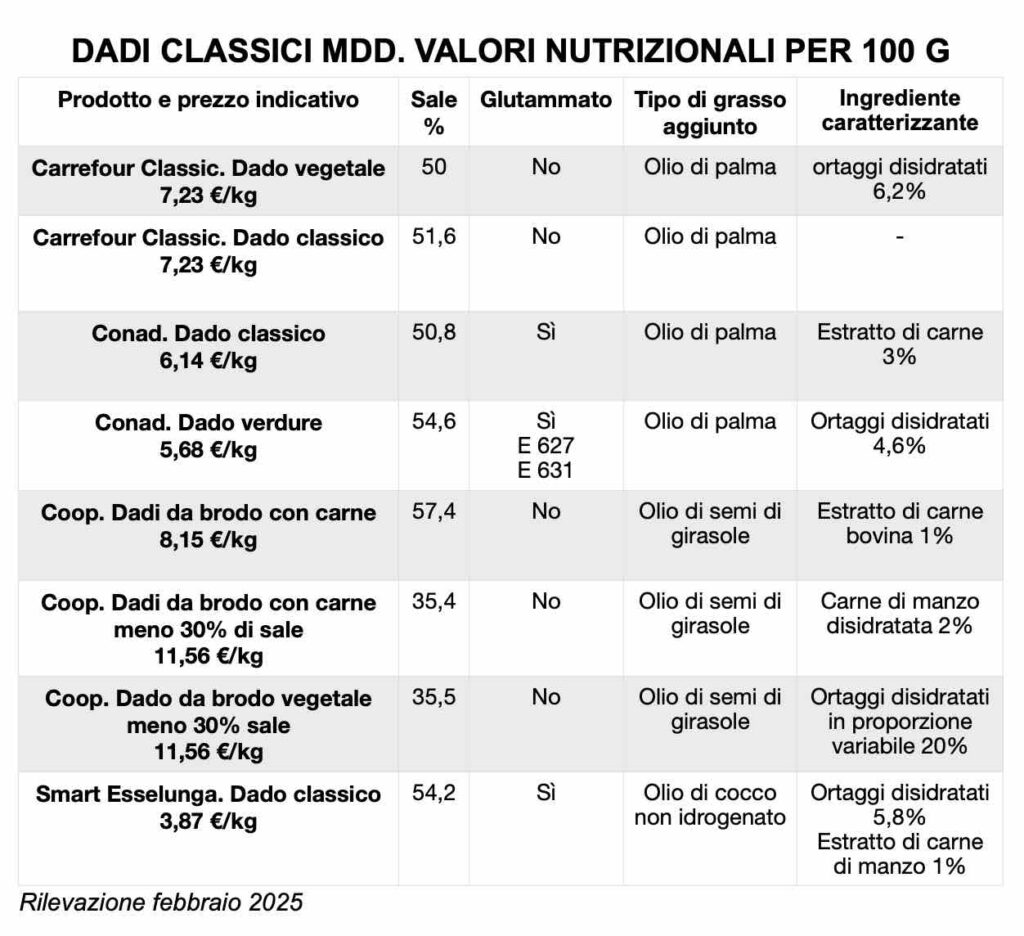
Eight classic distributor brand cubes
Of the eight private label stock cubes examined, three are vegetable, two are explicitly meat-based, and three are defined only as 'classic'.
Salt remains over half of the recipe and peaks at 57% in Coop’s meat stock cube. The same brand offers two ‘lower salt’ cubes, where the content is slightly over one third of the product.
Only Coop and Carrefour stock cubes are free of glutamate and other flavor enhancer additives: all are present in Conad’s vegetable cube.
Coop stands out favorably for the highest content of key ingredients in the lower-salt vegetable cube (20% dehydrated vegetables) as well as in the meat one (2%). The meat extract in the classic cube is instead higher in the Conad product.
All use palm oil, except Coop (sunflower seed oil) and Smart Esselunga (coconut oil, which contains many saturated fats).
The organic oasis
Organic broth cubes differ from ‘conventional’ ones by the absence of glutamate and other additives flavor enhancers, which are indeed prohibited in organic foods, along with many other controversial food additives.
The flavor comes fromyeast extract, always organic, except for Più Bene broth cubes from Naturasì, which replace it with miso, a traditional Japanese condiment made from soy, rice, salt, and koji mushrooms, very useful for reducing salt intake in home cooking.
Salt is always around 50%, but peaks at 55% in the Più Bene cube without yeast.
Palm oil only in Bauer organic
The fat content varies from sunflower oil, shea oil, or extra virgin olive oil (EVOO). Only the Trentino Bauer (the most expensive in the organic segment) uses palm oil.
The key ingredient ranges from 9 to 15% dehydrated vegetables in the seven plant-based products examined. In the only meat cube (Bauer), 3% beef is added to the 12.5% vegetables.
Misleading claims
Maggi (Nestlé) states on the packaging that its classic cube is ‘Made only with ingredients you know’. It is needless to ask how many consumers ‘know’ dehydrated glucose syrup and synthetic flavors present in the recipe.
Knorr, Naturally! Vegetable (Unilever). Compared to other cubes from the same brand, indeed, in this ‘naturally vegetable’ version the three glutamates are not found. Nonetheless, so much emphasis seems unjustified: nature, in fact, does not seem to include synthetic flavors added in the recipe.
Lawyer Dario Dongo notes, in both cases, a violation of fair information practices. Food Information Regulation (EU) 1169/11 indeed prohibits misleading consumers about the essential characteristics of foods, including their nature and composition (articles 36.2.a, 7.1.a).
Conclusions
The results of this investigation confirm the need for greater attention to the quality of ingredients in broth cubes. Organic alternatives, while representing an improvement, do not always completely eliminate risks related to excessive salt. The preparation of homemade broths, with fresh and controlled ingredients, remains the ideal solution for those who want a healthy and genuine diet, free of additives and excess salt.
Marta Strinati
References
1. WHO (2012). Guideline: Sodium intake for adults and children https://www.who.int/publications/i/item/9789241504836
2. WHO (2020). Salt reduction https://www.who.int/news-room/fact-sheets/detail/salt-reduction
3. European Society of Cardiology (ESC, 2021). 2021 ESC Guidelines on cardiovascular disease prevention in clinical practice https://www.escardio.org/Guidelines/Clinical-Practice-Guidelines/Cardiovascular-Disease-Prevention-in-Clinical-Practice
4. Ahangari, H., Bahramian, B., Khezerlou, A., Tavassoli, M., Kiani-Salmi, N., Tarhriz, V., & Ehsani, A. (2024). Association between monosodium glutamate consumption with changes in gut microbiota and related metabolic dysbiosis. A systematic review. Food Science & Nutrition, 12, 5285–5295 https://doi.org/10.1002/fsn3.4198

Professional journalist since January 1995, she has worked for newspapers (Il Messaggero, Paese Sera, La Stampa) and magazines (NumeroUno, Il Salvagente). Author of journalistic investigations on food, she published the volume 'Reading labels to know what we eat.'


