

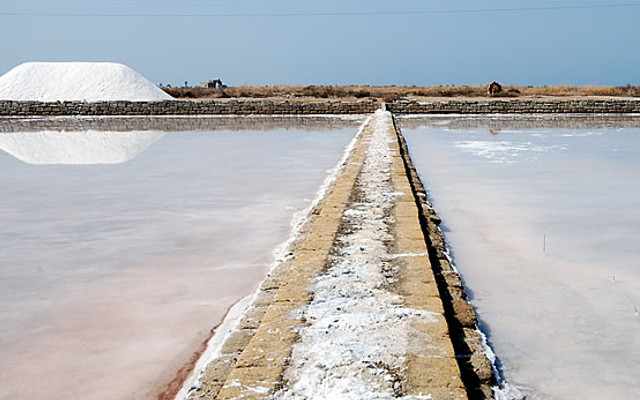
The Sea salt of Trapani PGI is the only Italian salt with a registered designation in the European Union. Its value lies not in generic promises of naturalness, but in verifiable requirements: geographic area, production method, analytical parameters, traceability, and labeling.
Added to these, in September 2026, are two developments that also concern international buyers: the candidacy of Sicilian salt pans as a UNESCO Biosphere Reserve and the process for recognizing sea salt as an agricultural product.
Designation and area
The designation ‘Sea Salt of Trapani‘ has been registered in the European register of geographical indications since 2012, with Commission Implementing Regulation (EU) No. 1175/2012 (European Commission, 2012a, 2012b). The specification reserves the PGI for sea salt produced in the salt pans of the Municipalities of Trapani, Paceco, and Marsala (MASAF, n.d.-a, n.d.-b).
The geographical area coincides with the coastal strip called ‘Salt Road’. It is bounded to the north by the town of Trapani, to the south by Marsala, to the west by the Mediterranean, including Isola Grande, Mothia, and Santa Maria dello Stagnone, and to the east by state road 115 (MASAF, n.d.-b).
All stages of production — salt pan cultivation, harvesting, and processing — must take place within the delimited area. The specification provides for registers of production plots, producers, and packers, with documentation of incoming and outgoing flows, to guarantee traceability (MASAF, n.d.-b).
From the basins to the harvest: the production method
The method is fractional precipitation of the compounds contained in seawater. The water passes through a succession of communicating tanks in which the salt concentration gradually increases: carbonates and sulfates precipitate in the intermediate stages, sodium chloride crystallizes in the final tanks (MASAF, n.d.-b).
The salt pans are organized into four orders of tanks: the fridde, or first entry tanks; the cultivation tanks cultivation or service; the caure, also called evaporating; the salting or crystallizing. The cycle è annual: start in April, one or two harvests between the second half of July and the first half of September, a possible third harvest in October in case of prolonged drought (MASAF, n.d.-b).
The cycle depends on the climate, and 2026 reminded us of this: the exceptional tides of the season diluted the deposits in the tanks and significantly reduced the yields, as reported by producers at the Confagricoltura conference on September 12, 2026, in Marsala (Marsala Live, 2026).
The harvest can be manual or mechanical. Subsequent processing may include washing in saturated water from the salt pans of the same area, centrifugation, grinding, drying in fluidized bed ovens at temperatures below 250 °C, and sieving. The specification defines whole salt the product that has been neither washed nor centrifuged (MASAF, n.d.-b).
I windmills that dot the landscape have a historic productive function. The Nubia Salt Museum documents two types: the 'star' mill, of Dutch model, with blades about four meters long, which operates an Archimedes' screw to lift water from one tank to another; and the 'American' mill, with smaller metal blades. At the Ettore and Infersa salt pans, in the Stagnone of Marsala, a 16th-century mill is still operational (Nubia Salt Museum, n.d.; Sosalt, n.d.).
Compliance parameters and labeling
The specification sets the physical characteristics and the analytical parameters that every certified batch must comply with (MASAF, n.d.-b).
| Parameter | Requirement provided by the specifications |
| Sodium chloride, on dry matter | >97.0% |
| Residual moisture | |
| Insoluble residue | |
| Magnesium | |
| Potassium | |
| Calcium | |
| Sulfates | |
| Iodine | >0.70 mg/kg |
The regulations also establish limits for iron, lead, zinc, copper, chromium, mercury, cadmium and arsenic. The‘appearance required is that of a white salt, with consistent crystals and mixed granulometry. They are additives, bleaching agents, preservatives and anti-caking agents are prohibited (MASAF, n.d.-b).
The packages intended for consumption must have a non-reusable guarantee seal. The allowed sizes range from 100 grams to 1,000 kilograms. The label must display the European graphic symbol and the wording ‘PGI – SEA SALT OF TRAPANI’, in clear and legible characters, with adequate contrast against the background (MASAF, n.d.-b).
Who controls: the control plan
The public control authority is the Chamber of Commerce of Trapani, appointed by the Ministry of Agriculture by decree no. 7881 of March 14, 2012. The control plan distinguishes four categories of operators: producers, processing centers, intermediaries and packers, all registered in a specific system (Chamber of Commerce of Trapani, n.d.).
The checks follow the saltworks calendar: applications for access to the system must be submitted by April 30, before the summer harvest; production reports by November 30; processing centers, intermediaries and packers transmit the documentation bimonthly.
Before the certification of a batch, the packer requests the official sampling of a 2 kg sample every 1,000 tons or fraction, divided into five aliquots of 400 g, sealed and identified. The Protection Consortium can assist operators in the preliminary verification of labels, but the final decision rests with the Chamber of Commerce (Chamber of Commerce of Trapani, n.d.).
Supply chain, volumes, and markets
The salt pans of Trapani and Paceco extend over about 1,000 hectares and supply most of the sea salt intended for the Italian food supply chains (Sosalt, n.d.). According to data presented by Confagricoltura in Marsala on September 12, 2026, the sector is worth 25-30 million euros per year; about 90% of the product is destined for the agri-food industry, where sea salt is used in salting, preserves, and baked goods, and exports reach the United States, Canada, and Japan (Marsala Live, 2026).
At the same conference, Confagricoltura reiterated the request to recognize the salt farming as an agricultural activity, distinguishing sea salt, harvested in summer and climate-dependent, from rock salt extracted from mines. The issue is under ministerial discussion and no act has yet been approved (Marsala Live, 2026).
Alongside the PDO production, there is a Slow Food Presidium 'Sea Salt of Trapani', manually harvested, referring to the Oro di Sicilia saltworks of the Culcasi family in Nubia di Paceco. The Presidium product is wetter and grayer compared to the washed one, with declared higher potassium and magnesium content (Fondazione Slow Food, n.d.).
History, territory and protected areas
The regulation links the tradition of salt trade in Trapani to about three thousand years ago and recalls the role of the Phoenicians in the economy of the so-called ‘'white gold'. The reconstruction should be presented as a historical tradition reported by the regulation, not as archaeological proof: the Salt Museum of Nubia itself notes that there is a lack of material evidence to establish its beginning with certainty (MASAF, n.d.-b; Museo del Sale di Nubia, n.d.).
More solid is the reference to al-Idrisi. In the Book of Roger, completed in 1154 for Roger II, the geographer notes a saltworks right in front of the gate of the city of Trapani. This is documentary proof of salt production activity in the Middle Ages, without needing unproven reconstructions about Bourbon primacies or European courts (Museo del Sale di Nubia, n.d.).
The Trapani and Paceco Salt Pans Natural Reserve it does not coincide with the entire PGI area, which also includes Marsala. Established by the Sicilian Region on 11 May 1995 and entrusted to WWF Italy for management, it extends over approximately 1,000 hectares, of which 700 are salt marshes in zone A. Since 1 April 2011 it has been a wetland of international importance under the Ramsar Convention, as well as a Natura 2000 site. 229 species of birds have been recorded there, including flamingos, spoonbills and avocets; the tanks with different salinity, created by saliculture, support this biodiversity (WWF Italy, n.d.-a, n.d.-b).
The UNESCO candidacy
In September 2026 the national technical commission for the programme ‘Man and the Biosphere’ (MaB) of theUNESCO approved the candidacy dossier of the ‘Saltworks of Sicily’ as a Biosphere Reserve.
The steering committee, initiated by the Chamber of Commerce of Trapani, brings together the Sicilian Region, the Free Consortium of Trapani, the municipalities of Trapani, Marsala, Misiliscemi and Paceco, and WWF.
The dossier is sent to Paris by the end of September 2026 for international evaluation. If positive, it would be the first coastal wetland of origin anthropic to obtain such recognition (AGI, 2026).
Sea salt, rock salt, and iodine: useful distinctions
The international standard Codex CXS 150-1985 defines the table salt as a product mainly composed of sodium chloride, obtainable from seawater, underground rock salt deposits or natural brines, with a minimum content of NaCl of 97% on the dry matter, excluding additives (Codex Alimentarius Commission, 1985).
Marine or mineral origin alone does not allow establishing a nutritional hierarchy among different salts. The Codex notes that secondary components depend on both the origin and the processing method. Therefore, it is not correct to generally oppose a ‘mineral-rich’ sea salt to a ‘purer’ rock salt, nor to assign intrinsic safety or health advantages to either category (Codex Alimentarius Commission, 1985).
The iodine content greater than 0.70 mg/kg indicated by the specification is a product requirement, but does not equate to iodization. In Italy, the national iodine prophylaxis programme, introduced by law 55/2005, refers to iodine-enriched salt marketed with a concentration of 30 mg/kg, that is over forty times the minimum required by the PGI specification (Higher Institute of Health, 2020).
Conclusions
Trapani Sea Salt PGI is defined by a verifiable system of rules: origin in the coastal belt between Trapani, Paceco and Marsala, production by evaporation and fractionated precipitation in successive basins, analytical requirements, public controls entrusted to the Chamber of Commerce, traceability and labeling.
Its enhancement comes from these documented elements and from the historical and environmental heritage of the salt pans, now candidates for Biosphere Reserve status, without attributing to the product unproven nutritional or health benefits (European Commission, 2012a; MASAF, n.d.-b).
Dario Dongo
References
Regulatory sources, registries, and specifications
Trapani Chamber of Commerce. (n.d.). IGP Control plan 'Sea Salt of Trapani'. https://www.tp.camcom.it/sites/default/files/contenuto_redazione/notizie/file/1_pdc_igp_sale_marino_di_trapani_-.pdf
European Commission. (2012a). Commission Implementing Regulation (EU) No 1175/2012 of 7 December 2012 entering a name in the register of protected designations of origin and protected geographical indications (Sale Marino di Trapani (PGI)). http://data.europa.eu/eli/reg_impl/2012/1175/oj
European Commission. (2012b). Sea Salt of Trapani: eAmbrosia register of geographical indications, file PGI-IT-0892. https://ec.europa.eu/agriculture/eambrosia/geographical-indications-register/details/EUGI00000014021
Ministry of Agriculture, Food Sovereignty and Forests. (n.d.-a). DOP and IGP specifications for agricultural products: 2.6 Salt. https://www.masaf.gov.it/flex/cm/pages/ServeBLOB.php/L/IT/IDPagina/9733
Ministry of Agriculture, Food Sovereignty and Forests. (n.d.-b). Production specification of the Protected Geographical Indication ‘Sea Salt of Trapani’. https://www.masaf.gov.it/flex/cm/pages/ServeAttachment.php/L/IT/D/6%252F0%252F7%252FD.24a9ddb94e0203ecdeaa/P/BLOB%3AID%3D9733/E/pdf?mode=download
Food standards and health sources
Codex Alimentarius Commission. (1985). Standard for food grade salt (CXS 150-1985). FAO & WHO. https://www.fao.org/fao-who-codexalimentarius/sh-proxy/en/?lnk=1&url=https%253A%252F%252Fworkspace.fao.org%252Fsites%252Fcodex%252FStandards%252FCXS%2B150-1985%252FCXS_150e.pdf
Higher Institute of Health. (2020). Iodine prophylaxis in Italy: ISS data 2015-19. EpiCentro. https://www.epicentro.iss.it/iodio/iodoprofilassi-in-italia-dati-iss-2015-19
Territorial, environmental, and supply chain sources
AGI. (2026, September 10). The Saltworks of Sicily apply for UNESCO heritage status. https://www.agi.it/cultura/news/2026-09-10/unesco-saline-sicilia-38970751/
Slow Food Foundation. (n.d.). Sea salt of Trapani. Slow Food Presidiums. https://www.fondazioneslowfood.com/it/presidi-slow-food/sale-marino-di-trapani/
Marsala Live. (2026, September 15). Sea salt as an agricultural product: in Marsala the discussion on the future of saltworks. https://www.marsalalive.it/2026/09/15/sale-riconoscimento-agricolo-marsala/
Nubia Salt Museum. (n.d.). History. https://www.museodelsale.it/storia.php
Sosalt. (n.d.). The saltworks. https://www.sosalt.it/le-saline/
WWF Italy. (n.d.-a). The Reserve. Oriented Nature Reserve Saltworks of Trapani and Paceco. https://wwfsalineditrapani.it/la-riserva/
WWF Italy. (n.d.-b). Regulation of the Oriented Nature Reserve Saltworks of Trapani and Paceco. https://wwfsalineditrapani.it/wp-content/uploads/2021/08/regolamento.pdf

Dario Dongo, lawyer and journalist, PhD in international food law, founder of WIISE (FARE - GIFT – Food Times) and Égalité.


