

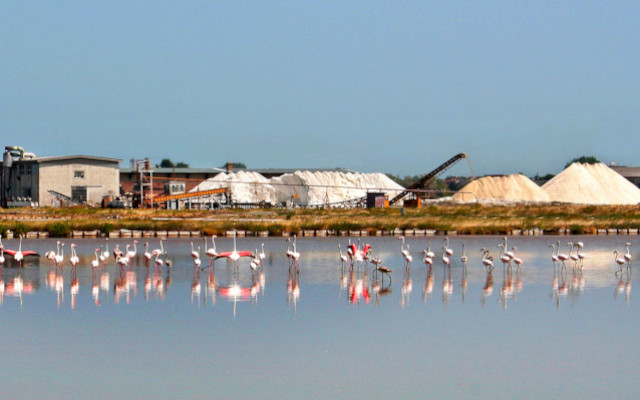
The Sweet Salt of Cervia is a whole sea salt produced in Emilia-Romagna at the Cervia saltworks, in the province of Ravenna: 827 hectares about 1,600 meters from the sea, the smallest and northernmost saltwork in Italy (Municipality of Cervia, 2023; Cervia Saltworks Park, n.d.-d).
The adjective 'sweet' describes the taste, not the composition. The salt is collected before magnesium and potassium salts, responsible for bitter notes, crystallize in the basins, then it is washed with water with a high salt concentration and centrifuged. It is neither dried in an oven nor ground, receives no additives, and retains moisture up to 2% (Municipality of Cervia, 2023; Cervia Saltworks Park, n.d.-c).
After the flood of May 2023, which compromised the harvest, the plants and the saltworks ecosystem, production restarted in May 2025. The commissioner structure for reconstruction allocated 4.9 million euros for the regeneration of the saltworks, with an additional allocation of 1.7 million (Emilia-Romagna Region, 2025a).
Why it is called 'sweet salt'
The term 'sweet' does not indicate the presence of sugars and should not be understood as a nutritional indication. It is a historical description of taste, referring to the lower presence of bitter salts contained in seawater together with sodium chloride: chlorides and sulfates of magnesium, calcium and potassium (Cervia Saltworks Park, n.d.-c).
The explanation è physical before gastronomic. As the water evaporates, sodium chloride crystallizes first; the bitterer salts require higher concentrations and longer times, difficult to achieve with the average temperatures of the Upper Adriatic (Slow Food Foundation for Biodiversity, 2024). In the Camillone saltwork the mother water does not exceed 28.5 Baumé degrees, the measure of salt density used by the salt workers (Municipality of Cervia, 2023).
The Cervese method multiple harvesting completes the picture. Each salt worker divided the collection basin into five sectors and 'dug' one per day, thus exhausting the salt in five days. The crystals remained in little contact with the mother water and the bitter salts did not have time to settle (Slow Food Foundation for Biodiversity, 2024).
Also the processing The following contributes to the product profile. A Korean study compared sea salts obtained by different processes: washed salt and centrifuged dehydrated salt had lower magnesium and sulfur contents, and kimchi prepared with that salt received better sensory evaluations (Yu et al., 2020). The comparison involves a different salt and food, but describes the same mechanism: brine washing and centrifugation, the two operations that the Cervia salt pan applies to its salt, reduce the components thatthe palate perceives as bitter or astringent.
Sensory profile and composition
The Sweet Salt of Cervia is presented in irregular crystals, unground, of color not bright white but with shades of gray and pink. Themoisture residual makes it slightly compact to the touch and very soluble (Cervia Saltworks Park, n.d.-c). On the palate the saltiness is clear and closes without the bitter and astringent aftertaste that magnesium-rich salts sometimes leave on the tongue.
The average composition reported on the label, referred to 100 g of product, is as follows (Municipality of Cervia, 2023):
- sodium chloride 97.5 g, moisture 2.0 g;
- sulfates 250 mg;
- calcium 60 mg, magnesium 60 mg, potassium 40 mg;
- strontium 3 mg, manganese 0.2 mg, zinc and fluorides 0.15 mg each, lithium and copper 0.03 mg each.
These are average values, which may vary between batches and formats. The most relevant data for taste is magnesium, equal to 0.06% of the product. Nutritionally, minor minerals have no significant weight: 5 g of Sweet Salt of Cervia provides about 1.9 g of sodium, 3 mg of magnesium, 3 mg of calcium and 2 mg of potassium. The value of these elements lies rather in the sensory profile, not in dietary intake.
From the Greek Ficocle to the Pope's salt
The origins of the salt pans are lost in antiquity. Some link them to the Etruscan presence, others to Greek colonization, citing the old toponym of Cervia, Ficocle. It is certain that in Roman times production was flourishing and supported rich trade, and that in the Middle Ages the salt of Cervia sustained the economy of Romagna, the Ancona March and some areas of Lombardy (Slow Food Foundation for Biodiversity, 2024). The Saltworks Park traces the city's name back to the salt piles, the heaps (Cervia Saltworks Park, n.d.-d).
The expansion of the basins was such that in 1698 the old village, now threatened by the waters, was dismantled and rebuilt two kilometers away: New Cervia, founding city (Municipality of Cervia, 2023; Salt and Sea Ecomuseum of Cervia, n.d.). Witnesses are the Salt Warehouses, the tower of San Michele and the quadrilateral of the salt workers' houses in the historic center (Slow Food Foundation for Biodiversity, 2024). From the salt pans the salt reached the warehouses on the burchielle, the transport boats of the canal. The ritual survives in the Armèsa de Sel, the salt deposit that every September concludes the ‘Taste of Salt’ festival (Municipality of Cervia, 2024).
The name ‘Pope’s salt’ attributed to Salfiore — the medium-fine grain variety — comes from the Cervia tradition of bringing the first harvest as a gift to the Pontiff (Municipality of Cervia, 2023).
The twentieth century changed the landscape. In 1959 the State Monopolies transformed the 149 small family-run salt pans into a single large plant, with only one annual harvest at the end of summer and mechanical means, according to the so-called ‘French method’ (Salt and Sea Ecomuseum of Cervia, n.d.; FAI, 2024). Only one artisanal salt pan has survived, the Camillone, basin number 89. Since 1989 it has been managed by volunteer salt workers of the Cultural Group Civiltà Salinara, and today it constitutes the outdoor section of MUSA, the Salt Museum (FAI, 2024; Slow Food Foundation for Biodiversity, 2024). Its seasonal production varies between 50 and 200 tons (Municipality of Cervia, n.d.).
In 1998 the State decided to cease production, but the Cervia community did not abandon the salt pans. On December 8, 2002, the Cervia Salt Pan Park Society was born, constituted by the Municipality of Cervia, the Province of Ravenna, the Po Delta Park, and the Ravenna Chamber of Commerce, public for 92% and with only one private partner, the Thermal Baths of Cervia and Brisighella (Slow Food Foundation for Biodiversity, 2024; Cervia Salt Pan Park, n.d.-d). Since 2004 the salt of Camillone has been Slow Food Presidium (Municipality of Cervia, 2023).
Uses in cuisine and product lines
The salt pan’s range is divided into a few main formats:
- Coarse Cervia Salt, in white and blue packaging, also in jute sacks and in 5 kg format for catering;
- Salfiore di Romagna, called ‘Pope’s salt’, the same medium-fine sifted salt, in burgundy packaging;
- Camillone salt, from the Slow Food Presidium, sold at the salt pan in an orange bag;
- aromatic salts, including Camillone salt glasswort, spontaneous plant of the salt pan hand-harvested between April and June, which salt workers use instead of the stock cube;
- pressed salt tile, in sizes 10×10 and 10×20 cm, for hot cooking and cold preparations (Slow Food Foundation for Biodiversity, 2024; Cervia Salt Pan Park, n.d.-a, n.d.-e).
The traditional use is curing of cold cuts and cheeses, for which the Presidio indicates Camillone salt as particularly suitable (Slow Food Foundation for Biodiversity, 2024). It is also an ingredient in products made in collaboration with other producers, from cold cuts to flatbread, from chocolate to craft beer (Cervia Salt Pan Park, n.d.-b).
A usage note. In pasta cooking water, differences between salts tend to be nullified by dilution. The character of Cervia salt is best appreciated raw, on vegetables, tomatoes, fish carpaccios, and grilled meats at the end of cooking, where the crystal reaches the palate without mediation.
Trademark, Presidio, Emblem: how it is protected
Sweet Salt of Cervia is neither a PDO nor a PGI, unlike Trapani Sea Salt PGI. Its identity is protected by different tools, each with its own scope.
The trademark. 'Sweet Salt of Cervia' is above all the name of the product of the Salt Pan Park Society, which presents it as its own trademark. The owner also qualifies it as a collective trademark, granted to producers who use the salt as an ingredient at the end of a research and quality path shared with the salt pan (Cervia Salt Pan Park, n.d.-b). The trademark tool, where registered in destination countries, offers on extra-EU markets a direct protection which PDOs and PGIs have only in countries linked to the European Union through mutual recognition agreements.
The Slow Food Presidio concerns only the production of Camillone, obtained with the multiple harvest method (Slow Food Foundation for Biodiversity, 2024).
The list of Traditional Agri-food Products of Emilia-Romagna includes the 'salt' (salt) of the province of Ravenna (Region Emilia-Romagna, 2025b).
The Emblem of Quality Products of the Po Delta Park includes Cervia salt among the admitted products. An Emblem Commission evaluates candidate companies, verifies compliance with regulations, and controls the correct use of the mark (Po Delta Park, n.d.).
Conclusions
The Sweet Salt of Cervia owes its profile to a combination of climate, water management, and processing: harvesting before the crystallization of bitter salts, washing in brine, centrifugation, no artificial drying.
The resumption of production in 2025, after the flood, gives buyers and consumers one more reason to support the recovery of a supply chain with a millennial history and a unique product, in the splendid Ravenna area.
Dario Dongo
Credit cover Cervia Saltworks Park
References
Institutional and territorial sources
Municipality of Cervia. (2023). The sweet salt. Tourism Municipality of Cervia. https://www.turismo.comunecervia.it/it/enogastronomia/prodotti-tipici/il-sale-dolce-di-cervia/il-sale-dolce
Municipality of Cervia. (September 10, 2024). Great success for the 28th edition of Taste of Salt. https://www.comune.cervia.ra.it/it/news/grande-successo-per-la-28esima-edizione-di-sapore-di-sale
Municipality of Cervia. (n.d.). Camillone saltpan. Tourism Municipality of Cervia. https://www.turismo.comunecervia.it/en/discover-the-area/nature-and-environment/parks-natural-reserves/camillone-saltpan
Ecomuseum of Salt and Sea of Cervia. (n.d.). The Salina of Cervia. https://ecomuseocervia.it/en/the-antennas/the-salina-of-cervia.html
FAI – Italian Environment Fund. (2024, 27 March). The Ancient Camillone Salina of Cervia prepares to restart. https://fondoambiente.it/news/lantica-salina-camillone-di-cervia-si-prepara-alla-ripartenza
Po Delta Park. (n.d.). The Emblem of Quality Products. https://www.parcodeltapo.it/it/pagina.php?id=157
Cervia Salina Park. (n.d.-a). Sweet Salt of Cervia. https://www.salinadicervia.it/prodotti/sale-dolce-di-cervia
Cervia Salina Park. (n.d.-b). Branded products. https://www.salinadicervia.it/prodotti/prodotti-a-marchio
Cervia Salina Park. (n.d.-c). Salt of Cervia. https://www.salinadicervia.it/sale-di-cervia
Cervia Salina Park. (n.d.-d). Salina of Cervia. https://www.salinadicervia.it/
Cervia Salina Park. (n.d.-e). Products. https://www.salinadicervia.it/prodotti
Emilia-Romagna Region. (2025a, 12 May). Post-flood reconstruction. Two years after the severe damage caused by the water, the production of Cervia Salt restarts. https://www.regione.emilia-romagna.it/notizie/2025/maggio/ricostruzione-post-alluvione-due-anni-dopo-i-pesantissimi-danni-causati-dallacqua-riparte-la-produzione-del-sale-di-cervia
Emilia-Romagna Region. (2025b). Regional list of Traditional Agri-food Products of Emilia-Romagna, twenty-sixth revision, Annex C (determination no. 23282/2025). https://agricoltura.regione.emilia-romagna.it/dop-igp/altri-regimi-di-qualita/prodotti-tradizionali
Scientific and health sources
Yu, T., Park, E.-S., Zhao, X., Yi, R.-K., & Park, K.-Y. (2020). Lower Mg and S contents in solar salt used in kimchi enhances the taste and anticancer effects on HT-29 colon carcinoma cells. RSC Advances, 10(9), 5351-5360. https://doi.org/10.1039/c9ra09032k
Slow Food
Slow Food Foundation for Biodiversity. (2024). Artisanal sea salt of Cervia. Slow Food Presidiums. https://www.fondazioneslowfood.com/it/presidi-slow-food/sale-marino-artigianale-di-cervia/

Dario Dongo, lawyer and journalist, PhD in international food law, founder of WIISE (FARE - GIFT – Food Times) and Égalité.


