

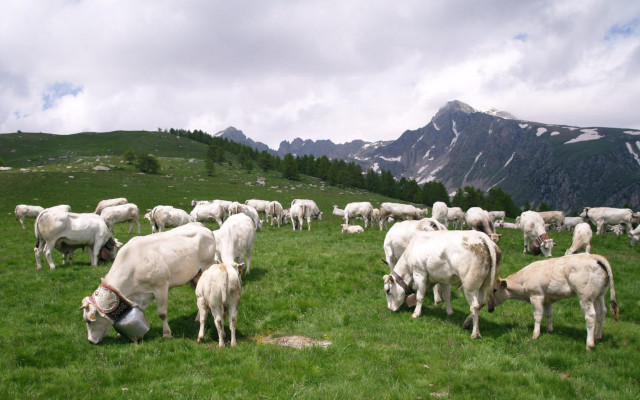
I Piedmontese thigh bulls IGP represent a unique feature in the European bovine scene. At the heart of this excellence lies the Piedmontese breed, known as Fassona, characterized by the natural muscular hypertrophy of the 'double rump'. It is not just an aesthetic distinction, but a genetic specificity that results in a superior nutritional profile and in a farming management that prioritizes biological efficiency and the inseparable bond with the Piedmontese territory.
The most recent available data confirm a stable but niche. The Piedmontese breed amounts to about 285,000 heads registered in the herdbook, mainly concentrated in Piedmont and, to a lesser extent, in Lombardy and Emilia-Romagna (ANABORAPI, 2025).
The certified IGP production in 2024 reached about 1,200 tons of packaged meat, that is a minority share although growing compared to the total marketed Piedmontese breed meat (Consortium for Protection, 2025). The domestic market remains predominant, with strong demand in quality catering and specialized butcher shops, concentrated in Northern Italy. Theexport It is limited but expanding towards high-value-added markets such as Germany, Switzerland, Austria, and Japan, where interest in premium traced and certified meats is growing (ISMEA, 2025).
In the two-year period 2025–2026, market dynamics show increasing attention to animal welfare and to sustainability environmental, the increase in demand for certified meats with transparent standards, the greater interest of international operators towards short and traceable supply chains, and competition with other quality European beef breeds such as Charolaise, Limousine, and Blonde d’Aquitaine.

From the Guarene mutation to international success
The Piedmontese breed — also known as Fassona, which according to some sources derives from the French ‘de bonne façon’ (literally ‘of good form’) — has ancient origins, with a breeding tradition rooted in the Piedmont territory since the 1800s. The distinctive feature of these cattle, the ‘double muscling’ or muscular hypertrophy, comes from a naturally occurring genetic mutation officially identified in 1886 the municipality of Guarene, in the province of Cuneo, Piedmont (production specification, art. 6).
This morphological peculiarity, initially met with suspicion by breeders, later became one of the main selective goals, leading to the establishment of the ‘thigh type’ as the most important and appreciated within the Piedmontese breed. The myostatin gene mutation indeed gives these animals unique anatomical and physiological characteristics, resulting in meat that is particularly lean, tender, and of high quality (McPherron & Lee, 1997; Fiems, 2012).
The denomination ‘Piedmontese Thigh Steers’ has enjoyed a well-established reputation since the early 20th century. The use of this term is documented in common and commercial language since 1983, as evidenced by the weekly market bulletins of Fossano (since 1985), the annual price bulletins of the Cuneo Chamber of Commerce (since 1984), and the industry magazine ‘L’Informatore Agrario’, which regularly reported prices for the ‘Piedmontese Thigh Steers’ referring to the Cuneo market from 1983 to 2008 (specification, art. 6).

Metabolic efficiency: the virtuous paradox of Fassona
I Piedmontese thigh bulls They have unique anatomical and physiological characteristics that substantially distinguish them from other conventional cattle. These differences, a direct consequence of the myostatin gene mutation, require specialized feeding and breeding practices developed over generations.
One of the fundamental peculiarities is the reduced volume of the digestive system compared to conventional cattle. This characteristic causes an increase in the transit speed of food in the rumen, resulting in a higher proportion of food being digested directly at the intestinal level rather than being fermented in the rumen. This peculiarity allows animals to tolerate rations consisting of high quantities of concentrated feeds (cereals over 60% of the feed – see regulations, art. 5) without developing ruminal acidosis phenomena, which would otherwise occur inconventional steers subjected to the same feeding regime (art. 6).
The particular body composition, characterized by a impressive development of muscle masses, makes traditional energy and protein evaluation systems of feed inadequate for these animals. Piedmont breeders have thus developed over time an original know-how, difficult to replicate in other areas, based on rations with high energy content (greater than 0.8 UFL/kg of dry matter) and with a protein content between 12% and 15% per kg of dry matter (art. 5).
An apparently paradoxical aspect is theexceptional efficiency in protein synthesis. Despite the very high capacity for protein retention, these animals are extraordinarily efficient in ‘recycling’ endogenous nitrogen that originates from the protein turnover phenomena of their muscle masses. This allows maintaining low protein concentrations in the rations without penalizing growth performance, with a reduction of nitrogen emissions into the environment (art. 6).
The carcasses are characterized by a higher weight than common type heads (minimum 360 kg for males, 260 kg for females, 340 kg for castrated), a state of poor fattening or very poor, a higher slaughter yield (≥62% for males, ≥59% for females and castrates) and carcass yield, with an average daily weight gain exceeding 620 g for males and over 400 g for females (art. 2 and art. 5).
Production standards and guarantees of the IGP regulations
TheProtected Geographical Indication ‘Vitelloni Piemontesi della coscia’ is reserved exclusively for fresh meats produced by cattle farming that meets the conditions and requirements established by the specification, registered with regulation (EC) no. 1107/96 and updated in 2017.
Product characteristics
The PGI is reserved for meats obtained from the slaughter of male and female cattle of the Piedmontese breed registered in the respective Herd Book or offspring of both parents registered in the Herd Book, of age over 12 months, raised and fattened from weaning to slaughter in the production area.
The carcasses are classified according to community table in the following categories: A (young non-castrated males under 24 months), C (castrated males), E (females). The admitted conformation classes are S, E, U; for category E, class R is also admitted. The fattening state must be 1 or 2.
The aging period minimum is 4 days from slaughter. The carcass pH at 24 hours must be below 6, measured on the longissimus thoracis muscle. The meat color ranges from pink to bright light red (disciplinary regulation, article 2).
Geographical area of production
The production zone includes the entire administrative territory of Piedmont region (all provinces of Alessandria, Asti, Cuneo, and Turin, plus selected municipalities of the provinces of Biella, Novara and Vercelli) and some municipalities of the Ligurian provinces of Savona and Imperia on the Piedmontese side of the Ligurian Apennines (disciplinary regulation, article 3).
This type of farming provides income opportunities to sector workers and brings environmental benefits due to maintenance and enhancement of marginal areas, limiting hydrogeological instability phenomena due to abandonment. Grazing and forage areas are mainly reserved for nursing cows, while concentrates produced in more fertile areas are conveniently used in rearing young bulls.
Breeding
After weaning (concluded between 3 and 8 months of age) and until slaughter, the cattle are raised on the same farm and fed with forages preserved coming from at least least 70% from natural meadows with spontaneous species of the area or artificial meadows with grasses and/or legumes.
I simple or compound feed may include cereals and their derivatives, seeds and fruits of legumes and oilseeds, and products from sugar beet processing. Compound feed must in any case contain a percentage of Cereals and cereal by-products higher than 60% of the total.
The use of is allowed corn silage provided they are produced exclusively in the defined geographical area. The ration must ensure medium-high superior nutritional levels with a protein quota between 12% and 15% per kg of dry matter and a very low microbiological load (8 CFU/kg of dry matter. Regulation, article 5).
Traceability and controls
The traceability of the meats is guaranteed through the recording of inputs and outputs during the production process by breeders, slaughterers, cutters and packers listed in special registers, who must promptly declare to the control body the number of heads intended for PDO 'Vitelloni Piemontesi della coscia' raised, slaughtered, cut, portioned (regulation, article 4).
Controls are carried out by theNorth West Quality Institute (INOQ) based in Moretta (CN), in accordance with the provisions of regulation (EU) 2024/1143 (regulation, articles 4 and 7).
Marketing and labeling
Meat can be sold fresh by the cut, pre-wrapped or pre-packaged (also vacuum-packed or in a modified atmosphere). The packaging can only take place in authorized laboratories and under the control of the designated body which allows the application of the PDO logo on individual packages.
Thelabel of the packaged meat must contain:
- the denomination ‘Vitelloni Piemontesi della coscia’ or the denomination logo;
- the wording ‘Protected Geographical Indication’, or P.G.I., and the related EU symbol;
- the sales denomination ‘adult bovine’.
The following information is also allowed:
- traceability code;
- farm/fattening company;
- slaughter date;
- animal's sex.
For category C, the following commercial definitions can be added on the label:
- castrated, for cattle under 24 months of age;
- steer, for cattle aged between 24 and 48 months;
- ox, for cattle older than 48 months.
In case of meat sales by the cut or pre-wrapped, the above information must be reported on a document displayed and clearly visible in the sales counter area (regulation, article 8).
Gastronomic valorization and buying guide
The Fassona thigh lends itself to multiple preparations, both traditional and innovative. The symbolic Piedmontese dish is the ‘raw meat Albese style’, served raw with a knife with extra virgin olive oil, lemon and perhaps also a few slices of white truffle. Other typical preparations include carpaccio with lemon and flakes of Parmigiano Reggiano DOP, the sliced steak grilled, rare steak, and braises or light roasts ideal for less noble cuts.
Thanks to its leanness, this meat requires short cooking times and gentle to preserve juiciness and tenderness. The optimal internal temperature for rare cooking is 50-52°C, while for medium cooking it is recommended not to exceed 60°C.
Advice for buyers
For gourmets
Private buyers must always check for the presence of the PGI mark and the consortium logo on the label, preferring meat from certified organic farms or extensive systems. It is advisable to buy from trusted butchers with a transparent and documented supply chain, carefully evaluating color, consistency, and absence of excessive surface moisture on the packaging.
For professionals
Operators in the Ho.Re.Ca. sector and distribution must select certified suppliers and subjected to third-party audits, favoring integrated supply chains with documented traceability through modern technologies such as blockchain or QR code.
It is important to consider organic and sustainable supplies, increasingly demanded by premium European markets, constantly monitoring quality standards, supply continuity, and logistical capacity.
In this context, the team of GIFT – Great Italian Food Trade offers qualified support to international buyers in the search and selection of reliable suppliers, with particular attention to quality, regulatory compliance, and supply chain sustainability.
Conclusions
The Protected Geographical Indication dedicated to Vitelloni della Coscia consolidates the role of Piedmontese livestock farming as a precision model. The ability to transform a natural mutation into a sustainable resource — thanks to a reduced nitrogen impact and a very high boneless yield — places this meat at the top of global premium productions. The future of the supply chain lies in the ability to communicate this technical and biological value to international markets, thereby enhancing transparency and integrity from grazingto distribution.
Dario Dongo
Credit cover Anaborapi
Bibliography
- ANABORAPI. Rational Association of Breeders of Piedmontese Breed Cattle. https://www.anaborapi.it
- Savoia, S., Brugiapaglia, A., Pauciullo, A., Di Stasio, L., Schiavon, S., Bittante, G., & Albera, A. (2019). Characterisation of beef production systems and their effects on carcass and meat quality traits of Piemontese young bulls. Meat science, 153, 75–85. https://doi.org/10.1016/j.meatsci.2019.03.010
- Brugiapaglia, A., Lussiana, C., & Destefanis, G. (2014). Fatty acid profile and cholesterol content of beef at retail of Piemontese, Limousin and Friesian breeds. Meat science, 96(1), 568–573. https://doi.org/10.1016/j.meatsci.2013.08.012
- Commission Regulation (EC) No 1107/96 of 12 June 1996 on the registration of geographical indications and designations of origin under the procedure laid down in Article 17 of Council Regulation (EEC) No 2081/92. Consolidated text: 20/11/2008 http://data.europa.eu/eli/reg/1996/1107/2008-11-20
- Consortium for the Protection of the Piedmontese Breed. https://www.vitellonepiemontese.it
- Fiems, L. O. (2012). Double muscling in cattle: Genes, husbandry, carcasses and meat. Animals, 2(3), 472–506. https://doi.org/10.3390/ani2030472
- ISMEA. (2025). Beef cattle trends no.1/2025 – October 2025. Institute of Services for the Agricultural Food Market. https://www.ismeamercati.it/flex/cm/pages/ServeBLOB.php/L/IT/IDPagina/13648
- MASAF. (2024). Production regulations of the Protected Geographical Indication ‘Vitellone Piemontese della coscia’. Ministry of Agriculture, Food Sovereignty and Forestry. https://www.masaf.gov.it/flex/cm/pages/ServeAttachment.php/L/IT/D/2%252Fd%252Fb%252FD.aa286c7113cd22ac92da/P/BLOB:ID=3338/E/pdf
- McPherron, A. C., & Lee, S. J. (1997). Double muscling in cattle due to mutations in the myostatin gene. Proceedings of the National Academy of Sciences, 94(23), 12457–12461. https://doi.org/10.1073/pnas.94.23.12457

Dario Dongo, lawyer and journalist, PhD in international food law, founder of WIISE (FARE - GIFT – Food Times) and Égalité.


