

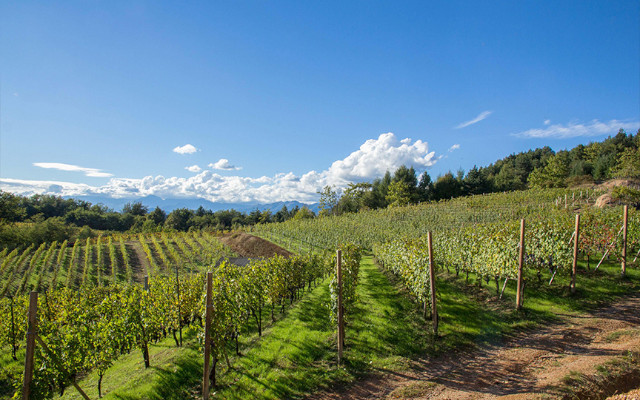
The Nebbiolo is the grape variety of Barolo and Barbaresco. Documented since 1266, it now covers over 7,500 hectares in Piedmont, 58% more than ten years ago (Cugnetto et al., 2026), and is the basis for the reds of six Piedmontese DOCGs (controlled and guaranteed denominations of origin): Barolo, Barbaresco, Roero, Gattinara, Ghemme and Terre Alfieri. Under the name Chiavennasca, it produces the reds of Valtellina. The year 2026 highlights two trends: the increase in surfaces, which has led to a reduction in yields of Langhe Nebbiolo, and the proposal to bottle Barolo and Barbaresco only in the production area.
Surfaces and grape prices, 2015-2025
Data from the single agricultural registry of the Piedmont Region, processed by the Academy of Agriculture of Turin, show that Nebbiolo vineyards have increased from 4,804 hectares in 2015 to 7,566 hectares in 2025. The share of the regional vineyard area rose from 11.9% to 17.8%, and Nebbiolo is today the third grape variety in Piedmont after Barbera and Moscato Bianca. With 2,762 hectares more it is also the one that has grown the most in absolute value, to the point that the authors talk about 'nebbiolizzazione' of the vineyard (Cugnetto et al., 2026).
Growth is concentrated in Langa and Roero. Between 2015 and 2025, the claimed areas increased from 2,069 to 2,285 hectares for Barolo (+10%), from 730 to 835 for Barbaresco (+14%), from 729 to 1,234 for Nebbiolo d’Alba (+69%) and from 197 to 366 for Roero (+86%). Langhe Nebbiolo more than quadrupled, from 282 to 1,278 hectares (+353%), also due to the partial conversion of vineyards of Dolcetto. In Monferrato the DOC (controlled designation of origin) Monferrato Nebbiolo rose from 156 to 425 hectares between 2020 and 2025 (Cugnetto et al., 2026).
The grape prices recorded by the Chamber of Commerce of Cuneo show the other side of the coin. Nebbiolo for Barolo fell from 4.12 euros per kilo in 2023 to 2.57 in 2025, for Barbaresco from 2.77 to 1.94, for Langhe Nebbiolo from 1.80 to 0.94, and for Nebbiolo d’Alba from 1.67 to 0.92. Based on the 2022-2025 average, and with the maximum yields of the regulations, the estimated gross operating margin net of all costs remains wide for Barolo (14,060 euros per hectare) and for Barbaresco (7,350), while it decreases to 1,775 euros forLanghe Nebbiolo. With 2025 prices, the gross production of one hectare of Langhe Nebbiolo (9,400 euros) does not cover the cultivation costs, estimated at 12,000 euros (Cugnetto et al., 2026).
Market and export 2025-2026
On the sales front the situation is more stable. In 2024 the Barolo recorded a +6% of bottled and the Langhe Nebbiolo a +12% (Consortium for the protection of Barolo Barbaresco Alba Langhe and Dogliani, 2025). In July 2026 the Consortium reported to the Piedmont Region that 'currently, no significant drops in sales are recorded': the reduction in bottlings, around 3%, depends on the smaller 2024 harvest, while bulk wine prices fell between 2025 and the first half of 2026 (Piedmont Region, 2026f).
The context is that of Italian wine exports exceeding 3.6 billion euros in the first half of 2026 (-6.2%), with reds at -9.3% and the United States at -14.1%. Piedmont grows by 2.4% and returns as the second exporting region, but the driver, according to the Italian Wine Union Observatory (UIV), is the Asti Spumante (UIV, 2026).
Yields 2026 and new vineyards
On the proposal of the Consortium assembly of June 26, 2026, the Region set a yield for the 2026 harvest of 9 tons per hectare (63 hectoliters) for Langhe Nebbiolo, compared to 10 in the regulations. Of the 18 quintals (1.8 t) surplus, 4.5 can go to wine and 13.5 to various uses, such as juices, distillates, or vinegars; alternatively, companies may downgrade an equivalent quantity of wine from the 2023-2025 vintages (Piedmont Region, 2026f; Law 238/2016, art. 39.2). The same measure applies to Barbera d’Alba. The Consortium justifies it with the increase in claimable surfaces for Langhe Nebbiolo and the drop in bulk prices. Barolo, Barbaresco and Nebbiolod’Alba maintain the yields of the regulations, and surpluses allowed up to 20% go 5% to wine and 15% to distillation or other uses (Piedmont Region, 2026e).
The access to the top designations is limited. The 2026-2028 program allows registration of 22 hectares per year in Barolo, equal to 1% of the surface, and 7 in Barbaresco, with a maximum of 0.4 hectares per company. These are not new plantings: suitability is assigned to Nebbiolo vineyards already suitable for Langhe Nebbiolo before July 31, 2021, with additional scores for companies under 2 hectares and for those certified in organic or with the National Integrated Production Quality System (SQNPI), Equalitas or VIVA (Piedmont Region, 2026b; 2026c). For Nebbiolo d’Alba the 2026 call assigns only 15 hectares, usable only for replanting (Piedmont Region, 2026a).
Barolo and Barbaresco, current rules and ongoing changes
The Barolo is obtained exclusively from Nebbiolo grown in the entire territory of Barolo, Castiglione Falletto and Serralunga d’Alba and partly in Monforte d’Alba, Novello, La Morra, Verduno, Grinzane Cavour, Diano d’Alba, Cherasco and Roddi, in the province of Cuneo. The vineyards must be in hill, between 170 and 540 meters, trained on trellis with Guyot pruning and, if newly planted, not exposed to the north (Barolo regulations, articles 2, 3 and 4). The maximum yield is 8 tons per hectare, 7.2 with the 'vigna' mention, and the aging lasts at least 38 months, of which 18 in wood, from November 1 of the harvest year; the Reserve goes up to 62 months (Barolo regulations, articles 4 and 5). The 181 additional geographical mentions (MGA), including 11 municipal ones, identify the individual cru (Barolo regulations, article 8). The regulations also allow Barolo chinato, a wine flavored with quinine (Barolo regulations, article 7). For a complete overview see the GIFT in-depth study on Barolo.
The Barbaresco is produced in Barbaresco, Neive, Treiso, and in the San Rocco Seno d’Elvio hamlet of Alba. Compared to Barolo, it requires a alcohol content natural lower, 12% versus 12.5%, and a shorter aging, 26 months of which 9 in wood, 50 for the Reserve (Barbaresco regulations, articles 3, 4 and 5). The MGAs are 66 (Barbaresco regulations, article 7). The regulations distinguish the hills of Barbaresco and Neive, which produce structured and powerful wines, from those of Treiso, more linked ‘to finesse and elegance than to structure’ (disciplinary Barbaresco, article 9).
In 2024 the producers approved, with the required majorities, the Consortium's proposals to limit the bottling The winemaking zone is allowed to admit for Barbaresco large formats, over 6 liters (Vignaioli Piemontesi, 2024). After the favorable opinion of the National Committee for DOP and IGP Wines on December 10, 2025, the Ministry of Agriculture, Food Sovereignty and Forests (MASAF) published the two proposals in the Official Gazette on December 30, 2025, for national oppositions, the first step of the Union amendment procedure (EU reg. 2024/1143, art. 10.4; MASAF, 2025a; 2025b). The text preserves, with authorizationsindividual, the rights of those who were already bottling outside the zone and maintains the exclusion of north-facing slopes. Until approval, the regulations last modified in 2015 remain in force.
Langhe Nebbiolo, Nebbiolo d'Alba and Roero
The Langhe Nebbiolo requires at least 85% Nebbiolo, a maximum yield of 10 tons per hectare, and no minimum aging, over an area that includes much of the hills of Cuneo between Langhe and Roero (Langhe regulations, articles 2, 3, and 4). The regulations exclude that they may be allocated 'excess production of DOCG wines located in the same production area' (Langhe regulations, article 4). The amendment proposal published by the Piedmont Region in June 2026 introduces, according to the Consortium, the mention sparkling for Nebbiolo and packaging in bag in box up to 5 liters (Piedmont Region, 2026d; Gambero Rosso, 2026a; 2026b). The Nebbiolo bubbles would thus join the Alta Langa, which is based on Pinot noir and Chardonnay.
The Nebbiolo d’Alba is a Nebbiolo in purity produced in 32 municipalities on both banks of the Tanaro river, 10 entirely and 22 partially. The maximum yield is 9 tons per hectare and the minimum aging is 12 months; the Superiore version requires 18 months, of which 6 in wood (Nebbiolo d’Alba regulations, articles 2, 3, 4, and 5). In the version modified in 2025, the regulations also include sparkling red, rosé, and white types, using the Martinotti or classic method (Nebbiolo d’Alba regulations, articles 1 and 5).
The Roero is produced in 19 municipalities on the left bank of the Tanaro, where the 'capturing of the Tanaro', the diversion of the river course, created the rocky outcrops and alternating layers of sands, clays, and limestone (Roero regulations, article 9). The red requires at least 95% Nebbiolo, a yield of 8 tons per hectare and 20 months aging, of which 6 in wood, increasing to 32 for the Reserve (Roero regulations, articles 2, 4, and 5). Spanning Roero and northern Asti, the DOCG Terre Alfieri has increased Nebbiolo from 18 to 59 hectares in ten years (Cugnetto et al., 2026).
Spanna and Chiavennasca, the Nebbiolo of the North
In northern Piedmont Nebbiolo is called Spanna:
- The Gattinara requires 90 to 100% Nebbiolo and aging of 35 months, of which 24 in wood, rising to 47 months, of which 36 in wood, for the Reserve (Gattinara regulations, articles 2 and 5);
- The Ghemme ages at least 34 months, of which 18 in wood, and the Reserve 46, of which 24 in wood (Ghemme regulation, article 5).
In Valtellina the grape variety is called Chiavennasca:
- The Valtellina Superiore requires at least 90% (Valtellina Superiore regulation, article 2);
- the Sforzato di Valtellina is obtained from dried grapes, with at least 20 months of aging, of which 12 in wood (Sforzato di Valtellina regulation, articles 2 and 5).
Nebbiolo is also called Prunent in Val d’Ossola and Picotendro in the lower Aosta Valley. A curiosity: in Biellese, Vercellese, and Novarese the name ‘Nebbiolo’ instead indicates Croatina (Schneider et al., 2014).
The origins of the grape variety and its genetic family
Nebbiolo is mentioned for the first time in 1266, a date recently established by J. Vouillamoz: the ‘Nibiol’ appears in the vineyards of Castellania di Rivoli, near Turin. At the beginning of the fourteenth century it was already widespread from Albese and Roero to the surroundings of Asti and up to Val d’Ossola, while in Valtellina it appears at the end of the sixteenth century. Until the Nineteenth century mainly a sweet and sparkling Nebbiolo was produced, and the still and austere style was established only in that century. In the first half of the nineteenth century Giorgio Gallesio defined it 'the prince grape of the Alpine slope' (Schneider et al., 2014). The Barolo regulation credits Camillo Benso di Cavour and Giulia Colbert Falletti, the last marchioness of Barolo, with the creation of a wine destined to become 'the ambassador of Savoy's Piedmont in the courts of all Europe' (Barolo regulation, article 10).
The DNA analyses conducted by the National Research Council (CNR) on 227 traditional varieties link seven grape varieties to Nebbiolo with direct parent-child relationships, all most likely its descendants, including Freisa and Vespolina. Nebbiolo's parents have probably disappeared. Nebbiolo rosé, Pignola, and Rossola nera, the latter two typical of Valtellina, instead appear as its siblings, an indication of a possible origin in the foothill area of the central Alps, on the Italian side (Raimondi et al., 2020).
Wine in the glass and at the table
Nebbiolo grapes are never rich in color and in the anthocyanin profile cyanidin and peonidin prevail: the wines therefore do not have the bluish tones of Bordeaux wines, but garnet shades. The tannic structure requires more or less long aging in wood, increasing from Roero to Barbaresco and Barolo, up to the wines of Northern Piedmont (Schneider et al., 2014). The regulations translate this profile into consumption characteristics:
- Barolo is ‘dry, full, harmonious’ (Barolo regulation, article 6);
- Barbaresco has orange reflections and a taste ‘velvety, just tannic’ (Barbaresco regulation, article 9);
- Nebbiolo d’Alba recalls ‘the fruity scents of raspberry, geranium, wild strawberry’ (Nebbiolo d’Alba regulation, article 9).
At the table Barolo accompanies braised meats, game, and aged cheeses, dishes with white truffle and with porcini mushrooms; it should be served at 16-18 °C and, if young, decanted (Dongo, 2026b). Langhe Nebbiolo, served at 18-20 °C, is suitable for the whole meal, from first courses and risottos to white and red meats, up to aged cheeses (Langhe Monferrato Roero Tourism Board, n.d.).
Nebbiolo and Barbera compared
The two grape varieties share the hills of Langhe, Roero and Monferrato but follow opposite trajectories. Between 2015 and 2025 Barbera fell from 11,326 to 10,691 hectares (-6%), while Nebbiolo grew by 58%. In the average prices 2022-2025 grapes for Barbera d’Alba are worth 1.29 euros per kilo, those for Langhe Nebbiolo 1.45 and those for Barolo 3.45 (Cugnetto et al., 2026). Their characters also separate them: Barbera produces well-colored wines, with a high acidity that ‘tends to be maintained even in warm climates’ (Schneider et al., 2013), Nebbiolo has a pale color and tannins that demand time. Genetically, Barbera descends from Coccalona nera, a variety now almost extinct, while the parents of Nebbiolo have not been identified (Raimondi et al., 2020).
Nebbiolo in summary
In ten years Nebbiolo has gained more than 2,700 hectares in Piedmont. The top DOCGs remain profitable and limited, with 22 new hectares per year for Barolo and 7 for Barbaresco, while the more widely distributed denominations, led by Langhe Nebbiolo, manage a quadrupled area with yield reductions and declining grape prices. The obligation to bottle Barolo and Barbaresco in the production area, being an EU modification, must now be approved by the European Commission.
Dario Dongo
Credit cover Consorzio Tutela Nebbioli Alto Piemonte
References
European Union regulatory sources
Regulation (EU) 2024/1143 of the European Parliament and of the Council of 11 April 2024 on geographical indications for wine, spirit drinks and agricultural products, as well as traditional specialities guaranteed and optional quality terms for agricultural products, amending Regulations (EU) No 1308/2013, (EU) 2019/787 and (EU) 2019/1753 and repealing Regulation (EU) No 1151/2012. Consolidated text: 18/03/2026. http://data.europa.eu/eli/reg/2024/1143/2026-03-18
Italian regulatory sources and production guidelines
Production specification for the controlled and guaranteed designation of origin wines ‘Barbaresco’. Presidential Decree 23.4.1966, Official Gazette no. 145 of 14.6.1966; Presidential Decree 3.10.1980, Official Gazette no. 242 of 3.9.1981; last amendment Ministerial Decree 17.4.2015, Official Gazette no. 97 of 28.4.2015. Current text with the proposed amendment: https://www.masaf.gov.it/flex/cm/pages/ServeBLOB.php/L/IT/IDPagina/22762
Production specification for the controlled and guaranteed designation of origin wines ‘Barolo’. Presidential Decree 23.4.1966, Official Gazette no. 146 of 15.6.1966; Presidential Decree 1.7.1980, Official Gazette no. 21 of 22.1.1981; last amendment Ministerial Decree 17.4.2015, Official Gazette no. 97 of 28.4.2015. Current text with the proposed amendment: https://www.masaf.gov.it/flex/cm/pages/ServeAttachment.php/L/IT/D/1%252Fb%252F5%252FD.32185a9a417ef7756be8/P/BLOB%3AID%3D22762/E/pdf?mode=download
Production specification for the controlled and guaranteed designation of origin wines ‘Gattinara’. Presidential Decree 9.7.1967, Official Gazette no. 200 of 10.8.1967; Presidential Decree 20.10.1990, Official Gazette no. 59 of 11.3.1991. Text published by the Piedmont Region. https://www.regione.piemonte.it/web/media/6416/download
Production specification for the controlled and guaranteed designation of origin wines ‘Ghemme’. Presidential Decree 18.9.1969; Ministerial Decree 29.5.1997, Official Gazette no. 137 of 14.6.1997. Consolidated text 2025 published by the Piedmont Region. https://www.regione.piemonte.it/web/sites/default/files/media/documenti/2025-10/docg_ghemme_disciplinare_consolidato_2025.pdf
Production specification for the controlled designation of origin wines ‘Langhe’. Ministerial Decree 22.11.1994, Official Gazette no. 283 of 3.12.1994, and subsequent amendments. Text published by the Piedmont Region. https://www.regione.piemonte.it/web/media/6453/download
Production regulations of the controlled designation of origin for ‘Nebbiolo d’Alba’ wines. DPR 27.5.1970, Official Gazette No. 228 of 9.9.1970; ordinary amendment published in Official Gazette No. 172 of 26.7.2025. Consolidated text published by the Piemonte Region. https://www.regione.piemonte.it/web/sites/default/files/media/documenti/2025-10/index.pdf
Production regulations of the controlled and guaranteed designation of origin for ‘Roero’ wines. DPR 18.3.1985, Official Gazette No. 258 of 2.11.1985; decree 7.12.2004, Official Gazette No. 301 of 24.12.2004; Ministerial Decree 9.7.2014, Official Gazette No. 165 of 18.7.2014; consolidated text with proposed amendment under ministerial provision 29.5.2018, published by the Piemonte Region. https://www.regione.piemonte.it/web/media/6944/download
Production regulations of the controlled and guaranteed designation of origin for ‘Sforzato di Valtellina’ or ‘Sfursat di Valtellina’ wines. Text published by the Italian Sommelier Association. https://aisitalia.it/Disciplinari/Lombardia/DOCG/Sforzato%20di%20Valtellina%20o%20Sfursat%20di%20Valtellina.pdf
Production regulations of the controlled and guaranteed designation of origin for ‘Valtellina Superiore’ wines. DPR 11.8.1968, Official Gazette No. 244 of 25.9.1968; Ministerial Decree 24.6.1998, Official Gazette No. 159 of 10.7.1998. Text published by the Italian Sommelier Association. https://aisitalia.it/Disciplinari/Lombardia/DOCG/Valtellina%20superiore.pdf
Law 12 December 2016, No. 238. Comprehensive regulation of vine cultivation and the production and trade of wine. Regulatory Last consolidated version: 05/14/2026. https://www.normattiva.it/uri-res/N2Ls?urn:nir:stato:legge:2016-12-12;238
MASAF (2025a). Communiqué. Proposal for modification of the Union of Protected Designation of Origin for ‘Barbaresco’ wines and its production regulations (25A06942). Official Gazette, General Series No. 301 of 30.12.2025. https://www.gazzetta ufficio.it/eli/gu/2025/12/30/301/sg/pdf
MASAF (2025b). Communiqué. Proposal for modification of the Union of Protected Designation of Origin for ‘Barolo’ wines and its production regulations (25A06943). Official Gazette, General Series No. 301 of 30.12.2025. https://www.gazzetta ufficio.it/eli/gu/2025/12/30/301/sg/pdf
Acts of the Piedmont Region
Piedmont Region (2026a). D.D. 2 March 2026, no. 201. Approval of the regional call for submission of applications for the assignment of suitability to vineyard surfaces for the purpose of claiming the controlled designation of origin Nebbiolo d’Alba for the year 2026. Official Bulletin no. 9 of 5.3.2026. https://www.regione.piemonte.it/governo/bollettino/abbonati/2026/09/attach/dda1700000201_10400.pdf
Piedmont Region (2026b). D.D. 3 March 2026, no. 206. Approval of the 2026-2028 three-year plan and regional call for submission of applications for the assignment of suitability to vineyard surfaces for the purpose of claiming the DOCG Barbaresco for the year 2026. https://bandi.regione.piemonte.it/system/files/DD-A17_206_2026_Barbaresco.pdf
Piedmont Region (2026c). D.D. 3 March 2026, no. 207. Approval of the 2026-2028 three-year plan and regional call for submission of applications for the assignment of suitability to vineyard surfaces for the purpose of claiming the DOCG Barolo for the year 2026. https://bandi.regione.piemonte.it/system/files/DD-A17_207_2026_Barolo.pdf
Piedmont Region (2026d). Statement from the Agriculture and Food Directorate. Proposal to amend the production regulations of DOC Langhe wines. Official Bulletin no. 25, ordinary supplement no. 2, of 25.6.2026. https://www.regione.piemonte.it/governo/bollettino/abbonati/2026/25/suppo2/index.htm
Piedmont Region (2026e). D.D. 24 July 2026, no. 754. Allocation of production surpluses of DOCG Barolo, Barbaresco and DOC Nebbiolo d’Alba for the 2026 harvest. Official Bulletin no. 30 of 30.7.2026. https://www.regione.piemonte.it/governo/bollettino/abbonati/2026/30/attach/dda1700000754_10400.pdf
Piedmont Region (2026f). D.D. 24 July 2026, no. 755. Reduction of production yields and definition of destination constraints of products excluded from the DOC Langhe Nebbiolo and Barbera d’Alba types for the 2026 harvest. Official Bulletin no. 30 of 30.7.2026. https://www.regione.piemonte.it/governo/bollettino/abbonati/2026/30/attach/dda1700000755_10400.pdf
Scientific studies and databases
Raimondi, S., Tumino, G., Ruffa, P., Boccacci, P., Gambino, G., & Schneider, A. (2020). DNA-based genealogy reconstruction of Nebbiolo, Barbera and other ancient grapevine cultivars from northwestern Italy. Scientific Reports, 10(1), 15782. https://doi.org/10.1038/s41598-020-72799-6
Schneider, A., Boccacci, P., & Raimondi, S. (2014). Nebbiolo. In Italian Vitis Database, ISSN 2282-006X. CNR, Institute for Sustainable Plant Protection. https://vitisdb.it/varieties/show/1108
Schneider, A., Torello Marinoni, D., & Raimondi, S. (2013). Barbera. In Italian Vitis Database, ISSN 2282-006X. CNR, Institute for Sustainable Plant Protection. https://vitisdb.it/varieties/show/979
Market data and economic studies
Consorzio di tutela Barolo Barbaresco Alba Langhe e Dogliani (2025, January 30). Grandi Langhe 2025 and BBWO2025. The promotional events of the first quarter confirm the positive trend of 2024. https://www.langhevini.it/en/grandi-langhe-2025-e-bbwo205_-gli-eventi-promozionali-del-primo-trimestre-confermano-landamento-positivo-dellannata-2024/
Cugnetto, A., Saluzzo, D., & Sartirano, P. (2026). Economy of Piedmontese hillside viticulture. Analyses and prospective reflections. Academy of Agriculture of Turin. ISBN 979-12-82673-01-3. https://www.accademiadiagricoltura.it/wp-content/uploads/2026/06/Economia-della-viticoltura-collinare-Piemontese_AC_DS_PS_03_06_26_A5-per-sito.pdf
UIV, Italian Wine Union (2026, September 11). Italian wine export: -6.2% in value in the first half of 2026. UIV Observatory on Istat data. https://www.unioneitalianavini.it/approfondimenti-tematici/news/export-vino-italiano-62-a-valore-nel-primo-semestre-2026
Vignaioli Piemontesi (2024). Barolo and Barbaresco: approved proposals for disciplinary modifications. https://www.vignaioli.it/barolo-e-barbaresco-le-proposte-approvate-di-modifica-disciplinari/
Other sources and GIFT insights
Dongo, D. (2017, September 11). Wood in wine. GIFT. https://www.greatitalianfoodtrade.it/vino-italiano/legno-nel-vino-3/
Dongo, D. (2026a, 21 February). Alta Langa DOCG: the Classic Method of Piedmont. GIFT. https://www.greatitalianfoodtrade.it/vino-italiano/alta-langa-docg-metodo-classico-piemonte/
Dongo, D. (2026b, 31 March). Barolo DOP: the ‘king of wines’ of Piedmont. GIFT. https://www.greatitalianfoodtrade.it/vino-italiano/barolo/
Langhe Monferrato Roero Tourism Board (n.d.). Langhe Nebbiolo Doc. https://www.visitlmr.it/en/vini/langhe-nebbiolo-doc
Gambero Rosso (2026a). Doc Langhe Nebbiolo in bag in box: the regulation change dividing Piedmont producers. https://www.gamberorosso.it/notizie/vino/doc-langhe-nebbiolo-bag-in-box-modifica-disciplinare/
Gambero Rosso (2026b, 29 January). Go-ahead for sparkling wine for the Doc Langhe Nebbiolo. Germano: ‘No competition with Alta Langa’. https://www.gamberorosso.it/notizie/uncategorized/spumante-doc-langhe-nebbiolo-nuovo-disciplinare/
GIFT Editorial Staff (2016, 4 July). Dolcetto Wine. GIFT. https://www.greatitalianfoodtrade.it/vino-italiano/vino-dolcetto/
GIFT Editorial Staff (2026, 25 February). Asti DOCG and Moscato d’Asti: market, territory and trends guide. GIFT. https://www.greatitalianfoodtrade.it/vino-italiano/asti-docg-moscato-asti-guida-mercato-disciplinare/

Dario Dongo, lawyer and journalist, PhD in international food law, founder of WIISE (FARE - GIFT – Food Times) and Égalité.


