

TheAlta Langa DOCG represents the pinnacle of sparkling wine production in Piedmont: a classic method rooted in Italy's history. Expression of a unique calcareous-clay terroir, among the provinces of Cuneo, Asti, and Alessandria, this denomination stands out for an indissoluble link with altitude and longevity. In a global market rewarding authenticity, Alta Langa does not chase volumes but consolidates a model of value viticulture, supported by structural growth and one of the most rigorous regulations in the world.
The 2024 had closed with significant results for the Alta Langa Consortium: 455 hectares planted, 85 producer members (+14 compared to the previous year) and double-digit growth in sales, +10% compared to 2023. (Alta Langa DOCG Consortium, 2024).
The 2025 consolidated success, with 500 hectares planted, 179 members (among growers and processing companies) and further double-digit sales growth, +11,5% compared to 2024, exceeding for the first time the milestone of 2 million bottles. 85% of production is still absorbed by the domestic market, with the remaining share export of the 15% destined to grow thanks to the numerous initiatives of the Consortium, from Expo 2025 Osaka to Slow Wine 2025 and New York.
In 2025 the Consortium obtained the designation of the Alta Langa DOCG sparkling wine as 'Piedmont Wine of the Year 2025', and launched the portal Alta Langa Academy, an online educational platform dedicated to the history, territory and identity of the denomination.
The harvest 2025 – thanks to regular spring rains and a sunny summer, ideal conditions for Pinot Noir and Chardonnay grapes – will lead to an estimated production of 3.5 million bottles which can be released on the market starting from autumn 2028, in compliance with the aging times provided by the regulations.
The prospects for structural growth are supported by the '2026 Call for suitability of DOCG Alta Langa surfaces' opened by the Piedmont Region on February 18, 2026, aimed at agricultural enterprises registered in the Regional Agricultural Registry (Piedmont Region, 2026).
From the UNESCO 'underground cathedrals' to modern identity
The history of Alta Langa has its roots in the mid-19th century, when the first experiments of classic method sparkling wine in Italy took place in the famous ‘underground cathedrals’ of Canelli: a vast system of tunnels and rooms carved into the tuff between the 16th and 19th centuries, up to 32 meters deep, where wines are still aged today at constant temperature and humidity.
These spaces, called ‘cathedrals’ for their grandeur, are today part of the UNESCO Site ‘Wine Landscapes of Piedmont: Langhe-Roero and Monferrato’, registered in 2014 as a cultural landscape of exceptional universal value (UNESCO World Heritage Centre, 2016).
The modern Alta Langa project began in the 1990s, with experimental crops of Chardonnay and Pinot Noir on suitable plateaus. In 2001 the Protection Consortium was established; in 2002 the DOC and in 2011 The DOCG, (Controlled and Guaranteed Designation of Origin), with retroactive effect up to the 2008 harvest, sealing the quality of this unique sparkling wine.
The Alta Langa disciplinary guidelines: strict rules for excellence
The controlled and guaranteed designation of origin ‘Alta Langa’ – protected at the European level as PDO (protected designation of origin, pursuant to Regulation (EU) 2024/1143) – is reserved for sparkling wines obtained exclusively through bottle refermentation, which meet the conditions and requirements prescribed by the production disciplinary for the types:
- ‘Alta Langa’ sparkling wine, including reserve;
- ‘Alta Langa’ rosé sparkling wine, including reserve (disciplinary guidelines, article 1 – Designation and wines).
Ampelographic basis
The designation is reserved for sparkling wines, obtained from grapes coming from vineyards with the following ampelographic composition within the company:
- grape varieties Pinot Noir and/or Chardonnay from 90 to 100%.
- grapes from non-aromatic varieties suitable for cultivation in the Piedmont region, for the possible remaining 10% (disciplinary guidelines, article 2 – Ampelographic basis).
Production area
The grape production area intended for the production of ‘Alta Langa’ sparkling wines consists of the hillside land parcels with a strong viticultural vocation located in the provinces of Cuneo, Asti e Alessandria, nei territori dei 149 comuni identificati (disciplinare, articolo 3 – Production area).
‘The marl soils must be calcareous-clay, with moderate fertility, with slope exclusively hilly and excluding those in the valley bottoms, damp and flat. Thealtitude not must be below 250 meters above sea level’ (disciplinary regulations, article 9 – Link with the geographical environment).
All winemaking, bottling and aging operations must be carried out in the entire territory of the Piedmont Region (disciplinary regulations, article 5 – Winemaking rules).
Environmental and viticulture conditions
The environmental and cultivation conditions of the vineyards intended for the production of Alta Langa DOCG sparkling wine must meet the following requirements:
- soils: i terreni marnosi calcareo-argillosi, a fertilità moderata;
- slope: exclusively .hill. Sono da escludere categoricamente i terreni di fondovalle, umidi e pianeggianti;
- altitude: non inferiore a metri 250 s.l.m.;
- planting density: non inferiore a 4.000 ceppi a ettaro;
- training forms and pruning systems: traditional ones, low trellis with traditional Guyot pruning or spur cordon;
- forcing practices are prohibited. Emergency irrigation is allowed.
The maximum grape yield per hectare of vineyard is set at 11 tons and the natural alcoholic strength of the grapes intended for winemaking is 9.5% alcohol by volume (disciplinary regulations, article 4 – Viticulture rules).
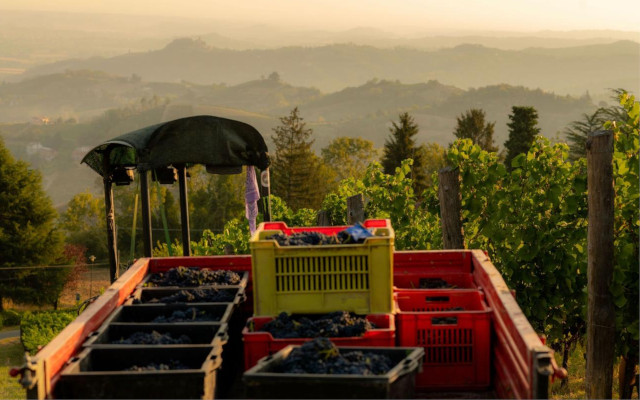
‘The harvest operations are carried out with manual picking of the bunches in small ventilated crates, through which they are also transferred to the pressing and winemaking centers. The transport to the cellar in small cratese , allows the transfer of perfectly healthy and intact bunches to the first phase of the winemaking process, pressing’ (disciplinary regulations, article 9 – Link with the geographical environment).
Winemaking and aging: the secret of the Millesimato
The maximum yield of grapes into wine cannot exceed 65%, equal to a maximum production of 7,150 liters per hectare. ‘If this yield exceeds the above percentage, but not beyond 75%, the excess is not entitled to the DOCG; beyond this percentage limit, the right to the controlled and guaranteed designation of origin for the entire product ceases’.
The Alta Langa DOCG is produced exclusively using the classic method (bottle refermentation). For improvement purposes, the addition of Alta Langa from different vintages is allowed up to a maximum of 15% (discipline, article 4 – Winemaking rules).
The process duration of processing – which includes aging at the production company, from the start of bottle fermentation aimed at sparkling the batch (cuvée) and the duration of its stay on the lees – must not be less than:
- 30 months for ‘Alta Langa’ sparkling and rosé sparkling wines;
- 60 months for wines with reserve mention (discipline, article 7 – Designation and presentation).
Characteristics
‘The arrangement of vineyards in particularly suitable areas, the great technical mastery of agricultural operators and the long wine expertise of sparkling wine houses have happily combined to produce important and structured wines: remarkable breadth of aromas, with hints reminiscent of yeast, bread crust, musk and vanilla, great fullness of flavor, which only time mitigates the ‘charpente‘ and marked body. These characteristics also comply with those of a white and rosé reserve’ (disciplinary regulations, article 9 – Link with the geographical environment).
At the time of consumption, the Alta Langa DOCG sparkling wine, including reserve, must meet the following characteristics:
- foam: fine and persistent;
- color: from pale straw yellow to intense gold; or rosé, more or less intense;
- odor: fragrant, complex, characteristic of bottle refermentation;
- flavor: savory, fine and harmonious;
- alcohol content minimum total volume: 11.50% vol;
- acidity minimum total: 5.0 g/l;
- minimum non-reducing extract: 15.0 g/l.
‘Regarding any storage in wooden containers, the flavor and smell of the wines may reveal a slight woody scent’.
As for indications of dosage, the regulations expressly exclude the qualifications Demi-Sec, Sec and Dolce, confirming the exclusive vocation of Alta Langa towards the driest types: Pas Dosé, Brut Nature, Extra Brut and Brut (regulation, article 6 – Consumption characteristics).
Designation and presentation
‘In the designation and presentation of wines with controlled and guaranteed designation of origin Alta Langa, the addition of any qualification different from those provided for by this production regulation, including the adjectives extra, fine, natural, chosen, selected, old and similar’.
Only the use of the terms ‘bottle fermentation according to the traditional method’, or ‘traditional method’, or ‘classic method’, or ‘classic traditional method’. Conversely, it is forbidden to use the simple term ‘bottle fermentation’. The Alta Langa rosé sparkling wine, including reserve, may also be designated with the terms ‘rosa’ or ‘rosé’.
‘The indication of thevintage of grape harvest is mandatory’.
The DOCG ‘may be accompanied by the mention «vineyard» followed by the relevant place name or traditional name provided that the vinification and storage of the wine take place in separate containers and that this mention is reported both in the grape declaration and in the registers and accompanying documents and appears in the specific regional list‘ (regulation, article 7 – Designation and presentation).
Sensory profile and gourmet pairings
The elegance and the freshness of Alta Langa DOP make it ideal for aperitifs and delicate finger food, seafood and shellfish dishes (baked fish or in light sauce), white meats and delicate second courses, fresh and semi-aged cheeses. The structure and complexity of the Reserve versions also lend themselves to accompany more elaborate preparations, from first courses with white truffle – a pairing that enhances its savoriness – to risottos with porcini mushrooms.
The TERRA glass
TERRA is the official glass of the Alta Langa DOCG Consortium, designed by the famous Giorgetto Giugiaro (Italdesign) in 2012 and made by the crystal master Collevilca in Colle Val d’Elsa (Siena). A 100% Made in Italy tasting glass where trilobate shapes take center stage, from the foot to the rim, with the dual function of:
- identity. Recall the three lobes of the vine leaf and the three provinces of the production area, which correspond to the three circles of the Consortium's logo, inside which are depicted the high hills of the Langhe with the Monviso mountain range;
- technique. The shape of the glass does not favor the rotation of the wine, which is not necessary for Metodo Classico sparkling wines, as the tasting focuses on perlage, freshness, and aromatic precision rather than oxygenation.
Buying guide: strategic value for enthusiasts and buyers
Those who wish to explore Alta Langa should consider both versions Brut and Pas Dosé, favoring labels that enhance the specific vintage and aging beyond the minimum of 30 months, which offer superior aromatic complexity. Many wineries offer versions made from organic or converting grapes, which enhance the transparency of the terroir chalky-clayey and the intrinsic quality of the grapes.
I international buyersshould consider Alta Langa DOCG as a valuable asset for niche Metodo Classico wine portfolios: 85% of production is absorbed by the domestic market, making the labels available for export particularly selective and positioned in thehigh-end.
The president of the Consortium Giovanni Minetti is explicit: 'We do not chase volumes: we build value' (Targatocn.it, 2026). The markets with the greatest growth potential include Japan, North America, and new emerging markets for quality Italian sparkling wines.
The team of GIFT (Great Italian Food Trade) for international buyers, offers support in the targeted selection of suppliers and DOCG excellence products, facilitating the building of transparent, lasting, and mutually beneficial commercial relationships, as well as consulting on import and logistics.
Conclusions
The Alta Langa DOCG is a manifesto of resilience and Piedmontese quality. The milestone of 2 million bottles and the strategic expansion towards foreign markets confirm the solidity of a project that values time (of bottle refermentation) and the territory. For the conscious consumer and the international buyer, Alta Langa is confirmed as a choice of excellence, able to evolve without betraying its artisanal rigor. A symbol of Made in Italy that looks to the future with the depth of its historicunderground cathedrals.
Dario Dongo
Credit cover Alta Langa DOCG Consortium
Bibliography
- Consorzio Alta Langa DOCG (n.d.). Production regulations (Ministerial Decree 21.02.2011, last amended by Ministerial Decree 13.10.2014). https://www.altalangadocg.com/consorzio-alta-langa/disciplinare-produzione/
- Alta Langa DOCG Consortium (2025). Alta Langa Academy. https://academy.altalangadocg.com
- Alta Langa DOCG Consortium (n.d.). The TERRA glass. https://www.altalangadocg.com/alta-langa-docg/terra-il-nuovo-calice-del-consorzio-alta-langa/
- Piedmont Region. (2026). 2026 Notice for suitability of DOCG Alta Langa surfaces. https://bandi.regione.piemonte.it/contributifinanziamenti/bando-2026-idoneita-superfici-docg-alta-langa
- Regulation (EU) 2024/1143 of the European Parliament and of the Council of 11 April 2024 on geographical indications for wine, spirit drinks and agricultural products. https://eur-lex.europa.eu/eli/reg/2024/1143/oj
- Targatocn.it. (2024, December 19). Alta Langa closes 2024 with sales growth of over 10%. https://www.targatocn.it/2024/12/19/leggi-notizia/argomenti/agricoltura/articolo/lalta-langa-chiude-il-2024-con-una-crescita-delle-vendite-di-oltre-il-10-1.html
- Targatocn.it. (2026, February 3). Alta Langa DOCG, ‘We don't chase volumes: we build value’. https://www.targatocn.it/2026/02/03/leggi-notizia/argomenti/attualita/articolo/alta-langa-docg-non-rincorriamo-i-volumi-costruiamo-valore-2.html
- UNESCO World Heritage Centre. (2016). Vineyard Landscape of Piedmont: Langhe-Roero and Monferrato. https://whc.unesco.org/en/list/1390/

Dario Dongo, lawyer and journalist, PhD in international food law, founder of WIISE (FARE - GIFT – Food Times) and Égalité.


