

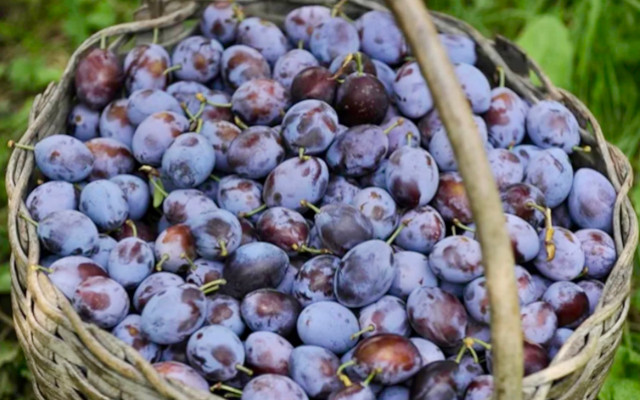
Italian fruit and vegetables preserves a botanical and regulatory distinction often overlooked in daily consumption: that between damsons and plums. This niche supply chain, where Italy stands out in Europe for the share of organic production, today proves to be an ideal case study to analyze the strict application of European regulations on nutritional and health claims. Recent scientific literature also sheds new light on the link between the consumption of this fruit and bone health through the modulation of the gut microbiota.
Plum or damson? Etymology, history and origins
The difference lies in language and botany. ‘Susina’ comes from Latin prunum susinum, the ‘(plum) of Susa’ – the ancient Persian city cradle of cultivation – while ‘plum’ and ‘prune’ derive from Latin prūnum, in turn from Greek proûmnon.
The true plums come from Prunus domestica, a species of Caucasian origin widespread in Europe since ancient times: tradition holds that the Romans introduced its cultivation in the Mediterranean area and that knights returning from the Crusades, around 1200, spread it in France, Germany and the rest of the continent.
Chinese-Japanese plums instead derive from Prunus salicina, an Asian species arrived in the West only in the late 1800s: in the United States, it was the work of varietal selection from the late 1800s (linked to the name of Luther Burbank, author of cultivars like Santa Rosa) that launched its spread. The more recent arrival explains why the plums ripen earlier, but are more sensitive to frost in spring.
From an organoleptic point of view, European plums tend towards deep purple and an elongated shape, with compact and sweet pulp, suitable for processing (jams, preserves, drying). Chinese-Japanese plums, rounder and yellow or reddish in color, have juicy pulp and a tart flavor, ideal for fresh consumption. A common misconception must be corrected: dried plums do not come from P. salicina, but rather from cultivars of Prunus domestica particularly suited for dehydration, such as ‘d’Ente’ (the basis of Agen plums) and ‘Stanley’.
Market dynamics and Italian primacy in the organic transition
TheItaly ranks among the top ten world producers of plums, in a ranking largely dominated by China (over half the global supply), followed by Romania and Serbia; in Europe, volume production is led by Romania, Serbia, and France (FAO, 2025). Our country therefore holds a niche but qualified position, supported by local cultivars and a protected designation.
Domestically, the area under plum cultivation, around 11,000-13,000 hectares, is in a slight structural decline (-6% in the last five years, in line with kiwi), with a production that ranges between 160,000 and over 200,000 tons depending on climatic conditions (CSO Italy; Confagricoltura based on ISTAT data, 2025). The 2025 campaign recorded lower volumes than 2024 but of high quality: Italy was spared the production collapse (-40%) that hit Spain, the main European competitor, due to flowering and fruit set problems (Fresh Point Magazine, 2025). Distribution remains concentrated: Emilia-Romagna leader (about one third of the national product), followed by Campania, Piedmont, Lazio and Basilicata (CSO Italy).
The internal consumption stands at about 65,000 tons, with traditional retail declining in favor of the discount channel and prices retail significantly rising. In the first months of 2025 fruit and vegetable purchases have started to grow again (+2% in volume and +5% in value over the same period 2024), marking a slow recovery of demand (Confagricoltura on ISTAT/ISMEA data, 2025).
Balancing domestic demand is theexport: the 2024 has reached a record with about 45,000 tons and a value of around 70 million euros, for a positive trade balance of 47 million; in 2025 exported volumes have returned to around 41,000 tons, still remaining at high levels (CSO Italy, 2026).
Growing is the organic, which adds further value to the supply chain. In 2024 the Italian agricultural area cultivated with organic methods has exceeded 2.5 million hectares (+2.4% over the previous year), equal to 20.2% of the Utilized Agricultural Area (UAA) national, with 97,160 operators and a leap of 68% in the last decade (ISMEA & SINAB, 2025). A context that places Italy at the top of the EU for organic incidence, ahead of Spain (12.3%), Germany (11.5%), and France (9.9%).
Botany and seasonality: Prunus domestica e Prunus salicina
The European plum tree (P. domestica, Rosaceae) is a deciduous tree or shrub 3-10 meters high, with a globose or small tree crown, with flowering white late which protects it from frost. Oval leaves with serrated edges; the fruit is a drupe that matures from June to September (October for late varieties), with staggered harvests and sizes up to 8 cm.
The Sino-Japanese plum tree (P. salicina) blossoms earlier, being more exposed to cold snaps, and produces generally rounder and juicier fruits, less suitable for storage. Physiologically, the European plum fruits well above 1,000 meters of altitude and requires a chilling requirement of about 500-800 hours below +7 °C to bloom regularly. The cool season runs from June to September, extendable to November thanks to highly storable cultivars like Angeleno; drying extends the availability of plums throughout the year.
Where Italian damsons are grown: territories, agronomy and sustainability
The most suitable areas are Emilia-Romagna (productive heart, for table and industry), Campania (particularly the Salerno area), Piedmont (Cuneo and Asti), Lazio (Viterbo and Rieti) and the Trentino of the Susina di Dro DOP, in the Sarca Valley.
From an agronomic point of view, two factors are decisive for the quality: early thinning of the fruits, to be completed by the end of June, and a careful water management during flowering and fruit setting. The Sino-Japanese plum is mainly trained as a spindle, the European one as a vase or wall. The Italian varietal panorama is today dominated by late cultivars (over 70% of the surfaces), with Angeleno largely prevailing; the European plum (Stanley, President) is experiencing a renewed attention after years of marginalization (CSO Italy).
Phytosanitary protection deals with adversities such as powdery mildew, scab, monilia, Sharka (Plum Pox Virus), bacterial canker, aphids, Cydia funebrana and Mediterranean fruit fly. Increasingly established is the integrated production and organic, based on the monitoring of phytophages, the use of beneficial organisms and targeted use of phytosanitary products, in compliance with regional regulations and the EU regulation on organic farming.
Territorial stewardship and historic value of Dro DOP Damson
The Susina di Dro DOP is the only Italian protected designation of origin dedicated specifically to plums. Its documented history dates back to 1284, when the Rule Charts of the 'Piano del Sarca' already identified the 'di Dro' area (Production Regulations Susina di Dro DOP). The area coincides with the basin of the Sarca river, in Trentino.
The fruits are distinguished by a high content of polyphenols, reduced sugar percentage, well-developed bloom (the natural white powder covering the skin) and a balance between sweetness and acidity. Organized plum growing started in 1911 with the Cooperative Consortium 'Lega dei Contadini del Bacino Arcense' (650 members at foundation); in 1941 a modern drying plant was built which, at the beginning of the 1960s, reached production of 150 tons of dried plums. The manual harvesting, in August and September, it follows the sequence of microclimates and involves detachment with the peduncle to preserve the bloom.
Nutritional values and indications on fresh and dried plums
The following are reported nutritional values indicated by CREA (Research Center for Food and Nutrition) for fresh and dried plums, respectively.
Fresh plums
According to the Food Nutritional Tables provided by CREA (2019), 100 g of edible portion of Fresh plums offer:
- energy: 45 kcal;
- proteins 0.5 g;
- lipids 0.1 g;
- carbohydrates 10.5 g, of which sugars 10.5 g;
- dietary fiber 1.5 g.
Some micronutrients cannot be displayed on the label and advertising of fresh plums and greengages as their presence does not qualify as ‘significant’, according to regulation (EU) no. 1169/11, i.e. equal to or greater than 15% of the Reference Nutritional Value per 100 g of product or per serving (which CREA suggests referring to 150 g). Fresh greengages or plums actually contain:
- potassium: 190 mg per 100 g, equal to 9.5% of the NRV;
- thiamine (vitamin B1): 0.08 mg, equal to 7.3% of the NRV;
- vitamin C: 5 mg, equal to 6.2% of the NRV.
Dried plums
CREA (2019) instead reports on Dried plums the following nutritional values (per 100 g of edible portion):
- energy 236 kcal;
- proteins 2.2 g;
- lipids 0.5 g;
- carbohydrates 55.0 g, of which sugars 55.0 g;
- dietary fiber 8.4 g.
In this case — following analytical verification of the actual presence in products of the micronutrients in the amounts indicated by CREA — it is possible to use in commercial information the nutrition claim as listed below, according to reg. (EC) no. 1924/06:
- ‘high potassium content’: 824 mg per 100 g, equal to 41.2% of the NRV;
- ‘source of iron’: 3.9 mg, equal to 27.9% of the NRV;
- ‘source of thiamine’ (vit. B1): 0.18 mg equal to 16.4% of the NRV.
health claim European and new evidence on the gut-bone axis
Intestinal function, health claim authorized in the EU
Dried plums boast a health claim authorized at the European level: ‘Dried plums contribute to normal intestinal function‘. This health claim has been included in the list of authorized health claims pursuant to reg. (EC) 1924/2006, article 13.1, through reg. (EU) 536/2013 amending reg. (EU) 432/2012. The conditions of use provide for a daily intake of 100 g of dried plums. The described function is attributed to the synergy between fiber and sorbitol intake, which represents about 15% of the sugars naturally present in dried plums and contributes to the laxative effect due to its osmotic action.
The clinical evidence is solid and under review. A systematic review on the effects of dried plums on gastrointestinal function confirmed their action on frequency and consistency of bowel movements (Lever et al., 2014). A subsequent randomized clinical trial on 120 adults showed that 80-120 g/day of dried plums, in addition to increasing fecal output, modulate microbiota and short-chain fatty acids (Lever et al., 2019). In patients with chronic constipation, a comparative trial placed fresh plums among dietary options effective, alongside kiwi — itself beneficiary of a similar health claim authorized, as has been seen — and psyllium (Chey et al., 2021).
Bone health in post-menopause
Recent research attributes to plums a role promising — although not yet subject to EFSA evaluation (European Food Safety Authority) for the purpose of authorization of specific health claim — in female bone protection:
- the synthesis of preclinical and clinical evidence describes effects anti-inflammatory and antioxidant of dried plums and modulation of pathways such as NF-κB (Damani et al., 2022);
- The clinical data most robust comes from ‘The Prune Study’, a 12-month randomized clinical trial on 235 postmenopausal women: 50 g/day of dried plums have preserved bone mineral density of the hip (-0.3% vs -1.1% in the control group), suggesting a non-pharmacological maintenance strategy (De Souza et al., 2022);
- consistent results emerge from previous clinical trials, at 6-12 months, with intakes of 50-100 g/day (Hooshmand et al., 2016; Arjmandi et al., 2017).
Microbiota and prebiotic mechanisms
Preclinical studies suggest the action of polyphenols and carbohydrates of dried plums as prebiotics, modifying the microbiota and increasing butyrate and propionate, associated with protection of bone tissue (Smith et al., 2022). In humans, supplementation for 12 months favorably alters the intestinal microbiome of postmenopausal women, with enrichment of Lachnospiraceae, bacteria linked to phenolic metabolism and reduction of pro-inflammatory cytokines (Simpson et al., 2022).
Antioxidant and lipid profile
Rich in caffeoylquinic acids (chlorogenic and neochlorogenic), plums show marked antioxidant and anti-inflammatory activity. A randomized study on 60 healthy adults with mild hypercholesterolemia suggests a favorable effect of a concentrated plum extract on blood lipids and intestinal function, although cardiovascular evidence remains less established than that on intestines and bones (Chiu et al., 2017).
Industrial uses and food processing logics
The fresh plums, juicy and balanced, are ideal at the table and in the kitchen, in sweet preparations (clafoutis, crumble, upside-down cakes) and savory (pairings with meats and aged cheeses). At the industrial level they lend themselves to the production of juices, Jams, syrups, ice creams, fermented beverages and distillates.
The Dried plums are the main processed product: drying concentrates the nutrients and prolongs shelf life, offering a naturally sweet functional food that combines usefulness with pleasure. They are also used in the confectionery industry (pies, cakes) and specialized nutrition (bars, baby food, dietary supplements).
How to choose quality damsons and plums
It is always recommended to prioritize products organic, as they are made in compliance with Regulation (EU) 2018/848, which guarantees the highest environmental and biodiversity protection standards, with strict limits on pesticide use. When purchasing, choose fruits with intact bloom, taut skin and free of bruises. The season of fresh Italian (plums) runs from June to September.
Conclusions
The sector of Italian plums and prunes demonstrates how the future of national fruit growing lies in informational rigor, agronomic sustainability, and the control of foreign markets. While global volumes see China's monopoly and strong Balkan competition, Italy consolidates its competitive positioning focusing on the commercial quality of late production and, above all, on conversion to organic farming, which sees our country at the top in the European Union.Consolidated and the correct framing of the related claims offer producers and consumers the tools to enhance a sector which, despite climate challenges, remains a strategic asset for the positive balance of Italian fruit and vegetable exports.
Dario Dongo
Credit cover Cooperative Agricultural La Trentina
References
Arjmandi, B. H., Johnson, S. A., Pourafshar, S., Navaei, N., George, K. S., Hooshmand, S., Chai, S. C., & Akhavan, N. S. (2017). Bone-protective effects of dried plums (prunes) in postmenopausal women: Efficacy and possible mechanisms. Nutrients, 9(5), 496. https://doi.org/10.3390/nu9050496
Chey, S. W., Chey, W. D., Jackson, K., & Eswaran, S. (2021). Exploratory Comparative Effectiveness Trial of Green Kiwifruit, Psyllium, or Prunes in US Patients With Chronic Constipation. The American journal of gastroenterology, 116(6), 1304–1312. https://doi.org/10.14309/ajg.0000000000001149
Chiu, H. F., Huang, Y. C., Lu, Y. Y., Han, Y. C., Shen, Y. C., Golovinskaia, O., Venkatakrishnan, K., & Wang, C. K. (2017). Regulatory/modulatory effect of prune essence concentrate on intestinal function and blood lipids. Pharmaceutical biology, 55(1), 974–979. https://doi.org/10.1080/13880209.2017.1285323
Commission Regulation (EU) No 432/2012 of 16 May 2012 establishing a list of permitted health claims made on foods, other than those referring to the reduction of disease risk and to children’s development and health. Consolidated text: 20/08/2025. http://data.europa.eu/eli/reg/2012/432/2025-08-20
Commission Regulation (EU) No 536/2013 of 11 June 2013 amending Regulation (EU) No 432/2012 establishing a list of permitted health claims made on foods other than those referring to the reduction of disease risk and to children’s development and health.
Confagricoltura. (2025, 11 August). Italian fruit under pressure: extreme climate, reduction of surfaces and consumption in slow recovery [Processing based on ISTAT/ISMEA data]. https://www.confagricoltura.it/ita/area-stampa/comunicati/frutta-italiana-a-dura-prova-per-il-clima.-lieve-ripresa-dei-consumi-bene-frutti-rossi-e-uva-senza-semi
CSO Italy. (2026). Italy – Plums: foreign trade / 2025. https://www.csoservizi.com/focus-prodotti/susine/
Damani, J. J., De Souza, M. J., VanEvery, H. L., Strock, N. C. A., & Rogers, C. J. (2022). The role of prunes in modulating inflammatory pathways to improve bone health in postmenopausal women. Advances in Nutrition, 13(5), 1476–1492. https://doi.org/10.1093/advances/nmab162
De Souza, M. J., Strock, N. C. A., Williams, N. I., Lee, H., Koltun, K. J., Rogers, C., Ferruzzi, M. G., Nakatsu, C. H., & Weaver, C. (2022). Prunes preserve hip bone mineral density in a 12-month randomized controlled trial in postmenopausal women: The Prune Study. The American Journal of Clinical Nutrition, 116(4), 897–910. https://doi.org/10.1093/ajcn/nqac189
FAO. (2025). FAOSTAT: Crops and livestock products. https://www.fao.org/faostat
Fresh Point Magazine. (2025, 27 June). The Italian campaign of plums and damsons between hopes, ambitions and problems. https://www.freshpointmagazine.it/curiosita/la-campagna-italiana-di-prugne-e-susine-fra-speranze-ambizioni-e-problemi/
Hooshmand, S., Kern, M., Metti, D., Shamloufard, P., Chai, S. C., Johnson, S. A., Payton, M. E., & Arjmandi, B. H. (2016). The effect of two doses of dried plum on bone density and bone biomarkers in osteopenic postmenopausal women: A randomized, controlled trial. Osteoporosis International, 27(7), 2271–2279. https://doi.org/10.1007/s00198-016-3524-8
ISMEA & SINAB. (2025). Organic in numbers 2025. https://sinab.it/bionovita/bio-in-cifre-2025-il-rapporto-completo/
Lever, E., Cole, J., Scott, S. M., Emery, P. W., & Whelan, K. (2014). Systematic review: the effect of prunes on gastrointestinal function. Alimentary pharmacology & therapeutics, 40(7), 750–758. https://doi.org/10.1111/apt.12913
Lever, E., Scott, S. M., Louis, P., Emery, P. W., & Whelan, K. (2019). The effect of prunes on stool output, gut transit time and gastrointestinal microbiota: A randomised controlled trial. Clinical Nutrition, 38(1), 165–173. https://doi.org/10.1016/j.clnu.2018.01.003
Simpson, A. M. R., De Souza, M. J., Damani, J., Rogers, C., Williams, N. I., Weaver, C., Ferruzzi, M. G., Chadwick-Corbin, S., & Nakatsu, C. H. (2022). Prune supplementation for 12 months alters the gut microbiome in postmenopausal women. Food & Function, 13(23), 12316–12329. https://doi.org/10.1039/D2FO02273G
Smith, B. J., Hatter, B., Washburn, K., Graef-Downard, J., Ojo, B. A., El-Rassi, G. D., Cichewicz, R. H., Payton, M., & Lucas, E. A. (2022). Dried plum’s polyphenolic compounds and carbohydrates contribute to its osteoprotective effects and exhibit prebiotic activity in estrogen deficient C57BL/6 mice. Nutrients, 14(9), 1685. https://doi.org/10.3390/nu14091685

Dario Dongo, lawyer and journalist, PhD in international food law, founder of WIISE (FARE - GIFT – Food Times) and Égalité.


