

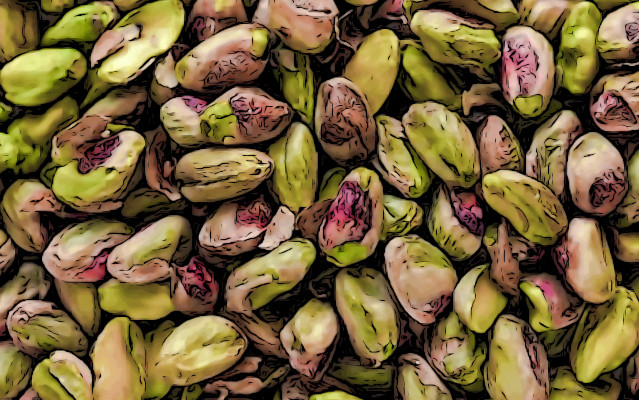
A small fruit with a shell, from an ancient Sicilian village at the gates of Catania, reveals the myth of the green pistachio of Bronte PDO. Symbol and wealth of the territory as well as protagonist of numerous festivals and fairs, such as the Pistachio Festival that every year attracts thousands of visitors to Bronte from all over Italy and abroad.
Pistachio, history and origins
The history The pistachio (pistàkion, in ancient Greek) history is lost in the mists of time. Its first written traces date back to the Old Testament (Genesis 42/43 verse 11). The Assyrians, during the reign of Ashurbanipal I (668-626 BC), celebrated the pistachio in the Kolach obelisk, among the most appreciated plants. Its cultivation in ancient civilizations – Jews, Babylonians, Assyrians, and Greeks – is documented as early as the 3rd century BC.
Lucius Vitellius, governor of Syria in the Roman Empire, brought the pistachio between 20 and 30 AD and helped spread its cultivation in Italy and Spain. The Arabs promoted its cultivation in Sicily around 900 AD, thanks to grafting techniques. The Bronte dialect still refers to the terms ‘frastuca’ and ‘frastucara’, from the Arabic ‘fristach’ and ‘frastuch’, to indicate respectively the pistachio fruit and the plant.
The territory of Bronte – thanks to the lava soil fertilized by the ashes of the nearby Etna volcano and its lava flows (accumulations of volcanic scoria) – proved to be an ideal habitat for the cultivation of an excellent quality pistachio which still occupies about 2,000 hectares of lava soil. An extraordinary combination, between the plant and the volcanic environment, where fruits appreciated in pastry and gastronomy are produced for their excellent organoleptic properties. (1)
Cultivation
The cultivation Pistachio cultivation requires attention as it is a dioecious plant, with male and female plants that must be planted nearby – ideally in a 1/10 ratio between male and female plants – to promote pollination. It is grafted onto the Terebinth (Pistacia terebinthus), a spontaneous shrub belonging to the same family as the Anacardiaceae, which also adapts to rocky soils.
The plant is resilient, as it adapts to poor and arid soils, in addition to tolerating high temperatures and drought. It is also long-lived, up to 300 years, although production is slow – starting in 7-8 years and peaking 15-20 years after sowing – and alternating, with abundant and sparse fruit in successive years.
The deep roots and the plant's ability to host various species of insects, birds, and microorganisms – as well as the possibility of not using pesticides or nitrogen fertilizers – promote biodiversity, in addition to helping prevent soil erosion.
Bronte green pistachio PDO
The Bronte green pistachio PDO is characterized both by the cultivar (Pistacia vera, L.), highly appreciated for its organoleptic qualities, and by the peculiar climatic and geological conditions of the territory.
The cultivations take place on the slopes of the still active Etna volcano, between 400 and 900 meters in altitude. The production area covers over 2000 hectares in the municipalities of Bronte, Biancavilla, and Adrano.
The volcanic eruptions and the lava flows have enriched the soil with minerals and organic substances, giving the Bronte pistachio its characteristic emerald green color and an intense, persistent aroma.
Nutritional properties
Pistachios are rich in proteins, dietary fiber, unsaturated fats, and micronutrients such as vitamins (A, B, C, E, K) and minerals (potassium, magnesium, calcium, iron, zinc, copper, manganese, selenium). (2) The Bronte pistachio also stands out, compared to other varieties, for its higher oil content, unsaturated fatty acids, and a unique concentration of aromatic substances. (3)
The presence of is also recorded carotenoids (beta-carotene, lutein and zeaxanthin) and polyphenols (anthocyanins, catechins and isoflavones), to which properties of cardiovascular disease prevention and contribution to the reduction of 'bad cholesterol' (LDL) in the blood are attributed. Anthocyanins, in particular, have anti-inflammatory and antitumor actions. (3)
Consortium for the protection of Bronte DOP pistachio
The Protection Consortium of the Bronte DOP Pistachio, founded in 2004, plays a fundamental role in safeguarding the authenticity and promotion of this unique product, which obtained protection in the European Union – through recognition of the 'Protected Designation of Origin' (PDO, or DOP, or AOP) – in 2009. The president of the Consortium, Massimo Enrico Cimbali, interviewed by GIFT (Great Italian Food Trade), provides some insights into ongoing activities:
– ongoing commitment in combating fraud, through inspections assigned to a network of inspectors collaborating with certifying bodies and reporting any irregularities and food fraud to the competent authorities,
– promotion and enhancement of the green pistachio of Bronte DOP through specific projects that include participation in fairs and events,
– collaboration with universities, research institutions, institutions and associations, for research and innovation under the banner of sustainable development of the supply chain. (4)
Attention to fraud
The international reputation of the green pistachio of Bronte DOP – which corresponds to a great demand from importers and buyers, often unaware of the commercial value and limited production – expose this product to widespread frauds and counterfeiting, in physical and online retail but also in collective catering, as has been seen. (5) Food frauds concern pistachios themselves and processed products where their presence is declared. The phenomena recorded so far concern:
– sale as 'Bronte pistachio' of pistachios coming from other countries and continents, from Turkey to Iran to California. Since imitation pistachios have organoleptic properties (taste, color and shape) different from those of Bronte, some frauds have included the addition of food additives (i.e. colorants) and banned flavors,
– mixing of Bronte pistachio with pistachios of different origins and characteristics, in variable proportions. This fraud is more difficult to detect because it requires chemical or genetic analysis to verify the presence of pistachios different from those of Bronte.
– evocation of the name Bronte on processed products (e.g., pesto and pistachio cream, nougat, ice cream, sweets, etc.) containing pistachios of different origin, misleading consumers about the provenance and authenticity of the precious fruit.
Prospects
The growth of the green pistachio supply chain of Bronte DOP – as well as that of the Pistachio di Raffadali DOP (6) – will only be able to express itself in quantities to a marginal extent, except in hypotheses of extension of the production area and long-term investments. Quality, however, can be enhanced by following the two parallel paths of:
– conversion of the production system to organic farming, as the highest expression of sustainability and increase of added value,
– supply chain traceability with blockchain technology, 'from seed to fork', to guarantee operators and consumers the authenticity of every production batch. (7)
The European Union has meanwhile introduced new 'marketing standards' for nuts, with mandatory indication of origin, which will facilitate official controls at borders and in the internal market. (8)
Dario Dongo and Gabriele Sapienza
Notes
(1) Consortium for the protection of Pistacchio Verde di Bronte DOP https://foodtimes.eu/4yuunfth
(2) CREA. Food composition tables Pistachio of Bronte DOP https://foodtimes.eu/2p8fsw9k
(3) Laura D’Evoli, Massimo Lucarini, Paolo Gabrielli, Altero Aguzzi, Ginevra Lombardi-Boccia (2015). Nutritional Value of Italian Pistachios from Bronte (Pistacia vera, L.), Their Nutrients, Bioactive Compounds and Antioxidant Activity. Food and Nutrition Sciences,06,1267-1276. doi: 10.4236/fns.2015.614132
(4) G. Marino, S. Di Martino, A. Amico Roxas, T. Caruso, L. Ferguson, E. Barone, F.P. Marra,
Sustainability of pistachio production (Pistacia vera L.) under supplemental irrigation in a Mediterranean climate. Scientia Horticulturae,
Volume 241, 2018, 260-266.
https://doi.org/10.1016/j.scienta.2018.06.032
(5) Dario Dongo, Marta Strinati, DOP and IGP at the restaurant, fraud in the menu, GIFT (Great Italian Food Trade). 5.5.19
(6) Marta Strinati. Raffadali Pistachio DOP, green gold of Sicily. GIFT (Great Italian Food Trade). 12.4.21
(7) Dario Dongo, Gianluca Mascellino. Public blockchain, Noberasco starts with Wiise Chain. GIFT (Great Italian Food Trade). 11.11.20
(8) Dario Dongo. Fruit and vegetables, dried and shelled fruit, mandatory origin in the EU. GIFT (Great Italian Food Trade). 22.11.23

Dario Dongo, lawyer and journalist, PhD in international food law, founder of WIISE (FARE - GIFT – Food Times) and Égalité.

Graduate in Agriculture, with experience in sustainable agriculture and permaculture, laboratory and ecological monitoring.


