

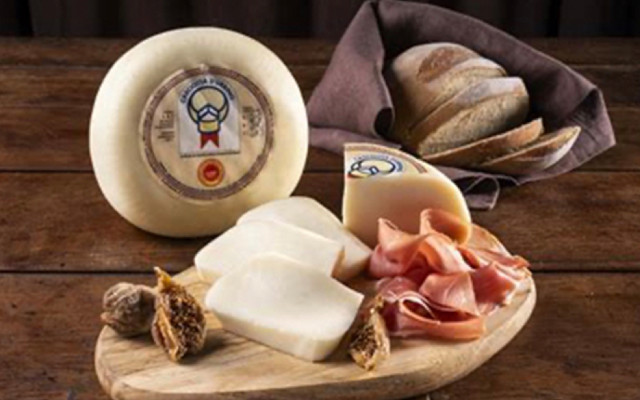
The caciotta is one of the most widespread cheeses in the peninsula: soft or semi-hard paste, round and low shape, delicate flavour, short or medium ageing. The name – as happens for the mozzarella and the robiola, among others – does not indicate a single product but a family of cheeses made from cow, sheep, goat or mixed milk, declined by each territory according to its own pastures and breeds.
There is no Protected Designation of Origin for caciotta as a category. Its protection comes from a PDO from Marche region, the Casciotta d'Urbino DOP, from regional lists of Traditional Agri-food Products (MATs) and from Italian and European rules on raw materials and additives.
Casciotta d'Urbino DOP, the current specification
The Casciotta d'Urbino DOP is the best-known caciotta on international markets. Recognized in Italy as a designation of origin in 1982, it was registered as Protected Designation of Origin in 1996. The current specification is the one modified in 2020, with the approval of the European Commission (EU executive reg. 2020/1719).
Origins and link with the territory
The regulation links Casciotta to permanent livestock farms of sheep and cattle documented in Montefeltro since Five hundred, favored by the Dukes of Montefeltro and Della Rovere to contain transhumance. Shape, weight and heel derive from the ancient terracotta or majolica moulds from the Urbania area, with a closed convex bottom and a small hole for draining the whey. The milk mixture instead reflects the production capacity of the small family farms in the province (regulation, article 6). A document preserved in the State Archives of Florence, dated 1590, already describes the sending of casciotte to the Duke of Urbino.
Production area and raw material
The area of origin of milk, production and maturing includes the entire province of Pesaro and Urbino in the Marche and the municipalities of Novafeltria, Talamello, Sant'Agata Feltria, Casteldelci, Maiolo, San Leo and Pennabilli. The latter passed to the province of Rimini, in Romagna, after the registration of the denomination, without any change in the geographical area (disciplinary, article 3).
The cheese is obtained from whole sheep milk for 70-80% e from whole milk of cow for the remaining 20-30% (regulation, article 2). The allowed breeds include, for sheep, Sarda, Sopravvissana, Gentile di Puglia, Merinos, Comisana, Massese, Vissana, Cornella Bianca, Fabrianese, delle Langhe, Lacaune, Assaf and Pinzirita, with their respective crosses; for cattle, Frisona Italiana, Bruna Italiana, Pezzata Rossa and Jersey. Animals can be kept in stalls or grazed. At least 50% of the base ration and 75% of the dry matter of daily forage must come from the area of origin (Exec. Reg. EU 2020/1719).
Manufacturing method
The milk, raw or heat-treated, coagulates at approximately 35 °C with rennet liquid or powder form, with possible addition of lactic ferments. The curd is placed in moulds suitable for promoting whey drainage, then dry-salted or brined. The maturation it lasts from 15 to 30 days, depending on the size of the wheel, at a temperature of 8-14 °C with humidity of 80-90% (disciplinary, article 5). The 2020 amendment eliminated the reference to 'semi-cooked pasta', no longer consistent with the actual technology, and admitted automatic milking (EU executive reg. 2020/1719).
Product characteristics
For consumption, Casciotta d'Urbino DOP has shape cylindrical with low heel and rounded faces, diameter of 12-16 cm, heel of 5-9 cm and weight of 800-1,200 grams. The rind, thin, about 1 mm and of colour straw-coloured, is not edible and can be treated on the surface with permitted substances. The Pasta it is tender and crumbly, with slight holes, of a straw-white colour. The flavor is 'sweet, characteristic of sheep's and bovine's milk, full and pleasantly acidic', the fat in the dry matter is not less than 45% (regulation, article 2).
Labelling and controls
Casciotta d'Urbino PDO is released for consumption in whole or portioned forms, even vacuum-packed. The label, on one of the faces, shows the untranslatable name followed by DOP or the full wording, the symbol of the European Union and the logo of the denomination: a quarter-cut caciotta in shades of straw yellow, with a blue edge and red swallowtail band (disciplinary, article 8). Compliance checks are entrusted to Valoritalia, a control body authorized in 2026 by the Ministry of Agriculture, Food Sovereignty and Forestry.
Fossa di Sogliano DOP cheese, underground refinement
On the Romagna-Marche Apennines, underground conservation has given rise to a unique refinement. The Formaggio di Fossa di Sogliano PDO is not a caciotta in the strict sense. It is born from sheep, cow or mixed cheeses already aged, sealed in bags inside pits truncated conical dug into the rock sandstone and sealed for the entire duration of the ageing (EC regulation 1183/2009). The local story traces the use back to 1486, when farmers hid their supplies in the pits to protect them from passing armies.
The figures of widespread production
Official statistics do not isolate caciotta from other cheeses, and its production remains in the hands of hundreds of dairies, large and small, in all regions. The cards of Traditional Agri-food Products (PATs) collected by the National Organization of Cheese Tasters (ONAF) still provide some significant measurements.
In Maremma, land of the Pecorino Toscano PDO, the sheep caciotta it is produced mainly by two dairies in Sorano and Manciano, with an estimate of around 500 tonnes per year and a demand capable of absorbing the entire supply. On the Pistoia mountains, in Cutigliano, a single company located at 1,279 meters above sea level produces around 10 tonnes of sweet caciotta of cow's milk and 30 quintals of aged caciotta.
The dairy sector as a whole is going through an expansionary phase on foreign markets. In 2025, Italy exported 678,974 tonnes of cheese, for a value of 6.09 billion euros, with a growth of 4.6% in volume and 12.8% in value compared to the previous year, according to the processing of the Italian Dairy Association (Assolatte) on Istat data.
Caciotta in the history of territories
In Lunigiana, a borderland between Tuscany and Liguria, caciotta is linked to the archaeological landscape of prehistoric sandstone statue-stelae. According to the ONAF sheet, it was the anthropomorphic representation of the moon that gave its name to the territory, inhabited in antiquity by populations of Ligurian-Apuan origin. The Latin poet Martial (40-104 AD) already celebrated the cheese of Luni: 'Caseus Etruscae signatus imagine Lunae / praestabit pueris prandia mille tuis' (Martial, Epigrams, XIII, 30), that is, the cheese marked with the image of the Etruscan Moon will give a thousand lunches to your servants.
The Caciotta della Lunigiana PAT is obtained today from whole raw cow's milk, with entirely manual processing, in two dairies in the area. It is a niche production, consumed mostly fresh.
On Monti Lattari, the backbone of the Sorrento Peninsula, the Romans spoke of Montes Lactarii, mountains rich in milk. Here is produced Goat caciotta from Monti Lattari PAT, known locally as caciotta 'e zì Maria, typical of the small town of Pimonte (Naples, Campania). It is obtained from whole, raw milk from goats raised on pasture, including the Neapolitan goat, which is rare today. The shapes, from 0.4 to 1 kg, resemble a truncated cone, the maturation ranges from 2 to 40 days and the flavor is very delicate, basically sweet. The ONAF sheet reminds us that this caciotta is 'appreciated for its particular lightness and its low calorie content'.
Milk, rennet and salt: how a caciotta is born
The basic method is simple and common to many Italian fresh cheeses, such as robiola: milk, rennet, salt and, in most cases, lactic ferments. Milk can be raw, thermised or pasteurized. The curd is broken and placed in moulds, often subjected to stewing in a hot environment to facilitate the drainage of the whey, then dry-salted or in brine. The variations depend on the animal species, the treatment of the milk and the maturing times.
In Lazio the Caciotta della Sabina PAT, typical of Montopoli di Sabina and Poggio Mirteto, in Lazio, is produced with whole sheep milk from the pastures of the lower Sabina, pasteurized at 70 °C for 15 seconds, and matured in historic premises on wooden boards at 12-13 °C. In the herbal version it is flavored with chives, rocket, wild fennel, basil and coriander. According to the Regional Agency for the Development and Innovation of Agriculture of Lazio (ARSIAL), processing once took place in high altitude pens, and the cheese retains the characteristics of transhumance products.
The Mixed Caciotta della Tuscia PAT combines sheep's and cow's milk. After breaking the curd, the cheeses are stewed in steam-heated boxes at 50-60 °C, dry-salted or in brine and matured at 8-15 °C, with humidity of 85-90%, for a period of between 20 days and 3 months. Compared to pecorino, observes ARSIAL, it has a more neutral taste and closer to current consumption guidelines.
In the province of Frosinone the Caciotta di vacca ciociara PAT, documented in the historical archives of the municipality of Ferentino, is a stretched-curd cheese made from cow milk. In the flavored version, immediately after stretching, it is enriched with chili pepper, garlic, pepper or truffle, and matures for about ten days in a cell at 4 °C. In Ceprano the Caciotta cepranese, with a semi-cooked texture, is obtained from thermised cow's milk of Friesian and Brown cows with access to pasture, in the two types Caciotta and Caciottone; ONAF indicates it as registered in the twenty-sixth list of PATs.
In Emilia-Romagna the Caciotta from the Modena Apennines it is protected by the collective brand 'Tradition and flavors of Modena' of the Modena Chamber of Commerce, with cow's milk from the Modena mountains. Some dairies also produce it with milk from pure Bianca Modenese cows.
Among the many other regional caciotta cheeses, we remember the Caciotta di Brugnato from the middle Val di Vara, in Liguria, made from whole raw cow's milk, the Caciotta dei Monti della Laga of Amatrice and Accumoli and the cow caciotta of Lazio, sold in the version primo sale or aged up to six months.
The nutritional profile according to CREA
The food composition tables indicated by CREA — Food and Nutrition Research Centre (2019) refer to the Tuscan caciotta (code 160840) the nutritional values listed below, per 100 grams of product. The values vary depending on the milk, fat content and aging. For this entry, CREA does not report the content of saturated fatty acids.
| Nutrient | Per 100 g | % VNR |
| Energy | 1,539 kJ / 368 kcal | |
| Fat | 29.6 g | |
| of which saturated fatty acids | N/A | |
| Carbohydrates | 0.8 g | |
| of which sugars | 0.8 g | |
| Fibre | 0 g | |
| Proteins | 24.6 g | |
| Salt | 1.29 g | |
| Calcium | 531 mg | 66% |
| Vitamin A | 453 µg | 57% |
Source: CREA (2019), caciotta toscana, code 160840. NRV: nutritional reference values as in Annex XIII to Regulation (EU) No 1169/2011.
Caciotta is a food with high energy and protein density. Proteins provide approximately 27% of energy, above the 20% threshold required for the 'ad' indication. high protein content'. Calcium and vitamin A exceed 30% of the nutritional reference values set out in Annex XIII to Regulation (EU) no. 1169/2011, threshold established for the indication 'high in' referring to vitamins and minerals (EC regulation 1924/2006, Annex). By way of comparison, the caciotta romana di pecora (code 160830) reports 364 kcal, 27.7 g of proteins, 27.3 g of fats and 380 µg of Vitamin A per 100 grams.
Fresh milk, additives and labelling
In Italy Law No. 138/1974 prohibits holding, selling or using milk to which milk powder or other preserved milks have been added, as well as dairy products derived in any case from milk powder (Law 138/1974, art. 1). Caciotta produced in Italian dairies is therefore made from liquid milko. On the packaging of pre-packaged dairy products, the origin of the milk is indicated with the country of milking and the country of conditioning or processing, based on a national regime extended until 31 December 2026 (DM 9.12.2016; interministerial decree 26.12.2025).
Regulation (EC) No 1333/2008 lists exhaustively the additives permitted for each food category. For aged cheeses the list includes substances with limited functions, such as lysozyme and calcium chloride. Natamycin is permitted only for the external treatment of the rind of whole hard, semi-hard and semi-soft cheeses, within 1 mg per square decimeter and without presence at 5 mm depth. Colorants are permitted only for specifically indicated types, such as aged orange, yellow and broken white cheeses (EC regulation 1333/2008, Annex II, part E, category 01.7.2). From 9 October 2026, the maximum dose of nitrates that can be added to milk for hard, semi-hard and semi-soft cheeses has dropped from 150 to 75 mg/kg (EC regulation 1333/2008, Annex II, part E, category 01.7.2). For i fresh cheeses the rules are different and allow, excluding mozzarella, Group I additives (Regulation (EC) 1333/2008, Annex II, part E, category 01.7.1).
Many caciotte, however, are limited to essential recipe. Indeed, European Union law exempts from the obligation to indicate the list of ingredients cheeses to which no ingredients other than milk products, food enzymes and cultures of microorganisms necessary for manufacturing have been added and, for cheeses other than fresh and processed cheeses, from the salt necessary for their production (EU regulation 1169/2011, art. 19.1, letter 'd').
How to choose caciotta at the counter
The choice starts from label, which indicates the origin of the milk and, if present, the list of ingredients: a list limited to milk, rennet, salt and ferments corresponds to the classic recipe. There fresh caciotta, a few days old, has a soft paste and milky flavour, and is ideal for the table with raw vegetables or in salads. The aged develops more intense aromas and a more compact texture, suitable for the board with cured meats and local red wines.
The animal species guides the taste: caciotta made from goat milk is delicate and light, that made from sheep milk richer and more aromatic, that made from cow milk the most versatile in the kitchen. Those looking for a precise link with a place can orient themselves on Casciotta d'Urbino PDO, linked by the specifications to a defined area and recipe, and on PAT caciotte.
Conclusions
Caciotta shows the variety of Italian cheesemaking: dozens of local recipes, from the Val di Vara to the Sorrento Peninsula, united by a simple method and rigorously regulated raw materials. Casciotta d'Urbino DOP represents the version certified at European level, the PATs document its history and techniques, the Italian ban on powdered milk and the positive list of EU additives define its production perimeter. Knowing the types, milk and label helps you choose the most suitable caciotta for each use.
Dairy and cheese sector enterprises can contact FARE (Food and Agriculture Requirements) for the strategic planning of commercial information compliance, in the environmental and sustainability fields (supply chains, processes and products), including nutrition & health claims, also with support for the development of management systems governance corporate and operational procedures.
Dario Dongo
Credit cover: AFIDOP (Italian Cheeses PDO and PGI Association)
Frequently asked questions
Is caciotta a PDO cheese? Caciotta is a family of cheeses without a single denomination. Casciotta d'Urbino DOP, made from sheep's and cow's milk, is registered as a protected designation of origin, while many other regional caciottas are registered among Traditional Agri-Food Products.
Caciotta and pecorino, what's the difference? Pecorino is made only from sheep milk and is often aged longer. Caciotta can be cow, sheep, goat or mixed milk, typically has short or medium ageing and a more delicate flavour.
How many calories does caciotta have? According to CREA, Tuscan caciotta provides 368 kcal per 100 grams, equal to 184 kcal per a 50-gram serving, with 24.6 g of proteins and 531 mg of calcium per 100 grams.
References
European Union regulatory sources
Commission Implementing Regulation (EU) 2020/1719 of 11 November 2020 approving a non-minor amendment to the specification for a name entered in the register of protected designations of origin and protected geographical indications ('Casciotta d'Urbino' (PDO)). OJ L 386, 18.11.2020, p. 5. http://data.europa.eu/eli/reg_impl/2020/1719/oj
Commission Regulation (EC) No 1183/2009 of 30 November 2009 entering a name in the register of protected designations of origin and protected geographical indications [Formaggio di Fossa di Sogliano (PDO)]. OJ L 317, 3.12.2009, p. 34-35. http://data.europa.eu/eli/reg/2009/1183/oj
Publication of an application for approval of a non-minor amendment to a product specification pursuant to Article 50(2)(a) of Regulation (EU) No 1151/2012 of the European Parliament and of the Council on quality schemes for agricultural products and foodstuffs ('Casciotta d'Urbino', 2020/C 223/06). OJ C 223, 7.7.2020, p. 20-30. https://eur-lex.europa.eu/legal-content/EN/TXT/?uri=CELEX:52020XC0707(04)
Regulation (EC) No 1333/2008 of the European Parliament and of the Council of 16 December 2008 on food additives. Consolidated text: 18/08/2026. http://data.europa.eu/eli/reg/2008/1333/2026-08-18
Regulation (EC) No 1924/2006 of the European Parliament and of the Council of 20 December 2006 on nutrition and health claims made on foods. Consolidated text: 13/12/2014. http://data.europa.eu/eli/reg/2006/1924/2014-12-13
Regulation (EU) No 1169/2011 of the European Parliament and of the Council of 25 October 2011 on the provision of food information to consumers. Consolidated text: 01/04/2025. http://data.europa.eu/eli/reg/2011/1169/2025-04-01
Italian regulatory sources
Interministerial decree of 9 December 2016, 'Indication of the origin on the label of the raw material for milk and dairy products, in implementation of Regulation (EU) no. 1169/2011'. Official Journal no. 15 of 19 January 2017. Extended until 31 December 2026 by the interministerial decree of 26 December 2025, in the Official Journal of 11 February 2026. https://www.masaf.gov.it/flex/cm/pages/ServeBLOB.php/L/EN/IDPagina/11193
Law 11 April 1974, n. 138, 'New rules concerning the ban on the reconstitution of powdered milk for human consumption'. Regulatory. Latest consolidated version: 06/24/2014. https://www.normattiva.it/uri-res/N2Ls?urn:nir:stato:legge:1974-04-11;138!vig=
Institutional sources
MASAF — Ministry of Agriculture, Food Sovereignty and Forestry. (2026). Regulation 2026. ICQRF – Authorization to the body called 'Valoritalia Srl' to carry out checks for the PDO 'Casciotta d'Urbino'. https://www.masaf.gov.it/flex/cm/pages/ServeBLOB.php/L/EN/IDPagina/163/YY/2026
Nutritional sources
CREA — Food and Nutrition Research Centre. (2019a). Food composition tables. Roman sheep caciotta (code 160830). https://www.alimentinutrizione.it/tabelle-nutrizionali/160830
CREA — Food and Nutrition Research Centre. (2019b). Food composition tables. Tuscan caciotta (code 160840). https://www.alimentinutrizione.it/tabelle-nutrizionali/160840
Market data
Assolatte. (2026). Italian cheese exports (January-December 2025). Processing of Istat data. https://www.assolatte.it/zpublish/4/uploads/4/eco_cate/17734129068187643865_Export%20formaggi%20dicembre%202025.pdf
Historical sources
Martial. Epigrams, XIII, 30, 'Caseus Lunensis'. The Latin Library. https://www.thelatinlibrary.com/martial/mart13.shtml
Product sheets
ARSIAL. (2025a). Caciotta dei Monti della Laga. In Lazio agri-food heritage. Between biodiversity and tradition. https://www.arsial.it/wp-content/uploads/2025/06/CACIOTTA-DEI-MONTI-DELLA-LAGA.pdf
ARSIAL. (2025b). Caciotta di bufala pontina; Caciotta della Sabina (plain and with herbs). In Lazio agri-food heritage. Between biodiversity and tradition. https://www.arsial.it/wp-content/uploads/2025/06/CACIOTTA-DI-BUFALA-PONTINA.pdf
ARSIAL. (2025c). Caciotta di vacca ciociara (plain and flavoured). In Lazio agri-food heritage. Between biodiversity and tradition. https://www.arsial.it/wp-content/uploads/2025/06/CACIOTTA-DI-VACCA-CIOCIARA-SEMPLICE-E-AROMATIZZATA.pdf
ARSIAL. (2025d). Caciotta mista ovi-vaccina del Lazio; Caciotta mista della Tuscia. In Lazio agri-food heritage. Between biodiversity and tradition. https://www.arsial.it/wp-content/uploads/2025/06/CACIOTTA-MISTA-OVI-VACCINA-DEL-LAZIO.pdf
Chamber of Commerce of Modena. (2017). Tradition and flavours of Modena. 15 years of history. https://www.mo.camcom.it/promozione/iniziative-e-progetti/tradizione-e-sapori/report-tradizione-e-sapori-di-modena-15-anni-di-storia/@@download/file/Ricerca%20Marchio%20TS.pdf
ONAF. (N/A-a). Caciotta (Caciotta di Brugnato, PATs Liguria Region). https://www.onaf.it/uploads/public/11133_caciotta.pdf
ONAF. (s.d.-b). Caciotta (PAT Emilia-Romagna Region and other typical cheeses, including Caciotta from the Modenese Apennines). https://www.onaf.it/uploads/public/14027_caciotta.pdf
ONAF. (N/A-c). Caciotta cepranese. https://www.onaf.it/uploads/public/20585_caciotta-cepranese.pdf
ONAF. (N/A-d). Caciotta della Lunigiana. https://www.onaf.it/uploads/public/10969_caciotta-della-lunigiana.pdf
ONAF. (n.d.-e). Caciotta della Sabina (plain and with herbs). https://www.onaf.it/uploads/public/9239_caciotta-della-sabina-semplice-e-alle-erbe-.pdf
ONAF. (n.d.-f). Caciotta di capra dei Monti Lattari. https://www.onaf.it/uploads/public/14151_caciotta-di-capra-dei-monti-lattari.pdf
ONAF. (n.d.-g). Caciotta di mucca. https://www.onaf.it/uploads/public/9276_caciotta-di-mucca.pdf
ONAF. (n.d.-h). Caciotta di pecora (Tuscany Region sheet). https://www.onaf.it/uploads/public/formaggi/10984_caciotta-di-pecora-reg-toscana.pdf
ONAF. (n.d.-i). Caciotta dolce. https://www.onaf.it/uploads/public/11010_caciotta-dolce.pdf
ONAF. (n.d.-j). Mixed Caciotta from Tuscia. https://www.onaf.it/uploads/public/9303_caciotta-mista-della-tuscia.pdf
ONAF. (n.d.-k). Aged Caciotta (Tuscany Region sheet). https://www.onaf.it/uploads/public/formaggi/11003_caciotta-stagionata-reg-toscana.pdf
ONAF. (n.d.-l). Casciotta di Urbino. https://www.onaf.it/uploads/public/15482_casciotta-di-urbino.pdf
ONAF. (n.d.-m). Formaggio di Fossa di Sogliano PDO. https://www.onaf.it/uploads/public/12553_formaggio-di-fossa.pdf

Dario Dongo, lawyer and journalist, PhD in international food law, founder of WIISE (FARE - GIFT – Food Times) and Égalité.


