

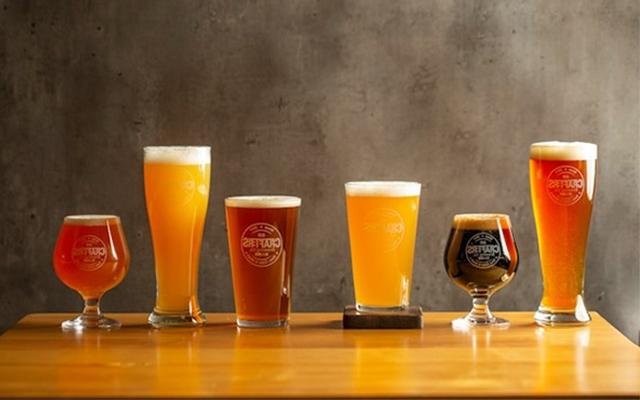
There is no universal classification of beers. The most commonly used criteria look at the type of Fermentation, geographical tradition, sensory profile and recipe. The main families are three: low fermentation lager, high fermentation ale and spontaneous or mixed fermentation beers.
Within the families there are the styles, described by two international reference systems: the guidelines of the Beer Judge Certification Program, updated in 2021, and those of the Brewers Association, whose 2026 edition added Rice Lager. They are technical tools for producers, judges and enthusiasts, not legal categories, and two styles were born in Italy.
Lager and ale, the difference starts with the yeast
The distinction depends on the yeasts and fermentation conditions, not on colour: there are light and dark lagers and ales. The Ale traditionally use Saccharomyces cerevisiae, the high fermentation yeast that tends to rise to the surface. The Lager instead they use Saccharomyces pastorianus, a natural hybrid between S. cerevisiae and Saccharomyces eubayanus – a cold-resistant wild yeast – from which the hybrid inherits the ability to ferment at low temperatures (Giorgetti et al., 2025).
| Characteristic | Lager | Ale |
| Typical yeast | Saccharomyces pastorianus | Saccharomyces cerevisiae |
| Fermentation | At lower temperatures | At higher temperatures |
| Aromatic profile | Clean and linear | Richer in esters and fermentative aromas |
| Maturation | Often cold (lagering) | Variable according to style |
| Examples | Pilsner, helles, bock | Pale ale, IPA, stout, saison |
The distinction is not rigid, as there are hybrid techniques and fermentations carried out at non-conventional temperatures.
The main lagers
| Style | Origin | Colour | Profile |
| Pilsner or pils | Plzeň, Bohemia, first half of the 19th century | Straw-gold | Delicate malt, herbaceous or floral hop, clean bitterness, dry finish |
| Helles | Bavaria | Golden | Malt and cereal prominent, moderate bitterness, soft finish |
| Märzen | Germany | Amber | Bread crust, biscuit, medium body, moderate bitterness |
| Bock, doppelbock, eisbock | Germany | From golden to brown | Dominant malt, higher alcohol content; eisbock is concentrated by partial freezing |
| Dark | Bavaria | Copper-brown | Toasted bread, dried fruit, malt |
Czech and German pilsners differ in malt intensity, hop character and bitterness. Bocks are not necessarily bitter, and dunkel simply means 'dark'. The term Oktoberfestbier also requires attention: the beers served at the Munich Oktoberfest follow a specific tradition and do not coincide with all beers sold under this name.
The styles born in Italy
Two styles have Italian roots. THE'Italian Grape Ale is an ale produced with grapes or grape must, born in 2006-2007 in the Montegioco and Barley breweries and today widespread in many Italian craft breweries. The Beer Judge Certification Program (BJCP) welcomed it in 2015 and maintains it among the local styles, while for versions from other countries it created the broader category of Grape Ale.
THE'Italian Pilsner was recognized as an autonomous style by the Brewers Association in 2024, with the name Italian-Style Pilsener: it originates in Northern Italy and combines a German pils base with generous dry hopping (dry hopping) with noble hops. It is a recognition of the creativity of Italian breweries and a useful element of identity for exports.
The main ales
| Style | Origin | Profile |
| Pale ale | England; American versions | Light malts, biscuit, moderate hopping; more citrusy and resinous in American versions |
| English IPA | England | Traditional hops, herbal notes, balance between malt and bitterness |
| American IPA, West Coast IPA | United States | Citrus, pine, tropical fruit; the West Coast is dry, clear and decidedly bitter |
| New England IPA | United States | Hazy, soft body, restrained perceived bitterness, tropical aromas |
| Double or Imperial IPA, Session IPA | United States | More intense or, on the contrary, less alcoholic versions |
| Bitter | Great Britain | Balance between malt and hops, not necessarily very bitter |
| Brown ale | Great Britain and United States | Hazelnut, caramel, toasted bread, moderate bitterness |
The acronym India Pale Ale (India Pale Ale) derives from the tradition of British breweries, in the 18th century, of producing beer also destined for English colonies in India. To withstand the long sea voyage, they developed a more heavily hopped beer with greater ability to survive during transport.
This acronym does not identify a single recipe, as the profile changes with hops, the timing of their addition, the dry hopping technique, the malt and yeast.
Porter and stout, dark beers
The Porter is an 18th century London style, with dark brown color, with notes of toasted bread, cocoa, coffee and caramel. The stout was developed on the basis of porter and uses toasted malts or grains, with aromas of coffee and dark chocolate.
| Stout variant | Distinctive element |
| Dry or Irish stout | Dry, toasted, relatively light body |
| Milk stout | Lactose, sugar hardly fermentable by brewing yeasts, for sweetness and softness |
| Oatmeal stout | Oats, for consistency and body |
| Imperial stout | High malt structure and high alcohol content |
| Pastry stout | Ingredients inspired by pastry-making, such as cocoa, vanilla and coffee |
Dark color does not imply a alcohol content high alcohol content: there are light stouts and highly alcoholic versions. The presence of lactose must always be listed among allergens.
Wheat beers, weiss and blanche
The Weissbier or British breweries contain an important share of wheat malt and is fermented with yeasts with top fermentation. It is recognized by abundant foam, high carbonation and notes of banana and clove. The main variants are Hefeweizen (unfiltered), Kristallweizen (filtered), Dunkelweizen (dark) and Weizenbock (more structured).
The witbier o Belgian blanche it can use unmalted wheat and traditionally includes coriander and orange peel, with citrus and spicy notes and a slight acidity. The two beers share wheat but belong to different traditions.
Saison and Belgian beers
The Saison is an ale of Walloon tradition, clear, dry and highly attenuated, with fruity, spicy and peppery notes. Belgian Blond Ale combines a balanced malt with the fruity aromas of yeast. Dubbel e Tripel they are styles of monastic tradition: the first is amber or dark, with caramel and dried fruit, the second is lighter, alcoholic and dry. The two names describe historical styles and not a mathematical scale of alcohol.
Lambic and spontaneous fermentations
Beer Lambic belgian comes from an environmental inoculation of the must and from a fermentation and maturation process in wooden barrels which can last up to three years. The process goes through four phases with different microbial communities, with yeasts of the genus Brettanomyces protagonists of maturation and bacteria such as Pediococcus damnosus and Acetobacter, responsible for acidity and specific aromas (De Roos et al., 2020).
The gueuze comes from the assembly of lambics of different ages and from refermentation in the bottle, while fruit lambics, such as kriek, are re-fermented with cherries, raspberries or other fruits.
| Term | Meaning |
| Spontaneous fermentation | Initiated by environmental microorganisms, without inoculation of selected cultures |
| Mixed fermentation | Multiple microorganisms, often with controlled inocula of yeasts and bacteria |
| Wild | Broad expression for unconventional yeasts or complex communities; not equivalent to spontaneous fermentation |
Colour, bitterness and body
The Colour depends on the blend of cereals and from malting and roasting processes and is measured using the EBC (European Brewery Convention) and SRM (Standard Reference Method) scales. It does not indicate strength, sweetness or bitterness: a dark beer can be light and dry.
THE'bitterness it derives above all from the iso-alpha-acids of hops and is expressed in IBU (International Bitterness Units), an analytical data which however does not always coincide with the perceived bitterness. The body depends on residual extract, proteins, dextrins, alcohol and carbonation, and cannot be deduced from colour alone.
Styles and protected designations
The styles describe the characteristics of a beer, but are not reserved legal designations. The sales designation in Italy follows the legal definition of beer, and the craft beer depends on legal requirements, not on the style.
However, some brewery names are protected by European Union law as geographical indications or guaranteed traditional specialties (EU regulation 2024/1143). Among them protected geographical indications include 'Bayerisches Bier', 'Münchener Bier' and 'Kölsch'. The Belgian 'Gueuze', obtained by spontaneous fermentation, is instead a guaranteed traditional specialty, protected for the production method and not for the geographical area.
The Court of Justice of the European Union has ruled on the registration of 'Bayerisches Bier', following a referral from the Court of Appeal of Turin, in the dispute between the association of Bavarian breweries and the Dutch group Bavaria, owner of trademarks containing the term 'Bavaria'. The Court confirmed its validity, also excluding that the name had become generic. However, it specified that the registration does not affect earlier trademarks containing the term 'Bavaria' - such as 'Bavaria Italia' - if registered in good faith before the application for registration of the geographical indication and not affected by causes of nullity or revocation. This verification is up to the national judges (case C-343/07).
Knowing the styles helps to choose according to your own tastes. No style is superior to others: quality depends on raw materials, process, stability and product safety.
The working group of DO supports breweries in strategic planning of production compliance and commercial information, from sales denominations and styles to environmental and sustainability assertions on supply chains, processes and products, also with support in developing governance corporate and operational procedures.
Dario Dongo
Frequently asked questions
What is the difference between lager and ale? The yeast and fermentation temperature: lagers use S. pastorianus at low temperatures, ales use S. cerevisiae at higher temperatures.
Is a dark beer stronger than a light one? Not necessarily. The color depends on the roasting of the malts, not on the alcohol content.
Do Italian beer styles exist? Yes. Italian Grape Ale, recognized by the BJCP, and Italian Pilsner, recognized by the Brewers Association.
Is the style of a beer a legal denomination? No, it is a technical classification. Some names, such as Kölsch or Gueuze, are however protected as geographical indications or traditional specialties guaranteed.
What does IBU measure? The concentration of bitter substances in hops, which does not always coincide with the perceived bitterness.
References
Regulatory sources and jurisprudence of the European Union
Regulation (EU) 2024/1143 of the European Parliament and of the Council of 11 April 2024 on geographical indications for wine, spirit drinks and agricultural products, as well as traditional specialities guaranteed and optional quality terms for agricultural products. Consolidated text: 18/03/2026. Regulation (EU) 2024/1143 of 18 March 2026
Court of Justice of the European Union, judgment of 2 July 2009, Bavaria NV and Bavaria Italia Srl v Bayerischer Brauerbund eV, Case C-343/07, ECLI:EU:C:2009:415. https://eur-lex.europa.eu/legal-content/EN/TXT/?uri=celex:62007CJ0343
Guidelines on styles
Beer Judge Certification Program. (2021). 2021 Style Guidelines. Beer Style Guidelines. https://www.bjcp.org/download/2021_Guidelines_Beer.docx
Brewers Association. (2026). 2026 Brewers Association Beer Style Guidelines. https://www.brewersassociation.org/edu/brewers-association-beer-style-guidelines/
Brewers Association. (2024, 6 November). Brewers Association Releases 2024 Beer Style Guidelines. https://www.brewersassociation.org/association-news/brewers-association-releases-2024-beer-style-guidelines/
Institutional documentation
European Commission. (s.d.). Objectives of EU quality schemes. https://agriculture.ec.europa.eu/farming/geographical-indications-and-quality-schemes/geographical-indications-and-quality-schemes-explained_en
Goethe-Institut Italia. (N/A). 9 curiosities about German beer. https://www.goethe.de/ins/it/it/kul/den/27258225.html
Scientific studies
De Roos, J., Verce, M., Weckx, S., & De Vuyst, L. (2020). Temporal shotgun metagenomics revealed the potential metabolic capabilities of specific microorganisms during lambic beer production. Frontiers in Microbiology, 11, 1692. https://doi.org/10.3389/fmicb.2020.01692
Giorgetti, S. I., Burini, J. A., Eizaguirre, J. I., & Libkind, D. (2025). Technological prospects of Saccharomyces eubayanus: Breakthroughs and brewing industry applications. Fermentation, 11(9), 499. https://doi.org/10.3390/fermentation11090499

Dario Dongo, lawyer and journalist, PhD in international food law, founder of WIISE (FARE - GIFT – Food Times) and Égalité.


