
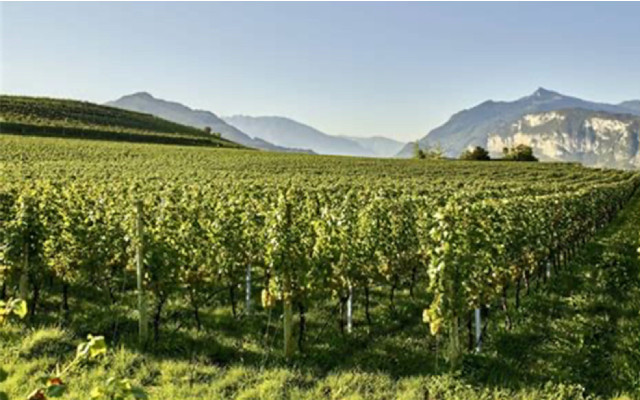
A designation that brings together 10,222 hectares of vineyards, the cooperative model of alpine micro-enterprises and the national leadership in certified integrated production. The distinction from Trento PDO, the five sub-zones and the rarity of Vino Santo from Nosiola grapes.
The Trentino PDO is the designation of origin for still wines from the province of Trento. Recognized in 1971, it includes white, red and rosé wines, single varietal and from two grape varieties, the Superior mention, five sub-zones and the Vino Santo from dried Nosiola grapes (Trentino regulations, article 1). In 2024 the designation claimed 502,446 hectoliters, 60% of wine produced in the province (Chamber of Commerce of Trento, 2025).
Trentino viticulture occupies 10,222 hectares, 1.4% of the Italian vineyard area, and mainly produces white wines. Cooperative wineries transform 85% of the wine and over four fifths of the vineyards are certified in integrated production (Trento Chamber of Commerce, 2025). Following is the distinction from Trento DOC, the rules of the specification, the vines, the Vino Santo, sustainability, the market and pairings.
A provincial PDO since 1971
The Trentino DOC specification was approved in 1971 and modified several times. The last ordinary modification was communicated to the European Commission and published in the Official Journal of the European Union in 2019 (Trentino regulations, introduction). In European Union law the PDO corresponds to a PDO, Protected Designation of Origin, protected according to rules on geographical indications wines (Regulation (EU) 1308/2013, art. 93; Regulation (EU) 2024/1143).
Protection is entrusted to Trentino Wine Protection Consortium, which carries out the functions of promotion, valorisation, consumer information and supervision for the DOC Trentino, Trento, Teroldego Rotaliano, Casteller and Valdadige and for the IGT Vigneti delle Dolomiti and Vallagarina. The ministry confirmed the assignment for three years in 2025 (MASAF decree 28.4.2025; law 238/2016, art. 41).
Trentino PDO and Trento PDO, wines and sparkling wines
Trentino DOC does not include the sparkling wine type (Trentino regulations, article 1). The classic method bubbles of the province belong to another denomination, the Trento PDO, recognized in 1993 and reserved for white and rosé sparkling wine obtained with 'refermentation in the bottle' - classic methods - from Chardonnay, Pinot bianco, Pinot noir and Meunier (Trento regulations, articles 1 and 2). The Trento Doc Institute promotes its wines with the collective name Trentodoc.
Trento PDO requires at least 15 months aging on the lees. The vintage on the label is optional after at least 24 months, the reserve mention requires 36 (Trento regulations, articles 5 and 7). The two denominations share territory, vines and protection consortium, but have their own specifications, typologies and markets. Trento DOC is described in the framework of Italian sparkling wine and the classical method as well as the Alta Langa DOCG and Franciacorta DOCG.
Alongside the two main provincial PDOs are Teroldego Rotaliano PDO, also from 1971, the Casteller PDO and Valdadige PDO, which also extends beyond provincial borders. Part of Trentino production is claimed as Delle Venezie PDO, the interregional denomination of Pinot Grigio, and as Vigneti delle Dolomiti PGI, Trevenezie PGI and Vallagarina PGI (Chamber of Commerce of Trento, 2025).
Production zone and sub-zones
The production zone comprises 73 municipalities in the province of Trento, some only partially. The regulation describes a entirely mountainous territory, with 70% of the surface above 1,000 meters and vineyards between 70 and 600-700 meters of altitude. The climate it is mitigated by Lake Garda and the Òra, the wind that rises from the lake along the Adige valley (Trentino regulations, articles 3 and 9).
The regulation provides for five sub-zones: Sorni, Isera or d'Isera, Ziresi, Castel Beseno or Beseno and Valle di Cembra. White and red are reserved for Sorni, with the words 'Bianco dei Sorni' and 'Rosso dei Sorni'; in Isera the Marzemino Superiore (Trentino regulations, articles 1 and 7). Vino Santo can only come from some municipalities in the Valle dei Laghi and Alto Garda: Arco, Cavedine, Drena, Dro, Madruzzo, Nago-Torbole, Riva del Garda, Tenno and Vallelaghi (Trentino regulations, article 3).
Grape varieties and types allowed by the regulation
The Trentino White requires at least 80% Chardonnay and/or Pinot Blanc, with Sauvignon, Müller Thurgau and Manzoni bianco up to 20%. The Red is obtained from Cabernet and Merlot; the rosé, or kretzer, by at least two between Enantio, Schiava, Teroldego and Lagrein, each no more than 70% (Trentino regulations, article 2).
Wines with name of the grape variety they must come for at least 85% from the indicated grapes; in wines from two grape varieties the lesser one must reach 25%. The Schiava designation is reserved for Schiava gentile, grigia and grossa (Trentino regulations, article 2). Among the varieties that can be indicated on the label are Chardonnay, Pinot grigio, Müller Thurgau, Nosiola, Moscato giallo, Marzemino, Lagrein, Moscato rosa, Pinot nero and Rebo, the black grape variety registered as a Rigotti 107-3 cross (Trentino regulations, article 5; Fondazione Edmund Mach, s.d.).
Rules for viticulture and winemaking
Trentino DOC vineyards must have at least 2,500 plants per hectare, in traditional forms. The Superiore requires 4,000 vertical wall vines or 3,500 simple pergolas, and vineyards in positions and altitudes indicated for each vine (Trentino regulations, articles 3 and 4). Vinification and bottling take place in the province of Trento, with exceptions for Bolzano and some municipalities in Verona; for Vino Santo, in the municipalities of the area (Trentino regulations, article 5).
The mention reserve requires at least one year of aging for the whites and two for the reds, from November 1st of the year of harvest. The Superiore provides for minimum aging from 4 months for Müller Thurgau, Nosiola and yellow Moscato up to 22 months for red, Cabernet, Merlot, Lagrein and Rebo (Trentino disciplinary, article 5). The year on the label is mandatory. The bottles are Bordeaux, Rhenish or Burgundy up to 5 litres; Yellow Moscato and Pink Moscato can use the Bocksbeutel-type amphorae bottle (Trentino regulations, articles 7 and 8).
| Type | Maximum yield of grapes | Minimum natural alcohol content | Superiore yield | Superiore natural alcohol content |
| White | 15 t/ha | 10.5% vol | 10 t/ha | 11.5% vol |
| Chardonnay and Pinot Grigio | 15 t/ha | 10.5% vol | 10 t/ha | 11.5% vol |
| Müller Thurgau and Nosiola | 14 t/ha | 9.5% vol | 12 t/ha | 10.5% vol |
| Red | 14 t/ha | 10.5% vol | 9 t/ha | 11.5% vol |
| Lagrein | 14 t/ha | 10.5% vol | 9 t/ha | 11.5% vol |
| Marzemino | 13 t/ha | 10.5% vol | 10 t/ha (Isera 9) | 11.5% vol |
| Vino Santo | 14 t/ha | 16% vol at consumption | 12 t/ha | 18% vol at consumption |
Source: Trentino DOC disciplinary regulations, articles 4, 5 and 6.
The Trentino PDO Vino Santo
The Vino Santo Trentino DOC is obtained from at least 85% Nosiola. The grapes dry on racks and cannot be pressed before February 1st following the harvest, or March 1st for the Superiore. The wine must reach at least 16% vol, of which 10% is done, and must be released for consumption only from 1 November of the third year after the harvest; the Superior requires 48 months of ageing and 18% vol (Trentino regulations, articles 2 and 5). The specification describes it as having a golden yellow color tending towards amber and having a 'pleasantly sweet, passito' taste (Trentino specification, article 6).
Trentino Vino Santo should not be confused with Vin Santo Tuscan, obtained from other vines and with its own rules. The long wait on the racks and the small production area make it one of the rarest dessert wines in Italy.
Areas, grape varieties and enterprises
In 2024 the Trentino vineyard covered 10,222 hectares, all specialised, 74.7% with white grapes. Chardonnay (2,906 hectares, 28.4%) and Pinot Grigio (2,856 hectares, 27.9%) together cover more than half the area. These are followed by Müller Thurgau (839 hectares), Teroldego (576), Pinot Noir (545), Merlot (468), Lagrein (282) and Marzemino (229); Nosiola stands at 50 hectares (Trento Chamber of Commerce, 2025).
The companies with vines total 6,154, with an average area of just 1.77 hectares; 58.7% cultivate no more than one hectare. There are 175 wineries, and the 15 social and cooperative wineries produce 85% of the wine (Trento Chamber of Commerce, 2025). The cooperative model enables small mountain winegrowers to deliver their grapes to structures capable of vinifying, bottling and selling on national and international markets.
The research has a historical role: the regulations indicate the foundation of the Agricultural Institute of San Michele all'Adige, in 1874, as a turning point for Trentino viticulture and oenology (Trentino regulations, article 9). The Institute is today the Fondazione Edmund Mach, which also selects clones of local vine varieties (Fondazione Edmund Mach, N/A).
Integrated and organic production
Trentino has chosen certified integrated production as a model of supply chain sustainability. According to the Consortium's estimates, the 81% of vineyard area is certified SQNPI, the national integrated production quality system, the 11% è organic and 8% follow non-certified integrated production. There are 5,303 wine-growing companies participating in the SQNPI system (Chamber of Commerce of Trento, 2025).
The area of organic vineyard it fell to 1,170 hectares in 2024, 13% less than 2023, after an exceptionally rainy year and strong pressure from downy mildew (Trento Chamber of Commerce, 2025). The certified organic and SQNPI certification respond to different rules: the first excludes synthetic products, the second limits their use according to regional integrated defense regulations (EU regulation 2018/848). The most recent national data is described in Organic in Figures 2026 report.
The market for Trentino wines
In 2024 Trentino harvested 106.111 kt of grapes and produced 829,696 hectolitres of wine, 11.7% less than 2023, 82.2% white. THE'87% of production was claimed as PDO: Trentino 502,446 hectolitres, Trento 100,514, Valdadige 41,384, Teroldego Rotaliano 30,074 and Delle Venezie 15,166 (Trento Chamber of Commerce, 2025).
In the same year 263,761 hectolitres of Trentino PDO were bottled, approximately 35 million bottles of 0.75 litre bottles (processing based on Trento Chamber of Commerce, 2025). Trentino wineries also bottle 273,911 hectolitres of Delle Venezie PDO, largely Pinot Grigio from grapes of multiple regions, and 94,250 hectolitres of Trento PDO, equivalent to 12.2 million bottles (Trento Chamber of Commerce, 2025).
Trentodoc closed 2025 with approximately 180 million euros in value and 12.2 million bottles sold, stable in 2024. Italy absorbs 85% of sales and export only 15%, 54% directed to Europe; the members of the Trento Doc Institute are 74 (WineNews, 2026). The companies of Trentino and Alto Adige exported wine for 554 million euros in 2025, 8% less than in 2024 (Baccaglio, 2026). The regional data includes the province of Bolzano and does not distinguish individual denominations.
Wine characteristics
The regulations describe the Trentino White with straw yellow colour and dry, full flavour, the Red with intense ruby red colour and dry, slightly tannic flavour (Trentino regulations, article 6). The Müller Thurgau it has greenish reflections, a 'delicate, slightly aromatic' scent and a fresh, fruity taste. There Nosiola It has a 'dry, savory, slightly bitter' taste. The Marzemino has a ruby red color tending towards garnet, intense aroma of ripe fruit and harmonious and structured taste (Trentino disciplinary rules, article 6).
The mountain climate and thermal variations between day and night promote acidity and aromas in white wines. Wood notes are permitted in wines aged in barrels (Trentino disciplinary rules, article 6).
Food pairings
Chardonnay, Pinot Bianco and Pinot Grigio accompany appetizers, freshwater fish and fresh cheeses. Müller Thurgau and Nosiola pair with trout and arctic char, canederli in broth and vegetables. Marzemino and Lagrein pair with cured meats, polenta, braised meats and alpine cheeses of medium aging; Cabernet and Merlot reserves go with game. Vino Santo is an after-dinner wine, to be enjoyed with dry pastries, strudel and blue cheeses.
Dario Dongo
Credit cover: Consorzio Vini del Trentino DOC, La Vis winery
References
European Union regulatory sources
Regulation (EU) No 1308/2013 of the European Parliament and of the Council of 17 December 2013 establishing a common organisation of the markets in agricultural products and repealing Council Regulations (EEC) No 922/72, (EEC) No 234/79, (EC) No 1037/2001 and (EC) No 1234/2007. Consolidated text: 18/08/2026. http://data.europa.eu/eli/reg/2013/1308/2026-08-18
Regulation (EU) 2018/848 of the European Parliament and of the Council of 30 May 2018 on organic production and labelling of organic products and repealing Council Regulation (EC) No 834/2007. Consolidated text: 25/03/2025. http://data.europa.eu/eli/reg/2018/848/2025-03-25
Regulation (EU) 2024/1143 of the European Parliament and of the Council of 11 April 2024 on geographical indications for wine, spirit drinks and agricultural products, as well as traditional specialities guaranteed and optional quality terms for agricultural products. Consolidated text: 18/03/2026. http://data.europa.eu/eli/reg/2024/1143/2026-03-18
Production disciplinaries and Italian acts
MASAF Decree 28 April 2025. Confirmation of the assignment to the Consortium for the protection of Trentino wines to carry out the functions of promotion, valorisation, supervision, protection, consumer information and general care of the interests for the DOC 'Casteller', 'Teroldego Rotaliano', 'Trentino', 'Trento' and 'Valdadige' and for the IGT 'Vallagarina' and 'Vigneti delle Dolomiti'. Official Journal, General Series n. 109 of 13.5.2025 (25A02680). https://gazzettaufficiale.biz/atti/2025/20250109/25A02680.htm
Production regulations for 'Trentino' DOC wines, approved with Presidential Decree 4.8.1971 (GU n. 221 of 2.9.1971), last ordinary amendment published in GUUE C 225 of 5.7.2019 and ministerial provision 12.7.2019 (GU n. 178 of 31.7.2019). Trentino Wine Consortium. https://vinideltrentino.com/wp-content/uploads/2020/09/DOC_Trentino.pdf
Production regulations for 'Trento' DOC wine, approved with Ministerial Decree 9.7.1993, last modification ministerial provision 12.7.2019. https://aisitalia.it/Disciplinari/Trentino/Trento.pdf
Law 12 December 2016, n. 238. Organic regulation of vine cultivation and the production and trade of wine. Normattiva. Last consolidated version: 14/05/2026. https://www.normattiva.it/uri-res/N2Ls?urn:nir:stato:legge:2016-12-12;238!vig=
Data and statistics
Baccaglio, M. (2026, 5 May). Italian wine exports by region and type – 2025 update. I numeri del vino. https://www.inumeridelvino.it/2026/05/esportazioni-italiane-di-vino-per-regione-e-tipologia-aggiornamento-2025.html
Chamber of Commerce I.A.T.A. of Trento, Palazzo Roccabruna, Observatory. (2025). Viticulture in Trentino. 2025 Edition (2024 data). https://www.palazzoroccabruna.it/sites/default/files/uploads/roccabruna/documents/osservatorio/Vitivinicoltura/Vitivinicoltura%202025%20web_Rev.pdf
Fondazione Edmund Mach. (N/A). Rebo, technical sheet. https://trasparenza.fmach.it/content/download/294616/10347373/version/1/file/Rebo+scheda+tecnica.pdf
Sector press
WineNews. (2026, 1 April). Trentodoc toasts stability: in 2025 values at 180 million euros, volumes hold up. https://winenews.it/it/il-trentodoc-brinda-alla-stabilita-nel-2025-valori-a-180-milioni-di-euro-tengono-i-volumi_586714/

Dario Dongo, lawyer and journalist, PhD in international food law, founder of WIISE (FARE - GIFT – Food Times) and Égalité.


