
Italian supermarkets offer an appreciable variety of industrial kefir, a drink considered beneficial due to its high content of lactic ferments and yeasts. We examined 27, white and flavoured, all 'to drink', i.e. liquids, to evaluate their nutritional profiles and adherence to the traditional recipe.
Kefir, the Caucasian tradition
Kefir is a fermented milk (or water) drink typical of the Caucasian region. It is considered beneficial for health - for the intestine, its microbiota and the immune system, in particular (Dongo, 2025) - thanks to the synergistic action of a variety of microorganisms contained in it.
The traditional recipe is based on kefir granules, small pearls, white or yellow, composed of a complex mixture of bacteria, yeasts and the exopolysaccharide kefiran (Witthuhn et al., 2005; Guzel-Seydim et al., 2011).
These microorganisms form a synergistic relationship where yeasts produce vitamins, growth factors and amino acids for bacteria, while bacteria in turn generate a series of metabolites used by yeasts.
The resulting fermented beverage is slightly carbonated and acidic, with a characteristic flavor.
Which bacteria and yeasts in kefir grains
The composition exact composition of kefir grains varies depending on their geographic origin (Prado et al., 2015).
The species of lactic acid bacteria common include:
– Lactobacillus paracasei ssp. paracasei,
– Lactobacillus acidophilus,
– Lactobacillus delbrueckii ssp. bulgaricus,
– Lactobacillus plantarum,
– Lactobacillus kefiranofaciens and
– Lactobacillus kefiri.
Species of yeasts such as Saccharomyces cerevisiae, S. unisporus, Candida kefyr, Kazachstania unispora and Kluyveromyces marxianus ssp. are frequently present.
I acetic acid bacteria (which produce vinegar), such as Acetobacter aceti, Acetobacter pasteurianus and Acetobacter rancens, in turn contribute to the microbial diversity of kefir grains.
Industrial kefir vs traditional kefir
Unlike traditional or authentic preparations, which can also be reproduced at home by purchasing granules, industrial kefirs are generally prepared using starter cultures, which are easier to control. Or with kefir granules left to ferment for a much shorter period than required by the traditional recipe. The result is a more standardized kefir with fewer benefits.
In the products examined here, among the lactic acid bacteria indicated in Prado's work as common in kefir grains:
– four never appear (Lactobacillus paracasei ssp. paracasei, Lactobacillus plantarum, Lactobacillus kefiranofaciens and Lactobacillus kefiri)
– Lactobacillus acidophilus is present in Almaverde kefirs, in all versions of Milk, Todis and Yomo, and only in the flavored versions of Conad and Esselunga
– Lactobacillus delbrueckii ssp. bulgaricus is instead indicated among the lactic ferments present in all versions of Milk, Todis, Conad, Coop and in Esselunga's plain kefir only.
I yeasts, when present, are not specified.
I acetic acid bacteria, finally, appear only in two organic products, Almaverde and BioNova.
Reduced bacterial variety
A lower bacterial variety in industrial kefir, compared to traditional ones, also emerges from scientific studies. The most recent was conducted in Ireland where Léon Maughan and colleagues analyzed the bacterial and fungal communities in 28 commercial kefirs (21 milk kefirs, of which 3 thick yogurt kefirs, and 4 water kefirs).
'Bacillota (formerly known as Firmicutes) dominated the bacterial population in all kefirs, accounting for 99% of the bacterial community. Lactococcus and Streptococcus were the predominant genera in 26 of 28 kefirs tested. This is in agreement with previous studies,' the authors conclude.
Consumer protest
The French consumer monthly Que Choisir, in 2024, dedicated an in-depth analysis to the characteristics of industrial kefirs. Faced with the enormous gap with traditional fermented drinks and the high shelf cost, Que Choisir denounced 'the kefir scam'.
The gaps in industrial kefir
Among the shortcomings of industrial kefirs, compared to authentic ones, are highlighted:
– the non-use of kefir grains, replaced by freeze-dried starters
– the absence of yeasts
– the reduced variety of microorganisms
– accelerated fermentation conditions, which keep industrial preparation far from the traditional one, even in cases where kefir grains are used instead of starter cultures (Que Choisir cites Danone's Activia kefir).
The regulatory gap
The food industry justifies these differences from the traditional recipe with the need to standardize the product, avoid the production of alcohol (due to small quantities of ethanol) and gas (from yeasts) which would make kefir fizzy (an anomalous taste in dairy products, according to Western habits).
The ultimate excuse, however, is that kefir in the EU lacks a specific regulation and is therefore simply equated to fermented milk.
The only reference to the correct composition of kefir actually comes from the Codex Alimentarius, which requires the presence of at least 10,000 yeasts per gram. The FAO-WHO standards on good food practices, however, remain voluntary, when not transposed into the regulations of the member states and/or the European Union.
Industrial kefir in Italy
The analysis of kefirs available in Italy confirms a general standardization of the product, a deviation towards industrial recipes with ingredients foreign to the Caucasian tradition (and perhaps to any food tradition) and a marked concentration of production in some large factories abroad.
The invasion of foreign milk
Several operators fail to indicate the origin of the milk and the country of production of the food. Furthermore, it is sufficient to consult the identification mark of the establishment, the presence of which on the label is mandatory for all products of animal origin (Dongo, 2024), to reveal the mystery. It turns out that:
– kefir Activia by Danone is made in Romania, in a factory owned by the French giant, as can be understood from the identification code (and confirmed to us by customer service)
– Quick I love kefir, which omits the origin of the food on the label, is made in Croatia. Precisely by Dukat, controlled by the French group Lactalis, which in partnership with Nestlé manages under the name LNPF Italia (Lactalis Nestlé Fresh Products) brands such as Frùttolo, Mio, Galak, Perugina and Nesquik, in addition to the aforementioned kefir. And 'on its own' - like Lactalis - it manages historic Italian brands, such as Galbani, Parmalat, Invernizzi, Locatelli, Cademartori, Vallelata, Nuova Castelli, and Ambrosi
– Smart Esselunga is made in Italy, in the Elena factory, Parmalat group (Lactalis), with milk from EU countries
– kefir Land of Eurospin is produced with EU milk in two different factories, the aforementioned Elena and another in Slovenia
– Milk the origin is explicit on the label Austrian. The manufacturer is NÖM, which entered the Italian market in 2009 and is now well positioned. Already after 5 years, in 2014, Italy replaced Germany as the main export market. Today, in addition to the large presence of its milk-based products under the Milk brand, it is the factory of origin for the majority of kefirs made on behalf of third parties, for large-scale retail chains such as Coop and Conad, and discount stores, such as Lidl and Todis.
The Austrian NÖM, as well as the Croatian Dukat, make great boast of the national origin of their products, a detail that matters to consumers:
'Dukat proudly carries the Milk from Croatian Farms brand, which is a guarantee of the best quality and national origin.'
'You too can choose a product from your region and make a valuable contribution to the local economy, because our milk comes exclusively from family farms in Lower Austria, southern Burgenland and eastern Styria.'
As for the Italy, the contribution to the local economy and pride 100% Italian milk contained in the branded kefirs examined belong only to the Yomo of Granarolo, which also produces for Esselunga, and to a large part of the kefir organic (except the two products from the Austrian NÖM: Milk and Lidl).
Plain kefirs compared
In the 11 plain kefirs examined, there are no flavourings, additives or colourings.
In the four branded industry products, two use granules and yeasts: Activia and Sveltesse. However, the latter does not indicate which lactic ferments are present in the compound. For the rest, the recipe is based on milk and various lactic ferments. In this segment we note the presence of milk powder in Danone's Activia kefirs.

The four kefirs of the private-label are all made up of yeast and lactic ferments. The latter are not disclosed in the Smart Esselunga ingredients list.
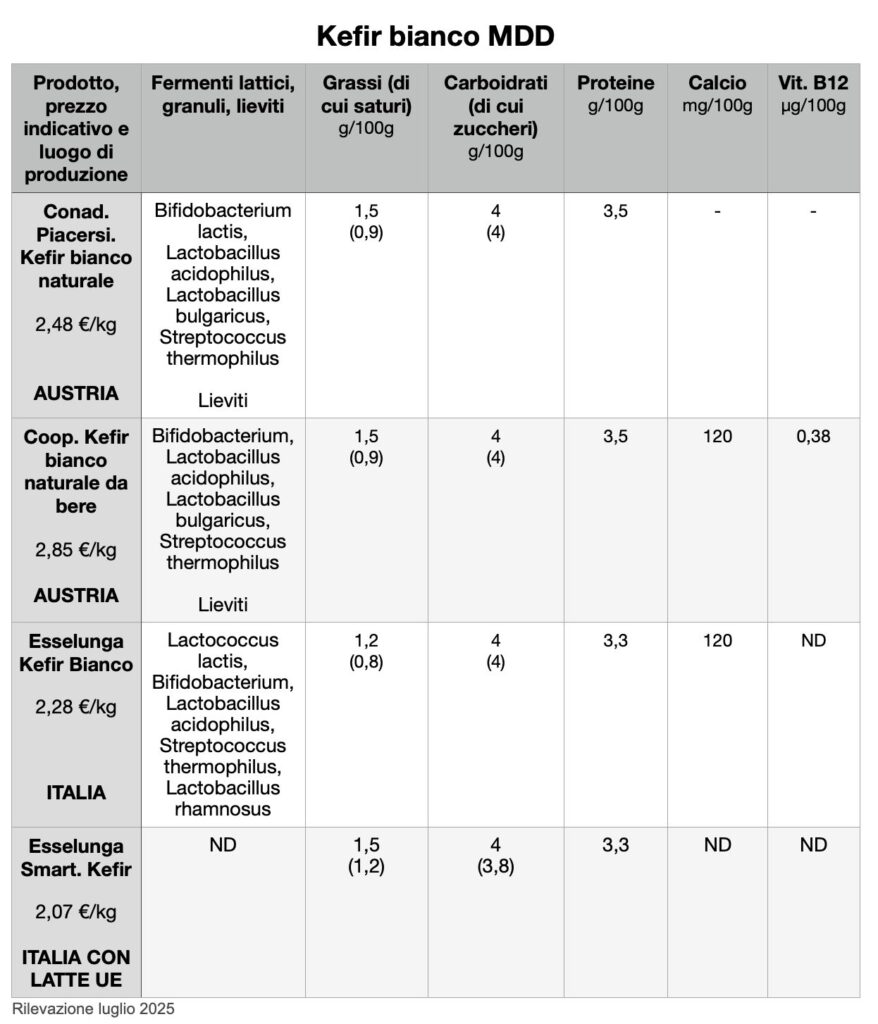
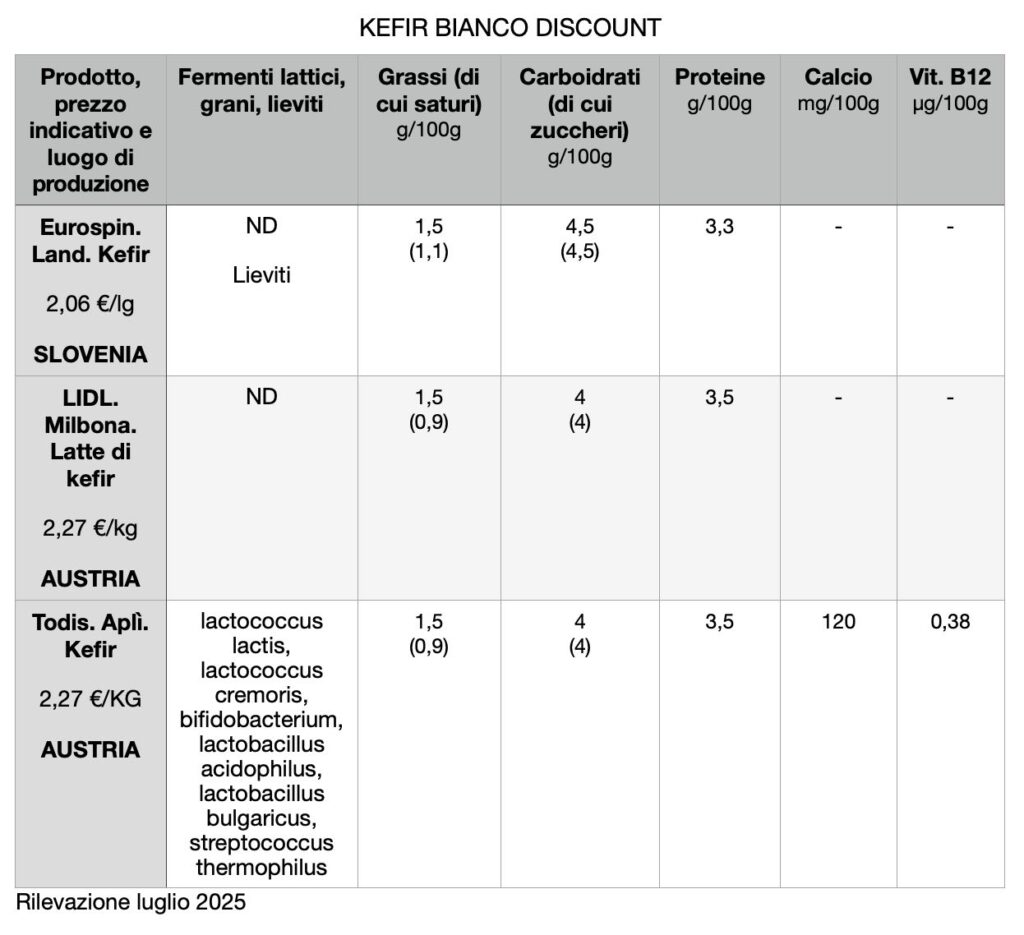
Of the three plain kefirs offered by the discount, two (Eurospin and Lidl) contain undisclosed lactic ferments.
Flavored industrial kefirs
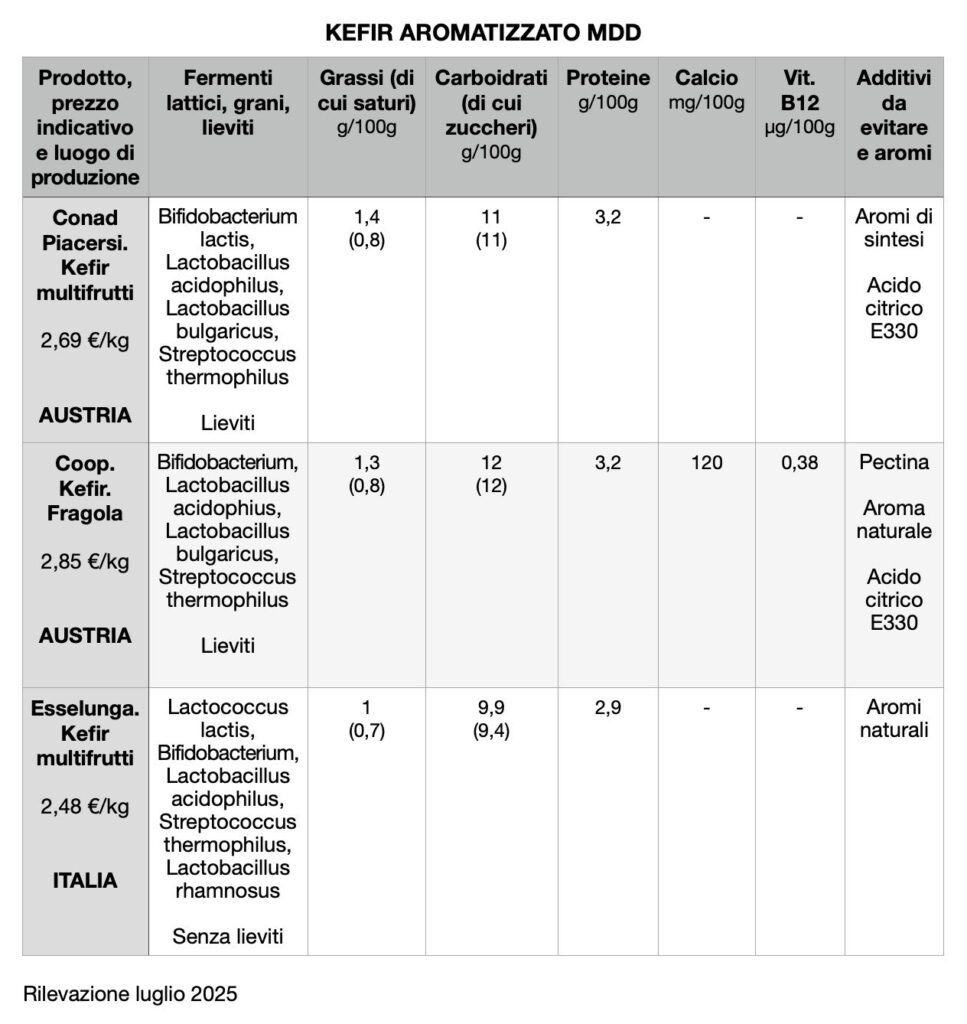
In the flavoured kefirs, the base is the product already examined, plain kefir, to which ingredients are added to give flavour and colour to the mixture.
Two problematic elements common to the entire sample are:
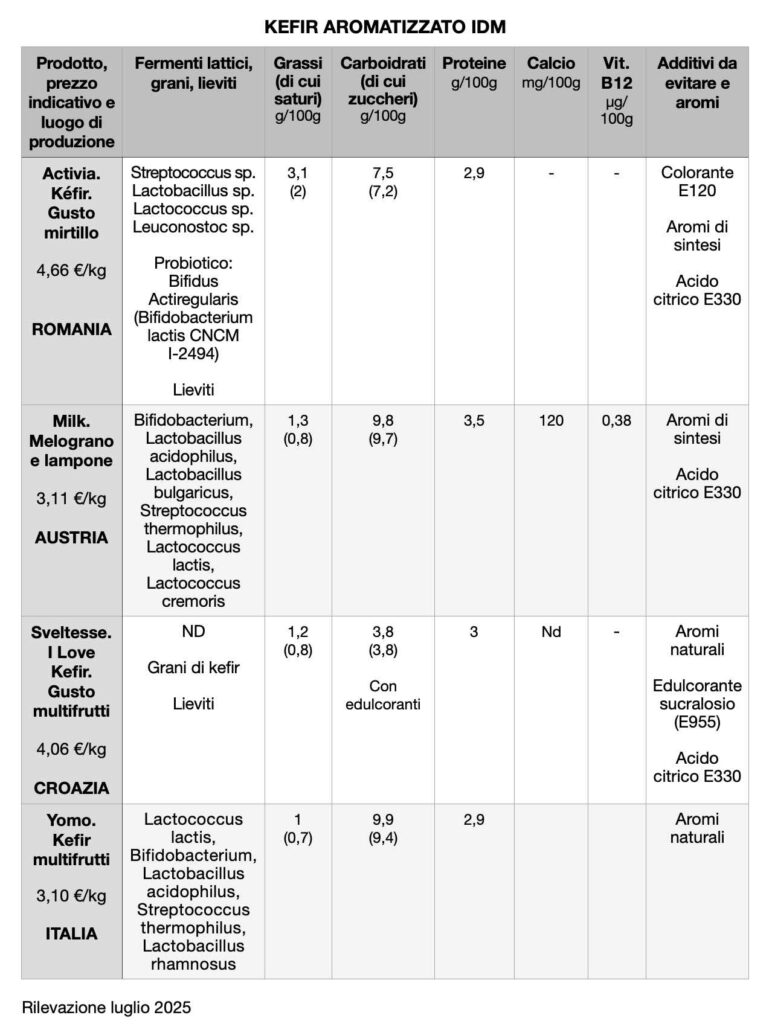
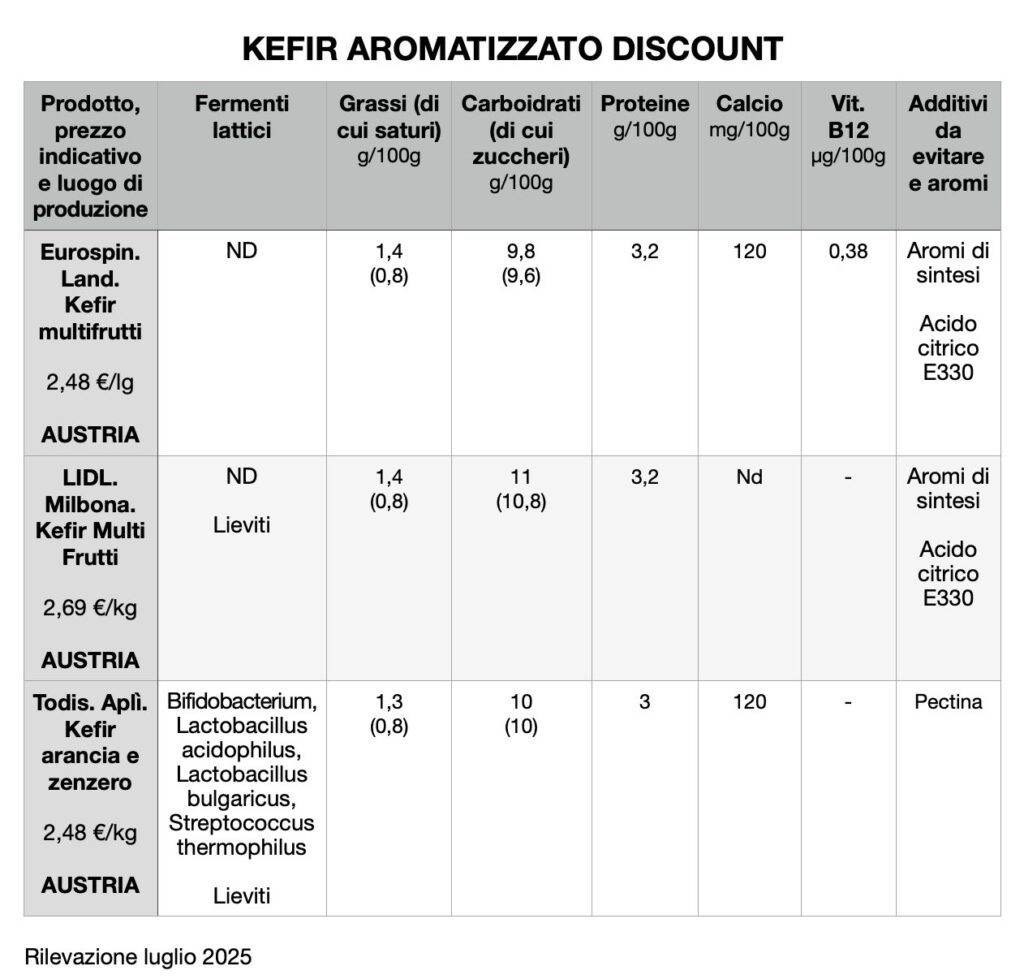
– the excessive amount of sugar. Without considering Sveltesse which uses a sweetener, the range goes from 7.2% (Activia) to 12% (Coop)
– the presence of citric acid (E330). With the exception of Yomo, Esselunga (both products from Granarolo) and Todis, it is always present. This additive, widely used in soft drinks as well, if consumed in high amounts can damage teeth, especially in children.
Two kefirs flavored with synthetic flavoring compounds
Big Food's two flavored kefirs follow the classic pattern of ultra-processed foods, which are characterized by the use of 'cosmetic' ingredients:
- Activia blueberry flavor contains not even traces of blueberry. The flavor of the sought-after red fruit is due solely to synthetic aromas. Among the six additives contained, cochineal (E120) stands out, obtained from the pressing of an insect and a potential cause of allergy.
- Sveltesse I love kefir multifruits flavor follows the same pattern. Synthetic aromas are responsible for recalling the flavor of fruit. To reduce added sugars, the choice is sucralose (E955), a sweetener suspected of harming health. It is a probable carcinogen, linked to a greater risk of cardiovascular diseases, type 2 diabetes, intestinal inflammation, alteration of the intestinal microbiota, as well as an enemy of weight control. Another problematic additive present is emulsifier locust bean gum (E410), linked to alteration of intestinal flora, as well as increased risk of breast cancer, according to a recent INSERM study.
In the other two kefirs in the branded products segment, instead, fruit is present in the form of concentrated juice and/or puree. Milk adds synthetic aromas, Yomo natural aromas.
Private-label brands
Among the flavored kefirs of the private-label, fruit (concentrated juice and/or puree) is always present.
The cleaner recipe is by Esselunga (produced by Granarolo), which uses only natural aromas. Followed by Coop, which adds pectin to natural aromas.
Flavored kefirs from discount stores
The three flavored kefirs offered at the discount store are all produced by the Austrian NÖM, with different recipes. The 'cleanest' is Todis, which however adds pectin. In the other two (Eurospin and Lidl) the fruit flavor is entrusted to synthetic aromas.
Organic kefir
Six organic white kefirs close the sample. As with 'conventional' white kefir, the recipe is free of problematic ingredients. The milk, always organic, in Sì Essenziale kefir by NaturaSì (produced by BioNova) is obtained from cows fed on hay.

There is an urgent need for regulations to protect consumers
Despite sharing the same name, commercial kefir available in supermarkets can never be like the traditional kefir from the Caucasian recipe, and would probably be difficult to appreciate for the average consumer.
Nevertheless, there appears to be a need for a regulatory reform which allows the use of the term kefir only in the presence of characteristics as close as possible to the traditional recipe.
Marta Strinati
References
– Abdoun, E (2024, November 22). After the skyr, the arnaque du kefir? Que Choisir. https://www.quechoisir.org/actualite-produits-laitiers-apres-le-skyr-l-arnaque-du-kefir-n132718/
– Codex Alimentarius. STANDARD FOR FERMENTED MILKS CXS 243-2003 Adopted in 2003. Revised in 2008, 2010, 2018. Amended in 2022 and 2024.
– Dongo, D. (2025, 3 July). Kefir, a functional beverage? FT (Food Times).
– Dongo, D (2024, 28 December). Operator name and identification mark? The lawyer Dario Dongo responds. FARE (Food and Agriculture Requirements).
– Maughan, L., Koolman, L., Macori, G., Killian, C., Fanning, S., Whyte, P., & Bolton, D. (2025). Characterization of bacterial and fungal populations in retail kefirs in Ireland. Journal of Dairy Science. Advance online publication. https://doi.org/10.3168/jds.2025-26587
– Prado, M. R., Blandón, L. M., Vandenberghe, L. P. S., Rodrigues, C., Castro, G. R., Thomaz-Soccol, V., & Soccol, C. R. (2015). Milk kefir: Composition, microbial cultures, biological activities, and related products. Frontiers in Microbiology, 6, 1177. https://doi.org/10.3389/fmicb.2015.01177

Professional journalist since January 1995, worked for daily newspapers (Il Messaggero, Paese Sera, La Stampa) and periodicals (NumeroUno, Il Salvagente). Author of food journalism investigations, published the book 'Reading labels to know what we eat'.


