


On July 5, 2023, at the headquarters of the Abruzzo Regional Council, the preview of the ‘Organic in numbers 2023’ report was presented, curated by ISMEA, SINAB, MASAF and CIHEAM (Centre for Advanced Mediterranean Agronomic Studies) of Bari. The data show a sector that continues to grow both in terms of memberships and – albeit less significantly – in terms of market attention.
The control system in organic farming
Organic farming is a production technique defined by legislative acts and protected by the Public Authority. Controls are carried out by technical bodies accredited by standardization bodies (Accredia) as well as by the Ministry of Agriculture, Food Sovereignty and Forestry (MASAF).
The checks by the technical bodies are carried out annually on all operators in the system, with an intensity of 120-130% of the total. This means that for every 100 operators subjected, an average of 120-130 checks are carried out, of which at least 10-15% are unannounced.
Organic, an exemplary standard
The system, as a whole, is subject to supervision by public institutions, on all certification bodies, and on a representative sample of operators. The control model thus organized is one of the reasons for the stability and balanced growth of the system in the last three decades.
To demonstrate Of this, the standard is indeed taken as an example and often adopted for other recently introduced quality schemes such as SQNPI and SQNBA, respectively National Integrated Production Quality System and National Animal Welfare Quality System.
The numbers of the survey
From the survey both elements of growth of sure interest and reassurance emerge, as well as the critical issues on which resources and attention must be focused, both by the institutions and by other actors: operators and certification bodies.
Both must abandon the attitude of seeking external support but feel like protagonists of a system they have been contributing to grow for years for the benefit of the environment.
On this last aspect a further consideration before moving on to data analysis. The organic production method aims at environmental sustainability, through technical tools represented by agronomic practices aimed at conserving natural resources, based on the renunciation of synthetic technical means, soil management, and great attention to animal welfare.
The concern of internal consumption
The data show an interesting growth of areas that brings us closer to the community's strategic objectives Farm to Fork, withItaly in second place in Europe after Austria with about 26% of the area involved.
On the other hand, a reduced growth of consumption is viewed with an almost disheartened attitude, almost as a lack of a result. Consumption are certainly important, but they express the consumer's awareness and adherence to values through food choice, but they do not identify the system's objective. Therefore an important factor, an indicator of the consumer's understanding of what the institutions are promoting for the common good. Not to be confused with real goal pursued: to increase the areas in order to ensure greater sustainability of current agricultural productions.
The data of growth in terms of memberships therefore represents an important result for the system. For consumption matters, a new challenge opens up now, and operators are invited to take it up.
Organic surfaces in Italy
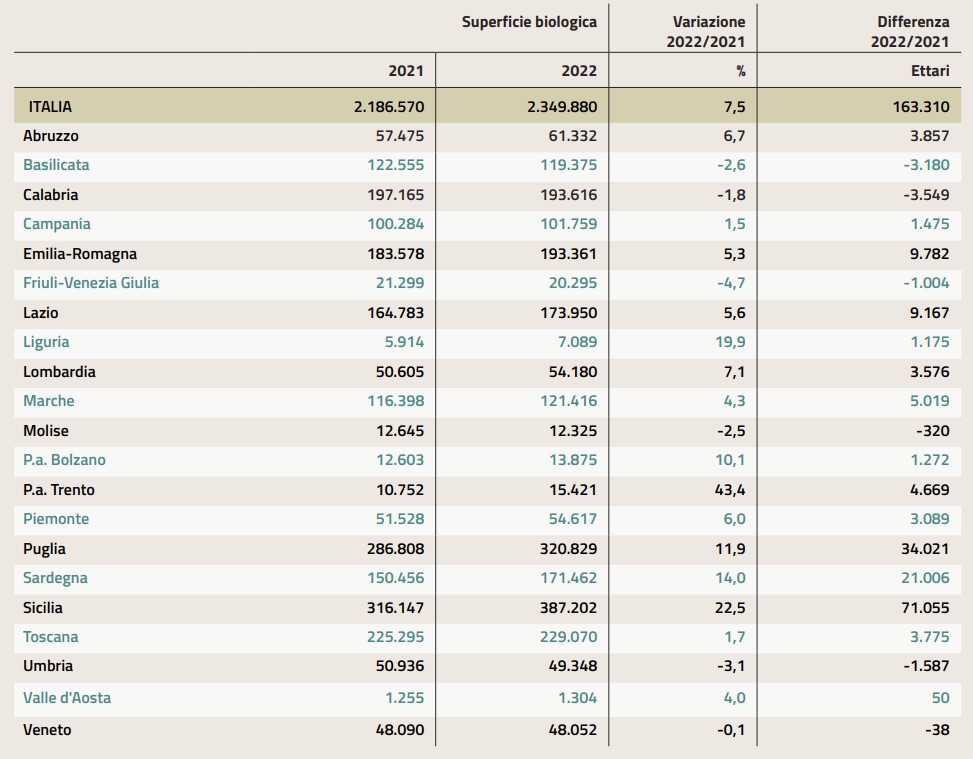
In 2022 surfaces in Italy exceeded 2.3 million hectares, showing a growth of 7.5% compared to 2021 and an increase of +111% if we consider 2010 as the reference point.
We have therefore reached almost 19% of the total utilized agricultural area surveyed by Istat, approaching with heartfelt pride the 25% threshold indicated by the Strategy Farm to Fork as a target for 2030.
There are six regions that have surpassed this goal: Tuscany, Marche, Lazio, Basilicata, Calabria, and Sicily. In immediate terms, for every 5 hectares cultivated in Italy, practically one hectare adheres to the organic production method (every 4 in the most virtuous regions).
The role of community aids
The development of the standard still appears strongly linked to community aids, which it is always necessary to reiterate compensate the loss of income due to adherence to the system and do not represent aid that increases the farmer's income.
The greatest results in terms of growth are represented by: Sicily (+22.5), Apulia (+11.9%), Autonomous Province of Trento (+43.4%), Liguria (+19.9%), Sardinia (14.0%), Autonomous Province of Bolzano (+10.1%), among areas with double-digit increases.
Organic livestock farming is recovering
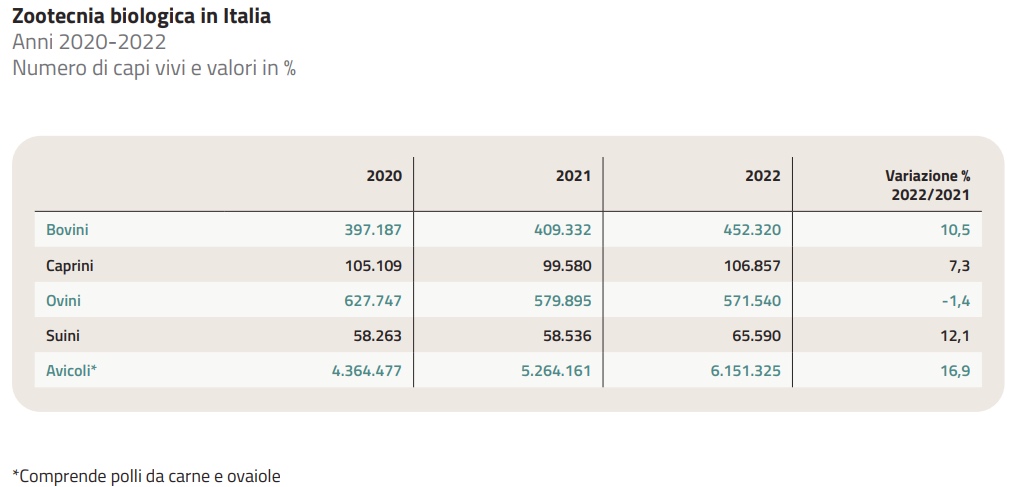
The livestock sector as well in 2022 shows signs of recovery. In most organic farms, significant increases are recorded:
- cattle (+10.5%),
- pigs (+12.1%)
- poultry (including broilers and laying hens, +16.9%, exceed 6 million heads)
- goats (+7.3%, reach 107 thousand heads)
The number of sheep instead shows a slight decline (-1.4%).
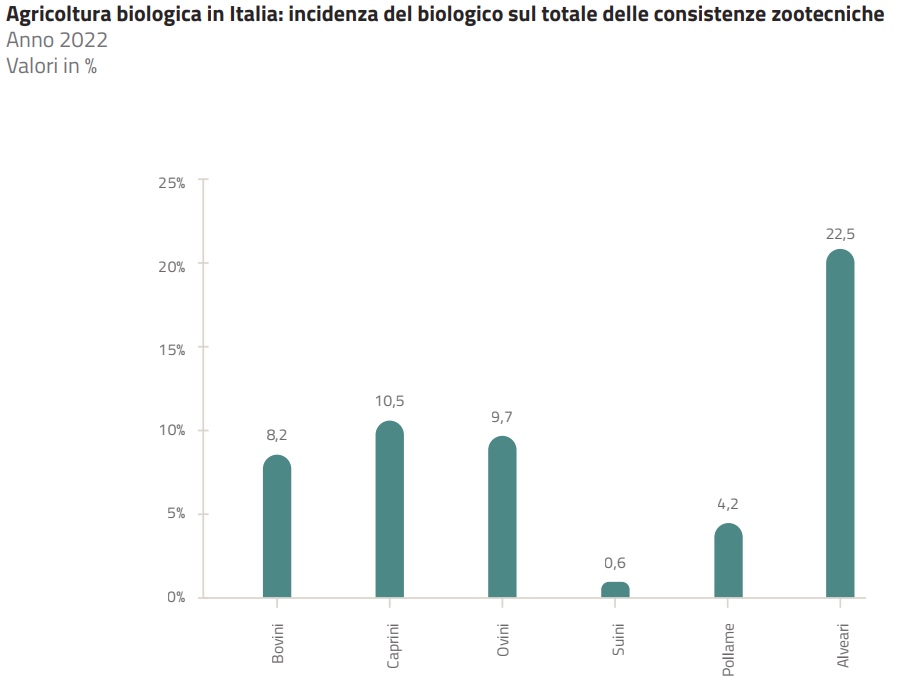
Compared to the entire sector national livestock sector, the most representative organic categories are cattle (8.2%), goats (10.5%), and sheep (9.7%). The contribution of “organic” pigs is more limited: out of 100 pigs raised in Italy, only 0.6% comes from organic farming. Significant is the incidence of beehives which reaches 22.5%.
Certified organic operators are increasing
Regarding certified operators, data indicate a increase of over 7% compared to 2021, there were indeed 6,655 new entries in the certification system which bring the total number of operators to exceed 92,000.
This increase is a confirmation of vitality and optimism in the sector, despite the difficulties of the context and the consequent market challenges.
Organic farms, three times larger than ‘conventional’ ones
Strong increase in the primary phase of the so-called ‘exclusive producers’, farms that produce only with organic methods and provide environmental benefits of the method more than any other operator, reaching 68,605 units (+10.1% over 2021).
In 2022, organic farms represent 7.3% of total farms but have an average size almost three times compared to that of conventional farms (28.4 hectares instead of 11 for the standard farm).
Significant also is the increase of producers/processors (+3.6%) reaching 13,998 units, a figure that still does not fully reflect the phenomenon. These are agricultural activities that process their productions, either in-house or through third parties, and represent a share equal to 16% of involved primary operators and exceed exclusive processors (processing companies) by about 4,400 units. Therefore, we are talking about short supply chains, the promotion of which is one of the innovative objectives introduced in reg. (EU) 2018/848, and which seems pursued and achieved by the system with a naturalness yet to be understood.
The exclusive preparers, probably due to sector difficulties and the rebound effect post Covid explosion, they lose -0.5%%, interrupting the positive trend carried forward for several years.

Graphic from Bio in Figures 2023. Source: SINAB elaborations on Control Bodies data
Graphic from Bio in Figures 2023. Source: SINAB elaborations on Control Bodies data
Consumption
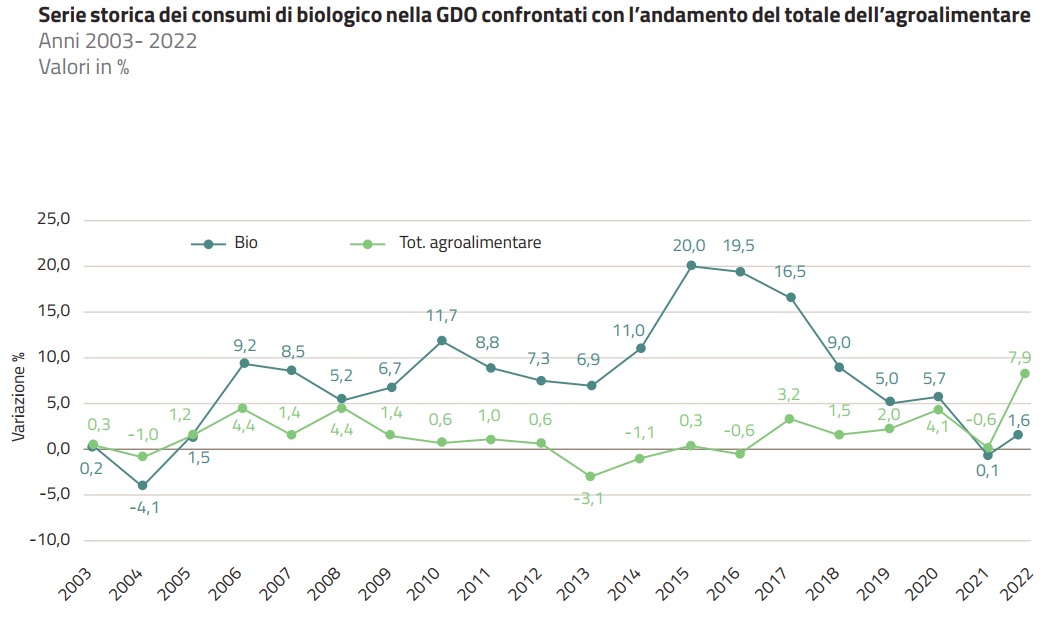
Regarding the household food expenditure, after a significant growth in 2020 (+9.5%), supported by the domestic confinement caused by the lockdown, followed by the consequent and expected decrease in 2021 (-4.6%), 2022 shows a moderate recovery of consumption.
We are facing 3.66 billion euros for the domestic market, with an increase of +0.5%. Considering an agro-food growth rate of +6.4% and price inflation in the same sector at +9.1%, this results in a reduction in the incidence of organic sales on overall food expenditure, dropping from 3.9% in 2021 to 3.6%.
The best performance
In a context of substantial stagnation, however, it is worth noting the positive trend of some categories commodity groups such as
– fresh eggs (+6.8%),
– fish products (+3.1%),
– fresh and processed meats (+3.7%).
Continues instead to slow down, as in 2021, spending in sectors where organic is more represented:
– fruit and vegetables (-2.8%),
– cereal derivatives (-3.4%).
Another sector in decline concerns organic wine and sparkling wines compared to 2021 (-3.7%), a decrease linked to the strong recovery of out-of-home consumption.
Organic food out of home is doing well
Interesting evolution instead emerges for out-of-home consumption of organic foods, which last year was the subject of the first qualitative survey conducted on a sample of 1,126 bars and 864 Italian restaurants.
The survey it provided very encouraging results regarding the presence of organic foods in public catering menus and the level of awareness among operators. More than half of bars (54.4%) and over two-thirds of restaurants (68.4%) declared that they had proposed or used organic foods, beverages, and raw materials in their culinary preparations during 2022.
The expenditure for the purchase of organic products made by bar owners is on average 18.9% compared to the total expenditure, focusing mainly on the purchase of milk (25.9%), fresh products, particularly fruit (20.1%) and vegetables (11%), wine (12.6%) and juices (11.9%). Additionally, 30% of bars that buy organic products believe that the organic offer positively affects overall turnover, and indicate a 14.6% surcharge for consumers compared to equivalent non-organic products.
Organic food at the restaurant
For restaurants the expenditure on organic products exceeds 33%, and the largest quantities purchased within the total category particularly concern: vegetables (42%), oil (34.5%), fruit (29.5%), eggs (24.1%), milk and derivatives.
51.5% of restaurants that purchase organic products, finally, evaluate positively the economic impact of organic in their establishment's offer, while the average declared price differential is 16.6% for the dish with organic product, compared to the equivalent with non-organic ingredients.
The foreign market still growing
However, remains the foreign market is fundamental. In 2022, sales of Italian organic agri-food products in international markets reached 3.4 billion euros, with a growth factor of +16%. Considering the long term, the trend supports optimism with a +181% increase compared to 2012.
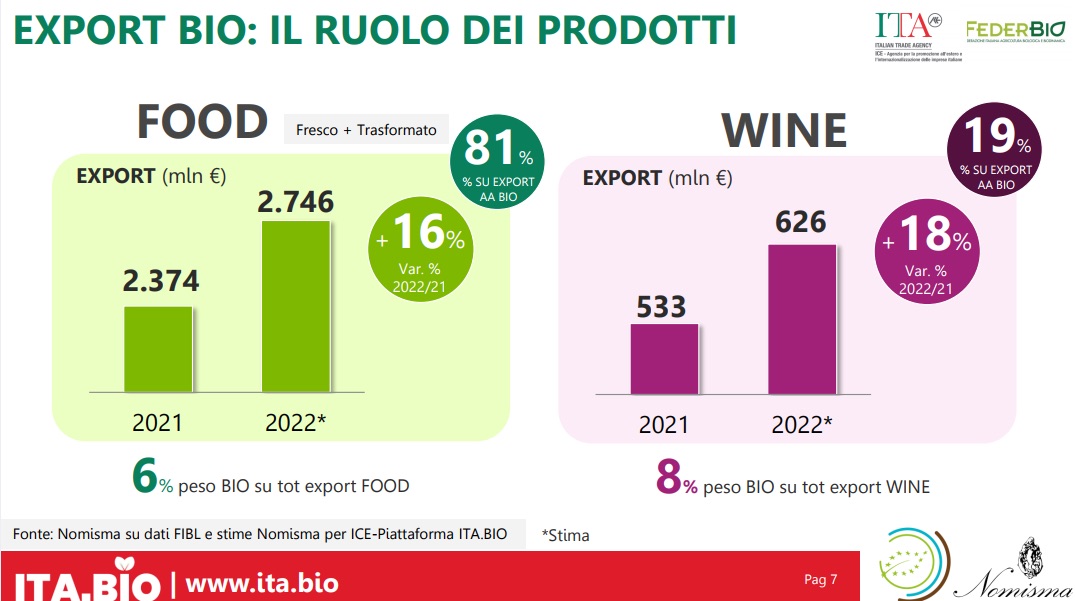
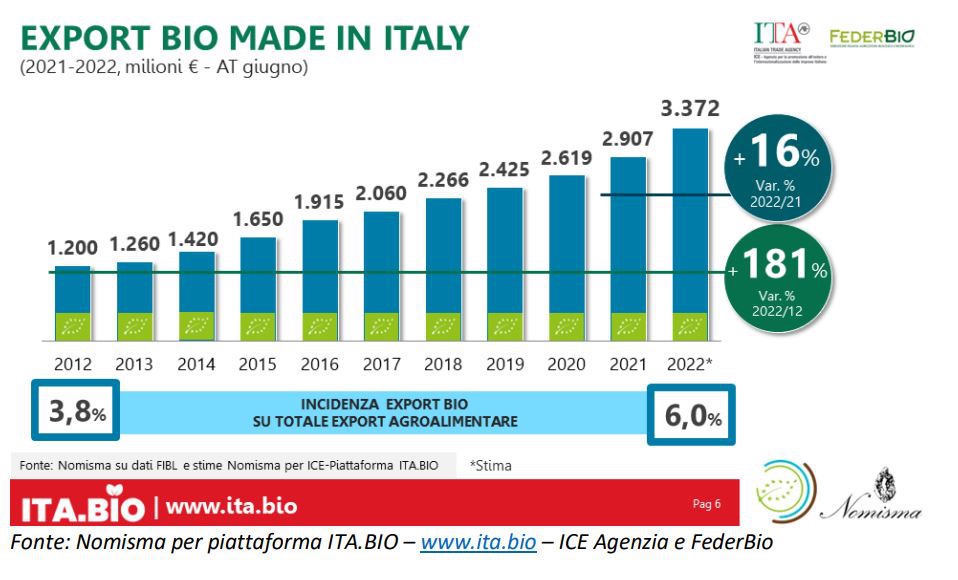
The share of export in the basket Made in Italy today weighs 6% on the total Italian agri-food export in 2022. Data emerging from the latest analysis conducted within Ita.Bio (Sana 2022).
Donato Ferrucci, Dario Dongo, Nicolò Passeri

Agronomist, master in food law. He deals with certifications and quality systems in the agri-food chain. He collaborates with institutions and universities and is a member of the editorial staff of rivistadiagraria.org.

Dario Dongo, lawyer and journalist, PhD in international food law, founder of WIISE (FARE - GIFT – Food Times) and Égalité.

Nicolò Passeri
Ph.D. in ‘Economics and Territory’ at the University of Tuscia. Consultant for organic product certification and technical-economic analysis of production processes


 che dal ministero dell'Agricoltura, della sovranità alimentare e delle foreste (MASAF).)