
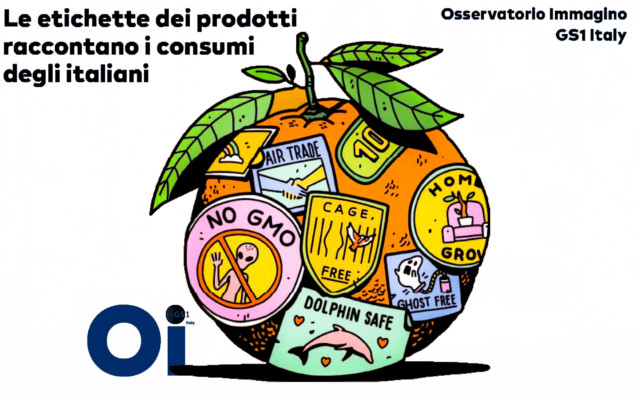
The food consumption trends of Italians are reported by XI edition of the Immagino Observatory. The report by GS1 Italy and NielsenIQ is based on the analysis of labels (ingredients and nutritional table) and claim of over 128 thousand products available in Italian hypermarkets and supermarkets, source of over 30 billion euros in revenue in 2021.
The return of fiber in the metaproduct of the Immagino Observatory
Preferences Italians' nutrient preferences are synthesized in the metaproduct, the statistical tool of the Immagino Observatory that indicates the average nutritional value of food products purchased in supermarkets and hypermarkets, based on the analysis of nutritional tables of 75,982 products.
In 2021, fibers have returned to grow (as it was until 2019) and there has been a contraction of calories, fats, proteins, and sugars, after significant increases in 2020, the first year of the Covid-19 era.
Made in Italy cooling down
Italianness of food is associated with a substantial stability of sales (-0.1%), while remaining the most pervasive phenomenon, present in 26.8% of detected references. The distinctive signs are always, in order,
– tricolour flag, with increasing sales of cold cuts, tea-based beverages, frozen pizzas and fourth processing poultry, in all cases due to greater use of the symbol on packaging.
– 100% Italian, with a positive effect on sales of snacks, cold cuts, fourth-processed poultry, and UHT milk accompanied by this claim,
– produced in Italy, with growing sales of frozen ready meals, breaded frozen fish, Easter eggs, grapes, and fourth range vegetables. This claim, we remind, only certifies that the last processing of the food took place in Italy, as recently seen in the comparison of orange juices from concentrate of unknown origin.
DOP, DOC, DOCG
The different articulations of the protected designation of origin mark instead record a +4%, thanks to dry charmat sparkling wines, classic sparkling wines and wines. These signs of Italian identity appear on over 4,000 products, for a turnover of 1.3 billion euros in 2021.
DOCG leads (+13.2% in sales), followed by DOC (6.4) and DOP declines (-2.1), due to the contraction in sales of grana cheeses and similar cheeses.
Basically stable, on the other hand, were the sales of 1,946 products marked by IGP (Protected Geographical Indication) or IGT (Typical Geographical Indication).
Regional origin
The supply of indications of origin from an Italian region is growing. Overall it shows an increase in turnover of +3.2%.
The ranking is still dominated by Trentino-Alto Adige with 968 products and a sales growth of 2.1%.
The indications most dynamic regions instead concern
– Veneto. The best performance 2021 with an excellent +9.1% turnover, thanks above all to Prosecco and Doc and Docg wines,
– Calabria. Bitters, red onions and clementines drive the brilliant year of the 247 Calabrian products: +8.7% turnover, for 102 million euros,
– Puglia. Burrata, taralli, mozzarella and red wines strongly contribute to the +8.3% increase.
Good also Liguria (7.7%), Basilicata and Marche (respectively 6.8 and 6.7%).
Free from
The labels Free from, which highlight the absence of an ingredient, suffer a slowdown in 2021. The most dynamic ones are ‘few calories‘ (10.9), ‘no added sugars‘ (10.6) and ‘few sugars‘ (10.4).
The claim ‘without antibiotics‘, of which Coop Italia was a pioneer, in 2021 had a turnover increased by 5.6%, up to 109 million euros.
First for performance however it is ‘not fried‘. Used for snacks and salty extruded products, records a +17%.
The ‘without‘ for intolerant and allergic people
Among the claim of the Free from dedicated to intolerant or allergic consumers the ‘gluten free‘ is stable with +0.7%, compared to 2020. Of the 8,400 products, Easter eggs and tea-based drinks grow a lot, while others lose ground würstel and cubed cold cuts.
More lively (+1.1) is the trend of the 1,965 products gluten free certified by the crossed ear of AIC, Italian Celiac Association. The most growing were soft breads and cereals snack.
The ‘lactose free‘ increases sales by 4.3%, mainly thanks to the expansion of the offer, with products such as kefir, vitamin supplements, UHT milk substitutes, infant milk, fresh desserts and functional yogurts. The claim related ‘milk free‘, present on the label of 481 products (such as cold cuts and third pork processing), records +1.8%.
Dynamic trend, finally, for the two recent claim ‘yeast free‘ (+3.9) and ‘egg free‘ (7.3), present on 172 products, among which stand out fresh uncovered pasta and fresh gluten-free pasta.
The charge of ‘rich in‘
Remains positive (+2%) the trend of the 9,642 products ‘rich in‘, that is accompanied by a claim on the high content of a nutrient.
Of the 12 claim monitored by Osservatorio Immagino, ‘fiber‘ is the most widespread (3,777 products) and is associated with a sales increase of 3.7%. It is overtaken by ‘proteins‘, the phenomenon of 2021, with a +6.4% sales increase of the 2,589 products that boast it.
For the rest, ‘vitamins‘ and ‘whole grain‘ mark +1.2 and +1.4%. Among the claim least common, finally, ‘magnesium‘ and ‘zinc‘ increase sales respectively by 5.6 and 5.7%
Lifestyle at the table
The absence of ingredients of animal origin is the most dynamic element among foods labeled with a claim or a certification relating to particular lifestyles or consumption.
Sales grow both at macro level ‘veg‘ (+0.6)), and also at individual level claim ‘vegetarian‘ and ‘vegan‘ (1.8 and 2.3). The best performing products are oat or soy drinks, potatoes, snack sweet cereal-based and almond milk.
Organic slows down
‘Organic‘ is the claim most widespread in this group. Sales of the 8,255 products so labeled are slowing down (-1.3%), mainly due to the cut in supply (-1.8%) while demand has grown slightly (+0.5%).
Increasing sales of extruded products, smoked salmon, simple breakfast cereals and oat drinks. Decreasing are spreadable fruit compotes, flours, free-range eggs and low-fat yogurt.
Kosher and halal
As for preferences related to religious dictates, for products with kosher certification (consistent with the Jewish religion) sales fall by -3.7%, as a consequence of the significant drop in demand (-6.8).
Foods certified halal as verified compliant with Islamic dietary requirements increased sales by +1.3% in 2021.
The charge of beneficial ingredients
The basket of the 6,304 products whose labels report the presence of one of the 27 super-ingredients detected by the Immagino Observatory increased sales by +3.1%. It is the only one, along with the claim on regional origin, to record a growth in demand.
Among the superfruit, which overall mark a +7.9, only coconut water decreases (-9.5). Almond remains the most widespread fruit and leads sales with +7.2. Blueberries gain +3% and coconut stands out with +19.9%, thanks especially to biscuits, drinks and skyr. Avocado is unstoppable: +21%.
Supercereals and flours stagnate, except for oats, +5.1, thanks to an increased offer of products such as oat drink, whole/multigrain biscuits, enriched wholemeal cookies, breakfast cereals, enriched rusks and table rolls.
Among sweeteners examined by Osservatorio Immagino, brown sugar collapses (-8.7) and stevia grows (+2).
Seeds and spices
The seed family is the most dynamic in the world of beneficial ingredients, with an overall +8.5% sales compared to 2020.
The phenomenon of 2021 is hemp: driven by infusions, its business expanded by +31.4%, reaching 3.5 million euros. The most important, pumpkin seeds, grows by 2%. The trend of flax seeds (12.6) and sesame seeds (11.3) is very positive.
The super-spices overall decline by -2.9. Unlike ginger and turmeric, cinnamon is an ingredient that boosts sales by +6.9, especially due to its presence in ice creams multipack and in desserts.
Superfood
Except Goji (-17.6), the other three Superfood monitored produce steadily increasing sales, especially thanks to expanding demand. The basket, with its 170 references, overall exceeded 13 million euros of sell-out (+3.2% annually). Matcha marks +25.6, açaí +19.3%, especially as an addition in functional yogurt and dark chocolate tablets and bars. Excellent growth, finally, for spirulina (+49.3), mainly due to natural extract supplements and smoothies/frappes.
The processing method
The label reference to the processing method (3,125 products) is overall stable. The claim most common ‘bronze drawn‘ (bronze) remains with a +2.2% sales growth. The second in value ‘cold extracted’, related to extra virgin olive oil, loses -2.8.
Physiological slowdown (+2.5) for the 142 products presented as ‘unfiltered’, craft beers first of all. Sales associated with ‘ are instead -11.4%,slow/natural leavening’, consistent with the drop in frozen pizzas and snacks.
‘Handmade‘, mainly found on tuna and canned fish, marks a +4.2%. The method of ‘drying’ (semolina pasta in particular) shows a decline of -7.3%. Demand (-8.9%) was particularly negative.
Likes the ‘processing‘artisan‘, +10.5%, in particular on chips, breadsticks, special occasion products and mozzarella. Very good, finally, 'smoking‘, which boosts sales by +16.2%, thanks to increased demand for fish specialties and cheeses primarily.
The preferred consistency, according to the Immagino Observatory
the appeal to texture of the food, finally. The claim most used is ‘crunchy‘ and drops by -0.8. Worse (-9.1) is ‘creamy‘, mainly due to lower sales of whole yogurt, sliced processed cheeses, traditional biscuits, industrial fresh cheeses and UHT cream.
They grow instead sales of products characterized by claim
– ‘soft‘ (+4.9) with sandwich bread, panettone, coffee, sliced table cheeses, cooking bases and nougat among key products,
– ‘soft’ (+2.3), particularly snacks, ready cakes and Christmas and Easter seasonal products,
– ‘filled‘, with a significant +12.8%, thanks to fresh filled pasta, pralines and chocolates, pastries and chocolate bars,
– ‘stuffed‘ (+2.1), led by sweet frozen foods, cooking bases and snack salty.

Professional journalist since January 1995, worked for newspapers (Il Messaggero, Paese Sera, La Stampa) and magazines (NumeroUno, Il Salvagente). Author of investigative journalism on food, published the book 'Reading labels to know what we eat'.


 e claim di oltre 128mila prodotti)