

Fresh ready-to-use puff pastry is a very versatile industrial food, for quickly making savory or sweet ‘rustic’ pies. The supermarket selection is wide, but the quality of the ingredients – and consequently, the product's nutritional profile – requires attention, as demonstrated by our analysis of 12 references.
Almost all products, even if marketed under different brands, come from the same French industry. And all of them come into contact with baking paper, without specifying whether it is free of the deadly PFAS chemicals that sometimes occur in it.
Fresh puff pastry or brisée
The fresh puff pastry is suitable for obtaining a crumbly preparation, while brisée produces a more compact variant.
The industrial recipe, in terms of ingredients, is almost identical. Instead, the processing varies. The same applies to the shape: rectangular or round, the pastry is based on the same recipe.
The basic recipe
In the industrial recipes we find wheat flour, fat, water, ethyl alcohol, salt, concentrated lemon juice, coloring (carotene) and L-cysteine, a harmless enzyme that acts as a ‘flour treatment agent’.
The decisive variable, in qualitative and nutritional terms, is represented by fat: almost all products rely on palm oil and rapeseed oil. Equally important is the amount of salt, whose excessive intake is very dangerous to health.
Only one producer (French)
A surprising aspect is the identity of the factory where the 12 brands of fresh puff pastry are produced. Both the private label products and those from discount stores all come from Cérélia Group's factories, a giant that bills 800 million euros a year.
The only industrial private brand of fresh puff pastry offered in Italy is Buitoni, from Nestlé. Also in this case the production plants are abroad, as derived from the statement on the label: 'Imported by: Nestlé Italiana S.p.A. In agreement with the trademark owner'. Whether this time they are also those of Cérélia Group is unknown.
The Buitoni-France association, moreover, instantly recalls the Pizza Fraîch’Up scandal, which cost two children their lives and caused illness to many others. The consumer is thus reassured about food safety: 'Our factories perform an average of 180,000 checks on all products every year', 'Each produced batch undergoes at least 15 different types of checks before reaching consumers' homes'.
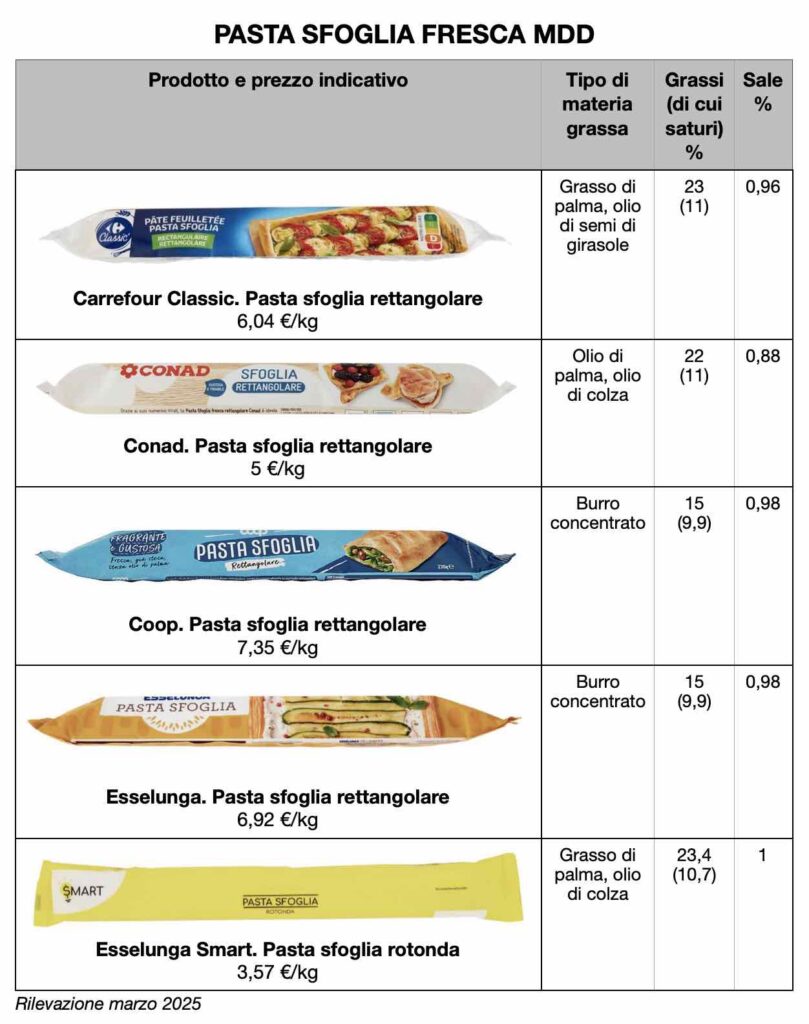
The 5 private label products (MDD)
Among the 5 types of fresh puff pastry private label
– Conad and Esselunga Smart use a mix of palm oil and rapeseed oil. A choice that brings fats to over 22% and saturated fats to 11 grams per 100 grams of product
– Carrefour mixes palm oil and sunflower seed oil. Evidently in a ratio favoring the poor quality tropical fat, since fats remain at 23% and saturated fats at 11%
– Coop and Esselunga instead use butter: total fats drop to 15% and saturated to 9.9%.
The Salt is always around 1%.
The Carrefour branded product is the only one to display the logo Nutri-Score on the label. Its D score, due to the significant content of fats and saturated fats, serves to inform consumers that this food should be consumed in moderation. It's a pity this valuable information is not present on other products, some of which could, moreover, achieve a Nutri-Score C thanks to better nutritional profiles.
Buitoni Nestlé, ‘the number 1’
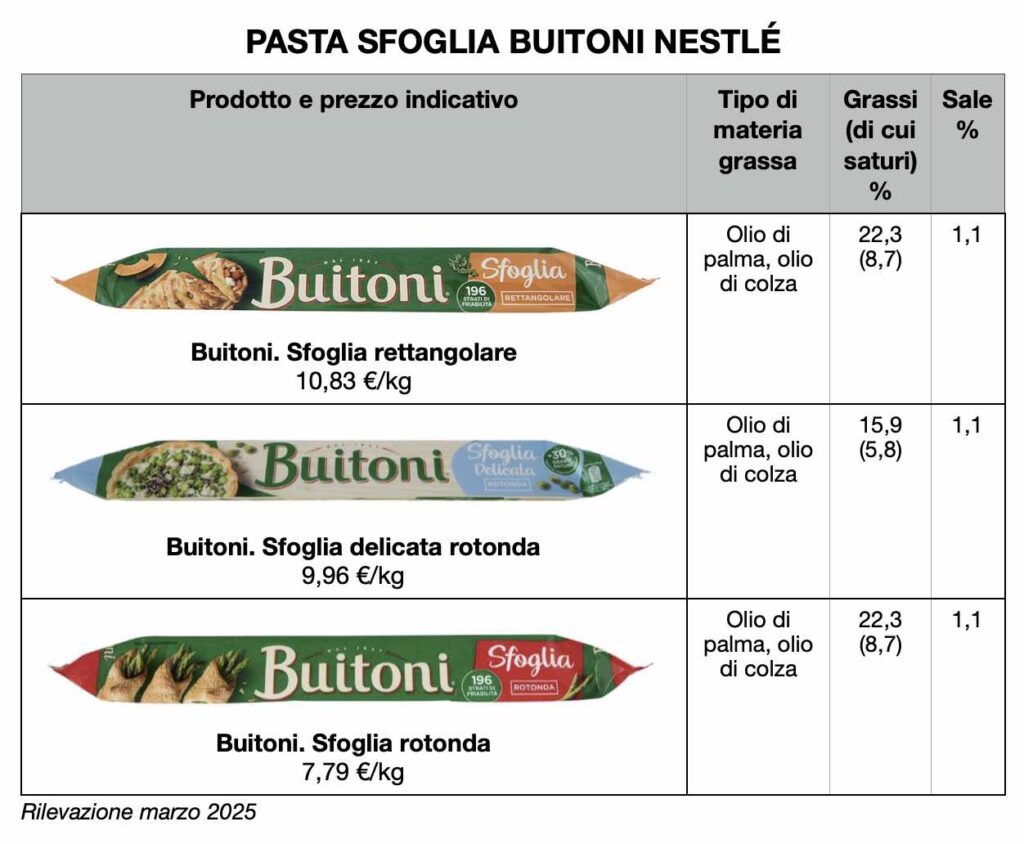
The habit of the most widespread industrial brands to proclaim themselves on the label ‘number 1 in Italy’ is well founded in the case of Buitoni puff pastry, which in fact is the only private label offer.
In Buitoni puff pastry the fat content is always a mix of palm oil and rapeseed oil, with 22.3% fat, of which 8.7% saturated (a little less than the same mix in ‘private label’ products). The salt is instead slightly higher, 1.1%.
For this brand we also examined the round puff pastry, with a recipe identical to the rectangular one, solely because it is indicated as a reference for the Delicate Puff Pastry with -30% fat.
Discount puff pastry
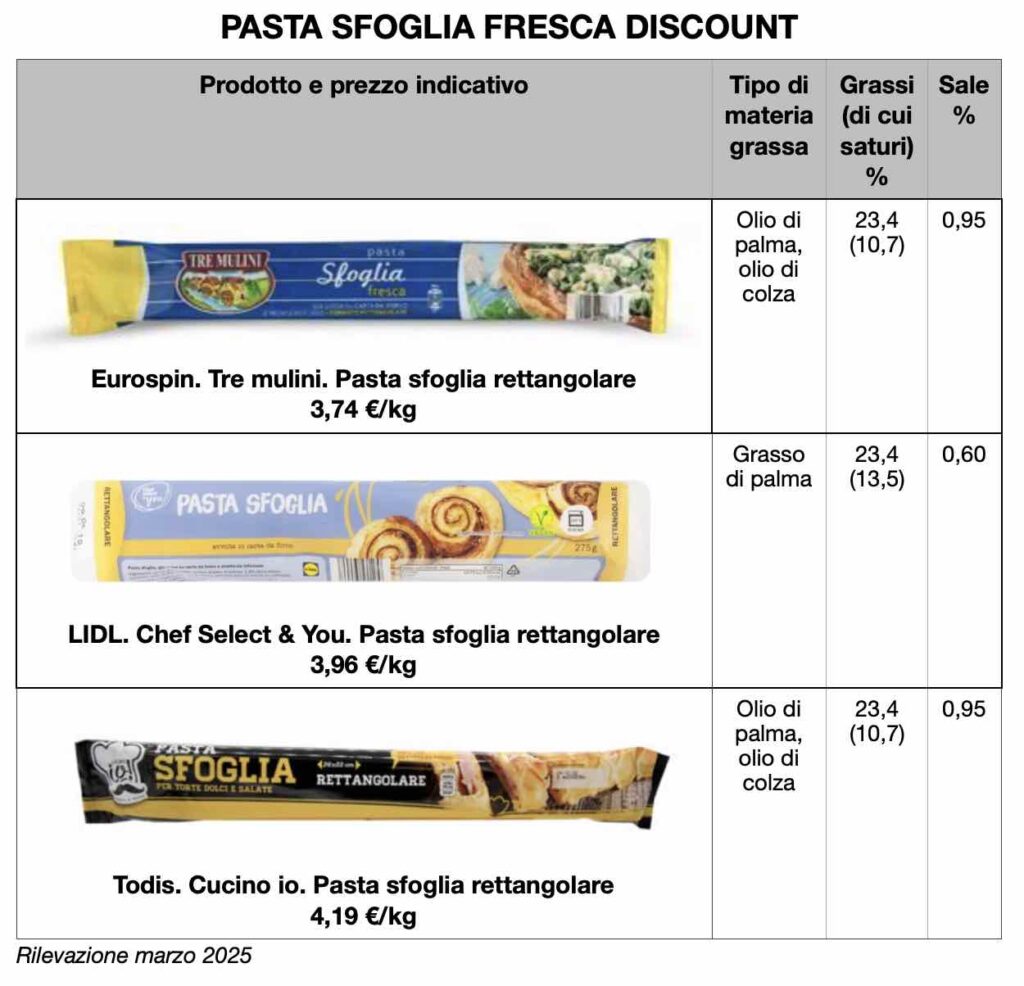
At discount stores, Lidl is the only product that uses exclusively palm oil, instead of the palm-rapeseed mix of Eurospin and Todis. As a result, with equal total fat (23.4%), the saturated fats are higher: 13.5% instead of 10.7%.
Also unique in the sample, the Lidl product is made in Germany. The others, as usual, come from the French Cérélia plants and seem identical.
The Salt, finally, it is lower in Lidl's puff pastry: 0.60% instead of 0.95%.
Only one organic product, with palm oil
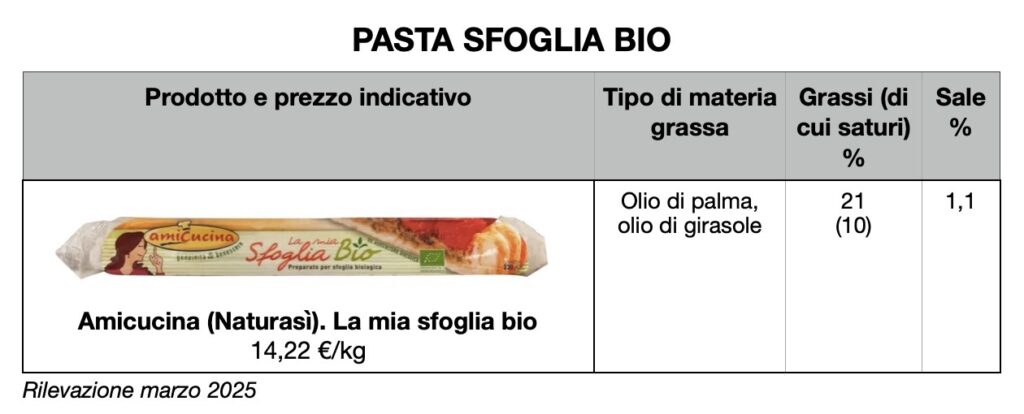
The only one fresh organic puff pastry that we found is Amicucina available at Naturasì.
The fat content is a margarine composed of palm oil, water, sunflower oil, salt, concentrated lemon juice. The fats are 21%, of which 10% are saturated. Salt is at 1.1%.
The producer? The French Cérélia, it goes without saying.
Baking paper, PFAS suspicion
One aspect that goes beyond any nutritional consideration concerns the baking paper that wraps all the examined puff pastries. This material often contains flame retardants and PFAS, the perfluoroalkyl substances used to make the paper water and grease repellent.
Despite the severity of the risk, none of the 12 puff pastry labels refers to the safety of the material that wraps the food.
A recent Italian study verified the migration of these chemical substances from baking paper to food and warns that
– flame retardants (OPE) migrate similarly towards both hydrophilic and lipophilic foods,
– PFAS mainly migrate towards acidic aqueous foods.
The only precautions that can be taken in case of baking paper not declared PFAS-free are
– do not exceed the temperature recommended by the manufacturer during cooking
– do not reuse baking paper already exposed to heat.
Marta Strinati

Professional journalist since January 1995, she has worked for newspapers (Il Messaggero, Paese Sera, La Stampa) and magazines (NumeroUno, Il Salvagente). Author of investigative reports on food, she published the book 'Reading Labels to Know What We Eat'.


