

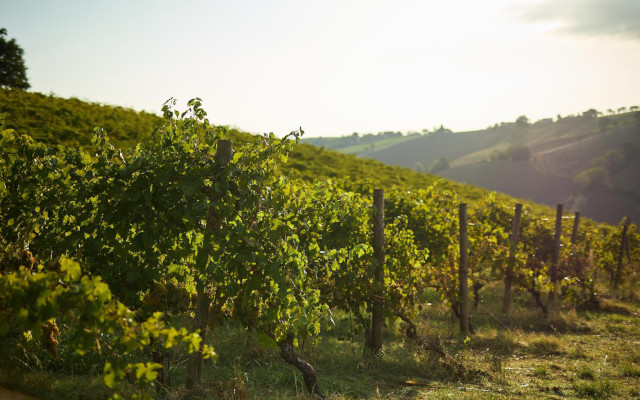
In the heart of the Marche, in central Italy, the Lacrima di Morro d’Alba DOC represents in a red wine centuries of winemaking tradition and artisanal mastery in a terroir unique. Below is a brief insight into the history, characteristics, and exclusivity of this superior quality wine still little known, with some tips for wine enthusiasts and international buyers.
1. A millenary history. The roots of Morro d’Alba
The vineyards of Morro d’Alba, a small village nestled among the smiling hills in the province of Ancona, between Senigallia and Iesi, have been cultivated since Roman times, with traditions handed down from generation to generation.
The red wine Lacrima di Morro d’Alba, obtained from the homonymous native grape variety, is the flagship of the area. The name ‘Lacrima’ comes from the thin skin of the grape, which often ‘weeps’ juice during ripening.
The geographical indication Lacrima di Morro d’Alba DOC - registered at the European level in 1985 - recognizes the unique qualities of wines produced in this limited area using at least 85% of grapes from the homonymous variety.
2. The terroir. A perfect balance between sea and land
The vineyards of Morro d’Alba are located at an altitude between 50 and 200 meters above sea levelat a distance no greater than 25 km from the Adriatic Sea, on gentle hills benefiting from a Mediterranean climate mitigated by the Adriatic breezes. This privileged position creates an ideal microclimate for slow and uniform ripening of the grapes.
I calcareous-clayey soils, rich in minerals, contribute to the structure and complexity of the wine. Research conducted by theUniversity of Marche have shown that these soils enrich the mineral profile of Lacrima di Morro d’Alba wines. The proximity to the sea also imparts a slight saltiness, giving the wine an aromatic profile identity Rio.
3. Organoleptic characteristics. A symphony of flavors
The Lacrima di Morro d’Alba is renowned for its intense aromas and vibrant flavors. Italian and international oenologists describe it as a wine with:
- aroma. Floral notes of violets and roses, combined with ripe berries, spices, and Mediterranean herbs;
- taste. A harmonious balance between fruitiness, acidity, and minerality, with a long and elegant finish;
- color. An intense ruby red with violet reflections, emphasizing its youthful vitality.
This wine pairs perfectly with Mediterranean cuisine, particularly dishes based on tomatoes, olives, aged cheeses, and grilled meats.
4. Exclusivity and limited production
The denomination Morro d’Alba DOC covers just 300 hectares of vineyards – in the municipalities of Morro d’Alba, Monte San Vito, San Marcello, Belvedere Ostrense, Ostra and Senigallia – excluding the valley floor areas and the slopes of the hills in the municipality of Senigallia facing the sea.
the maximum grape yield must not exceed 12 tons per hectare. Such a limited designated wine area corresponds to a production capacity slightly above one million bottles per year. The production of these wines, which still maintain an excellent quality/price ratio, therefore remains at an artisanal level.
5. Geographical indication and international recognition
The Morro d’Alba DOC is protected at the European level as Controlled Designation of Origin (DOC), ensuring that only wines produced in this area and conforming to strict quality standards may bear this name. The disciplinary regulations of the Lacrima di Morro d’Alba DOC provides for three types of wine: basic, Superior and Passito:
- the basic version must be composed of at least 85% grapes from the Lacrima variety, with a maximum of 15% of other non-aromatic black grape varieties permitted in Marche. It has a minimum alcohol content of 11.00% vol and displays a deep ruby red color with violet reflections, an intense and vinous aroma with floral notes of rose and violet, and a soft, harmonious, and slightly tannic taste. Release for consumption is allowed from December 15th of the harvest year;
- the Lacrima di Morro d’Alba DOC Superiore maintains the same varietal composition but with a minimum alcohol content of 12.00% vol. Compared to the basic version, it offers greater aromatic complexity and a more intense structure, with notes of ripe red fruit, spices, and dried flowers. The taste is more persistent and the tannins are better balanced. Although the regulations do not impose a specific aging period, this type often undergoes slight aging to enhance its characteristics;
- the Lacrima di Morro d’Alba DOC Passito It is instead obtained from naturally dried grapes, with possible use of noble rot. It must contain at least 85% Lacrima and have a minimum alcohol content of 15.00% vol. The color is intense garnet red, the aroma is complex with notes of dried fruit, sweet spices, and jam, while the taste is sweet, enveloping, and characterized by hints of honey and candied fruit. It often undergoes a short aging in wood to develop greater complexity.
6. Enological innovations. Ancestral methods and sparkling wines
In recent years, Morro d’Alba producers have experimented with innovative techniques, expanding the offer without betraying local traditions. Two notable variants follow.
6.1. Wines with ancestral method
The ancestral method, or méthode ancestrale, involves bottling the wine before fermentation is complete, allowing a natural refermentation in the bottle.
This technique produces a wine slightly sparkling, with delicate bubbles and a slightly cloudy appearance.
The acidity and thearomatic intensity of the Lacrima grape make it particularly suitable for this method, resulting in a fresh, fruity, and lively wine.
6.2. Sparkling wines with Charmat method
The Charmat method (or Martinotti, also used for Prosecco) is another technique used to produce sparkling wines based on Lacrima di Morro d’Alba.
the refermentation takes place in stainless steel tanks, preserving the fruity flavors and primary aromas of the wine. The result is a lively and versatile sparkling wine, ideal for celebrations or as an aperitif.
These innovations demonstrate the versatility of the Lacrima grape, meeting consumers' preferences, especially in international markets.
7. Tips for international buyers
For international buyers, especially Chinese buyers, wishing to import Morro d’Alba DOC wines, it is essential to consider the following aspects:
- authenticity verification. Ensure that suppliers are members of the Consorzio Morro d’Alba DOCGuarantee of compliance with production standards;
- Reliability of producers. Assess the financial stability and reputation of producers, favoring those with a history of quality and innovation;
- Traceability. Choose wines with clear labeling and traceability to ensure transparency from vine to bottle;
- Awards and recognitions. Favor wines that have received awards in international competitions, such as Decanter World Wine Awards, International Wine Challenge, Mundus Vini;
- Sustainability. Support producers who practice Organic and regenerative agriculture, enhancing low yields per hectare and good agricultural practices to promote soil fertility, as well as the use of mechanical methods replacing chemical weeding.
8. Conclusion. A wine with global potential
The Lacrima di Morro d’Alba is not simply a wine, but an expression of the centuries-old history, of the terroir unique and the dedication to the quality of the Marche region.
Its exclusivity, combined with an excellent quality/price ratio, makes it a perfect choice for international markets, including China, where the demand for high-quality Italian wines is steadily growing. high quality.
Focusing on authenticity, Sustainability e Traceability, international buyers will not only appreciate this extraordinary wine but will also contribute to preserving a centuries-old tradition.
Our GIFT (Great Italian Food Trade) team specializes in connecting international buyers with certified and reliable suppliers. We ensure access to partners committed to the highest standards of traceability, sustainability, and authentic Italian quality.
Dario Dongo
Notes
- Production regulations for wines with controlled designation of origin “Lacrima di Morro” or “Lacrima di Morro d’Alba”. Istituto Marchigiano per la Tutela dei Vini. https://tinyurl.com/mb7kh7ex
- Produttori Lacrima di Morro. https://tinyurl.com/bdmsv5w5
- Frega, N. G. (2000). La Lacrima di Morro D’Alba: Composition and Quality. Paper presented at the roundtable “Vino e Salute,” Morro D’Alba, AN, Italy. Retrieved from https://iris.univpm.it/handle/11566/56539
- Pavoni, C. (2020). Evolution of the wine aroma during aging (Bachelor’s thesis, Università Politecnica delle Marche, Italy). https://tinyurl.com/3t862f7z
- Colavizza, D. (2021). Evaluation of the anti-downy mildew, anti-powdery mildew and anti-botrytis efficacy of basic substances and other low environmental impact alternatives on vine (Master’s thesis, Università Politecnica delle Marche, Italy). https://tinyurl.com/48fnmmw8

Dario Dongo, lawyer and journalist, PhD in international food law, founder of WIISE (FARE - GIFT – Food Times) and Égalité.


