
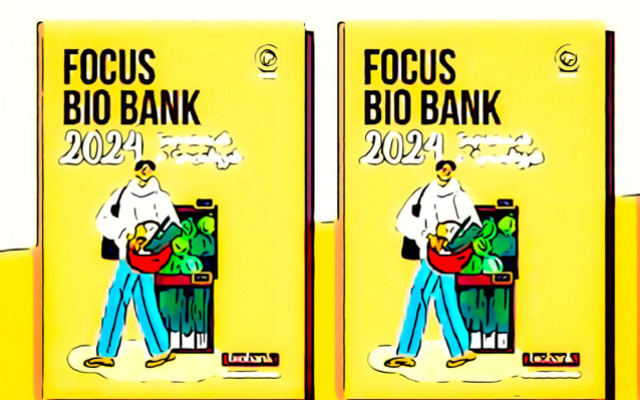
Mass distribution confirms itself as the most prolific channel in organic food sales, according to the Focus Bio Bank – Supermarkets & Specialized 2024. (1) Especially in supermarkets, organic food sales are growing, despite the long depressive impact of inflation.
An organic treasure
The contraction of consumption It is a fact. It continues to strangulate food consumption even in 'conventional', i.e., non-organic, as evidenced by the latest editions of the Immagino Observatory, marked by a minus sign in volumes sold and a plus sign in turnover. (2) Moreover, with an impact on household budgets much worse than in organic, as highlighted in the 'Bio in Figures 2024' report. (2)
Net of the negative trend overall, organic – tastier but more expensive – shows encouraging resilience for consumers – but above all for producers – without resorting to the low-cost shortcuts of synthetic pesticides and the worst food additives, which threaten the environment and human health.
The numbers of resilience
The business volume of Italian organic products – across retail, catering, and export – reached 9.1 billion euros in 2023. With a significant increase compared to 2022 (8.4 billion euros) and continuous growth, +8.7% compared to the previous year, over the last two years.
The turnover of retail alone increased by +6.7%, up to 4.2 billion euros (it was 3.9 billion in 2022). With significant performance differences between the two main sales channels.
- mass distribution marks a sharp increase in sales, +7.9%, reaching 2.4 billion euros
– specialized stores sales increase at a lower rate, +4.5%, reaching 957 million euros.
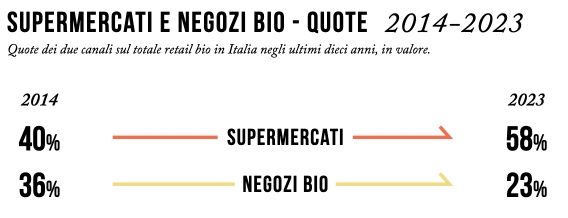
The trend It is clear: in 10 years the share of organic products in supermarkets has grown by almost half (from 40 to 58%), while that of specialized stores has decreased by more than a third (from 36 to 23%). Despite the large assortment in organic and biodynamic products, the fresh offer (think of yogurt and meats, as well as fruit and vegetables) being decidedly superior to that of general supermarkets, stores continue to be overshadowed by the GDO.
The driver of the private label
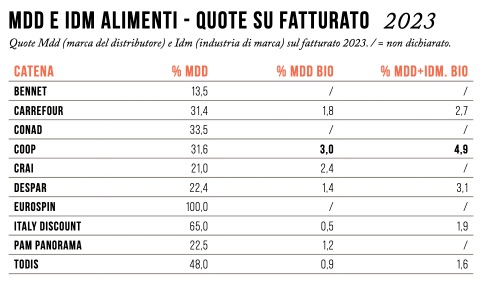
The unbeatable tool of the major retail chains is the MDD, the retailer brand, which has had and still has a decisive role in the democratization of organic products, understood as economic accessibility for the consumer.
The 24 chains of the GDO surveyed by Bio Bank in 2023 offer 21,000 organic products, of which 6,000 bear the retailer brand. In practice, 27.2% of the total organic sales are MDD. Coop Italia remains first for organic products under retailer brands.
The German way
The prevalence of GDO in organic product distribution is common to all major markets. In 2022 (Fibl-Ifoam data), the share of organic sold in supermarkets was:
- France 53%
- Italy 58%
- Germany 67%
- Switzerland 83%
- Austria 86%
- Denmark 96%.
In Germany the large supermarket and discount chains collaborate intensively with the historical organic associations. A path that can safeguard the further development of agriculture and food increasingly necessary to slow pollution and diseases, combining the commercial strength of GDO and the original and innovative thinking of the pioneers of organic.
Marta Strinati
Notes
(1) Focus Bio Bank 2024 Supermarkets & Specialized Stores. Free consultation at https://issuu.com/biobank/docs/focus_bio_bank_supermercati_2024
(2) Marta Strinati. Food consumption in Italy in the 15th edition of the Immagino Observatory. GIFT (Great Italian Food Trade). 1.7.24
(3) Marta Strinati. Bio in numbers 2024, growth continues in Italy. GIFT (Great Italian Food Trade). 18.7.24

Professional journalist since January 1995, she has worked for newspapers (Il Messaggero, Paese Sera, La Stampa) and magazines (NumeroUno, Il Salvagente). Author of journalistic investigations on food, she published the volume 'Reading labels to know what we eat'.


