

Non-alcoholic aperitifs are often considered tasty and harmless beverages since they contain no alcohol. However, examining their labels often reveals a profusion of 'unrecommendable' food additives and simple sugars in varying amounts.
Our test on 11 of the best-selling drinks indicates 4 as acceptable.
Non-alcoholic aperitifs, many additives
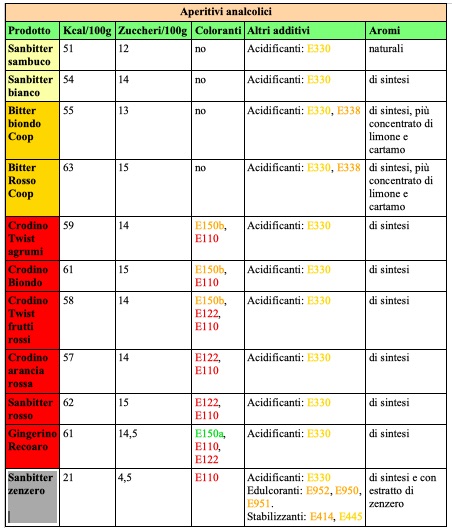
From Crodino to bitter, non-alcoholic aperitifs are essentially mixtures of water and sugar with almost always synthetic flavors. The addition of colorants gives the liquid its usual brightness, mostly in shades of yellow or red. Other additives are added as acidifiers, stabilizers, and sweeteners.
Our table comparative at the footer marks additives with green-yellow-orange-red colors, relating to the possible presence and severity of suspicions or evidence regarding health hazards associated with their intake.
Unsustainable colorants
7 out of 11 products – over 63% of the sample examined – contain azo dyes. Substances that the EFSA (European Food Safety Authority) has linked to the onset of attention deficit hyperactivity disorder (ADHD) in children, which in two-thirds of cases extends into adult life with debilitating socio-economic repercussions. In addition to suspected allergenicity and genotoxicity.
The presence of azo dyes in food products, including beverages with and without alcohol, therefore requires the warning label ‘can negatively affect children's activity and attention‘. (1)
In the sample the same three colorings always occur:
– E110 – Sunset Yellow FCF, orange yellow S,
– E122 – Azorubine, carmoisine (red color),
– E102 – Tartrazine, tartrazine yellow.
Caramel in non-alcoholic aperitifs
Among the colorings added in the 11 non-alcoholic aperitifs there are also two types of caramel, overall subject to an ADI (acceptable daily intake) of 300 mg/kg of body weight:
– E150a. The 'basic' caramel recipe does not present any critical issues (it is therefore marked green in our table),
– E150b, sulfite-caustic caramel. This coloring is obtained using sulfites. Altroconsumo suggests avoiding it in case of intolerance to this category of allergens. (3)
More fruit juices, fewer colorings
Avoid colorings problematic ones is possible. This is demonstrated by San Pellegrino in its Sanbitter white and elderberry flavor. Coop also forgoes them, using food concentrates (blackcurrant and carrot) as colorants in its bitters (white and red). Unfortunately, the same Coop yields by adding phosphoric acid (E338) as an acidifier, an additive from the phosphate family which is less recommended.
‘Recent studies have shown the existence, within populations, of an increase in phosphate levels in the walls of blood vessels. This could be potentially harmful as it would constitute a cardiovascular risk factor, especially in case of kidney failure’ (Altroconsumo. See note 3).
E338 is authorized in over 100 food categories. Nonetheless, according to EFSA, children and adolescents are exposed to it in quantities exceeding the ADI (Acceptable Daily Intake) set in 2019. (4)
Industrial citric acid
Citric acid (E330) is another additive present in all samples. It is used as an antioxidant and color stabilizer, to prevent browning of non-alcoholic aperitifs.
The industrial version of this acid, naturally present in many fruits, is produced by fungal fermentation Aspergillus niger. It is reported for three possible risks:
– damage to teeth, especially in children who regularly consume carbonated drinks,
– ingestion of mycotoxins possibly produced by Aspergillus niger,
– rare allergic reactions in people sensitive to molds. (2)
Laboratory taste
In 10 cases out of 11, the taste of drink non-alcoholic beverages examined is exclusively the result of synthetic flavors. Despite the claim, even for Crodino with blood orange, citrus or red fruit flavors, the taste is always artificial and the mixture is fruit-free.
‘Did you know I come from infusions of herbs and spices? Did you know that my infusions, once mixed, must rest for up to 6 months?‘ (Crodino claim, with synthetic flavors).
The only exception is Sanbitter Sambuco, which contains only natural flavors (not further specified) and natural elderflower aroma.
Fewer calories, more risks
Among the additives added to non-alcoholic aperitifs there are also intense sweeteners. Sanbitter ginger flavor uses three of them:
– E952, sodium cyclamate. Scientific studies correlate its consumption with microbiota alteration. Animal experiments have also shown reproductive effects,
– E950, Acesulfame K. It damages the microbiota and is suspected of carcinogenicity,
– E951, Aspartame. It is associated with microbiome alteration and various health damages (headaches, epilepsy, brain tumors, for example).
Stabilizers in the glass
Another category of additives added to non-alcoholic aperitifs are stabilizers. They appear in the recipe of Sanbitter ginger flavor. These are
Acacia gum (gum arabic) – Gum arabic (acacia gum). It is associated with gastrointestinal disorders and rare allergies,
Glycerol esters of wood rosin – Glycerol esters of wood rosin. EFSA highlights the lack of data on the toxicological impact of this additive, but does not indicate health risks.
Marta Strinati
Notes
(1) Foods containing colorants E102, E104, E110, E122, E124, E129 must bear the additional information on the label ‘May adversely affect activity and attention in children’. See Reg. EC 1333/2008, Annex V
(4) EFSA. Re-evaluation of phosphoric acid–phosphates – di-, tri- and polyphosphates (E 338–341, E 343, E 450–452) as food additives and the safety of proposed extension of use. 4.6.19. https://www.efsa.europa.eu/en/efsajournal/pub/5674)

Professional journalist since January 1995, she has worked for newspapers (Il Messaggero, Paese Sera, La Stampa) and magazines (NumeroUno, Il Salvagente). Author of journalistic investigations on food, she published the book 'Reading labels to know what we eat'.


