
The Consumer Users Association (ACU) presented the report 'Greenwashing in Italy 2023-2026', curated by the benefit company Giusto&Sostenibile. (1) The document assesses the regulatory vulnerability of environmental communication profiles, both actual and potential, of 70 brands active in the national market.
Environmental claims and ‘greenwashing’ risk
Environmental claims related to ecological transition and supply chain sustainability represent a central competitive asset for agri-food companies, given the growing consumer attention to these issues.
The validity of such assertions may however be compromised by greenwashing practices, if messages are vague, unverifiable, or disproportionate to the actual environmental impacts of the organization.
New rules from September 2026
Legislative Decree no. 30/2026 – which implements Directive 2024/825 in Italy (Empowering Consumers for the Green Transition Directive, ECGT Directive) – applies from 27 September 2026. This regulation extends the regulation of unfair and deceptive commercial practices – and the related million-euro sanctions – to commercial information concerning the environmental and social performance of products and organizations.
The analysis of the Consumer Users Association
In order to provide a technical-legal tool to analyze and recognize the risk of greenwashing, The analysis of the Consumers Users Association (ACU) adopts a comparative and multidimensional approach based on precise operational phases:
A. Selection of sectors and brands
ACU analyzed 8 sectors with high communicative exposure to citizens, identifying the brands of Italian companies and/or operating in Italy most visible based on their presence in the national market: automotive, banks and insurance, energy and utilities, food and beverage, fashion, multi-utilities, mobile telephony and smartphone manufacturers, national and local transport. (2)
B. Classification of claims and evidential support
Environmental claims were divided into five categories: product, process, impact, reputational and prospective (future targets and climate neutrality). With attention to generic statements (such as ‘eco-friendly’ o ‘carbon neutral’) and their actual verification through quantitative data, ISO standards, certifications, as well as consistency with ESG reports. The absence of verifiable elements is considered an indicator of vulnerability.
C. Consistency with the business model and scoring system
ACU's research also compared environmental communication with the main business activity and the structural impact of the reference sector, evaluating (especially in high carbon intensity sectors) possible gaps between the commitments projected towards the future and the actual current impact of their activities.
The quantification of greenwashing risk
The potential risk of greenwashing was measured by ACU through a scoring system, from 0 to 100, divided into five classes:
< 20: Negligible
< 50: Low / Moderate-low
> 50: Moderate / Moderate-high
> 60: High
> 80: Very high.
The assigned score, note well, exclusively expresses the vulnerability of the communication concerning the new regulatory context. The report clearly distinguishes the potential risk from the possible existence of illegal acts, whose verification falls under the jurisdiction of the Italian Competition Authority (AGCM, also known as Antitrust Italy).
The risk profiles of 10 food & beverage giants
ACU's analysis identifies three areas of particular importance in the application of the new rules on so-called 'environmental claims' in the food sector:
- the use of single-use plastic;
- the transparency of claims on recyclability;
- the statements of climate neutrality based on offsetting mechanisms. That is the so-called carbon offsetting, aimed at ‘neutralizing’ their own CO2 emissions by financing third-party environmental projects that reduce or absorb the equivalent greenhouse gases.
Added to these critical issues is the tendency towards communication that is sometimes too brief or generic on complex topics such as the so-called ‘regenerative agriculture’.
In this context, according to ACU, the major global players in the sector beverage show the greatest regulatory vulnerability.
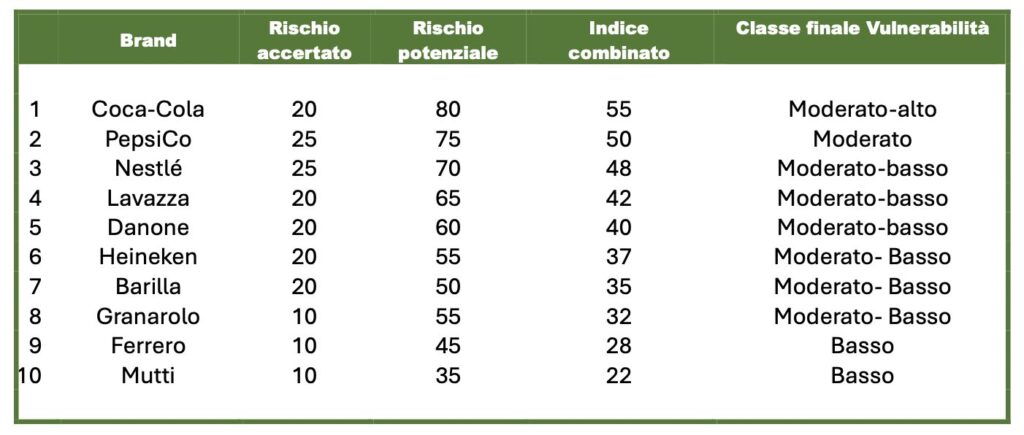
High or medium-high vulnerability
– Nestlé (high potential exposure): although the Swiss giant boasts one of the most articulated climate strategies in the sector — equipped with a roadmap detailed Net Zero, intermediate targets by 2030, structured agricultural programs and advanced reporting — its potential risk appears significant. This criticality is due to the vast industrial scale, strong dependence on tropical supply chains, extensive use of plastic packaging and use of offsets for carbon neutrality claims (carbon neutral).
Environmental claims detected:
‘Net Zero by 2050
50% emission reduction by 2030
Regenerative agriculture on millions of hectares
100% recyclable or reusable packaging
Zero deforestation in cocoa and coffee supply chains
Carbon neutrality for some brands/products
Billion-dollar investments in the climate transition’
– Coca-Cola (high prospective exposure)The US group has a structured environmental strategy, with climate targets anticipated for 2040 and an increase in the use of recycled plastic. However, its business model remains strongly anchored to single-use packaging. The main risk stems from the semantic ambiguity of claims on recyclability (referring to the global recycling rate and anyway linked to the performance of national systems), from the gap between equivalent collection and the actual closure of the cycle, and from strong regulatory pressureEuropean regulation on single-use plastic.
Environmental claims detected:
‘World Without Waste
We will collect and recycle the equivalent of 100% of bottles sold by 2030
100% recyclable bottles
25% reduction of virgin plastic by 2025/2030
Net Zero by 2040
Italian plants powered by renewable energy
Reduction in water consumption per liter produced.’
– PepsiCo (medium-high vulnerability): through the structured ‘pep+’ strategy, the group pursues ambitious climate targets and large-scale agricultural programs. Nonetheless, according to ACU, PepsiCo is positioned in a risk bracket similar to that of Coca-Cola, with specific exposure on snack packaging (often multilayer), synthetic recyclability communication, dependence on intensive agricultural supply chains, and adoption of complex concepts like ‘water positive’.
Environmental claims detected:
‘PepsiCo Positive (pep+)
Net Zero by 2040
100% recyclable, compostable or reusable packaging
50% reduction of virgin plastic by 2030
Regenerative agriculture on 7 million acres
Reduction of Scope 1, 2 and 3 emissions (3)
Water positive by 2030.’
– Lavazza (medium-high vulnerability): the Italian coffee leader offers a strong narrative on social and supply chain sustainability (transparency on programs, long-term institutional commitment, and attention to producing communities). However, according to ACU, it is also exposed to some structural environmental criticalities. Regulatory risk is mainly linked to the impact of capsules and the use of offsetting mechanisms for carbon neutrality. Its vulnerability is lower than that of global giants of soft drink, but higher than that of producers with lower packaging intensity.
Environmental claims detected:
‘Net Zero commitment by 2050
Recyclable / compostable capsules
Carbon neutral coffee for some lines
Lavazza Foundation and sustainability of producing communities
Sustainable packaging and material reduction
Coffee from sustainable and certified supply chains
Emission reduction along the value chain
Medium vulnerability
– Danone (medium vulnerability): the French giant has a structured and relatively advanced ESG strategy in the dairy sector, characterized by detailed reporting, public climate targets, regenerative agriculture initiatives, and less aggressive communication compared to competitors of beverage. The residual risk focuses on methane emissions from the milk supply chain, structural difficulties in sector decarbonization, and widespread use of plastic packaging. The risk level is lower than Coca-Cola and PepsiCo, but higher than players less exposed to intensive agriculture.
Environmental claims detected:
Net Zero by 2050
1.5°C aligned emission reduction
Regenerative agriculture and sustainable milk supply chains
100% recyclable, reusable or compostable packaging
B Corp certification
Virgin plastic reduction
Water stewardship and protection of water resources
– Ferrero (medium potential risk): the giant of the confectionery sector presents a structured and formalized ESG strategy, supported by detailed reporting, supply chain certifications, Net Zero targets, and specific programs against deforestation and for packaging management. The main risk does not lie in unfounded statements, but in the possible over-perception of the term 'sustainable' applied to complex tropical supply chains (e.g., palm oil), in the gap between certification and actual systemic impact, and in the use of long-term targets(2050) as a reputational lever.
Environmental claims detected:
‘Net Zero commitment by 2050
100% sustainable certified cocoa
Packaging 100% recyclable / reusable / compostable by 2025
100% segregated and sustainable certified palm oil
Scope 1–2–3 emission reductions
Regenerative agriculture programs
Zero deforestation in strategic supply chains’.
Medium-low or low vulnerability
– Heineken (medium-low vulnerability): its ESG strategy is structured and it is less exposed compared to producers of soft drink thanks to factors such as widespread use of recyclable glass, the presence of returnable vacuum systems and public climate targets. Potential issues concern the claim ‘zero emission brewing’, the discrepancy between emissions of the individual plant and those of the entire product life cycle, and sometimes overly brief communication on packaging.
Environmental claims detected:
‘Net Zero by 2040 (Scope 1 and 2) and 2050 (Scope 3)
100% renewable energy at European production sites
Zero emission brewing
30% reduction in Scope 3 emissions by 2030
100% recyclable packaging
Water stewardship and positive water balance in risk areas
Barley from sustainable agriculture’
– Granarolo (medium-low vulnerability): the Italian cooperation leader can rely on a traceable supply chain, initiatives related to biogas and emission reductions, and well-structured ESG reporting. According to ACU, its potential vulnerability – higher than Mutti’s but lower than that of major global brands – would be linked to the intrinsic challenges of the dairy sector: methane emissions, objective difficulties in decarbonization, and the need for plastic packaging for fresh dairy products.
Environmental claims detected:
‘100% Italian milk from controlled supply chain
Emission reductions along the milk supply chain
Certified animal welfare
Recyclable packaging and plastic reduction
Net Zero commitment by 2050
Renewable energy in plants
Circular economy projects (biogas from livestock manure)’
– Barilla (medium-low vulnerability): the ESG strategy of the global leader of Pasta is structured and consistent with the company's agricultural-industrial model, thanks to documented supply chain protocols, progressive emission reductions, the use of recyclable paper packaging, and transparent reporting. Free from statements lacking documentary basis, the risk is limited to the semantic breadth of the word ‘sustainable’, the potential gap between the theoretical recyclability of packaging and its actual recycling, and the complexity of measuring ‘Scope 3’ emissions in agriculture.
Environmental claims detected:
‘Net Zero commitment by 2050
100% Italian wheat for the main product lines
Sustainable supply chain and regenerative agriculture
100% recyclable packaging
Scope 1–2–3 emission reductions
Facilities powered by renewable energy
Paper sourced from responsibly managed forests.
– Mutti (lower regulatory vulnerability): the symbol of Made in Italy tomato preserves is the safest brand in the sample. The main risk mitigation factors are the short national supply chain, packaging mainly made of glass and tin, and less aggressive and non-generalist communication. The residual risk is marginal and confined to the generic nature of the term ‘sustainable supply chain’ and the water impact of agricultural activities.
Environmental claims detected:
‘100% Italian tomato
Controlled and sustainable supply chain
Carbon footprint reduction
Recyclable packaging (glass, tin)
Responsible agriculture and efficient water use
Renewable energy in facilities.
Conclusions
The ACU report confirms theintegrity of the major players of the Italian food industry, as regards socio-environmental sustainability and its communication.
In view of the application of Legislative Decree no. 30/2026 from next September 27, the structural factors determining the minimal regulatory vulnerability of Italian companies compared to global competitors are:
- supply chain integrationThe adoption of short, national, and traceable supply chains (as in the cases of Mutti, Granarolo, and Barilla) eliminates risks related to complex supply chains and indirect emissions (Scope 3);
- nature of materialsThe prevalent use of historically and fully recyclable packaging (glass, tin, and paper) mitigates the sanction risk related to claims on single-use plastic management;
- real decarbonization strategiesUnlike the large global beverage brands, which depend on unstable carbon offsetting mechanisms, Italian producers show lower exposure thanks to direct investments in plants and documented supply chain contracts.
The technical analysis shows that compliance with the new European rules is already a consolidated reality for the Italian agri-food model, resulting in an immediate competitive advantage based on objective and verifiable data.
Marta Strinati
Notes
(1) ‘GREENWASHING REPORT IN ITALY 2023-2026: How the main Italian brands and economic sectors communicate their environmental and sustainability claims’. By Giuseppe D’Ippolito. Giusto&Sostenibile. 524 pages. May 10, 2026. Kindle format on https://www.amazon.it/dp/B0H182VZ92
(2) The brands examined for each of the eight sectors are: Automotive: Stellantis, Volkswagen, Mercedes-Benz, BMW, Renault, Ford, Hyundai, Kia, Toyota, Tesla. Banks & Insurance: Generali, Allianz Italia, AXA Italia, Intesa Sanpaolo, UniCredit, Unipol, Poste Italiane / Poste Vita, Banco BPM, BPER Banca, Banca Etica. Energy & Utilities: Eni, Sorgenia, Edison, A2A, Hera, Iren, Snam, Acea, Enel, Terna. Food & Beverage: Coca-Cola, PepsiCo, Nestlé, Lavazza, Danone, Heineken, Barilla, Granarolo, Ferrero, Mutti. Fashion & Fashion: H&M, Zara, Nike, Adidas, OVS, Gucci, Calzedonia Group, Benetton, Armani, Prada. Multi-utility: ACEA S.p.A., HERA S.p.A., A2A. Mobile Telephony & Smartphone Manufacturers: TIM, Wind Tre, Vodafone / Fastweb, Iliad, Huawei, Samsung, Xiaomi, Apple, OPPO. National & Local Transport: ITA Airways, Ryanair, EasyJet, Italo – NTV, AMAT Palermo, ATAC Roma, Trenitalia, ATM Milano.
(3) To measure and classify a company's climate impact, the global standard of GHG Protocol divides greenhouse gases into three levels: direct company emissions (Scope 1), indirect emissions from purchased energy (Scope 2), and all other indirect emissions generated by the supply chain (Scope 3).

A professional journalist since January 1995, he has worked for newspapers (Il Messaggero, Paese Sera, La Stampa) and periodicals (NumeroUno, Il Salvagente). Author of journalistic investigations on food, she published the volume 'Reading labels to know what we eat'.


