

corn flakes and extruded cereals, filled with cocoa cream, are now established in the breakfast of adults and children. We have examined 24, among the industrial brands leaders (Kellogg’s, Nestlé) and the private label of mass distribution (Coop, Esselunga, Carrefour), discount (Eurospin, Lidl, Dico) and their suppliers (Consilia).
8 corn flakes classic compared
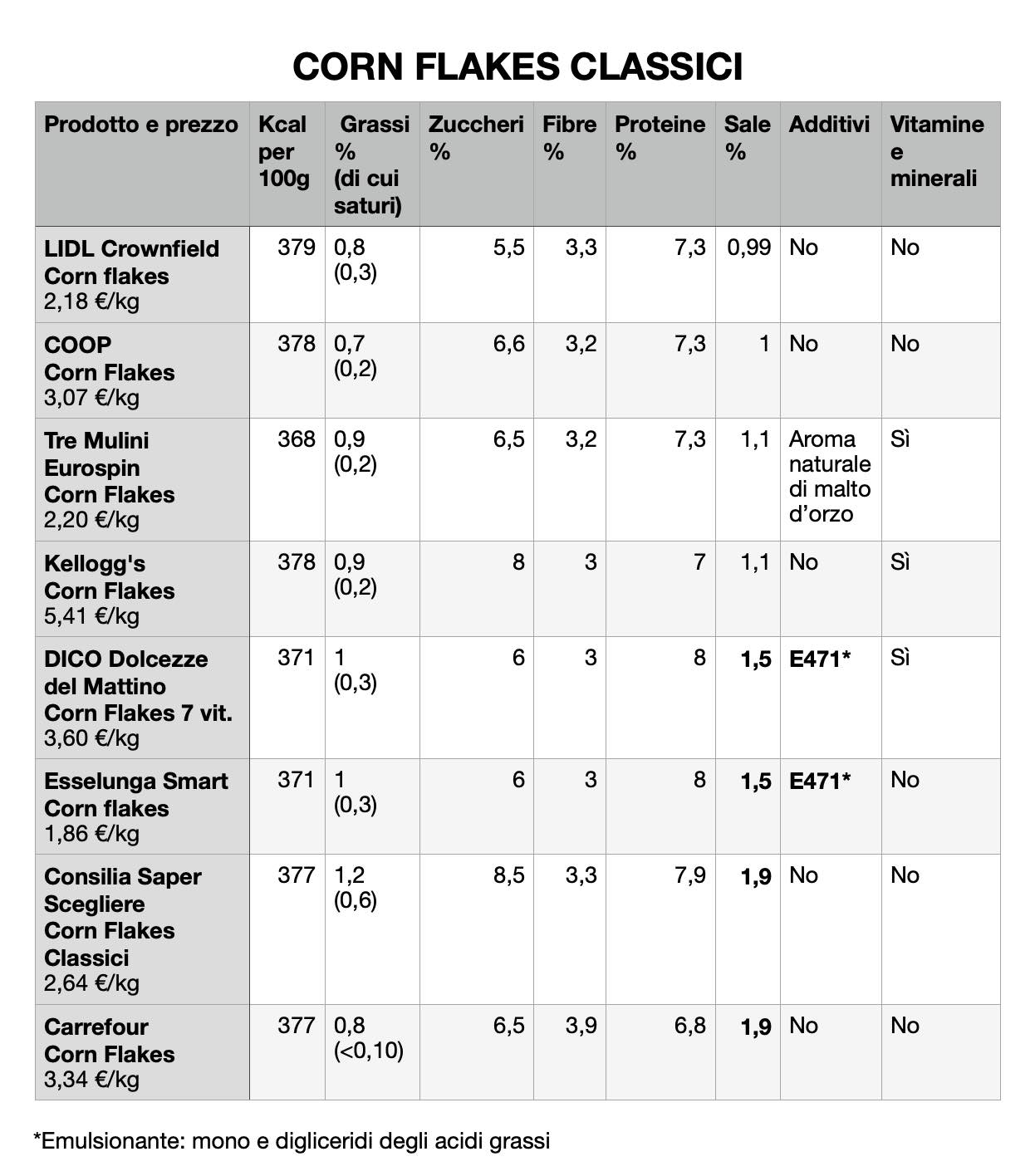
The base version, or classic, of corn flakes is made of corn (corn), sugar, salt and sometimes also malt extract or its flavor.
Additives are also found in this seemingly simple food. Two of the compared products – the corn flakes from Esselunga and Dico, both supplied by Lameri Spa – in fact also contain mono- and diglyceride emulsifiers of fatty acids.
These additives, widely used in industrial foods, are generally derived from palm oil or animal fats and can alter the balance of the intestinal microbiota.
corn flakes classic, the nutritional profile
According to the producers, the serving size of corn flakes is 30g. Few, in reality. Each one can weigh their typical portion for verification. More believable is Lidl, which indicates the portion as 50g. However, the comparison of nutritional values should be done per 100g of product to avoid common misunderstandings.
In the comparison, the most interesting elements are sugars and salt. Regarding the former, the range goes from 5.5 g/100g of Lidl to 8.5 g/100g of Consilia.
Salty flakes
As for the salt, the minimum amount is 1g, the maximum almost double, 1.9 g/100g. Not little, considering that the corn flakes start every day during which, according to WHO, the salt threshold of 5 g should not be exceeded.
The price lowest is Esselunga (1.85 €/kg), the highest – almost three times – Kellogg’s (5.41 €/kg).
corn flakes organic, few in attendance
For each product of MDD (private label) and of leaders of the market considered we looked for the organic version of corn flakes classics. But we found only four, with the signs of Esselunga, Carrefour, Lidl and DICO.
In the landscape of supermarkets and discount therefore missing are Coop and Eurospin. Not available is leaders Kellogg’s, as well as Nestlé (which as you will see excels in the breakfast cereal offer).
Watch the salt
The nutritional profiles of this segment, as the table shows, overlap those of corn flakes non-organic classics. Except Lidl which in the organic version minimizes sugars, but adds an emulsifier (sunflower lecithin).
Salt abounds in Dico and Carrefour products, which contain twice as much as the other examined references.
The price is at least double that of the non-organic equivalents. The most convenient are Lidl and Esselunga products.

The fiber of health
The usefulness of fiber has been widely proven. In addition to good bowel function and improvement of the intestinal microbiota, it exerts all-around beneficial effects.
The scientific literature associates the regular intake of fiber with a reduction of up to one third of premature mortality causes. For this reason, WHO and EFSA recommend adults consume at least 25 grams per day. Starting to consume it from breakfast is therefore a good start.
Cereals with more fiber
Looking within the same line of flaked cereals of the examined brands, the version with more fiber is offered in only 3 cases. Adding to these is Nestlé with its Fitness Original.
In this case, the flakes are no longer corn (corn) but wheat (grain). Bran and other cereals, such as oats and rice, are added to it.
The result is a fiber content in the sample ranging from 7 to 16 g/100 (compared to the average 3 g of corn flakes classic).
Carrefour flakes stand out for the high sugar content (19%), followed by Eurospin's (16).
Largely wholegrain
The recipes of the versions with more fiber remain very simple in Lidl and Carrefour flakes. They contain only 5 ingredients: whole wheat, bran, sugar, salt, honey.
The share of whole grains varies, as the table shows. Eurospin and Nestlé add a large amount of rice. Nestlé's Fitness Original flakes also stand out for the addition of sugar syrup, glucose and molasses. And for the high price, twice that of the others.

Filled cereals, explosive breakfast
The trend of Big Food to offer ultra-processed foods to children is unstoppable. As if cereals enriched with chocolate, sugar glaze, and honey were not enough, 'little pouches' filled with chocolate cream are added. A kind of mini-snacks, rather than 'breakfast cereals'.
Almost all foods targeted at children are harmful, as has been seen. But junk food generates addiction in consumers – as science has shown – and high profits. Nestlé and Kellogg's lead the way, followed by distributor brands.
Up to 32g of sugars in 100g
If the organic variants and with more fiber are lacking, cream-filled cereals are always present in private label.
The sugars vary from 24.5 to 32 g/100g in the 8 products examined. Saturated fats from 2.8 to 5.3 grams per 100g. Values unsuitable for nutritional education and children's health.
Palm oil is still used by Kellogg’s and Lidl. Others use sunflower oil, definitely better, and coconut oil (which is instead rich in saturated fats). Interesting is the addition of inulin (soluble fiber) in the Esselunga product.
Kellogg’s, a dye to avoid
The presence of creams brings with it a load of emulsifiers. In filled cereals we always find sunflower lecithins and in one case (Kellogg’s Krave Dark) soy lecithin.
To report finally in Kellogg’s Krave Dark the addition of a problematic dye, annatto norbixin (E160b), which can cause severe allergies.
Canary-sized portions
As for the corn flakes classic, also for cereals filled with cocoa cream almost all producers indicate the portion as 30 grams of product. A trick to mask calorie and sugar intakes. Weigh to believe. Only Lidl, once again, stands out for seriousness by reporting a more credible ration of 60g.
The trick is evident when considering that a 410g package of filled cereals should be enough for an individual's breakfast for two weeks. Try to believe. It is therefore essential to introduce a front-of-pack nutritional labeling system such as the NutriScore, referring to 100 g instead of false canary-sized portions.

Synthetic vitamins and added minerals
Very often breakfast cereals contain synthetic vitamins and added minerals, as highlighted in the tables. In the classic USA style of fortifying all cereal-based foods as if there were an endemic deficiency of micronutrients.
The doubts about the usefulness of this practice are many. First of all, a varied and balanced diet should itself guarantee coverage of vitamin and mineral requirements. Any deficiencies should be addressed individually – for example with supplements providing x% of the NRV of vitamin D or Omega 3 – and certainly not ‘by the handful’.
Marta Strinati
Notes
The sampling took place from 17 to 10.1.22.

Professional journalist since January 1995, she has worked for newspapers (Il Messaggero, Paese Sera, La Stampa) and magazines (NumeroUno, Il Salvagente). Author of journalistic investigations on food, she published the book 'Reading labels to know what we eat'.


