

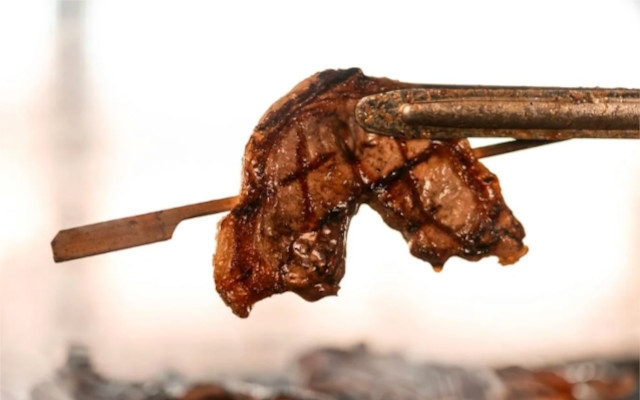
The picanha is a cut of beef typical of Brazilian tradition, corresponding to the rump cap or sirloin cap. Characterized by a triangular shape and a thick layer of external fat, picanha is the symbol of churrasco. Thanks to its nutritional profile rich in proteins and fatty acids such as CLA, this cut is conquering the Italian catering of excellence, combining slow cooking techniques and enhancement of quality raw materials.
From the pampas to the gauchos, the history of churrasco
The origins of picanha are linked to the history ofcattle breeding in the South American pampas and the culture of the gauchos, the cowherds who between Brazil, Argentina and Uruguay developed simple but effective cooking techniques based on live fire. When in the 16th century the Spanish conquerors introduced cattle and horses into the fertile plains covering central-eastern Argentina, Uruguay and the Rio Grande do Sul Brazilian, many animals dispersed forming wild herds. These herds attracted mixed-blood cowherds, descendants of Europeans and indigenous peoples, who made cattle breeding their way of life.
The barbecue as we know it today was born precisely from the practical needs of these gauchos. During long journeys across the plains, the cowherds cooked large cuts of meat skewered on skewers (metal or wooden skewers) and slowly roasted over wood embers, seasoned exclusively with coarse salt (coarse crystal salt). This method, conceived around the concept of ground fire (ground fire), allowed for even cooking and enhanced the natural flavor of the meat without overpowering it with foreign aromas.
According to one of the most widespread legends, the name 'picanha' would derive from 'picana', the long stick used by herdsmen to guide cattle by pricking the animals in the rear part of the back, precisely in the anatomical area from which the cut is taken. Although the etymology is not unanimously confirmed by food historians, this narrative has become an integral part of the Brazilian gastronomic imagination.
The popularity of picanha consolidated in Twentieth century, especially in the State of Rio Grande do Sul, cradle of barbecue modern. In the Forties and Fifties, with the migration northward of inhabitants from Rio Grande do Sul and the development of road networks, the first churrascarias (restaurants specialized in Brazilian barbecue) along the main routes, initially aimed at truck drivers. It was during this period that the style rodízio, the continuous service of spit-roasted meats sliced directly at the table, which transformed churrasco into a convivial and spectacular experience.

Animal husbandry, cattle breeds between Bos indicus and Bos taurus
From an animal husbandry point of view, the quality of picanha depends on several factors: cattle breed, animal age, nutrition, marbling and aging.
In Brazil, the cut is historically associated with zebu cattle (zebu) of the Nelore breed, belonging to the species Bos indicus. The breed derives from Ongole cattle originally from the Indian district of Nellore, imported to Brazil since 1868. Today over 80% of beef cattle in Brazil are purebred or crossbred Nelore. This breed is characterized by heat resistance, parasite tolerance, high fertility in tropical environments, and the ability to thrive on low-quality forage. Also for particularly lean meat, a feature that favors its use even in the production of bresaola.
In recent decades, crossbreeding has also taken hold in Brazil with taurine breeds of European lineage (Bos taurus) like Angus and Hereford, selected to achieve greater intramuscular fat infiltration and better tenderness (Decker et al., 2014).
In Europe and in Italy, picanha is often offered using breeds such as Black Angus, Simmental, Charolaise, Rubia Gallega, and Wagyu, as well as Italian cattle of Fassona Piedmontese or beef crossbreeds. The growing attention towards marbling and maturation dry aged has further increased consumer interest in this cut.
Anatomy of the cut and Italian correspondence
From an anatomical point of view, the picanha corresponds to the codone or tip of the sirloin, located in the upper posterior dorsal region of the bovine, between the rump and the sirloin. In Anglo-Saxon classification systems it is identified as 'rump cap', 'top sirloin cap' or 'coulotte steak'. The reference IMPS (Institutional Meat Purchase Specifications) number is 184D.
The shape triangular and the presence of a thick outer fat layer represent its distinctive characteristics. This lipid coating plays an essential role during cooking: by melting slowly, it protects the meat from excessive dehydration and contributes to aromatic development through Maillard reactions. The surface fat, which can reach about 1.2 cm in thickness, should never be removed before cooking: this practice would impoverish the cut, reducing its juiciness and thermal protection.
The weight of the whole picanha generally varies between 1 and 1.5 kg. Cuts that are too large often indicate incorrect anatomical processing or inclusion of adjacent muscles. The traditional Brazilian preparation involves slicing the cut into large crescent-shaped pieces and skewering them, keeping the fat side outwards to allow gradual melting and self-basting of the meat during cooking.

Why picanha conquers the Italian market
The rise of picanha in the Italian market can be attributed to various cultural, gastronomic, and economic factors.
The first element is the growing spread of barbecue culture. In the last ten years, interest in smoking, indirect cooking, and professional grills has encouraged the rediscovery of less conventional beef cuts compared to traditional Italian steaks.
The presence of Brazilian restaurants and churrascarias has also helped familiarize the Italian consumer with picanha. The success of the rodízio — continuous service of spit-roasted meats cut at the table — has turned this cut into a convivial and theatrical experience reminiscent of gaucho barbecue sociality.
Also the social media have played a decisive role. Images of rare-cooked picanha, with its characteristic crust and crispy fat, spread rapidly on food and barbecue platforms, increasing curiosity and demand.
From a gastronomic point of view, picanha also responds to a new culinary sensitivity: the reevaluation of fat as an aromatic component and not only as an element to be eliminated. In a context dominated for decades by the idea of lean meat, this cut proposes a different balance between succulence, texture, and flavor intensity.
Then the role of specialized butcher shops and premium meat e-commerce, which have made available on the Italian market picanha coming from different breeding systems and cattle breeds.
Finally, picanha benefits from a relative culinary versatility. Although it originates as a cut for grilling, it can also be prepared in the oven, in a pan, or with techniques sous-vide, adapting both to home cooking and contemporary catering.
Nutritional properties of beef: proteins, iron and CLA
The nutritional composition of picanha reflects the typical characteristics of quality beef, with some peculiarities linked to the presence of intramuscular and superficial fat.
A 100-gram portion of picanha provides on average between 15 and 20 grams of high biological value proteins, containing all the essential amino acids necessary for growth and tissue maintenance. Beef is indeed one of the most complete and bioavailable protein sources in human nutrition, also providing essential micronutrients such as heme iron (the most bioavailable form), zinc, selenium, phosphorus and B-group vitamins, particularly vitamin B12, niacin (B3), vitamin B6 e riboflavin (B2). Recent studies confirm that beef consumption is associated with higher intake and adequacy of these nutrients, often deficient in large population groups, especially elderly people and women of childbearing age (Agarwal & Fulgoni, 2024).
The lipid content varies depending on breed, diet, and the presence of the external fat cover, ranging from 10 to 20 grams per 100 grams of product. The lipid profile of picanha deserves particular attention: the intramuscular fat contains high proportions of monounsaturated fatty acids (MUFA) and polyunsaturated (PUFA) compared to other bovine fat deposits, with variable composition depending on breed and diet. Theoleic acid, the same present in olive oil, represents the predominant monounsaturated component, while among the saturated, thestearic acid constitutes a significant fraction that, unlike other saturated fats, exerts a neutral effect on blood cholesterol levels in most studies (Troy et al., 2016; Abebe et al., 2024; Tan & Jiang, 2024).
A bioactive component of particular interest is theconjugated linoleic acid (CLA), a polyunsaturated fatty acid naturally present in meat and dairy of ruminants, derived from the ruminal biohydrogenation of linoleic acid. Its main isomers — cis-9, trans-11 (c9,t11) and trans-10, cis-12 (t10,c12) — have been associated in preclinical studies and some clinical investigations with anti-obesity, anti-inflammatory, anti-carcinogenic, and immune modulation effects, although results in humans remain heterogeneous and require further study (Basak & Duttaroy, 2020; Putera et al., 2023). The composition and concentration of CLA vary significantly depending on animal diet and ruminal microbiome.
Preparation and cooking: from barbecue to sous-vide
The tradition of the gauchos provides that the picanha is cut into large half-moon folded slices and skewered on metal rods, keeping the fat on the outside. The skewers are placed at 25-30 centimeters away from the live embers and rotated regularly to ensure slow and even cooking.
The surface fat should not be removed before cooking, but may be scored lightly to favor its gradual melting. The aromatic smoke produced by fat dripping on the embers flavors the meat, which is then seasoned with only coarse salt.
To achieve an optimal result, the meat must be brought to room temperature before cooking. The ideal internal temperature varies between 52 and 56 °C for rare or medium-rare cooking, considered the most suitable to preserve tenderness and aroma.
In oven or barbecue with indirect cooking, many chefs recommend an initial phase at moderate temperature (140-160 °C), followed by a very short final searing at high intensity (over 200 °C) which allows developing an outer crust without drying the inside.
The preparation sous-vide – cooking meat in a vacuum-sealed bag, at low temperature, in a controlled water bath, for prolonged times – with a final searing represents another modern technique that ensures even cooking, greater tenderness, and better juice retention.
Contemporary variations
In recent years, contemporary variations have spread that include light marinades, use of spices, smoking, or prolonged aging dry aged.
Some Italian chefs are experimenting pairings with Mediterranean aromatic herbs, chimichurri – a typical cold Argentine and Uruguayan sauce made from parsley, garlic, vinegar, oil, oregano, and chili – or red wine sauces, without overpowering the authentic flavor of quality beef.
The final cut requires attention in any case: the picanha should be sliced against the grain, in relatively thin slices (about 0.5-1 cm), to maximize the perception of tenderness.
Quality and supply chain awareness
The picanha represents a meeting point between the pastoral tradition of the gauchos and the modern needs of professional and domestic catering. Beyond the folklore of churrasco, the interest in this cut highlights the importance of a proper valorization of all anatomical parts of the bovine, reducing waste and maximizing the intake of essential nutrients. The challenge for supply chain operators remains the guarantee of accurate information about origin, breeding techniques, and aging times.Essential elements for a conscious consumption of high-quality beef.
Dario Dongo
Credit cover Furkan Alakoç
Bibliography
- Abebe, B. K., Wang, J., Guo, J., Wang, H., Li, A., & Zan, L. (2024). A review of emerging technologies, nutritional practices, and management strategies to improve intramuscular fat composition in beef cattle. Journal of Applied Animal Research, 52(1), 2388704. https://doi.org/10.1080/10495398.2024.2388704
- Agarwal, S., & Fulgoni, V. L. (2024). Beef consumption is associated with higher intakes and adequacy of key nutrients in older adults age 60+ years: National Health and Nutrition Examination Survey 2011–2018 analysis. Nutrients, 16(11), 1779. https://doi.org/10.3390/nu16111779
- Basak, S., & Duttaroy, A. K. (2020). Conjugated linoleic acid and its beneficial effects in obesity, cardiovascular disease, and cancer. Nutrients, 12(7), 1913. https://doi.org/10.3390/nu12071913
- Decker, J. E., McKay, S. D., Rolf, M. M., Kim, J., Molina Alcalá, A., Sonstegard, T. S., Hanotte, O., Götherström, A., Seabury, C. M., Praharani, L., Babar, M. E., Regitano, L. C. A., Yildiz, M. A., Heaton, M. P., Liu, W. S., Lei, C. Z., Reecy, J. M., Saif-Ur-Rehman, M., Schnabel, R. D., & Taylor, J. F. (2014). Worldwide patterns of ancestry, divergence, and admixture in domesticated cattle. PLoS Genetics, 10(3), e1004254. https://doi.org/10.1371/journal.pgen.1004254
- Putera, H. D., Doewes, R. I., Shalaby, M. N., Ramírez-Coronel, A. A., Clayton, Z. S., Abdelbasset, W. K., Murtazaev, S. S., Jalil, A. T., Rahimi, P., Nattagh-Eshtivani, E., Malekahmadi, M., & Pahlavani, N. (2023). The effect of conjugated linoleic acids on inflammation, oxidative stress, body composition and physical performance: a comprehensive review of putative molecular mechanisms. Nutrition and Metabolism, 20(1), 35. https://doi.org/10.1186/s12986-023-00758-9
- Tan, Z., & Jiang, H. (2024). Molecular and cellular mechanisms of intramuscular fat development and growth in cattle. International Journal of Molecular Sciences, 25(5), 2520. https://doi.org/10.3390/ijms25052520
- Troy, D. J., Tiwari, B. K., & Joo, S. T. (2016). Health Implications of Beef Intramuscular Fat Consumption. Korean journal for food science of animal resources, 36(5), 577–582. https://doi.org/10.5851/kosfa.2016.36.5.577

Dario Dongo, lawyer and journalist, PhD in international food law, founder of WIISE (FARE - GIFT – Food Times) and Égalité.


