

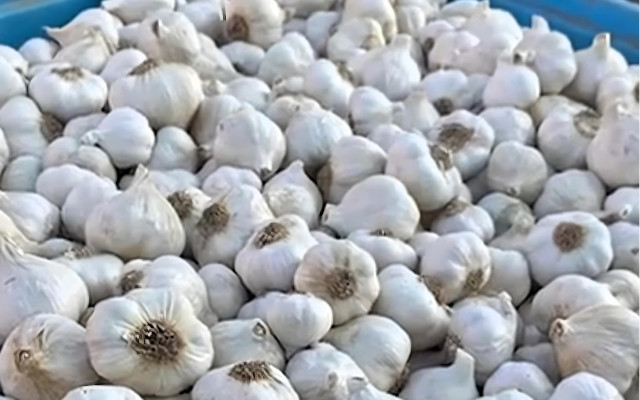
Ferrara (Emilia-Romagna) and Rovigo (Veneto), neighboring provinces in the territory of Polesine, in North-East Italy, offer a unique treasure to the global culinary landscape: high-quality garlic. Renowned for its exceptional sustainability and unparalleled quality, part of the cultivation in this area also boasts the DOP certification.
This article explores the unique varieties and the eco-friendly practices that distinguish the garlic of Ferrara and Rovigo. It reveals the strategic advantages that these regions offer to the most demanding international buyers searching for authentic and high-value Italian ingredients, ensuring both quality and traceability.
1. Brief history of garlic production in Italy
Renowned for its strong flavor and versatility, garlic (Allium sativum) has been a cornerstone of world cuisine for centuries. Its name derives from the Celtic word all, meaning 'burning' or 'pungent', and from Latin sativum, meaning 'planted' or 'cultivated'. In Italy, a country with a deep agricultural heritage dating back to theRoman era, garlic has long been appreciated for its culinary and medicinal properties. Workers of the time even chewed it to maintain strength during heavy labor.
Despite the strong competition from global producers such as China and Spain, Italy maintains its prestigious reputation for superior and aromatic garlic. In particular, the areas of Ferrara and Polesine in Emilia-Romagna and Veneto stand out as centers of cultivation of sustainable and highest quality garlic, including the renowned Aglio di Voghiera DOP and Aglio Bianco Polesano DOP. As the second largest garlic producer in the EU, this region meets significant international demand, driven by its commitment to excellence.
2. The prestigious garlic varieties of Ferrara and Polesine
Ferrara and Polesine are home to two garlic varieties officially registered at the European level as PDO (Protected Designation of Origin):
- Aglio di Voghiera DOP – renowned for its delicate aroma, mild flavor, and high digestibility, this garlic has been cultivated for centuries in the Voghiera area, in the province of Ferrara. It features large and regular bulbs with a smooth, pearly-white skin and a balanced taste that enhances both raw and cooked dishes;
- Aglio Bianco Polesano DOP – cultivated in the provinces of Ferrara and Rovigo, this garlic is distinguished by firm and compact bulbs, intense aroma, and long shelf life. It has a high allicin content, which contributes both to its pungent taste and health benefits, making it particularly appreciated in gourmet cuisine as well as medicinal applications.
In addition to its certified PDO varieties, garlic producers in Ferrara are actively working to obtain certification IGP for other local garlic varieties, equally recognized for their historical significance, sustainable production methods, and superior flavor compared to mass-produced alternatives.
3. A sustainable and circular supply chain
The Polesine, an important agricultural region located between the lower courses of the Adige and Po rivers (respectively the 2nd and 1st longest in Italy), extends to the Adriatic Sea. Its name, derived from Pullicium and from the Latin pullus o chicken, it has evolved through Policinium e Polesino, meaning "land that emerges from flowing waters, ideal for cultivation".
The fertile alluvial soils of Ferrara and Polesine, shaped by ancient marshes and meticulous reclamation, offer exceptional conditions for the cultivation of high-quality garlic. Parts of the Polesine territory are included in protected natural areas, including Natura 2000 network sites, for the environmental value of wetlands and delta regions. These soils, naturally rich in minerals and with an excellent drainage, effectively retain moisture and essential nutrients, minimizing the need for extensive irrigation and synthetic fertilizers in non-organic crops.
The mild and stable climate of the region, combined with consistent precipitation, promotes slow growth that enhances flavor, allowing high-quality production with reduced agricultural inputs. This commitment to sustainable and eco-friendly agricultural practices guarantees both the superior quality of garlic and environmental responsibility, as detailed below.
3.1. Low environmental impact agriculture
The production of Ferrara and Polesine garlic is distinguished by a minimal environmental impact, thanks to environmental conditions and labor-intensive agronomic practices:
- no irrigation, for winter garlic, and minimal irrigation for spring garlic, thanks to the optimal moisture of alluvial soils;
- organic fertilization with autumn barnyard manure pre-sowing and stable manure matured for at least six months, enriched with humic acids from seaweed;
- zero herbicides, thanks to minimal soil tillage with green manure and manual mechanical weeding (with hoe), avoiding wounds to stems that would require chemical treatments;
- manual harvesting (0.3% loss vs. 25% for mechanical harvesting), with careful selection to avoid damage to bulbs and reduce the risk of pathogen attacks;
- natural drying. The garlic is dried in the sun and in well-ventilated sheds to preserve the organoleptic profiles (flavor, aroma) and its bioactive compounds, renowned for their health properties.
Tradition and innovation meet to simultaneously preserve the integrity of the plants and the quality of the bulbs, as well as the health of the soil which, thanks to minimal and gentle treatments, naturally protects itself from infestations.
3.2. Circular economy and upcycling: from pharmacy to animal husbandry
The upcycling of waste and surpluses enables high value-added applications, within a circular economy approach, in the sectors of:
- pharmaceutical/cosmetic. Non-standard bulbs are used for extracts for natural antibiotics and antimicrobial active ingredients, thanks to studies conducted by the University of Padua;
- animal feed. Naturally low-temperature dehydrated bulbs are turned into flour and added to poultry feed (5%) to enhance the immune system of poultry and reduce the use of veterinary antibiotics.
The biomasses, such as dry stems and leaves, are intended for the production of compost and biogas. Further research could lead to the production of bioplastics and other biodegradable materials.
4. The organoleptic qualities of Ferrara and Polesine garlic
Ferrara and Polesine garlic is highly appreciated for its sensory attributes, making it a preferred choice for chefs, food importers, and gourmet food producers. Its main characteristics include:
- intense and lasting aroma. Thanks to its high allicin content, Ferrara garlic offers a deep and persistent scent;
- mild flavor. Unlike Chinese garlic, which is harsh and pungent, Ferrara and Polesine varieties offer a softer and more refined flavor with a slightly sweet aftertaste;
- firm, shiny, and juicy cloves. Polesano garlic maintains an exceptional texture, ideal for both raw and cooked uses.
5. Success in international markets: how Ferrara and Polesine garlic stands out
Ferrara and Polesine garlic is increasingly sought after in Germany, France, the United Kingdom, and the United States, thanks to:
- chef selection. Ferrara and Polesine garlic is highly valued in gourmet kitchens for its balanced flavor and richness, becoming a preferred choice among chefs and culinary experts;
- guaranteed traceability. Buyers can verify the production areas, sustainable agricultural practices, and certifications;
- superior shelf life. Proper drying techniques naturally prevent early sprouting, without chemical treatments or irradiation.
Despite higher production costs compared to common garlic, Ferrara and Polesine maintain a competitive advantage favoring quality over quantity.
6. How to choose Ferrara and Polesine garlic
For international food buyers and importers, investing in Ferrara and Polesine garlic means:
- authenticity. Look for garlic produced in the territories of Ferrara and Polesine, as well as Voghiera Garlic PDO and Polesano White Garlic PDO;
- sustainability. Support eco-friendly, labor-intensive agriculture, and small Italian producers;
- organic production. Choosing organic products stimulates the conversion of agriculture to a total abandonment of pesticides;
- gastronomic excellence. Ideal for quality cuisine, restaurants, and gourmet retail chains.
7. Expert guidance and strategic purchasing
- Support from local experts: our GIFT (Great Italian Food Trade) team specializes in connecting international buyers with certified and reliable suppliers. We guarantee access to partners committed to the highest standards of traceability, sustainability, and truly Italian quality.
- Optimize efficiency: explore options for pre-peeled or chopped garlic to simplify operations, reducing labor costs without compromising the exceptional quality of Ferrara and Polesine garlic.
- Strategic timing: take advantage of the harvest season (June-August) to ensure the best prices and maximum availability for your wholesale purchases.
8. Conclusions
The garlic of Ferrara and Polesine represents the pinnacle of Italian agricultural excellence, offering a product born from sustainable practices and characterized by exceptional flavor. By choosing this distinctive garlic, international buyers forge a partnership that supports small farmers, promotes eco-conscious production, and celebrates theauthentic Italian gastronomic heritage, contributing to its global recognition.
In the dynamic landscape of global markets, establishing solid international business partnerships is essential to ensure the future of this exceptional agricultural sector. Embracing the garlic of Ferrara and Polesine goes beyond a simple purchase, it is an investment in sustainable quality and in the preservation of the rural economy of the region and its enduring culinary tradition, ensuring its continued prominence.
Dario Dongo
Bibliography
- Voghiera PDO Garlic https://tinyurl.com/ynbu2w9c
- Polesano DOP White Garlic https://tinyurl.com/9u5jkefu
- Agahi F, Penalva-Olcina R, Font G, Juan-García A, Juan C. (2022). Effects of Voghiera garlic extracts in neuronal human cell line against zearalenone’s derivates and beauvericin. Food Chem Toxicol. Apr;162:112905. doi: 10.1016/j.fct.2022.112905
- Brandolini V, Tedeschi P, Cereti E, Maietti A, Barile D, Coïsson JD, Mazzotta D, Arlorio M, Martelli A. (2005). Chemical and genomic combined approach applied to the characterization and identification of Italian Allium sativum L. J Agric Food Chem. Feb 9;53(3):678-83. doi: 10.1021/jf0489623
- Brugnoli F, Dell’Aira M, Tedeschi P, Grassilli S, Pierantoni M, Foschi R, Bertagnolo V. Effects of Garlic on Breast Tumor Cells with a Triple Negative Phenotype: Peculiar Subtype-Dependent Down-Modulation of Akt Signaling. Cells. 2024 May 11;13(10):822. doi: 10.3390/cells13100822
- Lanzotti V, Barile E, Antignani V, Bonanomi G, Scala F. Antifungal saponins from bulbs of garlic, Allium sativum L. var. Voghiera. Phytochemistry. 2012 Jun;78:126-34. doi: 10.1016/j.phytochem.2012.03.009
- Lázaro Á, Frangiamone M, Maietti A, Cimbalo A, Vila-Donat P, Manyes L.( 2024). Allium sativum L. var. Voghiera Reduces Aflatoxin B1 Bioaccessibility and Cytotoxicity In Vitro. Foods. Feb 2;13(3):487. doi: 10.3390/foods13030487.
- Lidiková, J., Čeryová, N., Tóth, T., Musilová, J., Vollmannová, A., Mammadova, K., & Ivanišová, E. (2023). Garlic (Allium sativum L.): Characterization of Bioactive Compounds and Related Health Benefits. IntechOpen. doi: 10.5772/intechopen.108844
- Tedeschi P, Nigro M, Travagli A, Catani M, Cavazzini A, Merighi S, Gessi S. Therapeutic Potential of Allicin and Aged Garlic Extract in Alzheimer’s Disease. Int J Mol Sci. 2022 Jun 22;23(13):6950. doi: 10.3390/ijms23136950. PMID: 35805955; PMCID: PMC9266652.
- Tedeschi P, Brugnoli F, Merighi S, Grassilli S, Nigro M, Catani M, Gessi S, Bertagnolo V, Travagli A, Caboni MF, Cavazzini A. (2023). The Effect of Different Storage Conditions on Phytochemical Composition, Shelf-Life, and Bioactive Compounds of Voghiera Garlic PDO. Antioxidants (Basel). Feb 16;12(2):499. doi: 10.3390/antiox12020499

Dario Dongo, lawyer and journalist, PhD in international food law, founder of WIISE (FARE - GIFT – Food Times) and Égalité.


