

European regulations on sugars intended for human consumption reveal a marked asymmetry. While Directive 2001/111/CE — transposed into Italian law by legislative decree no. 51/2004 — reserves the designations of the white and refined sugar to products that meet stringent analytical purity parameters, with a prohibition on the sale and supply of loose products, 'raw' cane sugar o 'whole wheat' remains excluded from its scope of application. In the absence of harmonized requirements in the European Union, protection against unfair commercial practices (EU regulation 1169/2011) therefore finds an essential technical reference parameter in the international standard of the Codex Alimentarius (CXS 212-1999).
Reserved designations and purity requirements
The designations of the main sugars are reserved by Directive 2001/111/CE, transposed into Italian law by legislative decree no. 51/2004, to products that comply with precise purity requirements:
- the sugar o white sugar must have a polarization* of at least 99.7 °Z, invert sugar no more than 0.04%, loss on drying no more than 0.06% and a color type** no higher than 9 points;
- the refined sugar refined white sugar complies with the same limits, with an overall score not exceeding 8 points, summing color type (maximum 4 points), ash and solution color;
- the factory sugar admits a minimum polarization* of 99.5 °Z, with invert sugar as well as loss on drying*** up to 0.1%;
- the inverted sugar it is the mixture of glucose and fructose resulting from the splitting of sucrose;
- the specification 'semolina' is permitted only for white sugar and refined sugar (Legislative Decree 51/2004, Annex I).
(*) The polarization measures the sucrose content based on the rotation imparted to polarized light by the sugar solution, expressed in degrees of the International Sugar Scale (°Z), where 100 °Z corresponds to pure sucrose.
(**) The color type expresses the degree of whiteness of the crystals, measured with the method of the Brunswick Institute for Agricultural Technology and the Sugar Industry: a lower score (e.g. 4, for refined sugar) indicates a whiter sugar.
(***) The loss on drying indicates the residual humidity of the crystals (dir. 2001/111/EC, Annex, part B).
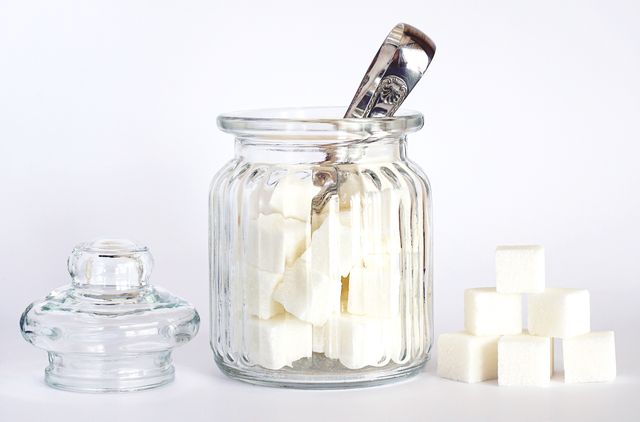
The technical datasheets of Italia Zuccheri indicate for white semolato a minimum sucrose of 99.80% and a maximum inverted sugar of 0.01%, values more stringent than legal limits (Italia Zuccheri, 2024). And on shelves, next to semolato, there are extra fine sugar, icing sugar, sugar cubes, organic sugars, as well as liquid sugars, all subject to Sugar Directive 2001/111/EC.
The decree also regulates syrups of glucose, dextrose and fructose, as well as liquid sugar, liquid inverted sugar, inverted sugar syrup (Legislative Decree 51/2004, articles 1 and 2).
For liquid sugars the label must show dry substance and invert sugar, while sachets under 20 grams can only indicate the sales name (Legislative Decree 51/2004, art. 2).
Mandatory packaging
The Packaging and Packaging Waste Regulation, so-called PPWR, prescribes reducing the weight and volume of packaging to the necessary minimum from 1 January 2030 (EU regulation 2025/40, art. 10.1), as well as reducing packaging waste per capita by 5% by 2030, by 10% by 2035, by 15% by 2040, compared to 2018 (EU regulation 2025/40, art. 43.1).
The legislative decree that transposes the Sugar Directive into Italian law, nevertheless, prescribes the packaging mandatory for the sale and supply of factory sugar, white sugar and refined sugar (Legislative Decree 51/2004, art. 2.2, letter 'f').
Products excluded from EU legislation
Products designated as 'raw' cane sugar o 'whole wheat' – as well as 'impalpable sugar', candy sugar and sugar blocks (Legislative Decree 51/2004, articles 1 and 2) – are excluded from the scope of Sugar Directive 2001/111/EC. It follows that:
- such products do not have to meet the requirements of composition and of purity provided for by the directive;
- their labelling and advertising is subject to the general rules on consumer information. Which prohibit, among other things, misleading the consumer regarding the essential characteristics of the product (EU regulation 1169/2011, articles 7.1.a and 36).
The Codex standard for raw cane sugar
At the international level, the Codex Alimentarius regulates sugars with a standard adopted in 1999, then amended in 2001, 2019 and 2022. The standard applies to sugars intended for human consumption without further processing, sold to the final consumer or used as ingredients, and defines their denominations with the related requirements (Codex Alimentarius, 2022).
For white sugar the standard requires a polarization of not less than 99.7 °Z, the same threshold provided for by the European directive. For raw cane sugar (raw cane sugar) does not set thresholds for polarization, color or moisture, but rather establishes:
- process and product requirements: partially purified sucrose, crystallized from partially purified cane juice without further purification, except for centrifugation or drying, with sucrose crystals coated with a film of cane molasses (CXS 212-1999, point 1);
- a safety requirement: the absence of heavy metals in quantities that represent a danger to human health (CXS 212-1999, point 3.1.1). In the European Union the requirement corresponds to the general principle according to which foods containing contaminants in quantities unacceptable from a public health perspective, in particular from a toxicological point of view, cannot be placed on the market, and their levels must be kept at the lowest levels reasonably achievable with good practices (EEC regulation 315/93, art. 2). However, the Contaminants Regulation (EU) 2023/915 does not set specific maximum levels of heavy metals for sugar;
- the correspondence of the designation to the product description (CXS 212-1999, section 5.1)
the soft brown sugar (soft brown sugar) must instead have a sucrose plus invert sugar content of at least 88%. The Annex, of optional application, adds for this product maximum thresholds for invert sugar (12%), for sulphated ash (3.5%) and for loss on drying, 4.5% (CXS 212-1999, point 1 and Annex).
The Codex definitions nevertheless constitute a useful technical reference for assessing correctness of the information commercial on products designated in the European Union as 'raw' or 'whole' cane sugar (EU regulation 1169/2011, art. 7). A refined sugar to which molasses is added does not, for example, meet the definition of raw cane sugar, which must be crystallized without further purification.
Conclusions
European rules offer precise guarantees on reserved designation products, from white to refined sugar. For 'raw' or 'whole' cane sugar, excluded from the directive, consumer protection is based instead on the general principles of fair information, which in this area should reflect the minimum requirements of the Codex standard.
Our team of FARE supports operators in the strategic planning of compliance in food safety and commercial information, in the field of sustainability as well as supply chains, processes and products, including nutrition & health claims. It also offers support for the development of systems governance corporate and operational procedures.
Dario Dongo
Frequently Asked Questions
What requirements does the law set for white sugar? Polarization of at least 99.7 °Z, invert sugar up to 0.04%, moisture up to 0.06% and colour not exceeding 9 points (Directive 2001/111/EC; Legislative Decree 51/2004).
Must raw cane sugar meet purity requirements? No, it is not included in the reserved designations of Directive 2001/111/EC. The Codex Alimentarius defines it descriptively, without numerical thresholds.
Can sugar be sold in bulk? No. In Italy, factory sugar, white sugar and refined sugar can only be sold or supplied pre-packaged (Legislative Decree 51/2004).
What does 'semolated' mean? It is a specification allowed only for white sugar and refined sugar (Legislative Decree 51/2004).
References
International standards on sugars
Codex Alimentarius. (2022). Standard for sugars (CXS 212-1999; adopted in 1999, amended in 2001, 2019 and 2022). FAO/WHO. https://www.fao.org/fao-who-codexalimentarius/sh-proxy/it/?lnk=1&url=https%3A%2F%2Fworkspace.fao.org%2Fsites%2Fcodex%2FStandards%2FCXS+212-1999%2FCXS_212e.pdf
Product technical datasheets
Italia Zuccheri. (2024). Semolato sugar 1 kg [Technical data sheet]. https://www.italiazuccheri.it/wp-content/uploads/2024/07/IZ-2024-B2C-Zucchero-semolato-100IT-astuccio-1kg.pdf
European Union legislation
Council Regulation (EEC) No 315/93 of 8 February 1993 laying down Community procedures for contaminants in food. Consolidated text: 07/08/2009. http://data.europa.eu/eli/reg/1993/315/2009-08-07
Council Directive 2001/111/EC of 20 December 2001 relating to certain sugars intended for human consumption. Consolidated text: 18/11/2013. http://data.europa.eu/eli/dir/2001/111/2013-11-18
Regulation (EU) No 1169/2011 of the European Parliament and of the Council of 25 October 2011 on the provision of food information to consumers. Consolidated text: 01/04/2025. http://data.europa.eu/eli/reg/2011/1169/2025-04-01
Commission Regulation (EU) 2023/915 of 25 April 2023 on maximum levels for certain contaminants in food and repealing Regulation (EC) No 1881/2006. Consolidated text: 19/08/2026. http://data.europa.eu/eli/reg/2023/915/2026-08-19
Regulation (EU) 2025/40 of the European Parliament and of the Council of 19 December 2024 on packaging and packaging waste, amending Regulation (EU) 2019/1020 and Directive (EU) 2019/904, and repealing Directive 94/62/EC. Consolidated text: 22/01/2025. http://data.europa.eu/eli/reg/2025/40/2025-01-22
Italian regulations
Legislative decree 20 February 2004, n. 51. Implementation of Directive 2001/111/EC relating to certain types of sugar intended for human consumption. Regulatory. Latest consolidated version: text in force since 02/29/2004. https://www.normattiva.it/uri-res/N2Ls?urn:nir:stato:decreto.legislativo:2004-02-20;51

Dario Dongo, lawyer and journalist, PhD in international food law, founder of WIISE (FARE - GIFT – Food Times) and Égalité.


