

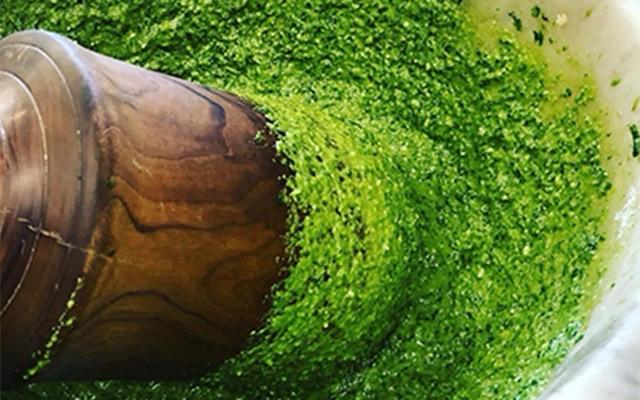
The Genoese pesto It is a raw sauce made from basil, extra virgin olive oil, aged cheeses, pine nuts, garlic, and coarse salt, all ground in a mortar. It is listed among the Traditional Agri-Food Products of Liguria (Dongo, 2017) and has driven the growth of the Italian basil industry, which has more than doubled its production in fifteen years (Soressi, 2026).
The name of the sauce is not protected in the European Union, while its main ingredient—Genoese basil, which, incidentally, only some producers use—has held PDO status since 2005. History, recipe, supply chain statistics, nutritional profile, and how to read the label.
A generic name, a protected ingredient
Anyone in the European Union can call a basil-based sauce “pesto genovese” or “pesto alla genovese.” The idea of registering it as a Traditional Specialty Guaranteed was already on the table in 2017 (Dongo, 2017), but it did not result in official recognition. Roberto Panizza, creator of the World Mortar Championship, explained that the term is now in common use and the recipe does not lend itself to protection as a designation of origin, hence the decision to defend it through the competition (Soressi, 2026).
The protection, on the other hand, applies to the Genoese Basil DOP, registered by Commission Regulation of October 4, 2005 (Reg. (EC) No. 1623/2005). The Protection Consortium comprises 50 producers—representing 98% of the total—across 153 hectares along the Tyrrhenian coast of Liguria. In 2025, certified production reached 7,000 metric tons of basil for processing and 60 million seedlings sold in bunches for the fresh market, with a value of approximately 18 million euros, which rises to 34 million when including the local economic impact. The production specifications require that only the apical part of the plant—the most tender portion—be harvested, and approximately 150 processing companies in Italy and abroad purchase the PDO basil (Soressi, 2026).
The reference recipe is the one specified by the Genoese Pesto Consortium (Consorzio del Pesto Genovese, n.d.), compliance with which is obviously not mandatory for any producer. The selection is wide—ranging from fresh, artisanal pesto to pasteurized, long-shelf-life jars—with compositions that can vary significantly.
Market and Supply Chain
In 2025, production of basil in Italy has exceeded the 8,600 metric tons (Istat data), which has more than doubled in fifteen years, placing Italy second in the world behind India and ahead of the United States. Sales of “Genoese-style” pesto in Italy, across modern retail and the restaurant industry, have exceeded 230 million euros and 27,000 metric tons (source: NielsenIQ), and pesto is the best-selling raw sauce in the world (Soressi, 2026).
Industrial demand has taken basil beyond Liguria. Basil for processing is sown in the spring and harvested in 4–6 cuttings from late June to mid-October; since the 1990s, it has gained a foothold in the Po Valley between Pavia and Parma, driven by local canning companies. Barilla, the world’s leading producer of pesto, purchases only Italian basil and has launched a training program for farmers on sustainable farming practices, while in 2025 the Casalasco Consortium invested over 10millions of euros in an integrated basil supply chain in the Parma area (Soressi, 2026).
The mowing Subsequent harvests affect the quality of the raw material. A study by the University of Naples Federico II on three cultivars of Genoese basil grown in open fields found that the second harvest increases the biomass 172% fresher and the total content of phenolic acids by 413%, with the aromatic profile varying depending on the cultivar. In the ‘Eleonora’ cultivar, for example, eugenol and trans-α-bergamotene increased by 75.3% and 48.2%, respectively, while eucalyptol and β-cis-ocimene decreased by 34.4% and 51.6%. The authors point to the varietal selection the tool for standardizing industrial pesto (Ciriello et al., 2021).
From Agliata to the Genoese Cook
One of the origins of pesto is said to be theAgliata, a medieval sauce with aromatic herbs and garlic, common in Liguria and Provence (Zanirato, 2016). The first printed recipe appeared in 1863 in the Genoese Stove by Giovanni Battista Ratto, as a “pounded” mixture of garlic and basil. Ratto admitted that, when basil, marjoram, and parsley were unavailable, he would combine grated Dutch cheese and Parmesan with pine nuts, pound everything together with a little butter, and thin the mixture with plenty of fine olive oil. The sauce was intended for lasagna and gnocchi (troffie), diluted with a little unsalted hot water (Ratto, 1863, as cited in Zanirato, 2016).
Butter and Dutch cheese were eventually phased out in favor of extra-virgin olive oil and Sardinian pecorino cheese. The cultivation of basil in greenhouses, with the young plants being harvested, then led to the use of more tender leaves in pesto (Zanirato, 2016). In Provence, there is a similar sauce, the pistou. The Marseille chef Jean-Baptiste Reboul, in the Provençal Stove from 1910, featured the Pistou Soup as “of Genoese origin” (Zanirato, 2016).
The Consortium's Recipe
The recipe from the Consorzio del Pesto Genovese, which serves six people, calls for 50 grams of Genoese Basil DOP, half a glass of Riviera Ligure DOP extra virgin olive oil, six tablespoons of Parmigiano Reggiano PDO, two tablespoons of Fiore Sardo Pecorino DOP, two wedges ofgarlic, a tablespoon of Mediterranean pine nuts and a few grains of coarse salt (Consorzio del Pesto Genovese, n.d.; Italia.it, n.d.). The Grana Padano It is accepted as an alternative to Parmigiano Reggiano (Guida di Genova, n.d.).
We work in a mortar made of marble with pestle wooden, at room temperature, and as quickly as possible to minimize oxidation. Crush the garlic (with the core removed) with a few grains of salt and the pine nuts until a creamy paste forms, then set it aside. Next, add the basil leaves a few at a time, rotating the pestle to tear them rather than chop them, so as to release the essential oils. Next, add the garlic and pine nut paste, the cheeses, and finally a slow stream of olive oil. Avoid using metal utensils during preparation. The pesto should be eaten immediately after preparation or stored inrefrigerator for no more than 3–4 days, covered with a thin layer of oil (Mangiare in Liguria, n.d.; Zanirato, 2016).
The World Mortar Championship
The Genoese Pesto World Championship Using a Mortar, conceived by Roberto Panizza and the Palatifini Cultural Association, has been held in Genoa every two years since 2007 and is a trademark of the Genoa Chamber of Commerce. The eleventh edition took place on March 21, 2026, at the Palazzo Ducale, featuring 100 contestants from around the world and 30 judges. The title went to Carla Pensa, 85, “besagnina” (a retired fruit vendor) from Roccatagliata, a hamlet of 53 residents in Neirone (Genoa).
All the contestants worked with the same ingredients: Italian pine nuts, garlic from Vessalico (Imperia), Genovese DOP basil, Riviera Ligure DOP extra virgin olive oil, extra-aged Parmigiano Reggiano, aged Sardinian Pecorino, and Coarse salt from Trapani (PGI). The jury evaluated manual skill and workspace management, the fineness of the texture, creaminess, color, and harmony of flavors (Genoa Chamber of Commerce, 2026). The organizers themselves are supporting the nomination of the pesto made in a mortar UNESCO Intangible Cultural Heritage (Palatifini Cultural Association, n.d.).
In the kitchen
In Genoa, pesto is mainly used to dress traditional Ligurian pastas: fresh pasta—such as trofie, mandilli de sæa (“silk handkerchiefs,” thin sheets of pasta)—or dried, such as trenette, which are cooked together with potatoes and cooked green beans (Guida di Genova, n.d.; Mangiare in Liguria, n.d.). Lasagna with pesto follows the method already described by Ratto, as does the practice of thinning the sauce with a little cooking water (Ratto, 1863, as cited in Zanirato, 2016). Pesto is also added to Genoese-style vegetable minestrone (Zanirato, 2016), and in any case, it is not cooked.
Nutritional Profile
The food composition tables provided by CREA—the Food and Nutrition Research Center (2019)—list the following nutritional values for Genoese pesto (code PC0008). The recipe analyzed by CREA is lighter than the Consortium’s: basil, extra virgin olive oil, garlic, Parmigiano Reggiano, pine nuts, and salt, blended with 100 ml of water, without pecorino.
| Average values per 100 g | Quantity | % of the NRV |
| Energy | 1,044 kJ / 250 kcal | |
| Fats | 21.8 g | |
| of which saturated fatty acids | not reported | |
| Carbohydrates | 1.8 g | |
| of which sugars | 1.8 g | |
| Fibers | 1.3 g | |
| Proteins | 11.0 g | |
| Rooms | 1.04 g | |
| Vitamin A | 278 µg | 34,8% |
| Vitamin E | 3.16 mg | 26,3% |
| Folate | 60 µg | 30,0% |
| Potassium | 321 mg | 16,1% |
| Soccer | 368 mg | 46,0% |
| Phosphorus | 330 mg | 47,1% |
| Magnesium | 70 mg | 18,7% |
| Zinc | 2.45 mg | 24,5% |
| Copper | 0.54 mg | 54,0% |
Note: The salt content comes from sodium (416 mg per 100 g); the percentages refer to the nutrient reference values set forth in Annex XIII to Regulation (EU) No. 1169/2011.
Per 100 grams, the pesto prepared according to this recipe meets the requirements for the label "high in" calcium, phosphorus, copper, vitamin A, and folate, and “source of” Vitamin E, potassium, magnesium, and zinc (Regulation (EC) No. 1924/2006, Annex). However, the amounts actually used to season a plate of pasta are well below 100 grams, and the actual intake is reduced proportionally.
How to Read the Label
The list of ingredients, listed in descending order by weight, helps you understand how closely a packaged pesto follows the Consortium's recipe. The key points to note are the type of oil (extra virgin olive oil or olive oil, or seeds), the presence of Genovese Basil PDO and its percentage, the type of cheeses used, pine nuts or their substitutes such as cashews and almonds. Any added ingredients, such as potatoes, vegetable fiber, or milk proteins, also matter. Milk and certain nuts such as cashews and almonds (but not pine nuts) are classified as allergens in the European Union and must therefore be highlighted in the list of ingredients (EU Reg. 1169/2011, Annex II).
Companies that use PDO basil highlight this on the label as a key feature of the product (Soressi, 2026). Fresh pesto sold in the refrigerated section and that sold at room temperature cater to different consumer needs. In 2017, a market survey by Food Times had identified 17 products with varying degrees of adherence to the traditional recipe (Dongo, 2017).
Dario Dongo
Credit cover Roberto Panizza
References
European Union Regulatory Sources
Commission Regulation (EC) No. 1623/2005 of October 4, 2005, supplementing the Annex to Regulation (EC) No. 2400/96 regarding the entry of certain names in the Register of Protected Designations of Origin and Protected Geographical Indications (Tuscia (PDO) and Basilico Genovese (PDO)). OJ L 259, Oct. 5, 2005, pp. 15–16. http://data.europa.eu/eli/reg/2005/1623/oj
Regulation (EC) No. 1924/2006 of the European Parliament and of the Council of December 20, 2006, on nutrition and health claims made on foods. Consolidated text: December 13, 2014. http://data.europa.eu/eli/reg/2006/1924/2014-12-13
Regulation (EU) No. 1169/2011 of the European Parliament and of the Council of October 25, 2011, on the provision of food information to consumers. Consolidated text: April 1, 2025. http://data.europa.eu/eli/reg/2011/1169/2025-04-01
Scientific Studies
Ciriello, M., Formisano, L., El-Nakhel, C., Kyriacou, M. C., Soteriou, G. A., Pizzolongo, F., Romano, R., De Pascale, S., & Rouphael, Y. (2021). The interaction between genotype and successive harvests affects the phenolic acids and aroma profile of Genovese basil for pesto sauce production. Foods, 10(2), 278. https://doi.org/10.3390/foods10020278
Nutritional Information
CREA Food and Nutrition Research Center. (2019). Food Composition Tables. Genoese Pesto, code PC0008. https://alimentinutrizione.it/tabelle-nutrizionali/PC0008
Institutions, consortia, and associations
Palatifini Cultural Association. (n.d.). Pesto Made in a Mortar. UNESCO Project. https://www.pestochampionship.it/unesco-project/?lang=en
Genoa Chamber of Commerce. (2026). 11th World Championship of Genoese Pesto Made in a Mortar, 2026. The 2026 World Champion Has Been Named [Press Release No. 3/2026]. https://www.ge.camcom.gov.it/it/la-camera/area-stampa/comunicato-stampa-3-2026.pdf/view
Genoese Pesto Consortium. (n.d.). Official Recipe and Production Specifications. https://www.basilicogenovese.it
Italia.it. (n.d.). Genoese Pesto. Ministry of Tourism, ENIT. https://www.italia.it/fr/ligurie/que-faire/pesto-alla-genovese
Zanirato, W. (September 12, 2016). Genoese-style pesto and other pounded sauces. National Association of Olive Oil Cities. https://cittadellolio.it/2016/09/12/pesto-alla-genovese-le-salse-pestate/
Publications and Guides
Dongo, D. (November 9, 2017). Genoese Pesto: A Market Survey. Food Times. https://www.foodtimes.eu/it/consumatori-e-salute/pesto-alla-genovese-indagine-di-mercato/
Guide to Genoa. (n.d.). Genoese Pesto. https://www.guidadigenova.it/en/what-to-eat-genoa/genoese-pesto
Eating in Liguria. (n.d.). Pesto Genovese – The Consortium’s Official Recipe. https://www.mangiareinliguria.it/pesto-genovese/ricetta-pesto-genovese
Soressi, M. (March 26, 2026). Basil: record crop growth (including in open fields) thanks to the worldwide popularity of pesto. Il Sole 24 Ore. https://en.ilsole24ore.com/art/basil-record-growth-crops-also-open-field-world-success-pesto-AIXpRd2B

Dario Dongo, attorney and journalist, PhD in international food law, founder of WIISE (FARE - GIFT – Food Times) and Égalité.


