

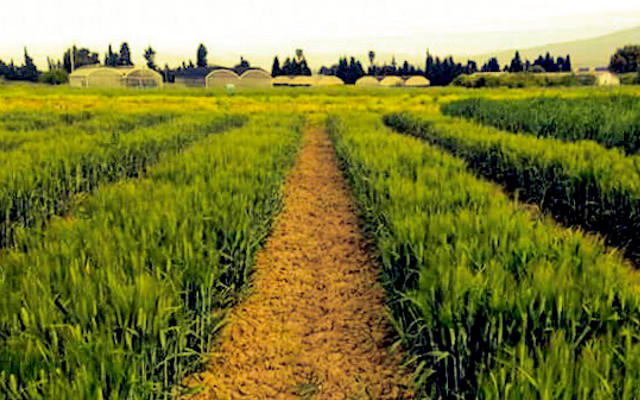
Ancient grains and stone mills, the centuries-old tradition is renewed in Sicily, once known as ‘the granary of Europe’. Thanks to the commitment and synergies between the University of Catania and the Simenza Association, which brings together virtuous farmers and processors.
Ancient grains in Italy
By ‘ancient grains’ we mean those varieties of wheat with historical origin and distinct identity, not subject to genetic evolution through crossings but locally adapted, thanks to traditional agricultural systems. (1)
Starting from the early 1900s these dynamic local populations, the result of selection work by farmers, gave way to varieties subject to genetic improvements. With the aim of increasing yields, in a historical period of severe wheat shortages, then more than ever indispensable to feed populations. (2)
Genetic improvements have at the same time enhanced inputs auxiliaries, fertilizers and especially synthetic pesticides. With the appreciable and extraordinary increase in production, the ‘flip side of the coin’ appeared, namely the reduction of biodiversity and the worsening of the ecological footprint of productions. From then on.
In Italy in 1927 291 varieties of wheat were recorded, 98 of which were widely cultivated. Just over forty years later, 250 had already disappeared, that is 86%.
Ancient grains, the rediscovery
In recent years there has been a renewed interest in several local varieties of durum and soft wheat known as ‘ancient grains’, widely cultivated until the first quarter of the last century (when genetically improved varieties through selection and cross-breeding took over).
The rediscovery of ancient grains is accompanied by an intense debate on their nutritional and health qualities within the farming and scientific communities. With wide resonance among the public opinion and consumers, increasingly attentive to the quality and healthiness of food. As well as to theintegrity of the supply chains and their rootedness in the territories.
The demand has increased so significantly as to stimulate an exponential growth in cultivated areas within a few years. According to an estimate by the Department of Agriculture, Food and Environment of the University of Catania, only in Sicily the areas cultivated with ancient grains have quintupled in the last 4 years. Reaching about 6,000 hectares, that is 2% of the total area sown with wheat in Magna Graecia.
Ancient grains, the Sicilian renaissance
In Sicily – thanks to the work of Universities, research institutions, and ‘guardian’ farmers – the germplasm of about fifty populations of durum and soft wheat has been preserved and recovered, representing part of the cereal biodiversity heritage available until the mid-last century.
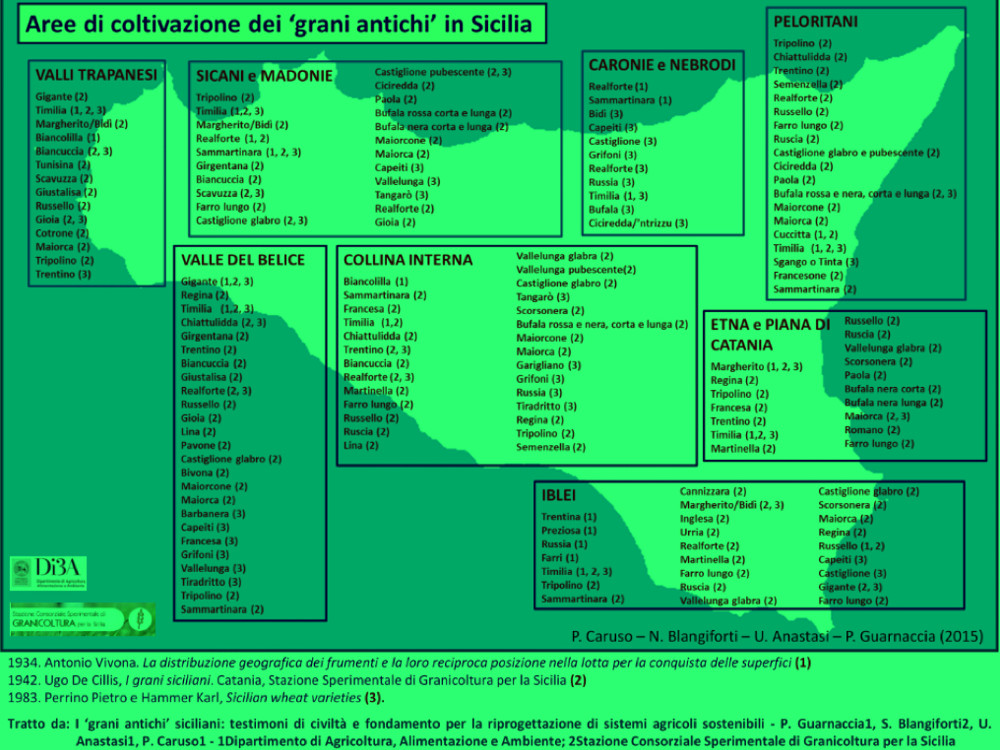
These genotypes, although yielding less than ‘modern grains’, have some valuable traits of hardiness, resistance to adversities (biotic and abiotic), and nutritional and organoleptic quality of the grain. About 20 varieties have thus been registered, an essential first step to ensure the traceability of the ‘from seed to table’ supply chain.
The Sicilian renaissance is one of the goals of the Simenza Association, established in 2016 to protect and enhance local agricultural biodiversity products. Simenza brings together most of the producers and processors of ancient Sicilian grains and provides them with agronomic and technical-scientific assistance, as well as representation useful to express shared values.
The perspective is to guarantee the integrity of a supply chain that can recover added value thanks to the processing of raw materials. Stone mill grinding, the production of pasta, flours, and high-quality milled products at km0 as barriers to social desertification of the inner areas of the large island.
Paolo Caruso and Dario Dongo
Notes
(1) The seeds of ancient grains must be kept pure by custodian farmers, who have registered them in the conservation species section of the national biodiversity registry. Their purity maintenance is controlled by CREA
(2) The work of Nazareno Strampelli is famous, one of the pioneers of genetic improvement of herbaceous plants, who through techniques of breeding developed about 150 varieties. See http://www.icar.beniculturali.it/biblio/pdf/strampelli/Strampelli_rivoluzione_verde.pdf

Paolo Caruso, agronomist, collaborates with the Department of Agriculture, Food and Environment at the University of Catania, Agronomy and Herbaceous Crops section. Researcher on ancient Sicilian grains.

Dario Dongo, lawyer and journalist, PhD in international food law, founder of WIISE (FARE - GIFT – Food Times) and Égalité.


