
Choosing cat kibbles is like buying baby food, as in both cases the recipients of the food cannot say if and why they do not like it. But aside from this analogy, the two product categories are at opposite ends. While baby food is subject to strict rules on nutritional quality, precisely expressed on the label, pet food is presented to the consumer with marketing appeals printed in large letters on the front of the package and few, vague, often illegible notices placed on the backor between the folds of the packaging.
Through the analysis of this information, GIFT – Great Italian Food Trade offers an overview of 37 cat kibbles available in Italy in large supermarket chains (retail). Always considering both industrial ‘brands’, ‘private labels’ and ‘discount’ brands.
Cat food, a growing business
The food to feed the over 10 million cats living in Italian households reached just over 1.484 billion euros in turnover by the end of 2022, according to the Assalco-Zoomark 2023 Report. Inflation and price increases in the ‘pet food’ sector have exceeded those in the food sector.
Price increases are well represented by market data, showing a turnover increase (value sales) well above the quantities sold (volume sales).
Cat kibbles alone, in 2022, recorded the following changes compared to 2021:
– pet food retailers significantly increased turnover (+38%) and volumes (+30.9%),
– general retail recorded a double-digit increase in value (+12.3%), with a significant volume delta (+2.3%),
– traditional pet shops, however, registered a modest increase in value sales (+1.4%), with a volume decline (-2.2%). (1)
Fussy or wise cats?
Choosing cat kibbles can be frustrating and costly. Marketing can convince the human, but not the house cat, who only eats good-quality food.
The biped is mainly attracted by information on the front of the package:
– the type of cat for which the food is intended. Junior, senior, sterilized, long-haired, etc.,
– the minimum percentage of meat (i.e., chicken), for those who can distinguish the legal designations corresponding to three different concentrations:
– less than 4% if 'chicken flavoured',
– between 14% and 26%, if defined as 'rich in chicken',
– more than 26%, if called 'chicken'.
– the most varied claims. The addition of micronutrients (vitamins, Omega 3-6 etc.), fibers and prebiotics, rather than the absence of colorants and preservatives. And even the exclusion or reduction of grain (grain free/low grain), which seems to attract cat owners. (2) In our survey we found two 'grain free' products, both from Esselunga Mao Nature, ‘Steril al maiale’ and ‘Adult al manzo’.
Reading the label
The most interesting information to compare cat kibbles is however found on the back of the package, usually in characters unreadable to the naked eye.
Pet food, in fact, is not subject to the minimum font height requirements instead provided by the Food Information Regulation (EU) No 1169/11 for mandatory food product label information.
A magnifying glass is therefore often necessary to compare the mandatory information under Regulation (EC) 767/2009, which is more attentive to the interests of operators than those of consumers.
Animal proteins
Animal proteins – essential to the carnivorous nature of the cat – are the first element to evaluate in the composition of kibbles.
The rule is to choose kibbles with the highest amount of good quality meat. But the task is difficult. We cite three factors of uncertainty:
1) the total amount of meat is almost never declared. Although its indication could help quality pet food producers to distinguish themselves, also for label transparency.
Stand out, under this aspect, the ‘Vitaplus Rico’ kibbles sold by Todis specify ‘meat and derivatives minimum 8%’ (sic). The labels of Conad chicken, rabbit and vegetable kibbles state ‘meat and derivatives 36% (chicken 6%, rabbit 1%)’. Other higher priced products, which praise fresh meat as the first ingredient and without the ‘meat and derivatives’ mixture, do not reveal the total amount of meat.
2) the position of meat in first place in the list of ingredients it does not always help to deduce its prevalence. It is true that ingredients must be listed in descending order of quantity, but it is also true that cereals can be listed individually (e.g. rice, rice flour, corn, etc.) without indicating their percentages. The sum of the various cereal items can therefore exceed the amount of meat, although the latter is indicated in first place in the ingredients list,
3) the quality of protein sources is not always specified. Unless otherwise indicated, proteins come from a mix of meat by-products, mechanically separated meat from carcasses, and parts not intended for human consumption (i.e. soft tissues, heart, bones, paws, beaks, skin residues), which provide low-quality proteins due to the lack of essential amino acids (which are rarely indicated on the label).
Less important is instead the difference between the indications ‘dehydrated meat’, ‘meat’ or ‘fresh meat’, as the physical state does not affect the protein content of the food. The only advantage of the fresh ingredient may in some cases be the greater meat flavor of the kibble.
The role of cereals
Starches and carbohydrates (wheat, corn, rice, barley, potatoes, legumes, etc.) are technologically indispensable to give kibble consistency. And their cost, much lower than animal proteins, helps to contain production costs.
Cereals and legumes are also appreciated – for cats, as for humans – because they provide dietary fiber useful for digestion, as well as minerals, vitamins, and plant proteins.
The adoption of the ‘closed label’ – that is the indication among the ingredients of the category ‘cereals’, instead of mentioning the individual items (i.e. rice, wheat, etc.) – can be useful, in this case, for two reasons:
– the ‘cereals’ category groups ingredients of lower economic value, defusing the trap of positioning meat first among the ingredients when it is in fact not so,
– operators can replace ingredients of the same category (i.e. rice with wheat, or vice versa) to counter the volatility of raw material prices (+20-25% in the last year), maintaining more or less stable quality and retail price.
Fats and fibers
the fats The fats added in the kibble are both vegetable and animal. The latter (usually lard or chicken oil) are the most loved by cats, although they are saturated fats. Fish oils (salmon, sardines, mackerel) are instead useful for supplying polyunsaturated fatty acids (PUFA, i.e. Omega-3), beneficial for overall health as well as eyes, coat, and skin. The intake of saturated fats should be minimized for indoor cats, more sedentary ones, and sterilized cats.
Fiber It is present in the composition of most kibbles. It helps control colon health, promotes digestion, and induces satiety. It is very important for indoor cats, sterilized ones, and also long-haired cats, as it promotes the proper elimination of hair with feces and thus prevents regurgitation. The fiber content in the examined sample ranges between 1.5 and 6%. Insoluble fiber, however, does not require significant amounts.
Additives
The additives are another piece of information reported on pet food labels. They are distinguished into:
– nutritional additives, that is vitamins A, D, and E and essential minerals for the animal's metabolism (iron, calcium, zinc, manganese, etc.),
– technological additives (i.e. preservatives)
– sensory additives (i.e. colorants, flavors).
Two positive elements are to be sought in cat kibble under the Additives section:
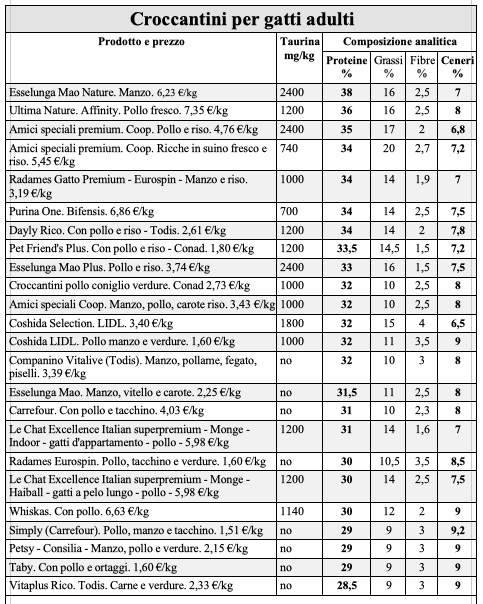
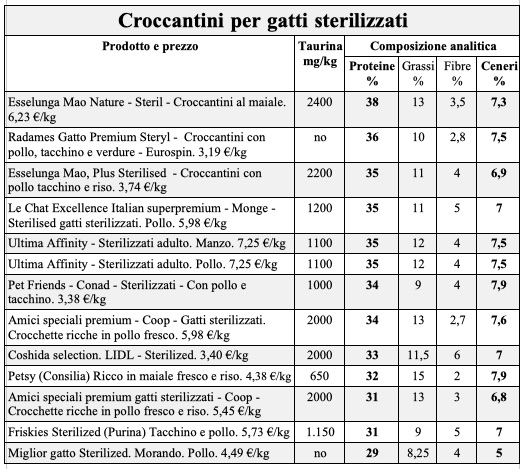
– the addition of taurine, an essential amino acid for small felines. As highlighted in the footnote tables, among the 37 examined products, 27 contain taurine in amounts ranging from 650 to 2,400 mg/kg, while 10 do not contain it,
– the absence of colorants, preservatives, and flavors. In our sample, colorants (for human use, obviously) are present in as many as 11 out of 37 products. (3)
Analytical components
The analytical components are in turn mandatory information on pet food labels, pursuant to EC regulation 767/2009. These values indicate what remains in the final product after cooking in terms of proteins, fats, ashes, and fiber.
The table of the analytical components can be very useful to compare two kibbles at the same price. The better product has a higher protein value and lower ash content.
The sample examined shows a wide variability in protein, fat, and ash contents, as shown in the tables:
- the proteins vary from 28.5 to 38%,
- the fats range from 9 to 17% in the category indicated for adult cats and from 8.5 to 15% for sterilized ones, for which it would be useful not to exceed 12%,
- crude ash indicate the residual quantity of minerals. The best level is between 4 and 7.5%. A value higher than 12% betrays the use of poor quality animal products (bones, cartilage, etc.). Among the 37 products examined, the value fluctuates between 5 and 9.2%,
- crude fibers, finally, in theory, they should be around 5%, to help the cat perceive satiety. In our sample, they vary from 1.5 to 6%.
The portion reveals the quality of the food
The recommended portion from the producer on the label, divided by weight category, is another element of great interest.
Comparing this data, in fact, you can infer the nutritional quality of the kibbles, even in the absence of detailed information.
Between two brands of kibbles with similar values in terms of protein, the one with the lower recommended portion (daily dose, expressed in grams) should be the most valid nutritionally. It might be more expensive compared to the other, but last longer.
Marta Strinati
Notes
(1) 16th edition of the Assalco-Zoomark Report. 15.5.23 https://www.assalco.it/archivio2_notizie-e-comunicati_0_1635_76_5.html
(2) Immagino GS1 Italy Report, 2nd edition, 2021 https://servizi.gs1it.org/osservatori/osservatorio-immagino-13/
(3) the colorants are present in adult cat kibbles Conad chicken, rabbit, vegetables; Coshida Lidl, chicken, beef, vegetables; Companino Vitalive Todis, beef, poultry, liver, peas; Esselunga Mao, beef, veal, carrots; Carrefour chicken and turkey; Radames Eurospin chicken, turkey and vegetables; Whiskas with chicken; Simply Carrefour, chicken, beef and turkey; Petsy Consilia, beef, chicken and vegetables; Taby Consilia, chicken and vegetables; and in sterilized cat food of Radames Steryl Eurospin chicken, turkey and vegetables.

Professional journalist since January 1995, has worked for newspapers (Il Messaggero, Paese Sera, La Stampa) and magazines (NumeroUno, Il Salvagente). Author of journalistic investigations on food, she published the book 'Reading labels to know what we eat'.


