
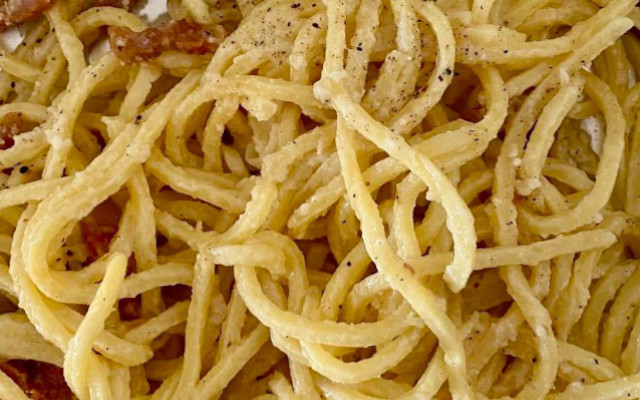
For who visits Rome, the encounter with the Carbonara pasta and the Gricia represents an unmissable cultural rite, a true immersion in Italian cuisine celebrated by the UNESCO. These symbolic dishes of Made in Italy come from a precise historical evolution of popular recipes and a strict chemical-physical balance. Understanding the material culture that unites guanciale, Pecorino Romano PDO, and durum wheat pasta allows you to transform a meal into an act of awareness and to distinguish true tradition from tourist imitations.
From the transhumance of the Apennines to the sets of Roman cinema
The Gricia is generally considered the oldest among the great Roman pastas. Its origin is linked to the transhumant shepherds of the central Apennines — particularly in the area between Lazio and Abruzzo — who traveled the seasonal trails carrying with them preservable and nutritious foods: dried pasta, aged guanciale, pecorino cheese, and black pepper. The name may derive from Grisciano, piccola frazione del comune di Accumoli (Rieti), dove ancora oggi il 18 agosto si celebra la sagra della ‘griscia’, con il termine dialettale che nel tempo ha prevalso sulla forma originaria. Esiste però una seconda ipotesi altrettanto documentata: il termine ‘gricio’ designava a Roma, dal Quattrocento in avanti, i venditori ambulanti di pane e generi alimentari provenienti dal Canton dei Grigioni svizzero, riconoscibili per il caratteristico spolverino grigio chiamato griscium.
The Carbonara ha origini più controverse e decisamente più recenti. Il piatto non compare nei principali ricettari italiani antecedenti alla Seconda guerra mondiale. Ada Boni non la menziona nella prima edizione de La cucina romana del 1930, e la stessa Scienza in cucina di Pellegrino Artusi la ignora del tutto. La prima menzione del nome in un contesto pubblico risale al 1949, nel film Yvonne la nuit con Totò, dove un cameriere di una trattoria di Trastevere ordina ‘spaghetti alla carbonara per tre’. Due anni dopo, nel 1951, è Aldo Fabrizi a consacrarne la nascente notorietà nella commedia Cameriera bella presenza cercasi (regia di Giorgio Pastina, con soggetto di Federico Fellini tra gli altri): nei panni del commendator Marchetti, Fabrizi interroga la cameriera Maria — una Elsa Merlini candidamente ignara — chiedendole se sappia preparare gli spaghetti alla carbonara. La risposta negativa della donna era, in quel momento, verosimile: a differenza dell’amatriciana, la Carbonara era ancora una novità.
The first published recipe in Italy appears in August of 1954 sulla rivista La Cucina Italiana, con ingredienti che oggi farebbero inorridire i puristi: spaghetti, uova, pancetta, groviera e aglio. La ricetta moderna — guanciale, Pecorino Romano, tuorli d’uovo, pepe nero, niente altro — si è stabilizzata solo tra gli anni Sessanta e Settanta, attraverso un processo di progressiva depurazione dalle contaminazioni del dopoguerra.
Settant’anni dopo, il mondo intero avrebbe cercato di trovare se stesso a tavola attraverso le ricette romane: nel 2010, in Mangia Prega Ama (Ryan Murphy), una Julia Roberts in crisi esistenziale approda a Roma e si abbandona ai piaceri della cucina capitolina — cacio e pepe, spaghetti, vino rosso — come terapia dell’anima. Il film è intriso di luoghi comuni, ma coglie qualcosa di vero: c’è nella semplicità radicale dei piatti romani qualcosa che assomiglia a una promessa di autenticità, in un’epoca in cui l’autentico è merce rara.
The historical path that consolidated the modern recipe
The Gricia is often defined as the 'white ancestor' of Amatriciana and Carbonara. Its structure è essential durum wheat semolina pasta, guanciale, Pecorino Romano PDO, black pepper. The absence of tomato and eggs makes the technique particularly demanding: the creaminess depends exclusively on the emulsification between the fat of the guanciale, the cheese, and the starchy cooking water. There are no correctives.
La letteratura gastronomica italiana — da Il Cucchiaio d’Argento (Editoriale Domus, 2024) a La Cucina Italiana (Condé Nast Italia, 2024) — converge ormai su alcuni shared principles:
- absolute exclusion of cream;
- preference for guanciale over pancetta (instead favored for Amatriciana pasta);
- stirring/mantecatura strictly off the heat, to avoid coagulation of the eggs.
The modern codification of Carbonara reflects a historical evolutionary process rather than an immutable recipe: it is the result of decades of collective practice, not a punctual invention.
The physical and structural properties of Made in Italy ingredients
As happens with great traditional Italian preparations, the final quality largely depends on strictly Made in Italy ingredients.
Durum wheat semolina pasta. La Pasta must be made from durum wheat semolina, preferably bronze-drawn, with high cooking resistance. The surface roughness favors sauce adhesion and starch emulsion. Spaghetti (more recently replaced by tonnarelli) remain the symbolic format of Carbonara; rigatoni and mezze maniche are frequently used both for Carbonara and Gricia.
guanciale. The aged guanciale is the identifying ingredient of traditional Roman pasta dishes. Made from pork cheek, it has a different lipid composition from pancetta (made from the belly): the cheek is richer in monounsaturated fatty acids, particularly oleic acid, with a lower melting point. The more fluid fat melting releases volatile aromatic compounds that form the aromatic base of the sauce.
Pecorino Romano PDO. Il formaggio storicamente associato alla cucina romana e laziale, prodotto esclusivamente con latte fresco intero di pecora proveniente da Sardegna, Lazio e provincia di Grosseto, according to the production specification. Its intense saltiness, emulsifying capacity, and high protein content make it a technical as well as aromatic ingredient.
Fresh eggs. Nella Carbonara la qualità delle uova è decisiva. I tuorli conferiscono struttura, colore, capacità emulsionante e ricchezza aromatica. L’uso prevalente dei tuorli rispetto all’uovo intero garantisce maggiore cremosità e minore rischio di coagulazione durante la mantecatura.
Extra virgin olive oil. In traditional Gricia and Carbonara recipes, the fat released by the guanciale during cooking constitutes the only lipid base of the preparation: extra virgin olive oil is not included in the codified formulations. In current practice, however, a small quantity of EVOO it is sometimes added raw before serving, generally to make the seasoning smoother; in this case a neutrally or delicately flavored oil is preferable, so as not to overpower the aromas of aged guanciale and pecorino.
The protection of the authenticity of Italian agri-food products worldwide
The international popularity of Carbonara has generated a proliferation of reinterpretations which would be long to list: cream, bacon, onion, garlic, mushrooms, chicken, vegetables, vegan variants. These contaminations testify to the global success of the dish but simultaneously highlight the cultural value of the original recipes and the agri-food supply chain that supports them.
Carbonara and Gricia represent a food model based on simplicity, quality of raw materials, nutritional balance, and enhancement of certified typical productions. In this sense, the protection of authentic Made in Italy also passes through correct knowledge of traditional preparations and their identifying ingredients — and through the ability to distinguish, without snobbery but with firmness, between a dish and its imitation.
Marta Strinati
References
Boni, A. (1929). La cucina romana: Piatti tipici e ricette dimenticate di una cucina genuina e ricca di fantasia (rist. 2017). Newton Compton. ISBN 9788822772688
Cesari, L. (2019, 7 aprile). Carbonara: la sua popolarità è merito del cinema. Gambero Rosso. https://www.gamberorosso.it/attualita/carbonara-la-sua-popolarita-e-merito-del-cinema/
Editoriale Domus. (2025). Il Cucchiaio d’Argento (12ª ed., 75° anniversario). Editoriale Domus. ISBN 9788833334110
La Cucina Italiana. (1954, agosto). La Cucina Italiana. [Edizione delle sorelle Gosetti]

Professional journalist since January 1995, she has worked for newspapers (Il Messaggero, Paese Sera, La Stampa) and magazines (NumeroUno, Il Salvagente). Author of journalistic investigations on food, she published the book 'Reading labels to know what we eat'.


