

What makes a Neapolitan Pizza 'real'? Beyond the myth, the answer is contained in a strict European specification: the Traditional Specialty Guaranteed (TSG). Unlike other marks, the TSG does not protect the ‘where’ the pizza is made, but the ‘as'. This article precisely analyzes what distinguishes the icon of Naples from every other imitation in the world. We will explore the pillars of the authentic method:
- the science of ingredients. From the specific strength of the flours (W) to the quality of peeled tomatoes and Campania Buffalo Mozzarella PDO;
- the art of processing. A technique that prohibits the use of a rolling pin, requiring exclusively manual shaping to obtain the famous alveolated crust;
- the cooking ritual. The secrets of the wood-fired oven, where extreme heat transforms the dough in only 60-90 seconds.
The originality of this analysis lies in looking beyond the recipe: we examine how new European laws on ‘reserve of name are changing the rules of the game. While the name ‘Neapolitan Pizza’ is now more protected than ever, this rigidity poses new challenges for artisanal pizzerias and excellent Italian industries.
First testimonies
The birth of Neapolitan Pizza can be placed between 1715 and 1725, period in which the tomato began to be used as a condiment for the leavened dough disk. Vincenzo Corrado, general cook of Prince Emanuele di Francavilla, was among the first to document the use of tomato to season pizza, equating it with macaroni in the Neapolitan culinary tradition.
Evolution of pizzerias
The first pizzerias were born in Naples in the 18th century, transforming from simple shops into real establishments dedicated exclusively to the preparation of pizza. A crucial moment in the history of this product was when Ferdinand of Bourbon, King of Naples, broke court etiquette to personally taste pizza in one of the city’s most renowned pizzerias, definitively popularizing this popular dish.
The Margherita and Marinara Pizza
The two most famous variants of the Neapolitan tradition are the ‘Marinara’, born in 1734, and the ‘Margherita’, dating back to the period 1796-1810. The latter became particularly famous in 1889, when it was served to the Queen of Italy Margherita of Savoy during a visit to Naples. Its colors – red of the tomato, white of the mozzarella and green of the basil – recall those of the Italian flag, contributing to its symbolic success.
The TSG production specification
Basic raw materials
The specification precisely establishes the fundamental ingredients for the STG Neapolitan Pizza. The basic ingredients are:
- soft wheat flour (W 220-380);
- brewer's yeast;
- natural drinking water;
- peeled tomatoes and/or fresh cherry tomatoes;
- sea salt or table salt;
- extra virgin olive oil.
The complementary ingredients are instead:
- garlic and oregano (for the Marinara);
- Campana Buffalo Mozzarella PDO;
- STG Mozzarella;
- fresh basil (for the Margherita).
The production method
1. Dough preparation
Thebasic dough is made by mixing 1 liter of water with 50-55 grams of sea salt, adding 10% of the total expected flour (1800 grams with strength W 220-380) and dissolving 3 grams of brewer's yeast. The mixing operation must last 10 minutes, followed by 20 minutes of kneading in the mixer, preferably fork type, at low speed, until a compact mass is obtained.
The flour for Neapolitan Pizza must absorb 50 to 55% of its weight in water. The final dough must appear non-sticky, soft and elastic, with a temperature that must not overheat during processing.
The specification also defines the technical characteristics of the flour: W: 220-380; P/L: 0.50-0.70; absorption: 55-62; stability: 4-12; falling number (Hagberg index): 300-400; dry gluten: 9.5-11 g%; proteins: 11-12.5 g%
2. Leavening
The leavening must take place in two phases:
- in a first phase the dough rests for 2 hours on a worktable, covered with a damp cloth to prevent the formation of a surface crust. At the end, the pizzaiolo manually forms the dough balls, which must weigh between 180 and 250 grams;
- in a second phase the dough balls ferment in food containers for at least 4-6 hours at room temperature, being ready for use within the next 6 hours.
The characteristics of the dough, with a tolerance of ±10%, are defined in the following terms: fermentation temperature 25°C; final pH: 5.87; total acidity 0.14; density: 0.79 g/cm³ (+34%).
3. Shaping
After leavening, the dough ball is taken out of the container and placed on a light layer of flour. With a movement from the center outwards and the pressure of the fingers, the pizzaiolo shapes a dough disk with a central thickness not exceeding 0.4 cm (tolerance +10%) and a edge (cornicione) of 1-2 cm. The specification expressly prohibits the use of rolling pins or mechanical presses, requiring exclusively manual processing.
4. Topping
The specification provides for three official variants:
- Pizza Marinara. 70-100 g of crushed peeled tomatoes, salt, oregano, garlic cut into slices, 4-5 g of extra virgin olive oil (tolerance +20%);
- Pizza Margherita (with Mozzarella di Bufala Campana DOP). 60-80 g of peeled tomatoes/fresh cherry tomatoes, salt, 80-100 g of Mozzarella di Bufala Campana DOP in strips, fresh basil leaves, 4-5 g of extra virgin olive oil (tolerance +20%);
- Pizza Margherita (with Mozzarella STG). 60-80 g of peeled tomatoes, salt, 80-100 g of Mozzarella STG in strips, fresh basil leaves, 4-5 g of extra virgin olive oil (tolerance +20%).
5. Cooking
Cooking represents the most critical and defining moment of the process. The Neapolitan Pizza STG must be cooked exclusively in wood-fired ovens, where high and specific temperatures must be reached.
I cooking parameters concern the temperature of the oven floor (about 485°C) and its dome (about 430°C), the temperature reached by the dough (60-65°C), the tomato (75-80°C), the oil (75-85°C) and the mozzarella (65-70°C), and the cooking time (60-90 seconds).
During cooking, the pizzaiolo must constantly monitor the pizza, rotating it towards the fire and always using the same area of the oven floor to ensure even cooking.
Characteristics of the final product
Physical description
The Neapolitan Pizza STG appears as a round product with a maximum diameter of 35 cm, characterized by:
- crust (raised) edge (1-2 cm), golden in color, soft to the touch;
- in the center, thickness of 0.4 cm (tolerance +10%), covered by the topping;
- general consistency soft, elastic, easily foldable ‘like a booklet’.
Visual aspect
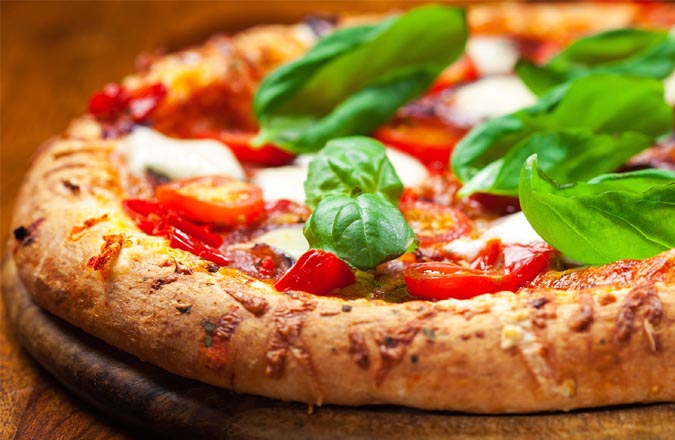
The pizza has a distinctive color contrast: the golden crust typical of baked products, the intense red of the tomato sprinkled with extra virgin olive oil, the white of garlic or mozzarella in patches, the green of oregano or basil,.
Organoleptic characteristics
Taste characteristic and savory, with the crust reminiscent of well-leavened and baked bread, mixed with the acidic taste of tomato and the flavors of the specific ingredients.
Aroma. Characteristic, fragrant scent, with intense notes of oregano, garlic or basil depending on the variants.
Consistency soft to the cut, elastic, with a texture that balances the surface crunchiness of the crust with the softness of the interior.
Storage and consumption
According to the regulations, Pizza Napoletana STG must be consumed immediately after cooking, preferably in the same place of production. The regulation explicitly prohibits freezing, deep freezing or vacuum packaging for subsequent sale, thus guaranteeing the authenticity of the traditional gastronomic experience and at the same time preventing those who aspire to try it in different contexts.
The official logo
The official logo of Pizza Napoletana STG consists of a horizontal white oval image with a light gray border, representing a plate containing a stylized but realistic pizza, with its classic visible ingredients: tomato, mozzarella, basil, and extra virgin olive oil. A green shadow under the plate recalls the colors of the Italian flag.
Superimposed on the plate is a red rectangle with rounded corners bearing the white inscription ‘PIZZA NAPOLETANA STG’, with ‘Traditional Specialty Guaranteed’ above and ‘Produced according to Neapolitan Tradition’ below. The latter phrase and the STG acronym are translated into the language of the country of production.
TSG, protection in the EU and its paradoxes
Evolution of TSG recognition
Regulation (EU) No 97/2010 recognized Pizza Napoletana as a Traditional Specialty Guaranteed without name reservation, through . This means that the name ‘Pizza Napoletana’ could also be used by producers who did not follow the specifications, but only those who met all the requirements could apply the STG logo.
Regulation (EU) 2022/2313 then strengthened the protection with the ‘name reservation’, making the use of the name ‘Pizza Napoletana’ on any product that does not comply with the specifications and is certified by a third party effectively illegal, with the risk of administrative penalties in case of violations.
The reform of the discipline of Geographical Indications, introduced by regulation (EU) 2024/1143, has not, however, strengthened the legal protection of STGs which remains very weak compared to Protected Designations of Origin (PDO) and Protected Geographical Indications (PGI), even at the level of official controls.
Paradoxes and debates
The reservation of the name, paradoxically, has generated debates within the same Neapolitan community. The adherence to the specification, drafted in 2010 in collaboration with the Verace Pizza Napoletana Association (AVPN) and the Neapolitan Pizzaioli Association (APN), indeed presents non-negligible burdens and costs of certification and controls.
Some are added rigidities, which can exclude many Neapolitan pizzerias in Italy and abroad. Both for the choice of ingredients – such as alternative flours (e.g., ancient grains, multigrain), or equally fine mozzarellas but different from Mozzarella di Bufala Campana PDO or STG Mozzarella, not always and everywhere available – and for innovative leavening methods that find no place in the current regulation.
The effective diffusion of pizzerias certified with the STG logo therefore remains extremely limited compared to the widespread use of the name 'Pizza Napoletana'. With the further paradox that Italian producers of frozen and deep-frozen pizzas, unlike their non-EU competitors, can no longer use the denomination 'Pizza Napoletana' to promote their products on international markets.
Conclusions
The STG Neapolitan Pizza represents an emblematic case of the tension between protection of tradition and dynamism of gastronomic innovation. The European recognition, with the intrinsic limits of the STG instrument in Regulation (EU) 2024/1143, primarily serves a cultural value: codify and pass on a culinary heritage that has spanned three centuries of history. In line with the subsequent UNESCO recognition of the Art of the Neapolitan pizzaiolo as Intangible Cultural Heritage of Humanity, in 2017.
This recognition constitutes a living archive of artisanal knowledge, a reference for professional training, and an identity symbol celebrated worldwide. The future challenge will be to find a balance between preserving traditional authenticity and openness to contemporary evolutions and markets that Neapolitan and Italian pizza continue to experience worldwide, keeping alive the innovative spirit that has always characterized its gastronomic culture.
Dario Dongo
Bibliography
- European Commission. (2010). Commission Regulation (EU) No 97/2010 of 4 February 2010 on the registration of a denomination in the register of traditional specialties guaranteed [Neapolitan Pizza (TSG)]. Official Journal of the European Union, L 34/7. https://eur-lex.europa.eu/legal-content/IT/TXT/PDF/?uri=CELEX:32010R0097
- European Commission. (2022). Commission Implementing Regulation (EU) 2022/2313 of 28 November 2022 on the registration of a name in the register of traditional guaranteed specialties [Neapolitan Pizza (TGS)]. https://eur-lex.europa.eu/legal-content/IT/TXT/?uri=CELEX:32022R2313
- European Parliament and Council. (2024). Regulation (EU) 2024/1143 of the European Parliament and of the Council of 11 April 2024 on geographical indications of the European Union for wines, spirit drinks and agricultural products, and on quality schemes for agricultural products. https://eur-lex.europa.eu/legal-content/IT/TXT/?uri=CELEX:32024R1143
- Italian Republic. (2010). Production disciplinary of the Traditional Guaranteed Specialty “Neapolitan Pizza”. Official Gazette of the Italian Republic, General series no. 56, 9 March 2010, pp. 42-47. https://www.gazzettaufficiale.it/do/atto/serie_generale/caricaPdf?cdimg=10A0276000100010110013&dgu=2010-03-09&art.dataPubblicazioneGazzetta=2010-03-09&art.codiceRedazionale=10A02760&art.num=1&art.tiposerie=SG
- UNESCO. (2017). Art of Neapolitan ‘Pizzaiuolo’. (Nomination file No. 00722) [Intangible Cultural Heritage]. https://ich.unesco.org/en/RL/art-of-neapolitan-pizzaiuolo-00722

Dario Dongo, lawyer and journalist, PhD in international food law, founder of WIISE (FARE - GIFT – Food Times) and Égalité.


