

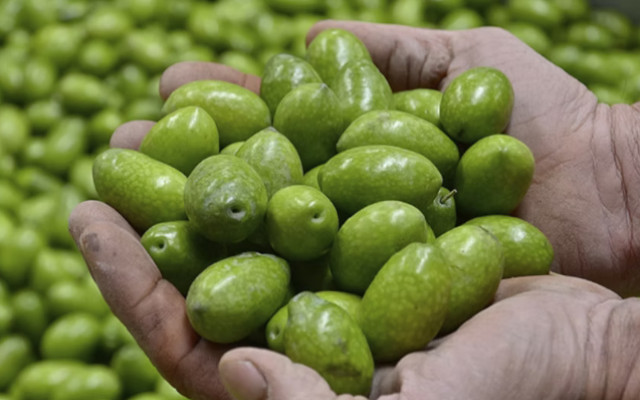
‘La Bella della Daunia’ DOP stands out among Italian table olives for the imposing size (up to 30 grams per drupe), the firm and compact pulp and a balanced taste. Obtained from the cultivar ‘Bella di Cerignola‘ and cultivated in northern Puglia, obtained the Geographical Indication recognition in 2000. The recent revision of the production regulations, approved in December 2024, introduced the possibility to market the changing color olive with natural fermentation, in addition to green and black olives.
The historical origins in the Cerignola countryside and ancient Daunia
According to some authors, the cultivar derives from Olives Orchites of ancient Rome, celebrated in ancient chronicles for exceptional size (Consortium for the protection of DOP table olives La Bella della Daunia, n.d.). Other sources indicate that the cultivar was introduced from Spain before 1400, during the Aragonese period; the absence of this variety among indigenous Iberian cultivars makes plausible the hypothesis of an variety native of the Cerignola countryside, in ancient Daunia.
The origin of cultivation is attributed to the 15th century, initially for self-consumption. Subsequently, the variety took the name of the town where it found its greatest diffusion, becoming known as ‘Bella di Cerignola’. In the 1930 a technical commission selected it among the best Italian table varieties for the production of green olives.
Its commercial history has distant roots: already in the early Twentieth century the seasoned olives of Cerignola were shipped to America, especially in California, in characteristic wooden containers of 5-10 kg called Cugnett. The logo of the PDO recalls the iconographic vascular tradition of Daunia: a dancer rendered ‘in negative’ holding an olive branch in her left hand.
Geographical factors and the delimitation of the Tavoliere
The territory of Daunia, today divided between the provinces of Foggia and Barletta-Andria-Trani, is a crossroads of agricultural cultures. The Tavoliere — one of the largest Italian coastal plains, 100-150 m above sea level — offers clay-limestone soils, a Mediterranean climate with marked temperature excursions, and a hydrographic network that has shaped a unique pedoclimatic context for olives. The truly suitable cultivated areas, after excluding unsuitable zones, amount to about 850 hectares.
Production regulations
The production specifications — registered with reg. (EC) no. 1904/2000 and lastly amended in December 2024 — defines the requirements for the production and marketing of the ‘La Bella della Daunia’ PDO olive.
The denomination is reserved for table olives By green color e of color black compliant with the specifications, obtained exclusively from the ‘Bella di Cerignola’ variety. The varietal traceability is therefore the first link in quality, as the use of different cultivars leads to exclusion from the denomination.
The production area is limited to the province of Foggia, within the boundaries described with cartographic precision covering parts of the territories of Cerignola, Orta Nova, Stornarella, and the entire Stornara district. This delimitation reflects the pedoclimatic vocation of the Tavoliere (specifications, article 3).
Suitable olive groves and processing companies are registered in a special list, managed by the control body, which guarantees the traceability complete supply chain (disciplinary regulation, article 5).
Production and processing methods
Cultivation. The system is the traditional one of the area, with annual pruning and a maximum of 420 plants/hectare, also intercropped. The olive harvest takes place directly from the plant from October 1st: the green ones when the skin turns from leaf green to straw green with pronounced lenticels, the black ones when the drupes are turning color or mature with a wine red coloration. To avoid contact with the ground, tarps; irrigation ends 10-15 days before harvest; transport is done in suitable plastic crates. The maximum allowed production is 15 tons/hectare.
Green olives – Sevillian system. After grading, olives are treated with alkaline lye (sodium hydroxide) at 1.7-4.0% (w/v) until penetration of 2/3 of the pulp, for 8-15 hours, always covered with water. Followed by washing and a fermentation lasting 30-60 days in initial brine at 9-10%, which rapidly falls to around 5%. The product is packaged in glass or tin with a final brine at 3-5% and pH < 4.6, followed by pasteurization.
Black olives – Californian system. The specification foresees two methods. In Method A the olives, placed in 2.5-10% brine, are treated with about 2% lye and repeated aeration; if necessary ferrous gluconate or ferrous lactate up to 150 mg/kg for blackening, with packaging at pH ≈ 4.6 and subsequent sterilization. In Method B the initial brine is at 8-10% and lye varies from 1.3 to 2.5%; final brine at 2-5% and pH > 4.6 (specification, article 4).
Visual and chemical parameters of green and black olives
At the time of placing on the market, thegreen olive for table use D.O.P. ‘La Bella della Daunia’ must have the following characteristics:
- uniform straw green color with marked lenticels;
- elongated shape similar to a small plum;
- full and compact pulp;
- weight between 6 and 30 g;
- pulp yield > 80%;
- fat < 15%;
- reducing sugars < 2.8%.
The black olives DOP in turn must present the following characteristics:
- intense black color;
- same shape and consistency;
- weight 6-30 g;
- yield > 80%;
- fat < 18%;
- reducing sugars < 2.4%.
Labeling rules and commercial formats
Thelabel shows the denomination, the PDO acronym, the inseparable logo, the company data, and the drained net weight. The graphic symbol — the Daunia dancer inside a Pantone 872 gold frame — is reproduced on a self-adhesive sticker in three sizes: 2, 3, and 5 cm.
The product can be sold in glass or thermoplastic (minimum drained weight 30 g), in tin (from 180 g), or in plastic containers from 20-150 kg for transport between processors and packers; packages are pasteurized or sterilized, subject to exemptions introduced in 2024.
The 2024 regulation amendment: the ‘changing’ olive arrives
A significant update is the regular amendment approved by decree on December 10, 2024, of MASAF (Ministry of Agriculture, Food Sovereignty and Forests). The main news:
- third type. Alongside green and black, theolive ‘color-changing’, processed with natural method: fermentation in brine (7-10%) for not less than six months, with shades from tobacco to dark brown, fat < 18%, and reducing sugars < 2.4%;
- allowed processing. For all three types, whole, crushed, scored, or pitted olives are allowed;
- production area. The delimitation is updated according to the new administrative geography: Foggia for Cerignola, Orta Nova, Stornarella, and Stornara; Barletta-Andria-Trani for part of Trinitapoli and the whole area of San Ferdinando di Puglia;
- packaging. The minimum drained weight decreases to 30 g; for plastic containers of green and color-changing olives the pasteurization is not è mandatory; for black olives in glass jars, packaging at pH > 4.6 is also allowed without liquid.
Phenolic compounds and nutritional value of the product
Table olives are a food fermented cornerstone of the Mediterranean diet. Their nutritional value derives from the richness in monounsaturated fatty acids (especially oleic acid), fiber, vitamin E and various phytocomplexes; among these, thehydroxytyrosol is the main phenolic compound present in all types (Rocha et al., 2020). The benefits associated with consumption are mainly attributed to the effect of MUFAs on cardiovascular health and the activity antioxidant and anti-inflammatory of polyphenols.
The phenolic profile changes with maturation and processing method: theoleuropein, responsible for bitterness, reaches its maximum in the green phase and during processing it hydrolyzes into hydroxytyrosol and tyrosol (Montagano et al., 2024). In fermentation the lactic acid bacteria contribute to the functional profile of the product and a potential probiotic effect. It should be noted that table olives provide sodium due to the brine: moderate consumption is advisable as part of a balanced diet.
Gastronomic pairings and optimal preservation
In the Apulian tradition green olives accompany fresh cheeses and durum wheat bread, while the black ones, softer and with a slightly higher fat content, are used in breads, flatbreads, first courses and preparations based on white meats and blue fish.
In contemporary cuisine, the Cerignola olive is a star of appetizers, where its salty and pleasantly slightly bitter note balances the rich fat content of aged cheeses and cured meats. The crunchy and abundant pulp — over 80% of the fruit, according to the specifications — also makes it ideal in salads, cold pasta, and summer dishes, to which it adds taste and character.
As for the preservation, packaged olives must be kept in a cool place, protected from sources of light and heat. After opening, they should be transferred (if in a bag) or kept (if in a jar) in a glass container, always covered by their brine — which protects the fruit from oxidation and microbial alterations — and stored in the refrigerator.
Purchase advice
For the discerning consumer, the purchase of DOP olives is a guarantee of authenticity. Some practical advice: verify that the label bears the wording ‘La Bella della Daunia’ DOP and the logo official with the dancer; prefer glass, which better preserves the organoleptic characteristics; check that the brine is clear; evaluate the size (weight between 6 and 30 g); and, where possible, choose organic.
Theorganic farming — according to the largest meta-analysis conducted so far, which examined over five hundred scientific publications — highlights significant advantages in terms of water protection, soil fertility, and biodiversity conservation. Compared to conventional agriculture, it reduces nitrogen emissions (-28% on average) and promotes an increase in field flora diversity (+95%), birdlife (+35%) and pollinating insects (+23%), as well as increasing earthworm abundance (Sanders et al., 2025).
For professional buyers — in addition to investing in organic, for absolute excellence in the premium segment — is useful to diversify the offer by proposing the three versions of Bella di Cerignola (green, black and iridescent). valorising the narration of the territory and the selectivity of the authentic PDO product.
Conclusions
The update of the specifications for the PDO ‘La Bella della Daunia’ demonstrates how European quality schemes can intercept market evolutions without distorting territorial identity. The extension of the range to the changing variant and the support of scientific data in favor of organic practices offer agricultural companies and distributors the necessary tools to oversee premium market segments. The transparency of the supply chain and analytical rigor remain the fundamental coordinates to guarantee theconsumer a conscious and high environmental value purchase.
Dario Dongo
Credit cover Consortium The Beauty of Daunia PDO
References
Bengtsson, J., Ahnström, J., & Weibull, A. C. (2005). The effects of organic agriculture on biodiversity and abundance: A meta-analysis. Journal of Applied Ecology, 42(2), 261–269. https://doi.org/10.1111/j.1365-2664.2005.01005.x
Consortium for the protection of table olives PDO The Beauty of Daunia. (n.d.). https://www.consorziotutelaolivabella.com/
Production disciplinary of the protected designation of origin ‘The Beauty of Daunia’. (2024). Council for Agricultural Research and Economics Analysis (CREA) – Oil Research Center. https://oleario.crea.gov.it/wp-content/uploads/2024/05/Disciplinare_La_Bella_della_Daunia-4-1.pdf
Montagano, F., Dell’Orco, F., Prete, R., & Corsetti, A. (2024). Health benefits of fermented olives, olive pomace and their polyphenols: A focus on the role of lactic acid bacteria. Frontiers in Nutrition, 11, 1467724. https://doi.org/10.3389/fnut.2024.1467724
MASAF (Ministry of Agriculture, Food Sovereignty and Forestry). Decree December 10, 2024. Ordinary amendments to the production disciplinary of the protected designation of origin «The Beauty of Daunia». (24A06686) (Official Gazette General Series No. 295 of 17-12-2024), pages 57-59
Rocha, J., Borges, N., & Pinho, O. (2020). Table olives and health: A review. Journal of Nutritional Science, 9, e57. https://doi.org/10.1017/jns.2020.50
Sanders, J., Brinkmann, J., Chmelíková, L., Ebertseder, F., Freibauer, A., Gottwald, F., … Heß, J. (2025). Benefits of organic agriculture for environment and animal welfare in temperate climates. Organic Agriculture, 15, 213–231. https://doi.org/10.1007/s13165-025-00493-w

Dario Dongo, lawyer and journalist, PhD in international food law, founder of WIISE (FARE - GIFT – Food Times) and Égalité.


