

Ready tomato and basil sauce imposes some compromise for lovers of traditional Italian cuisine. Convenience sometimes involves the presence of ingredients not used in homemade preparation, as shown by the examination of 18 products available in supermarkets and discount stores.
Ready tomato sauce, basil and…
The traditional recipe of this classic pasta condiment is very simple:
– tomato, extra virgin olive oil, garlic and/or onion, basil, and a pinch of salt;
– some, to soften the acidity of the tomato, also add a pinch of sugar.
The industrial version of the ready tomato and basil sauce may instead include – depending on circumstances – the use of antioxidant additives, sugar, and even synthetic chemical aromas, as well as concentrated tomato.
Salt, oil and sugar
Among the weaknesses of industrial foods often stands out the use of excessive amounts of salt and sugar, two substances whose intake in the modern diet of many populations is excessive and harmful to health:
– daily salt intake should never exceed 5 grams per day, according to the World Health Organization;
– consumption of added sugars should be avoided or at least minimized, according to the European Food Safety Authority (EFSA).
The concentrations of such ingredients in ready tomato and basil sauce are much lower than those in many ultra-processed foods. However, in some cases, they deserve attention:
– the Salt reaches 1.30%. 100 grams of ready sauce can thus provide 26% of the maximum daily salt intake. Not to forget that salt is also added to the pasta cooking water, as well as added by the possible addition of grated cheese (e.g., Parmigiano Reggiano PDO, Grana Padano PDO);
– the sugar – sucrose or cane sugar – is almost always added and represents approximately 1% of the sauce (considering the order of appearance in the ingredient list). The total sugar content – provided by tomato, carrots, and sucrose – thus reaches up to 8.4% of the sauce.
The quality of the oil is in turn crucial and variable: from the ‘low price’ sunflower oil level, through olive oil, up to the finest extra virgin olive oil (EVOO).
Tomatoes, origin and concentration
Theorigin of the tomatoes – in almost all of the 18 sauces examined, except the ready sauce by Carrefour (‘EU origin’), is Italian.
Ready sauces are almost always made by mixing pulp (or chopped tomato), tomato puree e concentrate, to optimize color and ideal density. The type of tomato processing – pulp, puree, concentrate – is not, however, an indicator of value.
‘Without a chemical-physical analysis one cannot judge the quality’, explains Antonio Trifirò, internationally renowned researcher who at the Experimental Station for the Food Preserving Industry (SSICA) in Parma developed theunique analysis method capable of tracing back the origin of tomatoes used in preserves.
Extra ingredients
Products with the brands Biffi, Esselunga Smart, Lidl, Eurospin, Todis use ingredients or additives foreign to the traditional tomato and basil ready sauce recipe – rice and corn starch (also chemically modified versions, in the cases of Lidl and Todi’s) – with a thickening function.
The sauce of Le ricette della nonna (Fini group), composed of ‘tomato 92%’, ‘with fresh Italian tomato’ instead contains carrots (2%), which in turn can contribute to the density and mitigate the product's acidity.
Sauce with the scent of basil
The basil is present in variable concentration from 0.80 to 2%. The two major pasta brands – De Cecco and Mutti – use the precious Genoese basil PDO. Others instead resort to the use of flavors. Our lawyer Dario Dongo emphasizes the importance of carefully distinguishing the type of flavors indicated on the label:
– the natural aromas must be obtained exclusively from materials of natural origin (vegetable, animal or microbiological). and with physical, enzymatic or microbiological methods (e.g., distillation, fermentation, extraction with permitted solvents)
-
- the wording ‘natural basil flavor’ means that at least 95% of the flavoring part comes from this plant;
- the ‘flavors’ that do not bear the adjective ‘natural’, on the contrary, are obtained by chemical synthesis (Reg. EC 1334/08, articles 3 and 16).
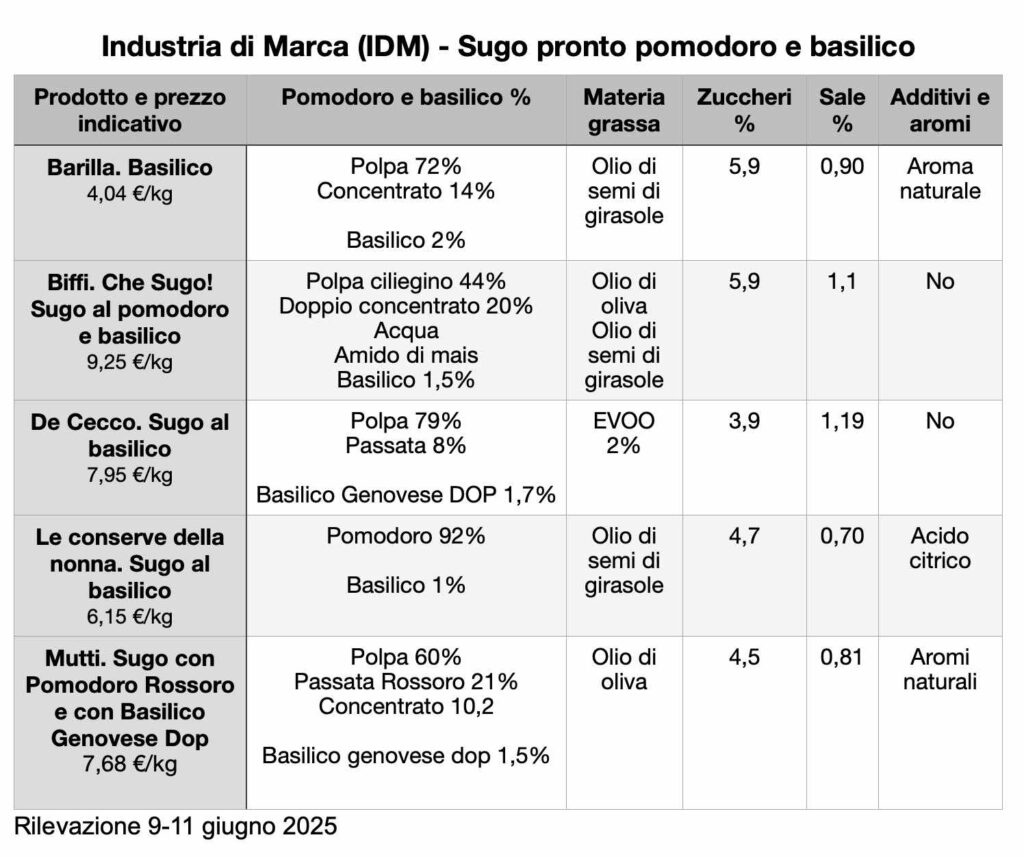
Branded industry, five ready-made sauces
Among the five brand industry references examined, only the De Cecco product is made by a subcontractor, the Feger of Andri, recently acquired by the giant La Doria.
The tomato is always Italian.
The basil is Italian in Barilla sauce; Genovese Dop in Mutti and De Cecco; of unspecified origin in other brand industry sauces
The oil is extra virgin olive (EVOO) only in De Cecco sauce.
Mutti and Barilla use natural aromas. Grandma Fini's preserves add instead a additive, l’acido citrico.
Salt e sugar reach, respectively, 1.19% (De Cecco) and 2% (Biffi). Only Mutti and De Cecco ready sauces contain no added sugars.
Private label (PL)
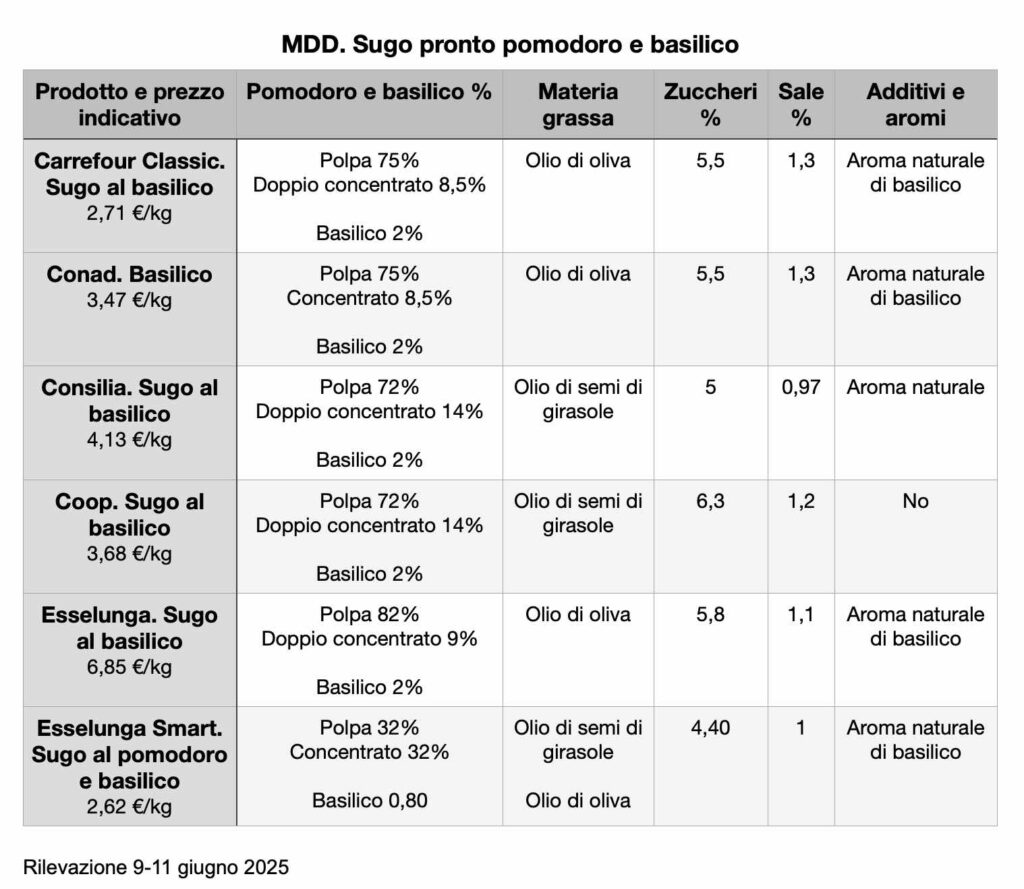
In the six ready tomato and basil sauces of the Distributor brand (MDD), tomato remains Italian except for Carrefour’s product. The basil – always at 2% except Esselunga Smart – is of unknown origin. Except for Coop, all use ‘natural basil aroma’.
Extra virgin olive oil is a mirage. The fat content consists only of olive oil and sunflower seed oil.
Salt and sugars reach, respectively, 1.3% and 6.30%.
The Salerno group La Doria – the leading Italian producer of distributor-branded ready sauces, with a turnover of 1.277 billion euros in 2024 – produces 4 of the 6 examined sauces. The other two (Coop and Consilia) rely instead on the Sicilian Gustibus Alimentari.
Ready tomato and basil sauce from discount stores
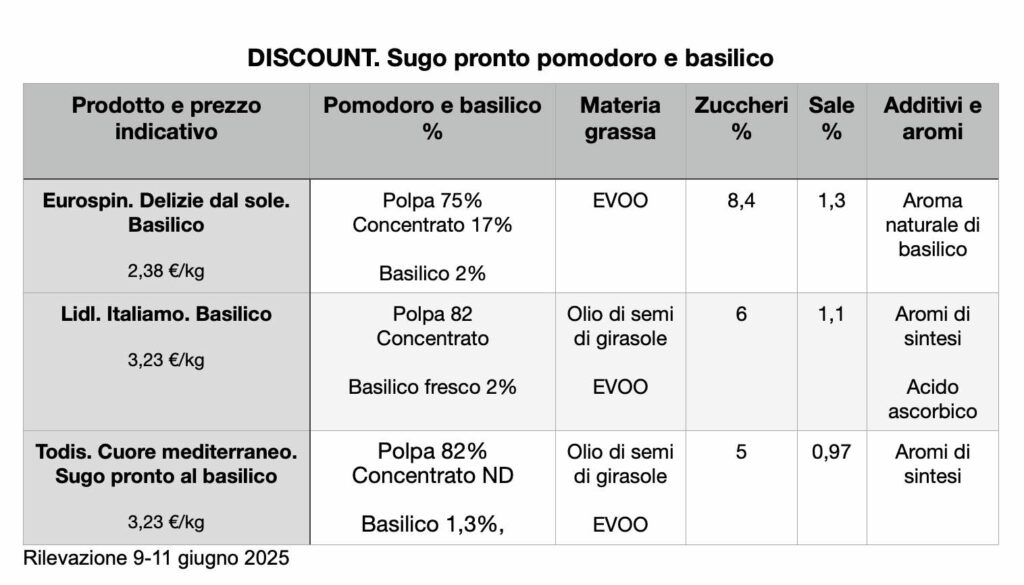
In the three discount ready sauces, there is always theextra virgin olive oil. In two cases (Gustibus producer) it is mixed with sunflower seed oil. In the Eurospin sauce (produced by Casalasco Società Agricola spa) it is the only oil present in the recipe.
An indispensable addensante: amido di riso per Eurospin e amido modificato di mais per Lidl Italiamo e Todis.
The basil scent, finally, is ‘enhanced’ with natural aroma in Eurospin sauce and with synthetic ‘flavors’ in the other two products.
A single sauce, from Lidl, also contains a additive, ascorbic acid.
Salt and sugar, finally, reach respectively 1.3% and 8.4%. Also in these three discount products, sucrose is added.
The plus of organic
The four ready-made organic agriculture sauces examined all have extra virgin olive oil, at 4% in Conad and Esselunga. The origin of the tomato is always Italian, whereas that of the basil is unknown.
The plus of organic is the absence of synthetic inputs in the field, as is well known. The general trend of simple recipes, without additives and in this case without even ingredients with thickening function or natural flavors.
The (cane) sugar reaches 5.7%, an excessive value, in the case of Conad and Esselunga. It is added in three cases, with NaturaSì being the exception. The nutritional declaration of Carrefour's organic sauce may be inaccurate, as the sugar value indicated there is identical to the total carbohydrates, despite the use of cane sugar.
The Salt reaches 1.20% in Carrefour sauce.
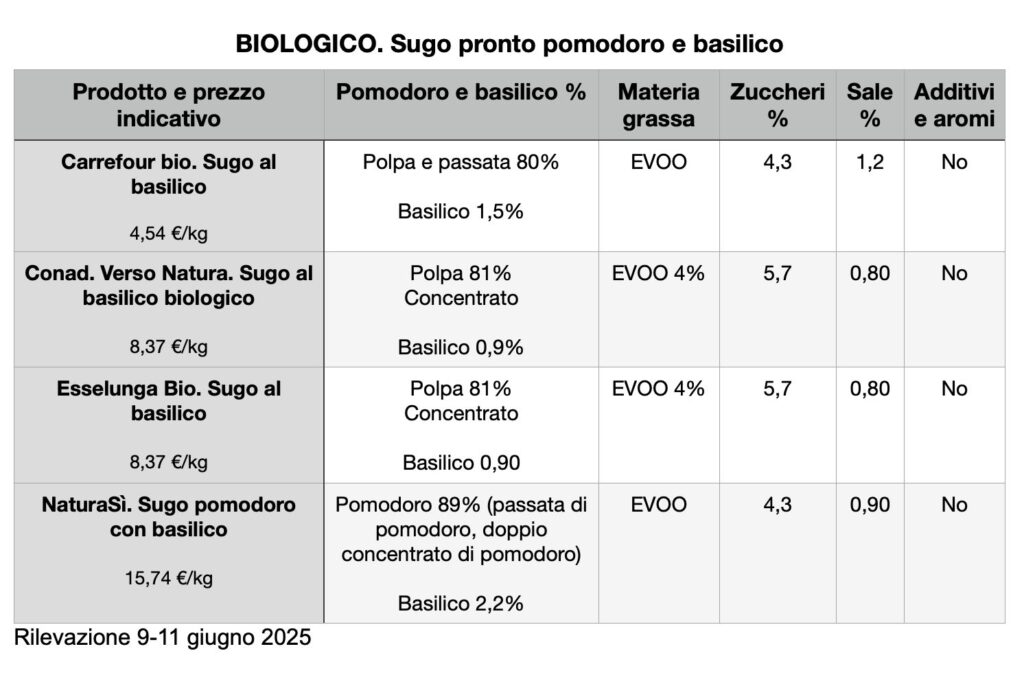
The sauces of Conad and Esselunga are made by La Doria, the recipe appears identical. Carrefour is produced by the agricultural cooperative Arc en ciel, in the Turin area. NaturaSì, instead, produces at the Cereal Terra plant, also in the Turin area.
Marta Strinati
References
– Luca Salomone. La Doria acquires the very close Feger. Distribuzione Moderna. 29.5.2025 https://distribuzionemoderna.info/finanza/la-doria-acquista-la-vicinissima-feger

Professional journalist since January 1995, she has worked for newspapers (Il Messaggero, Paese Sera, La Stampa) and magazines (NumeroUno, Il Salvagente). Author of journalistic investigations on food, she published the book 'Reading labels to know what we eat'.


